
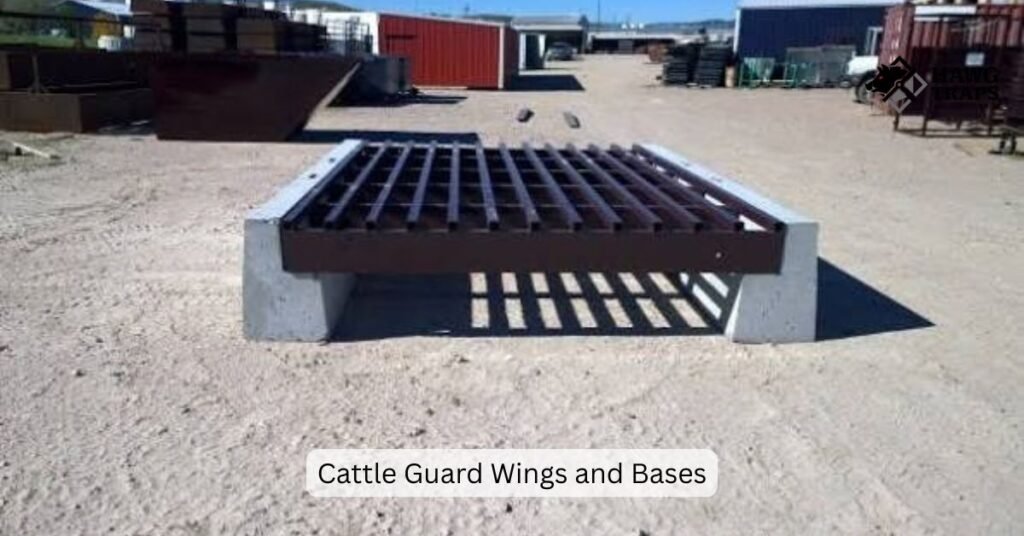
Every rancher has met that one cow. She’s the one who studies the fence line like a lawyer reading a contract, looking for a loophole. Put in a brand-new cattle guard without wings, and she’ll find the loophole by lunchtime: the gap at the end of the guard where the fence doesn’t quite meet it.
That’s what wings are for. The base is the other part people forget: the thing under the guard that keeps it level, solid, and in one place for years. It is the base that will take the pressure and keep the guard in place. Search for either one and you’ll mostly find wing sets for sale as universal add-ons, with very little about which one fits your guard or what goes underneath. This page covers what wings and bases do, the types, how to size them, and how we build them to match the guard you need.
Key Takeaways
- Wings close the gap between the guard’s ends and your fence. Without them, animals can escape the fence.
- The base carries the guard and every truck that crosses it. A weak base lets the guard settle and causes rock.
- Wings should match the guard. Universal wing sets may need adapting to fit.
- Base type depends on your ground, your traffic and the guard. Concrete footings, steel sills and compacted caliche each have their place.
- Order wings and base with the guard, not after. Tell us your road width, fence type, and ground type.
Why Trust Us: How We Put This Together
We build cattle guards, wings and the steel that ties them into a fence line, and we see what happens when one of those pieces is missing. Our team in the US works with guards on real ranch roads. We talk with the ranchers who install them, read what owners say about wing sets and bases from different brands, and look at how the major makers design theirs. Where we cite an outside source, like the US Forest Service or a precast maker, we name it.
What cattle guard wings do
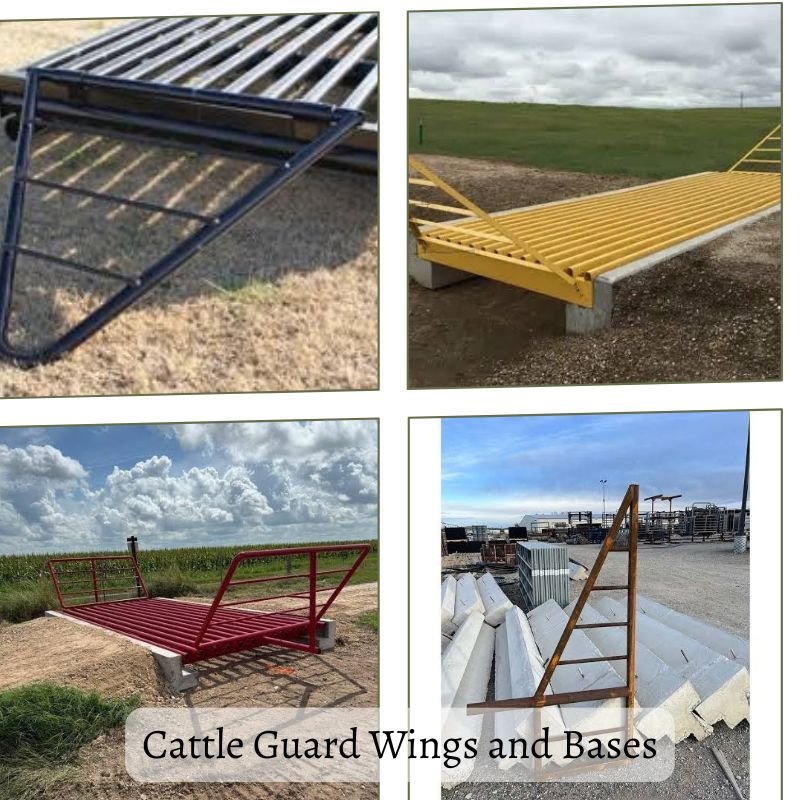
Cattle guard wings are steel panels at each end of a guard that close the gap between the guard and the fence. Without them, livestock can walk around the ends instead of crossing.
Here’s the simple version:
- The rails stop an animal from crossing the guard.
- The wings stop it from going around the guard.
You need both. A guard without wings is like a front door with no walls beside it.
And animals do walk around. The US Forest Service notes that horses and mules may try to walk around a guard’s ends. Sheep have been recorded running alongside grids. Cattle are patient about it, too: give them an open gap and a greener pasture on the other side, and they’ll take it. A guard without wings leaves your fence line open on both sides of the road.
Cattle guard wing designs
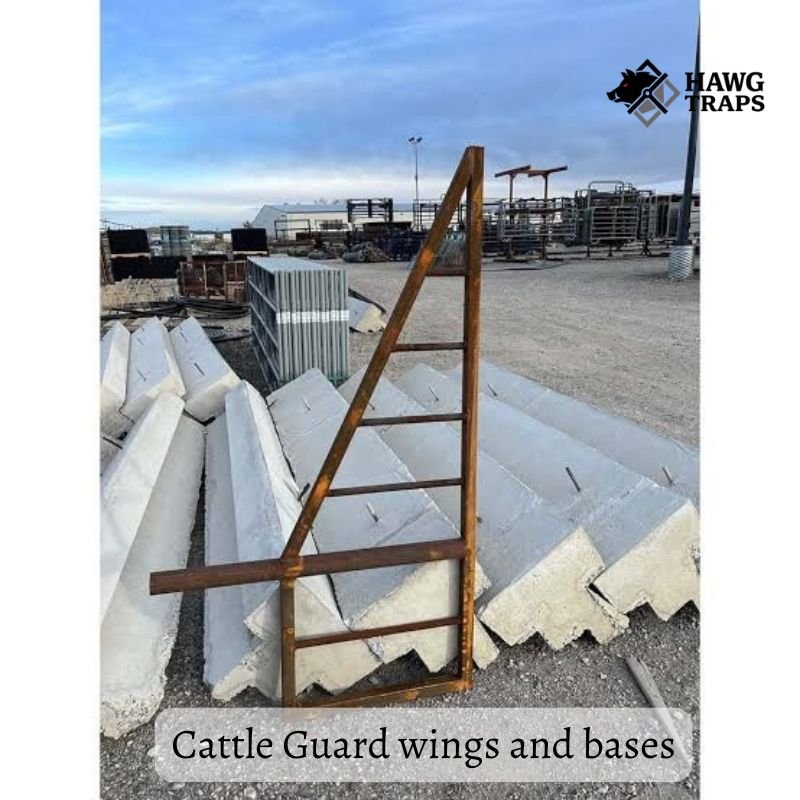
Boss Hawg wings are custom-built to match the cattle guard they go on and the fence they tie into.
Wing sets sold online are usually built to fit “most” guards. The trouble with “most” is that your guard might not be in it. When we build a guard, we build the wings for it:
- Shape: designed for your guard and your opening.
- Height: set by the guard and the fence it’s meeting.
- Attachment: designed to match how the guard is installed.
- Fence tie-in: planned for your fence type, whether that’s barbed wire, net wire, or pipe.
Cattle guard base types
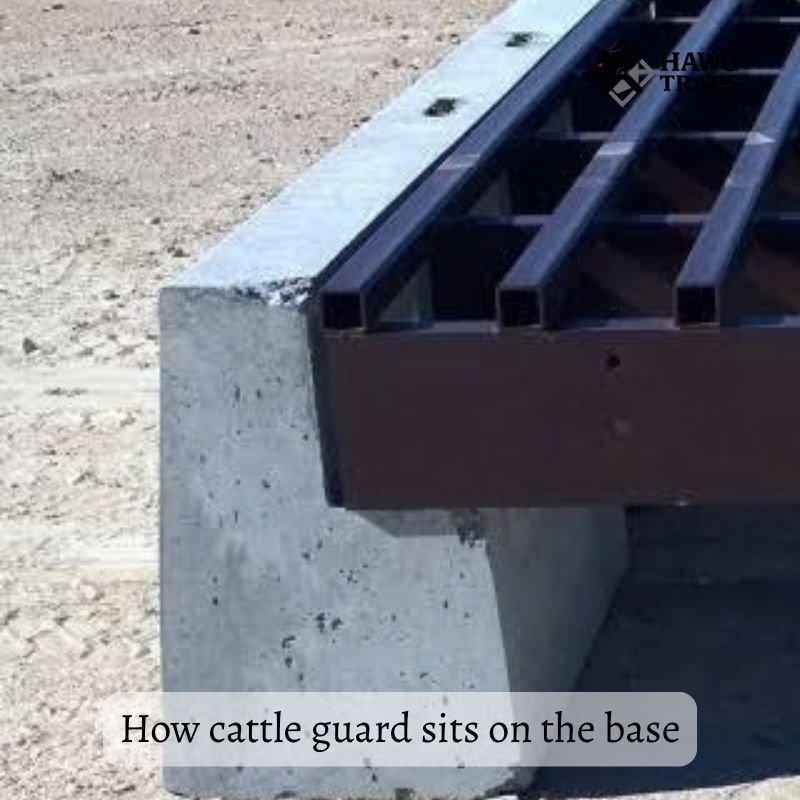
A cattle guard base is what carries the guard, and its design depends on the guard, the site, and the traffic. One precast concrete maker builds the footer into the guard itself.
Think of the base as the foundation of a house. Nobody admires it, nobody photographs it. But everything falls apart without it. Here are the common types:
| Base type | How it carries the guard | When it’s used | Source |
|---|---|---|---|
| Poured concrete footings | A solid foundation that supports the guard and spreads the vehicle loads | When the installation design calls for concrete | Boss Hawg |
| Steel sills | Support the guard frame and pass the load into the prepared ground | When specified for the design | Boss Hawg |
| Compacted caliche or fill | A stable, prepared surface under the guard | When the site conditions suit it | Boss Hawg |
| Built into a precast guard | The footer is cast into the guard; the maker says no separate foundation is needed | Precast concrete guards only | L.B. Foster (CXT) |
The right base depends on the guard size, the ground and the traffic that will cross it; there’s no one base for every guard.
Weighing steel against precast? The trade-offs are on concrete vs steel cattle guards.
Sizing wings and bases to the guard
Wings are sized to the guard’s width and the installation, and the base is sized to the guard, the expected traffic and the site.
The rule of thumb is simple: order wings and base with the guard, not afterwards. Pit and base dimensions for each guard are on cattle guard sizes and load ratings.
Installing wings and tying in the fence
Wings are attached to the guard ends, then the fence is tied into each wing to suit the fence type and layout, so no gap remains.
- Attach the wing to the guard end, as the guard design calls for.
- Set a post at the wing’s outer end, if your fence layout needs one.
- Tie the fence in to the wing, whether it’s wire, net or pipe.
- Walk the whole line and look for any gap an animal could use. Then look again. Your cow already did.
The full installation, from excavation to fence tie-in, is on cattle guard installation.
Three wing and base mistakes we see on ranch roads
1. Buying the guard now and the wings “later.” Later has a way of turning into never, and in the meantime the ends are open. Order them together.
2. Leaving a gap at the bottom. A wing that stops a few inches above uneven ground is an invitation for calves, and for anything smaller that fits under it. Check the gap at ground level after the fence is tied in.
3. Treating the base as an afterthought. A great guard on a poor base is still a poor crossing. If the ground is soft, wet or full of rock, the base design matters as much as the guard does.
Your wing and base checklist
Before you order, have these answers ready:
- Road width at the opening, fence post to fence post
- Fence type on each side: barbed wire, net wire or pipe
- Ground type: soil, caliche or rock
- The heaviest vehicle that will cross
- Whether horses share the pasture (if so, plan a bypass gate)
With those five, we can build the guard, the wings, and the base as one set that fits the day it arrives.
Order wings and bases with your Boss Hawg guard
Wings and bases are ordered with the guard so they fit on delivery. Include your road width, fence type, and ground type in the quote request.
Here’s why each one matters:
- Road width sets the length of the guard and the wings.
- Fence type (barbed, net wire, or pipe) sets how the wings tie in.
- Ground type (soil, caliche or rock) sets the base.
Send us those three and we’ll build the guard, wings and base as one set. See our guards on cattle guards for sale.
REQUEST A QUOTE — or call the shop at (254) 725-4554. Every guard is built to your opening.
Also check our partner products that go with this job: [PARTNER LINKS — e.g. fence stretcher, wire tensioners, T-post driver, fence staples/clips]
As an Amazon Associate, we earn from qualifying purchases. Partner products are listed separately from our own and never replace them.
Frequently asked questions
Do I need wings on a cattle guard? Yes. Without wings, animals can walk around the ends of the guard. The wings close that gap and tie the guard into your fence.
Can wings be added to an old guard? Often, yes, if the guard’s design and condition allow a proper fit. Call Boss Hawg about your specific guard.
Do no-pit guards need wings? Yes. A guard on the surface can be walked around just as easily. See no-pit cattle guards.
What base goes under a steel cattle guard? It depends on your ground and traffic: poured concrete footings, steel sills or compacted caliche are all used. We design the base with the guard.