
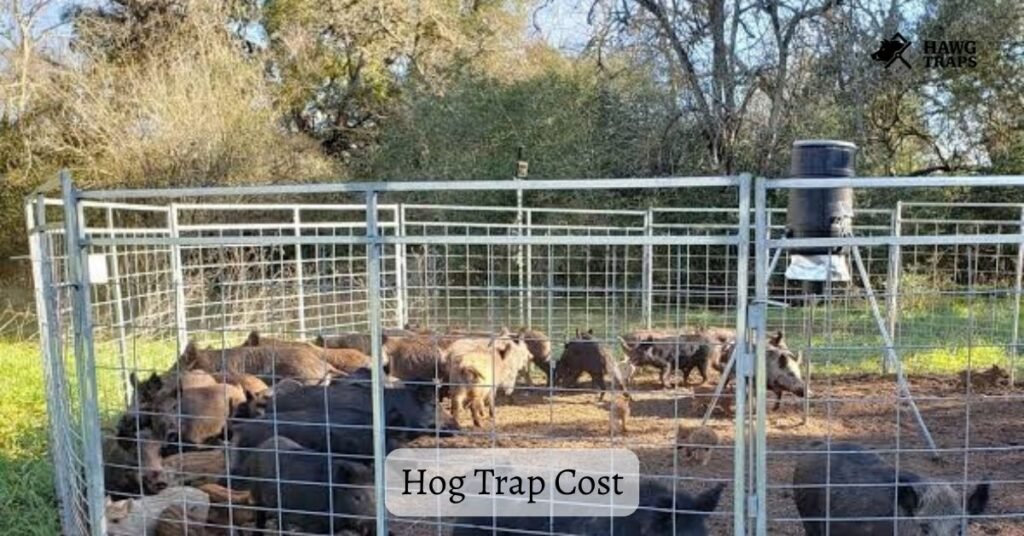
You’ve got two browser tabs open. One shows a hog trap for $549. The other shows a hog trap for $8,995. Both promise to catch hogs.
Meanwhile, the pasture looks like somebody ran a tiller through it at midnight, and you’d like to fix that without buying the wrong thing twice.
So which price is the real one? Both, as it turns out. This page lays out what hog traps actually cost, using prices we read on sellers’ own pages. It shows what you get as the price climbs, what it costs to build one yourself, what you’ll keep paying after you buy. Why the cheapest trap can turn out to be the most expensive way to catch a hog.
Key Takeaways
- Steel box traps list at about $550 to $700. Corral systems with a gate run from $2,900 to about $9,000.
- Remote control is the biggest step on one maker’s price list. Its single-gate package is $3,500, and its remote-controlled package is $4,800.
- A basic home-built corral costs about $715 in parts at farm-store prices, and about half of that is the gate.
- In a Georgia study, a pig caught in a box trap cost $671.31. A pig caught in a corral trap cost $121.28.
- Cellular triggers carry a monthly fee, put at $20 to $70 by a 2016 University of Arkansas guide.
- Boss Hawg quotes each trap to the job and ships anywhere in the US, with freight paid by the buyer.
Why Trust Us: How We Put This Together
Boss Hawg didn’t start out selling traps. The shop started out trapping hogs that were destroying its own property. Then local ranchers began contracting with the shop to remove hogs from their land. Our traps came out of those years of hands-on work.
For this page, we read every price on the seller’s own product page on 3 October 2026. We name the seller each time, including our competitors. We added up the cost of a home-built corral from a university extension parts list and today’s farm-store prices, and we show the sum so you can check it. The cost-per-hog figures come from a study in the Journal of Wildlife Management. Where a seller doesn’t show its prices, we leave it out. We don’t guess.
What a hog trap costs: prices by trap type
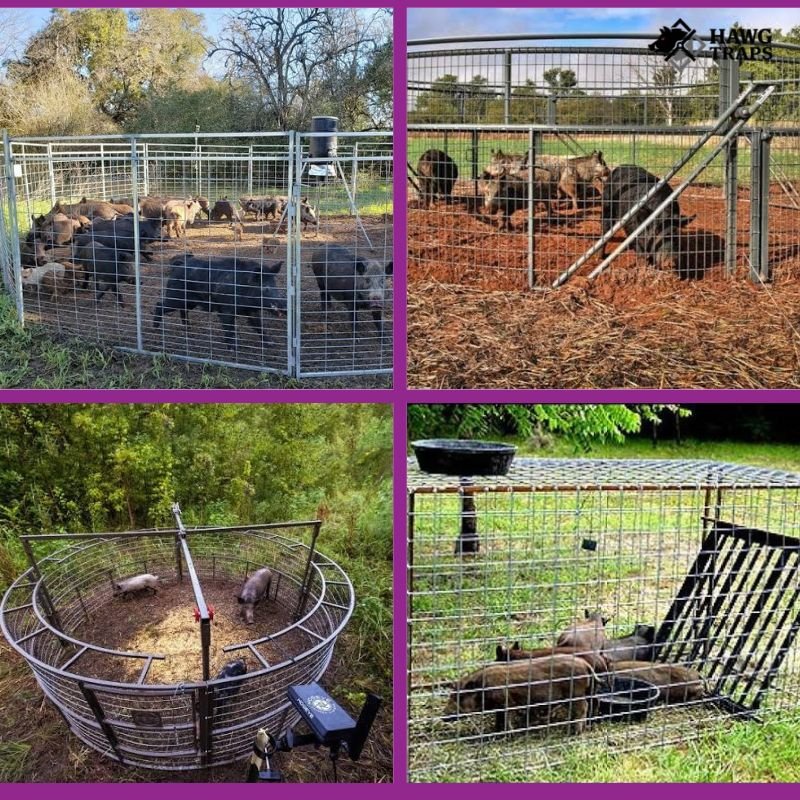
A hog trap costs about $550 to $700 for a steel box trap, $2,300 to $4,500 for a drop trap, and $2,900 to $9,000 for a corral system with a gate, based on US listed prices checked in October 2026.
Prices last checked: 3 October 2026. A listed price is the price printed on the seller’s own page on that date, before freight.
| Trap type | What it is | Listed price | What it catches |
|---|---|---|---|
| Steel box trap | A 4 × 8 × 3-foot cage with one-way doors | $549.99 | One or two adult hogs |
| Net trap | A ring of netting that hogs push under and can’t leave | From $2,500 | A whole group |
| Drop trap | A rigid pen hung in the air that falls around the hogs | $2,295 to $3,245; from $4,499 with a camera app | A whole group |
| Corral package, one gate | Steel panels plus a gate | $2,900 to $3,500 | A whole sounder |
| Remote-controlled corral system | A corral you close from your phone | $4,800 | A whole sounder |
| Trailer-mounted system with camera | A 29-foot trap with four gates that tows behind a truck | $8,995 | A whole sounder |
| Home-built corral | Farm-store panels, T-posts and a steel gate | About $715 in parts | A whole sounder |
Prices run from about $550 to about $9,000, and the jump is mostly gates, cameras and wheels, not steel. Sellers, in table order: Tractor Supply, Pig Brig, That’s A Hog Trap and Big Pig Trap, JAGER PRO (both corral rows), Game Changer. The last row is our own sum, shown further down.
A sounder is a family group of feral hogs, usually sows and their young. That last column matters more than the price column, and we’ll come back to it. Texas A&M AgriLife says box traps “may catch only one or two adult pigs.” A large corral trap, it says, can capture an entire sounder.
If you want to see how these types compare beyond price, start with our hog traps for sale page. Drop traps have their own price breakdown on our drop hog traps page.
What drives the price of a hog trap
Three things move a hog trap’s price most: how many hogs it can hold, the gate and trigger, and whether a camera lets you drop the gate from your phone. Steel gauge decides what that money buys.
One maker’s price list shows the steps clearly. All three figures are JAGER PRO’s own listed prices.
- A single gate with flexible panels: $2,900.
- The same idea with rigid panels: $3,500. That’s $600 more for rigid panels in place of flexible ones.
- A remote-controlled system: $4,800. That’s another $1,300 for remote control: you watch the trap and close it from somewhere else.
The camera step shows up everywhere you look. One drop trap seller charges $750 extra for a camera system that drops the trap by cell phone. A cellular gate sold by itself lists at $1,599.99, plus $100 a year. And in 2021 a University of Arkansas wildlife professor, Becky McPeake, said cellular systems “typically cost about $8,000 or more.”
Wheels are the last step. The $8,995 system in the table rides on its own trailer, and its maker says it can be “deployed in under 15 minutes.” You’re paying for speed.
Now the part the price tag doesn’t show. Two traps at nearly the same price can be built very differently, so ask every seller the same three questions:
- What is the frame made of?
- What gauge is the wire? With steel, a lower gauge number means thicker metal. The higher the gauge the sturdier the trap.
- Is the wire welded to the frame, or clipped on?
Our own answers are published: 1½-inch, 14-gauge square tubing with bracing, and 6-gauge wire MIG welded to the frame. The reasons are on how Boss Hawg traps are built.
What it costs to build your own hog trap
Building a basic corral hog trap costs about $715 in parts at farm-store prices: four 16-foot panels, thirteen T-posts and a steel rooter gate (prices checked 3 October 2026). Bait, tie wire and your labor are extra.
That parts list isn’t ours. It comes from the Cooperative Extension guide to building a corral trap: four utility panels 16 feet long and 52 inches tall, thirteen 6-foot T-posts and a rooter gate. A rooter gate is a gate hogs push open with their snouts, which falls shut behind them. We priced each part at Tractor Supply.
| Part | Quantity | Price each | Total |
|---|---|---|---|
| 16 ft × 52 in combo panel | 4 | $69.99 | $279.96 |
| 6-foot T-post | 13 | $6.49 | $84.37 |
| Steel 3-door rooter gate | 1 | $349.99 | $349.99 |
| Total | $714.32 |
The extension-service corral costs about $715 in parts, and about half of that is the gate. Not included: tie wire, a T-post driver, pliers and bait.
Can you do it for less? Yes, in two ways, and both come with a catch.
Cheaper panels. A plain 16-foot cattle panel was $39.99 on sale. Swap those in and the total drops to about $595. But that panel’s openings run up to 8 inches by 6 inches. Texas A&M AgriLife’s rule is to “use small enough mesh to catch all hogs, even juveniles,” and its own corral design uses 4 × 4-inch mesh. The combo panel costs more because its openings are small at the bottom, where the piglets are.
A home-built gate. Clemson Extension calls drop-style doors “the most budget-friendly doors,” usually built from lumber. A 2016 University of Arkansas guide costed a wooden guillotine gate at $131.25, and a whole minimal corral at $546.25.
Did you know? Prices have moved since that 2016 guide. It listed T-posts at $4.50 each and panels at $53. Today’s listings are $6.49 and $69.99. That’s 44% more for the post and 32% more for the panel.
Here’s the honest verdict on building. If you have the time, a T-post driver and a strong back, a home-built corral is the cheapest way to own a trap that can hold a sounder. What the $715 doesn’t buy is your weekend, and it doesn’t buy welds. The panels are tied on with wire, and penned hogs test every tie.
The costs that come after the trap
After the trap, budget for bait, a camera and its data plan, freight and your own hours. A cellular trigger carries a service fee: a 2016 University of Arkansas guide put it at $20 to $70 a month.
| Cost | What to expect | Source |
|---|---|---|
| Camera | $209 to $618 for trap cameras | JAGER PRO listed prices, 3 October 2026 |
| Data plan or trigger service | $20 to $70 a month; one cellular gate is $100 a year | University of Arkansas guide, 2016; a seller’s listing |
| Bait | Enough corn to pre-bait for weeks | Texas A&M AgriLife says it may take several weeks for hogs to get used to a new trap |
| Freight | Quoted to your ZIP code | Ask before you order; at Boss Hawg the buyer pays freight |
| Your time | A check every day | AgriLife says traps need checking within 24 hours and before the day heats up |
A trap with a camera has a monthly bill; a trap without one has a daily drive.
None of these is large by itself. Together they explain why two people with the same trap can spend very different amounts catching the same number of hogs. The one people forget is time. A trap forty minutes from the house costs you eighty minutes a day until the job is done.
There’s another number worth putting next to all of this. Texas A&M AgriLife has estimated the damage feral hogs cause at $200 per hog per year. By that estimate, a sounder of fifteen costs you $3,000 a year for as long as it stays.
Cost per hog: why the cheapest trap can cost the most
The cheapest trap is not often the cheapest way to catch hogs. In a Georgia study, each pig caught in a box trap cost $671.31, against $121.28 in a corral trap, about 5.5 times as much.
Cost per pig is simple arithmetic. Take everything spent on the traps and divide it by the pigs caught. Researchers from Auburn University did exactly that at Fort Benning, Georgia, in the spring of 2008. They compared six box traps with six corral traps.
| Box traps | Corral traps | |
|---|---|---|
| Cost per pig caught | $671.31 | $121.28 |
| Cost to build six traps | $4,200 | $3,300 |
| New pigs per trap-night | 0.05 | 0.23 |
| Pigs caught | 12 | 59 |
The corral traps were cheaper to build and caught almost five times as many pigs. Source: Williams, Holtfreter, Ditchkoff and Grand, 2011, Journal of Wildlife Management.
Read that table twice, because it turns the price ladder upside down. The box traps cost more to build and caught twelve pigs. The corral traps cost less and caught fifty-nine. The authors’ conclusion was blunt: “corral traps are more efficient than box traps in terms of time, money, and effort spent trapping.”
Two cautions, so we don’t oversell it. Those are 2008 dollars from one military base over one spring. The exact figures won’t match your place. The ratio is pertty useful.
And a box trap still has its job. If you’re seeing one or two hogs, or you need to move a trap by yourself every few days, it’s the right tool and the cheapest one. It’s when a whole sounder shows up that a small trap gets expensive. It catches a few, and the rest keep rooting.
That’s the reasoning behind our Big Pen corral hog trap. Which type suits which situation is a bigger question, and we cover it in our guide to the best hog traps by situation.
What a Boss Hawg hog trap costs, and how to get an exact price
Boss Hawg quotes each trap to the job, so this page prints no Boss Hawg price. Call (254) 725-4554 with your hog count, your ground and your ZIP code for a price with build time and freight. A picture of the location will be helpful.
We know that’s not the answer you wanted on a page about cost, so here’s how our lineup fits the ladder above.
- Standard hog trap a 4 × 8 × 3-foot steel box trap that fits a full-size pickup bed. It belongs to the box-trap tier. Texas dealers that stock it publish their own prices.
- Big Pen corral hog trap: welded steel panels sized to your site. The price depends on how many panels your sounder needs.
- Pro Pen hog trap the pen plus a loading ramp and panel gates, so it naturally costs more than the pen alone.
- Custom hog traps quoted per build, drop traps included.
Every one uses the same steel, so the price moves with size and parts, not with quality.
Have these ready when you call:
- Your hog count. The biggest group your trail camera has shown.
- Your ground. Pasture, brush, creek bottom or woods.
- How you’ll move the trap. Pickup bed, trailer or tractor.
- Your delivery ZIP code. We ship anywhere in the US. Freight is paid by the buyer and quoted before you order.
Three honest trade-offs. We don’t list prices online, so it takes a phone call to get the numbers. We build to order, so ask about the current build time. And if your hogs and your budget point to a home-built corral, we’ll tell you that too. What you get from us is welded steel, a published spec and a price that includes the freight before you commit to it.
REQUEST A QUOTE: CALL (254) 725-4554
Tell us how many hogs you’re seeing and where. You’ll get a real number, not a range.
Also check our partner products for building, baiting and watching a trap:
- Cellular trail cameras to count the sounder before you spend anything
- T-post drivers for setting a home-built corral
- Fencing pliers for tying panels
- Rebar tie wire for joining panels to posts
- Game feeders for pre-baiting
- Hog attractants to pull hogs to the trap site
As an Amazon Associate we earn from qualifying purchases. Partner products are listed separately from our own and never replace them.
Frequently asked questions
What is the cheapest hog trap that works?
The cheapest ready-made trap we found listed is a steel box trap at $549.99. A home-built corral costs about $715 in parts and can hold a whole sounder.
How much does a JAGER PRO hog trap cost?
JAGER PRO listed three trap packages on 3 October 2026: $2,900 for a single gate with flexible panels, $3,500 with rigid panels, and $4,800 for its remote-controlled system.
How much does a BoarBuster trap cost?
We couldn’t find a current listed price. FARM SHOW magazine once reported $5,995 for the trap and camera system, in an article with no date, so treat that as history and ask the maker.
Can you get money back by selling trapped hogs?
Sometimes. In Texas, approved buying stations pay for live feral hogs by weight, and prices change. Loading and the hauling rules are covered in our guide to hog trap trailers and loading ramps.
Is there cost-share money for hog traps?
In some places. In 2024, Arkansas ran a pilot that repaid 75% of trap costs, up to $10,000, for people managing 100 acres or more. It may have closed since, so ask your county extension office what’s open now.