
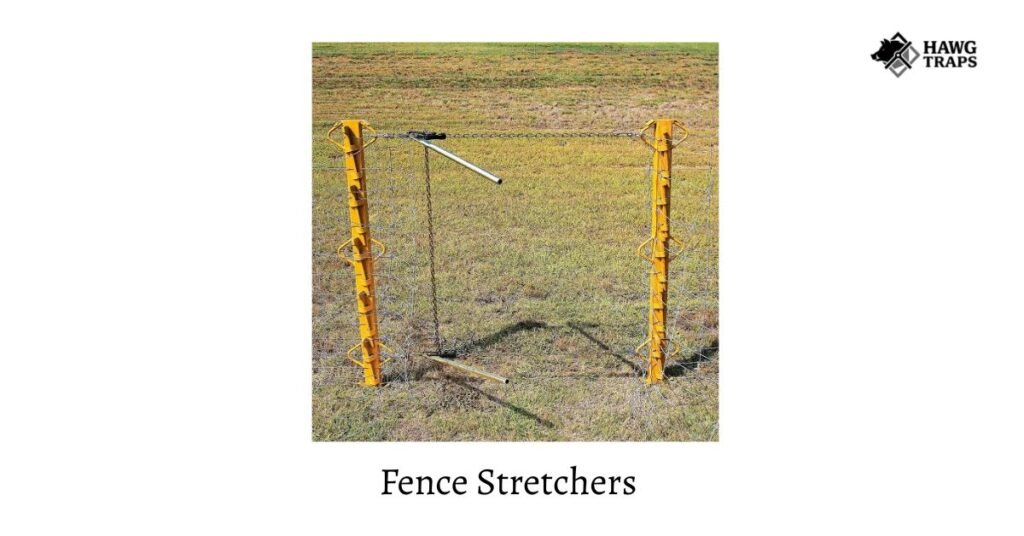
A tight fence is a wall. A loose fence is a suggestion, and cattle are very good at ignoring suggestions.
You know the fence. The top wire droops between posts like a clothesline. Somewhere along it there’s a cow with her head through, eating the neighbor’s grass and looking you right in the eye while she does it.
The cure is tension, and you can’t put real tension on a wire with your hands. You can pull until your face goes red, and the wire will still twang like a loose guitar string. So somebody invented a tool for it. Then somebody else invented a different one, and now there are four tools sharing one name.
That’s the trouble with shopping for a “fence stretcher.” The name covers four different tools, and the wrong one may not grip your wire. This page sorts them out, puts fifteen of them side by side with prices, and tells you how tight is tight enough.
We’re a steel shop. We build hog traps, cattle guards and H-posts, and we don’t make a fence stretcher. Some links are affiliate links, and as an Amazon Associate we earn from qualifying purchases.
Key Takeaways
- “Fence stretcher” means four tools. Which one you need depends on the wire: single strands or woven wire.
- Barbed, smooth and high-tensile wire take a ratchet stretcher. The Goldenrod 405 was listed at $102.59 by its maker.
- Woven wire takes a stretcher bar and something to pull it. A 4-foot bar ran from $154.75 to $349.99.
- The cheap ratchet stretchers had the worst reviews. The four cheapest we found were rated 2.6 to 3.7 out of 5.
- Don’t pull the crimps out of woven wire. Fence builders say to flatten them by a third to a half and stop.
- Five wires at 250 pounds each put 1,250 pounds on the corner, by our arithmetic. The brace matters as much as the stretcher.
- Harbor Freight listed no fence stretcher when we searched its site on 11 October 2026.
Why Trust Us: How We Chose These Stretchers
Boss Hawg is a steel shop in Cross Plains, Texas. We weld the H-posts and H-corners that fence wire pulls against, along with cattle guards and hog traps. Our team has built ranch fences and used these tools themselves. We also talk with ranchers who use them.
That is experience as users. It is not a lab. We have not run a side-by-side test of the stretchers below, so this page carries no star ratings of our own and no “winner” badge.
Here is what it carries instead.
- Prices and specifications come directly from the manufacturer’s listing, read on 11 October 2026.
- Ratings come from customer reviews on those listings, with the number of reviews behind each.
- We include both positive and negative reviews. So you have the whole idea.
- Tension figures come from two NRCS fence specifications. NRCS is the Natural Resources Conservation Service, part of the U.S. Department of Agriculture.
- Fence builders’ rules of thumb come from two farm forums, and we label them as that.
- Where we did arithmetic, or made a judgement, we say so.
We make no stretcher, so every tool here is somebody else’s, and some links pay us a commission. Our editorial policy and affiliate disclosure explains the rest.
What a fence stretcher is
A fence stretcher is a tool that grips fence wire and pulls it tight so it can be tied off or spliced. Some pull a single strand, while others grip woven wire across its full height.
These tools do two jobs. It pulls, and then holds. People often overlook the holding part. Once the wire is tight, you need both hands free to wrap it around a post or twist a splice, and the stretcher has to keep the tension while you do.
A good stretcher grips firmly and releases tension without any friction. A bad one does the opposite, usually in that order.
You’ll also hear a stretcher called a wire stretcher, a wire puller, a come-along or a fence tightener. Some of those are the same tool and some aren’t, which brings us to the types.
The four types of fence stretcher, by the wire they pull
Fence stretchers come in four types, sorted by the wire they pull: a ratchet stretcher for single strands, a stretcher bar for woven wire, a slack tightener for old fence, and a tractor-mounted stretcher for long runs.
| Type | Wire it pulls | How it grips | Price seen, 11 Oct 2026 | Example |
|---|---|---|---|---|
| Ratchet stretcher (stretcher-splicer) | One strand: barbed, smooth, high-tensile | Two clamps on a ratcheting bar | $39.99 to $102.59 | Goldenrod 405 |
| Stretcher bar | Woven wire, field fence, net wire | A tall bar that clamps every horizontal wire | $154.75 to $479.99, plus a puller | Bekaert, Fencer’s Choice |
| Slack tightener | Wire already on the posts | Squeezes or grips a slack section | About $90 | Texas Fence Fixer |
| Tractor-mounted (3-point) | Woven wire by the roll | Carries the roll and pulls with the tractor | $629.99 to $699.99 | CountyLine, Tarter |
The wire decides the tool: single strands take a ratchet stretcher and woven wire takes a bar.
Ratchet stretcher
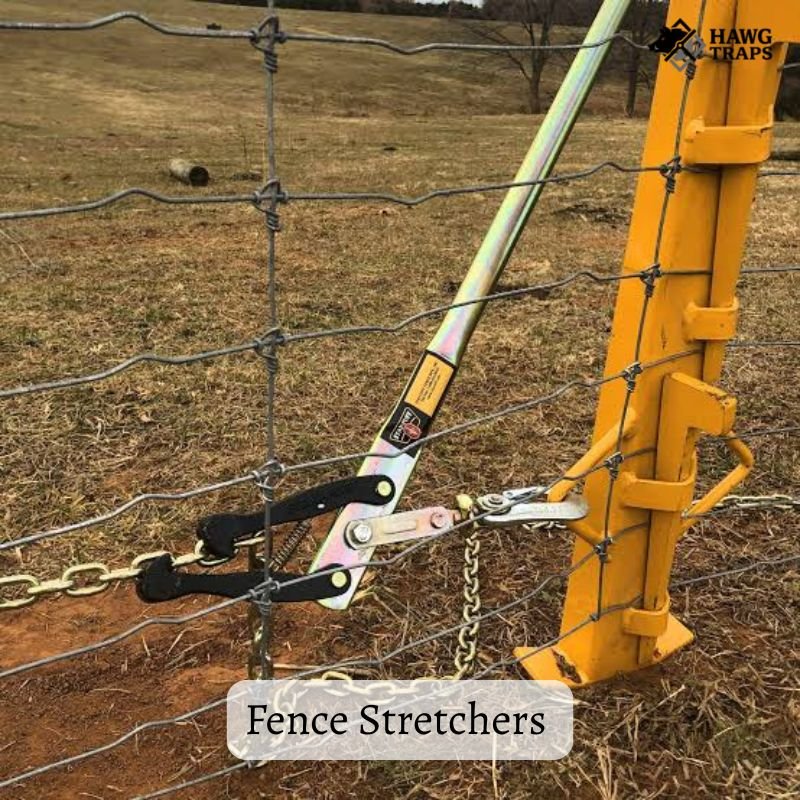
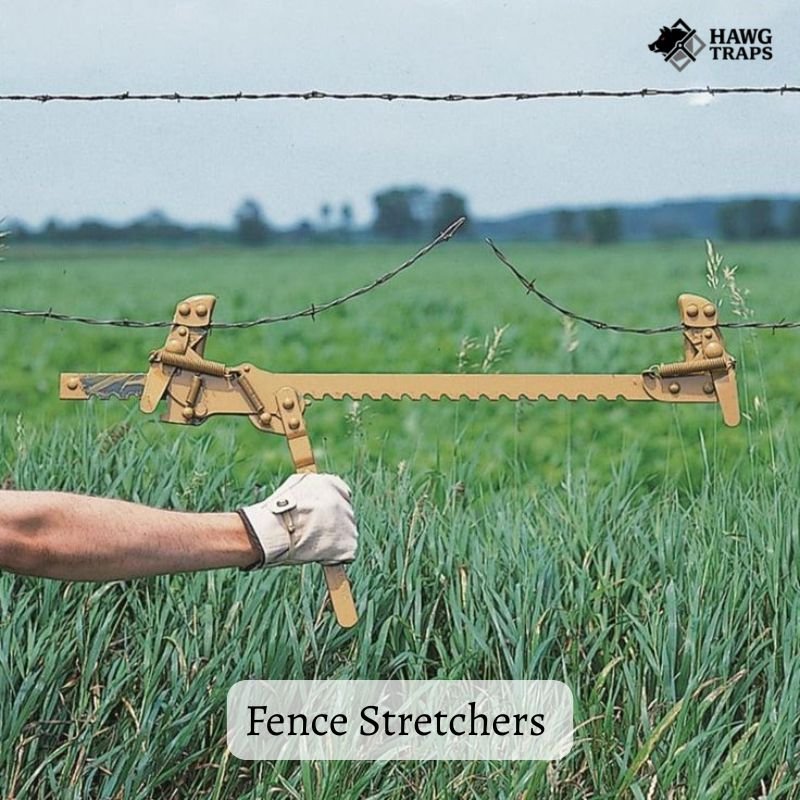
This is the classic. It’s a steel bar around three feet long with two wire clamps and a ratchet handle. One clamp bites the wire coming from the fence. The other bites the end you’re pulling. Work the handle and the two clamps walk toward each other.
A long-running name is Goldenrod, made by Dutton-Lainson. Its maker says the standard model has been in use since the 1970s. On that model, by the maker’s description, a stationary hook holds the wire while a traveler hook ratchets along the bar.
Because it grips both ends, it also helps you splice the broken wire. Break a wire in the middle of a fence, clamp both broken ends, crank them together, and you have two free hands to twist the splice.
Dutton-Lainson lists its stretchers “for high tensile, barbed, and smooth wire.” Woven wire isn’t on that list.
Stretcher bar
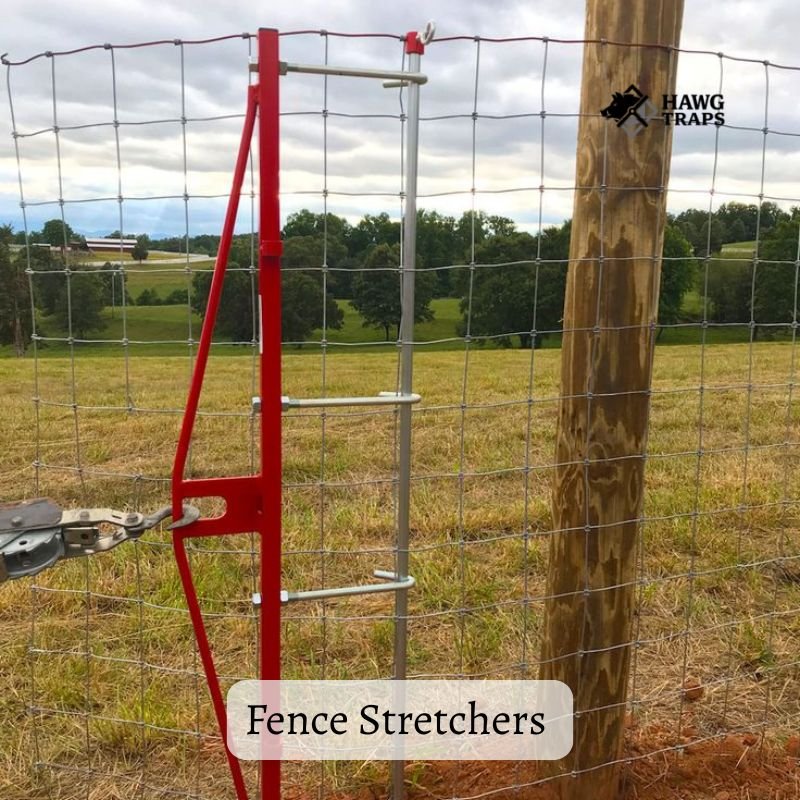
Woven wire has a whole stack of horizontal wires, and they all have to come tight together. Pull on one and you get a fence shaped like a bow tie.
A stretcher bar solves that. It’s a tall steel bar that clamps across the full height of the roll. Wire maker Red Brand says the bar “uses steel bars and bolts to clamp down on the horizontal wires.” Other makers use wedges in place of bolts: Bekaert’s 4-foot bar has five and its 5-foot bar has six.
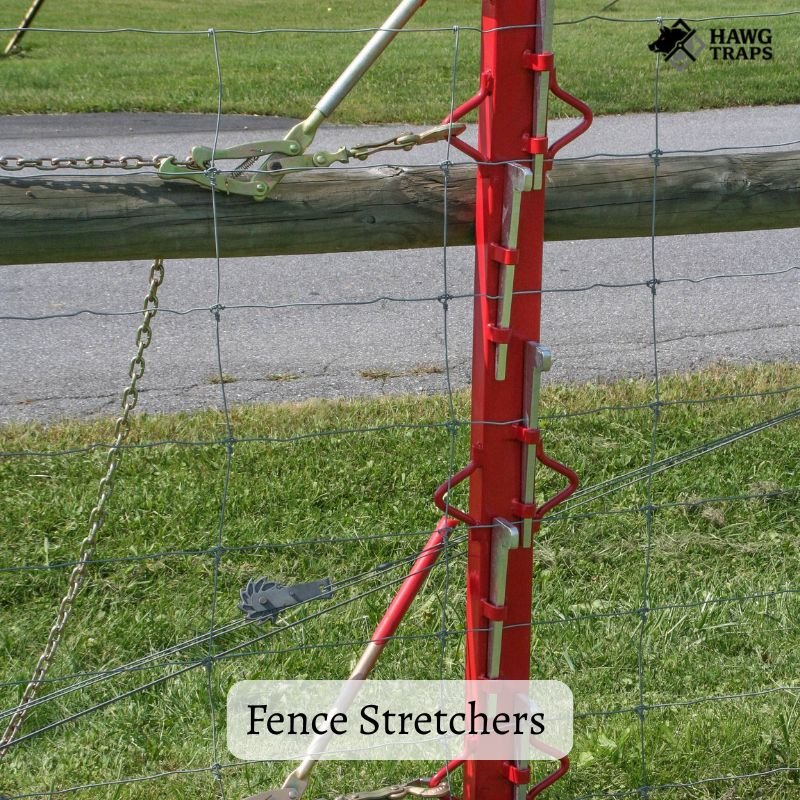
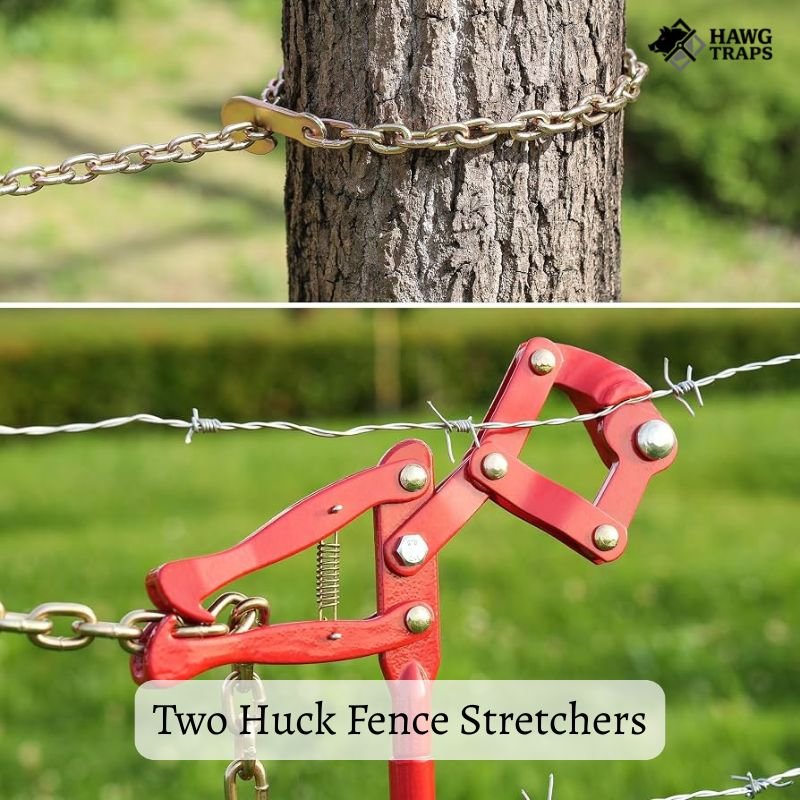
The bar only grips. Something else has to pull it: a bar puller with a chain, or a pair of come-alongs. A come-along is a hand-operated ratchet puller. Red Brand’s own method uses two, one at the top of the bar and one at the bottom.
Woven wire goes by a few names, by the way. Field fence, net wire and woven wire are the same family.
Slack tightener
Sometimes an existing fence has just become loose and unstable. You don’t want to pull staples and start over.
That’s the job of a tool like the Texas Fence Fixer, out of Seguin, Texas. The National AgrAbility Project describes it as a V-shaped tool that tightens slack “without removing fence-post staples or tie wires.” You hook a slack wire on each leg, squeeze the legs together, and wrap a short piece of wire to hold what you gained. AgrAbility lists it for barbed wire, electric fence wire, horse fencing and net wire, and says it suits water gaps and short runs.
If you went looking for a “Texas fence stretcher,” this is the tool we found by that name.
Tractor-mounted stretcher
For long runs of woven wire there are stretchers that hang on a tractor’s 3-point hitch. They carry and unroll the wire along the fence, then they use the tractor to pull it tight.
Tractor Supply’s listing for its CountyLine unit says it “unrolls and stretches field fences” and is built for one person. A seller’s answer on that listing says it is not designed for barbed wire.
It’s for large fencing jobs. It also puts a tractor’s worth of pull on your corner post, and we’ll come back to why that deserves some respect.
Fence stretchers compared: prices and public ratings
Fifteen fence stretchers and pullers were listed from $39.99 to $699.99 on 11 October 2026. Public ratings ran from 2.6 to 5 out of 5, and the cheaper ratchet stretchers drew the lowest scores.
| Tool | Type | Listed price | Public rating | Seller |
|---|---|---|---|---|
| SpeeCo Fence Wire Stretcher | Strand stretcher | $39.99 | 2.6 of 5 (10 reviews) | Tractor Supply |
| AgraTronix Standard Duty Fence Wire Stretcher | Strand stretcher | $49.99 | 3.7 of 5 (3 reviews) | Tractor Supply |
| Field Tuff 33 in. Fence Stretcher | Ratchet stretcher | $64.99 | 3.0 of 5 (7 reviews) | Tractor Supply |
| Country Pro Wire Stretcher | Ratchet stretcher | $69.99 | 3.6 of 5 (61 reviews) | Tractor Supply |
| Goldenrod 405 Stretcher-Splicer | Ratchet stretcher, controlled release | $102.59 | Not shown | Dutton-Lainson |
| Tuf-Tug Field Fence Pull Bar | Pull bar for 4 ft field fence | $59.99 | No reviews yet | Tractor Supply |
| Fencer’s Choice Stretcher Bar, 4 ft | Stretcher bar, 5 wedges | $154.75 | 5 of 5 (92 reviews) | Kencove |
| Stretcher Bar for Woven Wire, 4 to 8 ft | Stretcher bar | $279.95 shown | Not shown | Deerbusters |
| Bekaert Stretcher Bar, 4 ft | Stretcher bar, 5 wedges | $282 at Bekaert; $349.99 at Tractor Supply | 4.7 of 5 (62 reviews, Tractor Supply) | Bekaert, Tractor Supply |
| Bekaert Stretcher Bar, 5 ft | Stretcher bar, 6 wedges | $392 at Bekaert; $479.99 at Tractor Supply | 4.5 of 5 (31 reviews, Tractor Supply) | Bekaert, Tractor Supply |
| Fencer’s Choice Stretcher Bar Puller | Bar puller, 20 ft chain | $119.75 | Not shown | Kencove |
| Bekaert Stretcher Bar Puller | Bar puller, 20 ft chain | $206 at Bekaert; $239.99 at Tractor Supply | 4.4 of 5 (12 reviews, Tractor Supply) | Bekaert, Tractor Supply |
| Texas Fence Fixer | Slack tightener | $90, from a 2024 listing | Not shown | AgrAbility toolbox |
| CountyLine 71 in. Wire Fence Stretcher | 3-point, woven wire | $629.99 | 4.2 of 5 (138 reviews) | Tractor Supply |
| Tarter 3 Point Wire Stretcher, 200 Series | 3-point | $699.99 | 4.0 of 5 (2 reviews) | Tractor Supply |
Listed prices ran from $39.99 to $699.99, and the four cheapest ratchet stretchers scored 2.6 to 3.7 out of 5.
Three things jump out of that table.
The lower-priced strand stretchers had the lowest customer ratings when we compared it. Four of them sit between $39.99 and $69.99, and not one reaches 4 stars. The stretcher bars, which cost more and do a simpler job, sit at 4.5 and up.
The same bar costs different amounts at different sellers. Bekaert’s 4-foot bar was $282 in Bekaert’s own store and $349.99 at Tractor Supply on the same day. That’s a $67.99 gap, by our arithmetic, before shipping on either one. The 5-foot bar showed an $87.99 gap. Check both of them before you buy.
The best-rated bar was also the cheapest. Kencove’s Fencer’s Choice bar had 92 reviews at 5 stars and cost $154.75. Its page showed no review text, so we can’t tell you what those buyers liked.
What buyers wrote
Country Pro Wire Stretcher, Tractor Supply. A split verdict: 33 five-star reviews and 16 one-star reviews out of 61. On one side: “It’s a tried a true simple stretching tool.” On the other: “Doesn’t matter what gauge wire you use it wont hold.” A stretcher that cannot grip the wire does not have much practical use.
Field Tuff 33 in., Tractor Supply. Seven reviews, three of them one star. One buyer said it “broke on the very first short pull of barbed wire.” Another kept his but had to “grind the teeth deeper to make it hold the wire.” With only seven reviews, there isn’t enough evidence to draw a firm conclusion about its reliability.
SpeeCo Fence Wire Stretcher. The lowest rating in the table, 2.6 from 10 reviews. We didn’t read the individual reviews on that one.
CountyLine 3-point stretcher. 86 five-star reviews out of 138. “Convenient to use, way better than rolling wire fence out on the ground.” Nine buyers gave it one star, and one of them wrote that “all 3 nuts stripped out in the first few hours of use.” One more thing matters for Texas readers: the listing says it can’t be shipped to 18 states, and Texas is on the list.
Goldenrod 405. We read it on its maker’s page, which shows no public rating. What we have is the maker’s own description and a long history. That’s a spec, not a review, and we treat it as one.
How tight to stretch a fence
Stretch woven wire until its tension crimps are partly flattened, not gone: fence builders give one-third to one-half. For high-tensile wire, two NRCS specifications give 150 to 250 pounds per wire.
This is the question behind every other question on the page, so let’s take it wire by wire.
Woven wire: read the crimps
Look closely at a roll of woven wire. Every horizontal wire has a small kink in it between each pair of vertical wires. Those kinks are tension crimps. Some people call them tension curves.
They’re there on purpose. A wire fence gets longer in summer heat and shorter in winter cold, and the crimps open and close to take up the difference. A member of the Yesterday’s Tractors forum put the rule in four words: don’t remove the kinks.
So how far do you flatten them? Fence builders differ on how much to flatten the crimps. Here are the two approaches according to our experts.
- One-third. A TractorByNet member, citing a wire maker’s advice, pulls until the crimps flatten about a third.
- Half or better. A Yesterday’s Tractors member stretches until “half or better of the crimps” are gone.
Neither of those is a specification. These are practical guidelines from real fence builders, not manufacturer specifications. What they agree on matters more than where they differ: stop while there is still crimp left.
Red Brand’s own guide gives no number at all. It gives a warning: “tighter isn’t always better.” Its reason is the posts. “Overstretching a field fence can put too much pressure on posts, especially at the ends of a fence line.”
One more test, from a fence builder on TractorByNet, needs no tools. Push on the standing wire. If it won’t lie down flat, and an animal hitting it would bounce off, you’re there.
Single wires: what the specifications say
For high-tensile wire there are real numbers.
- NRCS Pennsylvania (1989): “Tension: 150-250 lbs. each wire.” It adds: “Install a tension spring on at least one wire to gage tension.”
- NRCS Illinois (2012): tension of “approximately 200 – 250 pounds.”
A tension spring is the trick in that first one. It’s a spring spliced into the fence line that shows by its length how hard the wire is pulling. Without one, you’re guessing.
For barbed wire we found no published figure, and we won’t borrow the high-tensile one and pretend. On the forums the answer is a feeling. One member says “tight as a fiddle string.” Another wished out loud for “a scale of sorts.” For barbed wire, aim to eliminate sag without putting enough tension on the line to move the corner post.
What tight wire does to the corner
Here’s the part that concerns a steel shop.
Every wire you tighten pulls on the end post with all of its tension. They add up. Take a five-wire fence with each wire at 250 pounds. By our arithmetic, that’s 1,250 pounds pulling on the corner, all day, every day. At 150 pounds a wire it’s 750.
That’s a simple sum, and a real fence is messier. But set it beside this: wire maker Stay-Tuff rates a single H-brace at 1,500 to 3,000 pounds, depending on its width, depth and soil. At a 1,500-pound rating, the brace’s stated capacity is only 250 pounds above the combined 1,250-pound wire tension.
A forum member said it better than we can: “If your wires are loosening, you are over tightening what your corner/brace can handle to start with.”
So the stretcher is half of a pair. The other half is the brace, and our page on H posts and H braces covers how wide and how deep to build one.
Did you know? The NRCS specification for Illinois caps the distance between pull points on a barbed wire fence at 1,320 feet. That’s a quarter of a mile. Longer than that, and you stop and build another brace to pull from.
How to use a fence stretcher
Using a fence stretcher comes down to three moves: anchor to a braced post, pull until the wire reaches its tension, and tie off before you release. Never release the stretcher before the wire is fastened.
A ratchet stretcher on a single strand
- Tie off the far end first. The wire has to be fastened to a braced post at one end before you pull from the other. The NRCS specification for Illinois is firm on two points: “Tie off all wires at pull assemblies,” and “Do not pull wire around corner posts.”
- Clamp both ends. One clamp takes the wire coming from the fence. The other takes the end you’re pulling toward the post.
- Ratchet. The clamps walk together and the wire comes up tight.
- Fasten the wire. Wrap it on the post or twist the splice while the stretcher holds.
- Release slowly. This is where a controlled release earns its money. Dutton-Lainson says the 405’s holding ratchet is there “to reduce line stress and breakage when wire is released.” Its older model lets go all at once.
A stretcher bar on woven wire
These steps follow Red Brand’s guide for stretching field fence alone.
- Fasten the starting end. Wrap each horizontal wire around the first corner post.
- Unroll and stand the fence along the line of posts.
- Clamp the bar across the free end of the roll, so it grips every horizontal wire.
- Chain to a braced post. Run a chain around the top and bottom of a braced post beyond the end of the fence. Red Brand builds a temporary “dummy” post for this.
- Hook up two come-alongs, one high and one low, between the chains and the bar.
- Ratchet them in turn, a little on the top, a little on the bottom, so the fence comes tight evenly.
- Walk the line as it tightens and free the wire from any root or stump it has caught on.
- Tie off the middle wires first, then the top and bottom. Only then take the come-alongs off.
A Yesterday’s Tractors member adds the rule that saves corners: “Staple all wires and brace the corner post before releasing tension.”
A word on safety
Stretched wire stores force, and wire does break. One forum member says of barbed wire that you “Usually snap the wire in the middle a time or two while tightening.” So stand to the side of the wire, never in line with the pull. Wear eye protection and leather gloves, keep other people back, and follow the instructions that came with your stretcher.
What a fence stretcher costs
A fence stretcher costs about $40 to $103 for a ratchet stretcher and about $155 to $480 for a stretcher bar, by listings read on 11 October 2026. Tractor-mounted stretchers ran $630 to $700.
Note that, the bar is only part of the cost. You also need a puller or come-alongs to apply the tension. Here’s one way it adds up, and the arithmetic is ours. Kencove’s 4-foot bar at $154.75 plus its bar puller at $119.75 comes to $274.50. Using two hand-operated come-alongs instead of a dedicated bar puller changes the total cost. One 1-ton come-along was listed at $70.99 at Gemplers.
At the other end of the scale, a forum member on TractorByNet buys old commercial stretchers at farm auctions for $5 to $20. He does grumble about all the bolts. A well-maintained used stretcher with decades of service has a track record worth considering, however you still need to inspect its condition.
Where to buy or rent one
Tractor Supply listed fifteen fence stretchers on 11 October 2026, and Harbor Freight’s site search returned none. Sunbelt Rentals lists a chain link fence stretcher for rent. We found no rental for a farm wire stretcher.
Does Tractor Supply have fence stretchers? Yes. Its fence stretcher category showed fifteen products that day: strand stretchers, Bekaert stretcher bars and pullers, tractor-mounted stretchers, and three items for chain link and electric fence.
The makers sell direct. Dutton-Lainson lists the Goldenrod line on its own site, and Bekaert and Kencove sell bars and pullers from theirs.
Does Harbor Freight have a fence stretcher? Not that we could find. We searched its site for “Fence Stretcher” on 11 October 2026 and got one result: a 10-inch fence pliers and staple puller at $11.99. Stock changes, so run the search yourself before you drive.
Can you rent a fence stretcher? For chain link, yes. Sunbelt Rentals lists a chain link fence stretcher, though its page showed no rate without a location. For barbed or woven wire, we found no rental listing. At $40 to $103, a ratchet stretcher is a tool people buy and keep. That’s our reading of why.
Which fence stretcher to buy
For barbed or smooth wire, we’d buy a ratchet stretcher with a controlled release, such as the Goldenrod 405. For woven wire, we’d buy a stretcher bar as tall as the fence and pull it with two come-alongs.
That’s our judgement, built on the listings and the reviews above. Here it is by job, with the drawback on each.
For barbed, smooth or high-tensile wire: the Goldenrod 405. $102.59 from its maker, made in the USA, with a holding ratchet that lets the tension off gradually. The drawback: it costs more than twice the cheapest strand stretcher. Its maker also says it stretches only a few feet of slack before you have to secure the wire and take a new bite.
On strand stretchers under $70: read the reviews first. We can’t point you to one with a clear conscience. The four we found were rated 2.6 to 3.7, with complaints about grip and breakage. If your budget is tight, consider a used stretcher from a farm auction, but inspect its clamps, ratchet, teeth, and other moving parts before buying. That’s our opinion, not a test result.
For woven wire: a stretcher bar the height of your fence. Kencove’s Fencer’s Choice bar is $154.75 at 4 feet with a 5-star rating from 92 reviews. Bekaert’s is $282 from Bekaert with a 4.7 rating at Tractor Supply. The drawback: a bar is heavy, 30 pounds for the Kencove, and it pulls nothing by itself. Budget for a puller or two come-alongs.
For one short run of 4-foot field fence: a pull bar. Tractor Supply listed the Tuf-Tug pull bar at $59.99 with a stated 1,000-pound pull capacity. The drawback: it had no reviews at all when we looked, and it’s made for standard 4-foot field fence only.
For slack in a fence that’s already up: the Texas Fence Fixer. It tightens a wire where it hangs, with no staples pulled. The drawback: it mends fence. It doesn’t build it. The $90 price we found is from a 2024 listing, so check it.
For miles of woven wire: a 3-point stretcher, if you can get one. The CountyLine has 138 reviews at 4.2. The drawbacks: stripped nuts in the bad reviews, no barbed wire, and a listing that says it won’t ship to Texas.
The rest of the fencing kit is on our page of ranch tools and trapping gear.
The other half of a tight fence
A stretcher can only pull as hard as the corner can stand. Put 1,250 pounds on a post that was set too shallow and you haven’t tightened the fence. You’ve tilted the post.
Boss Hawg welds H-posts and H-corners in Cross Plains, Texas: the braces that hold a fence’s tension at every end, corner and gate. We ship by freight anywhere in the USA, quoted to your ZIP code before you order.
REQUEST A QUOTE: CALL (254) 725-4554
Tell us the fence height, the wire, and how many ends, corners and gates. We’ll tell you the pipe and what it costs delivered.
Also check our partner products for stretching and tying off wire fence: – Goldenrod fence stretcher-splicers – Woven wire stretcher bars and come-alongs – Fence tension springs and in-line wire strainers – Fencing pliers and crimp tools with sleeves – Leather work gloves and safety glasses
As an Amazon Associate we earn from qualifying purchases. Partner products are listed separately from our own and never replace them.
Stretching a fence without a stretcher
A fence can be stretched without a stretcher. The usual substitutes are two bolted 2x4s as a clamp, a come-along for the pull, and a claw hammer to take up small slack. A tractor pull risks overstretching.
The 2×4 clamp. The homemade stretcher bar. Sandwich the end of the woven wire between two boards and bolt them tight. One TractorByNet member bolts his about every 6 inches and pulls with chain so the load spreads evenly. He says the knots in the wire bite into the wood and stop it slipping, and that the fence comes up “like guitar strings.”
A come-along. With a clamp or a bar to grip the wire, a hand come-along supplies the pull. Remove bold; consider retaining the first clause as a short emphasis if needed.
A claw hammer. For a little slack in one wire, fence builders hook the wire in the claw and lever it tight against a post. It’s a repair trick, not a way to build fence.
A tractor. It will certainly pull. One Yesterday’s Tractors member describes pulling with a small tractor until it spins or stalls, then leaving it in gear. Red Brand takes the other side: “using a tractor to tension a fence will almost certainly lead to overstretching.” A tractor can’t feel the crimps flattening. You can.
If the job starts with taking an old fence down, our page on T-post pullers covers getting the posts out in one piece.
Chain link fence stretchers: a different tool
A chain link fence stretcher is a different tool, made for chain link fabric. Home Depot listed a Maasdam chain link stretcher at $18.11 on 11 October 2026, and Sunbelt Rentals lists one for rent.
If you searched for a fence stretcher and you’re fencing a backyard, this is probably the one you meant. Chain link is a woven steel mesh, and it’s stretched with its own bars and pullers. Tractor Supply listed two chain link items in the same category as its ranch stretchers, which is how people end up with the wrong one in the cart.
We build ranch steel, so chain link is where this page stops. The short version: don’t buy a barbed wire stretcher for chain link, or the other way round.
Frequently asked questions
Do you need a fence stretcher?
For a new wire fence, yes. Hands can’t put working tension on a wire, and a fence that starts loose stays loose. For a small repair, a claw hammer or a slack tightener can take up the sag.
What is the best fence stretcher?
It depends on the wire. For barbed or smooth wire we’d pick a ratchet stretcher with a controlled release, such as the Goldenrod 405. For woven wire we’d pick a stretcher bar as tall as the fence.
How does a fence stretcher bar work?
A stretcher bar clamps across the full height of a roll of woven wire, gripping every horizontal wire. A puller or a pair of come-alongs then pulls the bar, so the whole fence comes tight together.
How much does a fence stretcher bar cost?
A 4-foot stretcher bar was listed from $154.75 to $349.99 on 11 October 2026, and Bekaert’s 5-foot bar from $392 to $479.99. A bar puller added $119.75 to $239.99.
Can you rent a fence stretcher?
Sunbelt Rentals lists a chain link fence stretcher for rent, with no rate shown without a location. We found no rental listing for a barbed or woven wire stretcher on 11 October 2026.
Does Tractor Supply have fence stretchers?
Yes. Tractor Supply’s fence stretcher category showed fifteen products on 11 October 2026, from a $39.99 wire stretcher to a $699.99 3-point stretcher.
What is a Texas fence stretcher?
The Texas Fence Fixer is a V-shaped tool from Seguin, Texas that tightens slack in a fence without removing staples or tie wires. You squeeze its legs together and wrap wire to hold the tension.
How do you stretch a fence with a come-along?
Clamp a stretcher bar or two bolted 2x4s on the end of the wire, chain a come-along to a braced post, and ratchet. On woven wire, use two come-alongs, top and bottom, and tighten them in turn.
How tight should barbed wire be stretched?
We found no published tension figure for barbed wire. Two NRCS specifications give 150 to 250 pounds per wire for high-tensile fence. Our own rule is to stretch barbed wire until it stops sagging and before the corner post moves.
What are the different types of barbed wire stretchers?
Barbed wire is stretched with a ratchet stretcher-splicer, which pulls one strand between two clamps, or tightened in place with a slack tightener such as the Texas Fence Fixer. Stretcher bars are for woven wire.
Before you pull that wire
Go back to the cow with her head through the fence.
The problem may not be the age of the wire but the slack in the fence. With the right tool and a sound corner assembly, you may be able to correct it in an afternoon.
Pick the tool that fits the wire. Pull until the crimps are partly flattened or the strand stops sagging. Tie off before you let go.
Then go and look at the corner. If it took all that pull without moving, you built a fence. If it leaned, the stretcher did its job and the brace didn’t.
The stretcher we can only recommend. The brace we can build.
REQUEST A QUOTE: CALL (254) 725-4554