
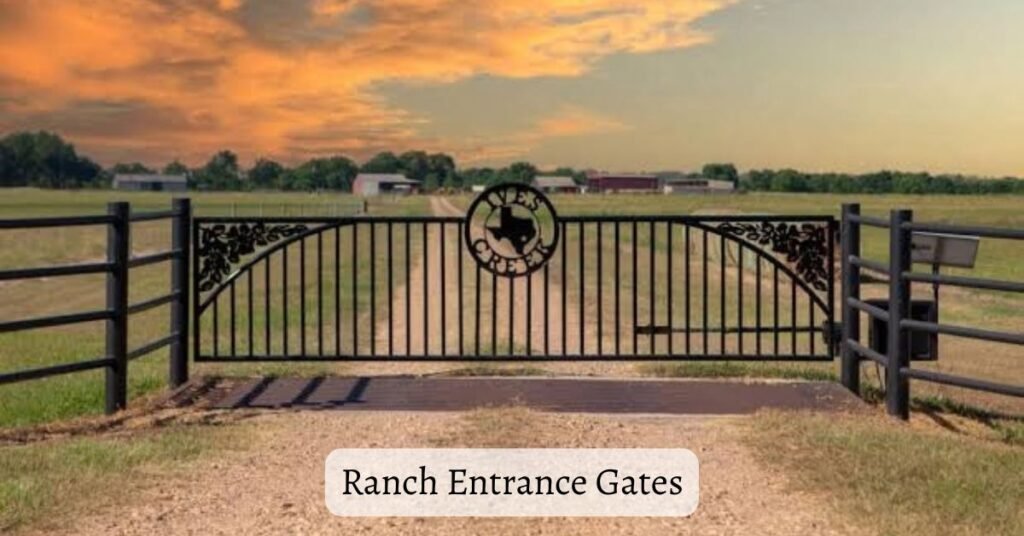
You’ve spent three weekends on fence. The corners are done, the wire is tight, and your hands are tired. All that’s left is the gap by the road.
So you do what everybody does. You hang the gate that fits the gap, and you admire it.
Then the hay truck arrives. The driver looks at your gate, looks at his trailer, and looks at the ditch. He tells you some number that never comes to your favor.
A ranch entrance isn’t hard to build. It’s hard to build once. This page gives you the numbers for how wide, how tall and how far back, and where each one comes from.
Note – We build cattle guards and H-posts. We don’t build entrance gates or arches, so we have no gate to sell you. Some links to other products are affiliate links, and we may earn from qualifying purchases.
Key Takeaways
- The gate is only one part of a ranch entrance. Posts, braces, an overhead and often a cattle guard do the rest.
- Texas caps a vehicle and its load at 14 feet high. An overhead that should pass every legal load needs more than that.
- TxDOT’s typical farm and ranch driveway has a 20-foot throat and 25-foot return radii.
- Set the gate back from the road. TxDOT wants room to park your longest rig between the pavement and the gate.
- Prices run a long way. A 16-foot farm-store tube gate was listed at $329.99, and one Texas maker’s custom gates at $20,000 to $35,000 and up, on 5 October 2026.
- Check an opener’s fine print. One widely sold model is rated to 18 feet or 850 pounds, and only for gates under 30% solid surface.
- Boss Hawg builds two parts of an entrance: the cattle guard and the H-posts.
Why Trust Us: How We Put This Together
Boss Hawg is a steel shop in Cross Plains, Texas. We weld cattle guards, H-posts and H-corners. We don’t build entrance gates or arches, and we haven’t built or tested the gates on this page. But we do have relevant experience for decades.
That’s useful to you. We have no gate to defend.
- The rules come from the source. That means the Texas Department of Transportation’s access manual and the Texas statutes, and we name each one.
- Prices come from sellers’ own pages, checked on 5 October 2026.
- Builders’ figures are labelled as builders’ figures. When a Texas gate company publishes a number, we say whose it is.
- Owner experience comes from rancher forums. When we say “in the forum threads we read,” that’s what we mean.
The one thing we do know first-hand is the steel that goes in the road. That part we build.
What a ranch entrance gate is
A ranch entrance gate is the main gate where a ranch road meets the public road. The full entrance usually adds hinge posts, braces, an overhead sign or arch, and often a cattle guard.
People call it a ranch gate, an entry gate or a ranch entrance. Same thing.
Its first job wasn’t security. Texas Monthly traced the history in 1983. Once fences crossed the plains, the house could sit miles from the road, so ranchers marked the main gate to show visitors the way in. Later the gate carried the ranch name, the brand and the founding date.
The same article has a line worth remembering. It says the gate to a modern working ranch may be little more than “two cedar king posts flanking a cattle guard.” In a place like this, the gate is often the smallest part of the entrance.
The parts of a ranch entrance
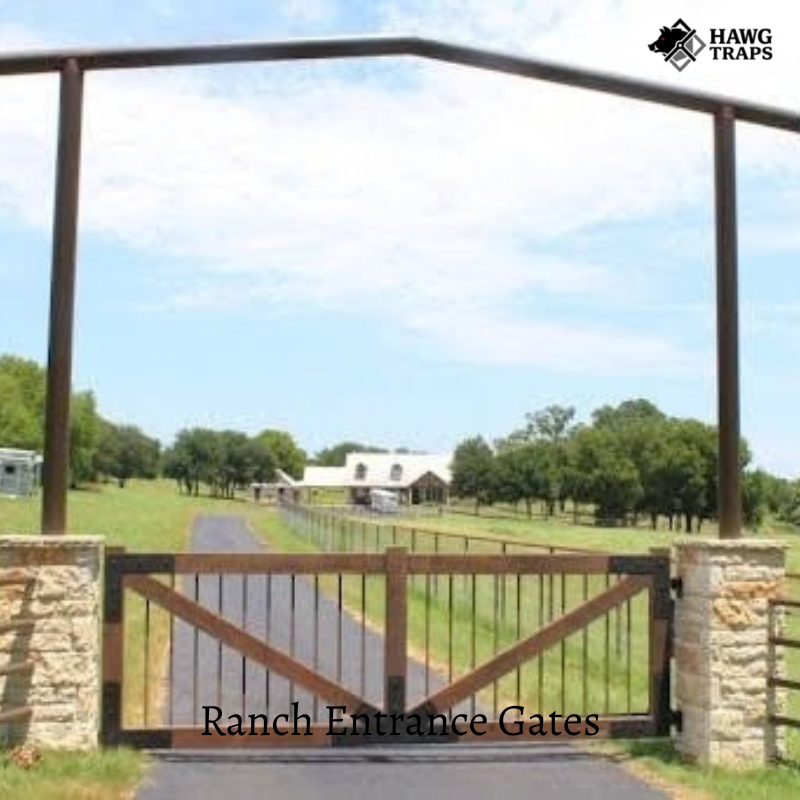
A ranch entrance has six working parts: the gate, the hinge and latch posts, the braces, the overhead, the cattle guard, and the opener. Boss Hawg builds two of them: the cattle guard and the H-posts.
Here’s what each one does.
- The gate. The part that swings, slides or gets bumped.
- The hinge post and latch post. One carries the gate. The other catches it.
- The braces. They keep the hinge post from leaning toward the gate.
- The overhead. Also called a header or an arch. It carries the name and ties the two posts together. One forum poster called it a “headache brace,” which tells you what happens when it’s built too low.
- The cattle guard. A steel grid in the road that lets you drive in without touching a gate.
- The opener. A motor, a battery and a keypad, for people who are finished climbing out of the truck.
Not every entrance has all six. Most good one have three of them.
Our two parts are plain steel. A Boss Hawg cattle guard has 2 7/8-inch pipe rails on an 8-inch channel iron frame. It measures 7 feet 5 inches in the direction of travel, and we build it to the length of your opening. We also build H-posts and H-corners.
Types of ranch entrance gates
Ranch entrance gates come in five main types: single swing, double swing, slide, bump, and wire gap. Swing gates are the usual choice because they need less hardware than slide gates and are easier to automate.
Most of them are metal. One Texas contractor, Texas Ranch Resources, says steel gates are “typically the most durable and common for ranch entrances.” The same page says wood gives a rustic look and is often set in a steel frame. It adds that aluminum is light and resists corrosion but may not be as heavy-duty.
| Type | How it opens | Suits | Watch for |
|---|---|---|---|
| Single swing | One leaf on one hinge post | Simple to hang and to automate | The whole gate hangs on one post |
| Double swing | Two leaves that meet in the middle | Wider entrances | Two leaves to open and latch by hand |
| Slide | Rolls sideways on a track or a cantilever | Needs room along the fence and extra support | |
| Bump | Your bumper pushes it open, and it closes itself | Roads you drive daily without getting out | More than a bump can damage the gate or the truck |
| Wire gap | Fence wire on loose sticks, unhooked by hand | Cheap openings of any width | Opened and closed by hand every time |
Swing gates suit most ranch entrances; slide gates need room along the fence and more hardware.
Single swing gate
A single swing gate is one leaf hung on one post. It’s the gate most people picture. Swing gates are also the easier kind to put a motor on.
The catch is leverage. The longer the leaf, the harder it pulls on that one post.
Double swing gate
A double swing gate splits the opening between two shorter leaves. Each post carries half the load.
Ranchers argue about this one. In the forum threads we read, one poster preferred two gates of 8 to 10 feet for “lots less stress on the posts.” Another said double gates “are a pain.” Both are right. Two leaves can be kinder to your posts and but not that kind to your patience.
Slide gate
A slide gate rolls sideways instead of swinging. Texas builder Trails West Gate Company lists two kinds: track slide and cantilever.
Texas Ranch Resources says slide gates often need more room along the fence line. They also need extra support for a cantilever system, which adds cost.
Bump gate
Of all the ranch gates, the bump gate takes the crown for being the most Texas thing ever. You ease the truck against it, it swings away, you roll through, and it closes behind you.
Texas Monthly’s Texanist column covered it in October 2026. It credits Robert J. Kleberg Jr. of the King Ranch with devising the bump gate in 1925, and notes earlier references in West Texas. The King Ranch claims about 150 of them.
The same column carries a warning. Anything more than a bump risks damage to the gate or the vehicle. A bump gate doesn’t forgive a heavy foot.
Wire gap
A wire gap is something that experts can make in 10 minutes. It’s a few strands of fence wire on loose sticks that hook to a post.
Beef Magazine calls it economical and says it can be made to fit just about any opening. It’s fine for a pasture. At a main entrance, it means getting out twice in the rain.
Want to see how these look when they’re finished? Our ranch gate entrance ideas page is the picture book.
Gate, cattle guard or both
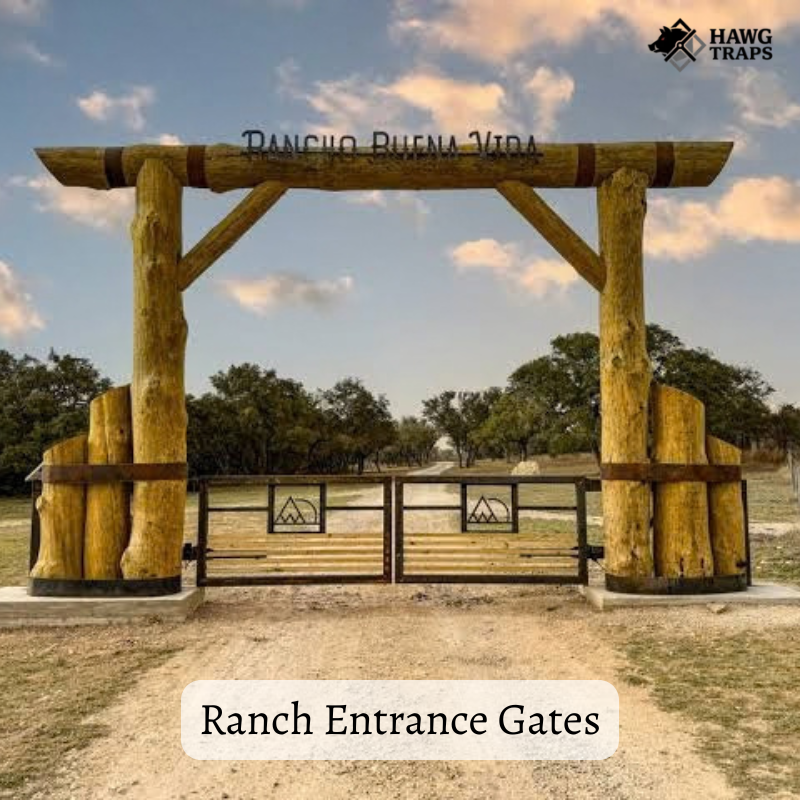
A cattle guard lets vehicles through without anyone opening a gate. A gate handles livestock, horses and loads the guard cannot. Many working ranch entrances use both, with a bypass gate beside the guard.
A cattle guard is a grid of steel rails set across a road opening in a fence, so vehicles can drive through while cattle will not walk across it.
This is the choice most gate pages tend to skip. Here’s how it breaks down.
What a guard does well. You never stop. Go out and come in with your vehicle without having to open the gate.
What a guard can’t do. Three things, and they apply to ours too.
- It isn’t for horses. The U.S. Forest Service calls cattle guards dangerous for horses and advises a vehicle gate to contain loose stock.
- It doesn’t lock. A guard stops cattle. It doesn’t stop a pickup that isn’t yours.
- It doesn’t fit everything. In the forum threads we read, one rancher’s main entrance crosses a cattle guard. A second entrance with two gates takes the combines, frack tanks and sprayers.
What a guard costs. More than a gate. One landowner on a tractor forum wrote that he was quoted $4,600 for an installed guard. One national retailer listed steel guards at $3,757 to $5,194 on 27 September 2026. A farm-store tube gate was $329.99. You aren’t saving money with a guard. You’re buying back every stop you’d otherwise make, for as long as you own the place.
So which one?
- Gate only: you keep horses, you want the entrance locked, or the road is used a few times a week.
- Guard only: an interior road with daily traffic, cattle, and no need to lock.
- Both: a working main entrance. The guard takes the daily traffic. The gate beside it takes stock, horses and wide loads.
Our guards are on the cattle guards for sale page. One honest note: they don’t carry a third-party load rating. Tell us the heaviest axle that will cross and we’ll build for it. The gate that sits beside a guard has its own page, cattle guard bypass gates.
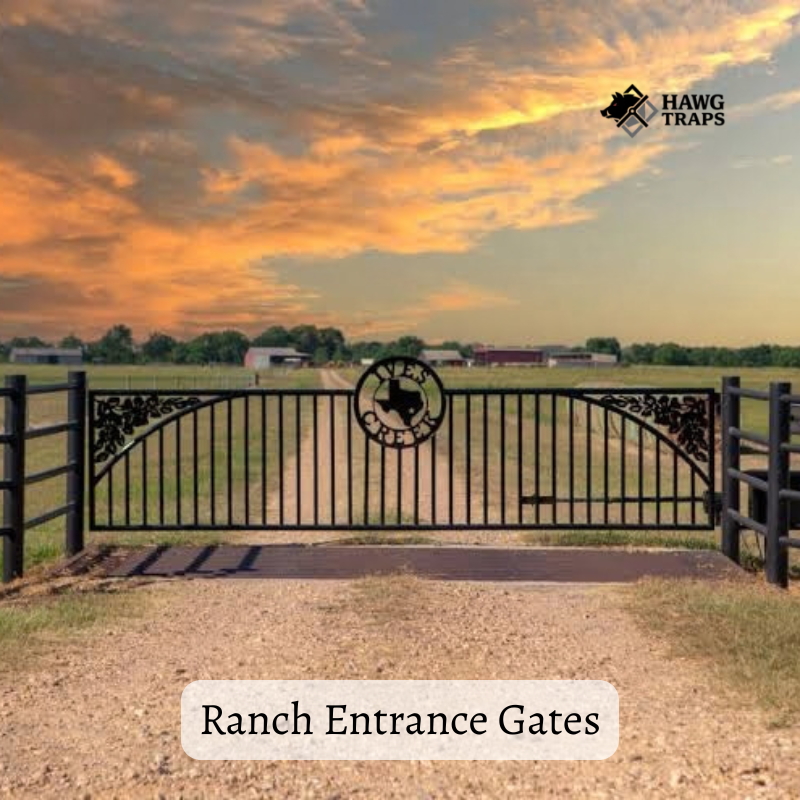
How wide should a ranch entrance gate be?
Sixteen feet is the width rancher forum threads recommend again and again for a main entrance. Twelve feet works on a straight approach. TxDOT’s typical farm and ranch driveway has a 20-foot throat.
There is no standard size of gate, it depends on your necessities and specifics. What you have instead is three numbers and one rule.
The legal number: 102 inches. That’s the widest a truck or trailer can be on a Texas highway without a permit. It’s 8 feet 6 inches.
Now do the arithmetic on a 12-foot opening. A 102-inch trailer has 21 inches to spare on each side, if you’re dead straight. You’re never dead straight. You’re turning off a road with a ditch on both sides.
The forum number: 16 feet. In the threads we read, the advice hardly changed across nearly twenty years. One poster wanted 16 feet, and 14 at a minimum, for turning in with a long trailer. Another said a straight shot through 12 feet is fine. A third gave the rule that explains both: the closer the gate sits to the road, the wider it has to be.
The official number: 20 feet. TxDOT is the Texas Department of Transportation. Its Access Management Manual describes a typical private farm or ranch driveway with a 20-foot throat and 25-foot return radii. The throat is the width of the driveway where it meets the road. The return radii are the curved corners that let a trailer swing in.
That figure covers driveways onto state highways. It isn’t a rule for county or private roads. It’s still the best official picture of what a truck and trailer need.
The rule: set the gate back. This one comes from the same manual, and almost nobody talks about it. TxDOT says the distance from the pavement edge to the gate must be enough to store the longest vehicle using the property. At a minimum, that’s a pickup with a trailer.
The reason is simple. If the gate sits at the fence line, your trailer sits in the highway while you fumble with the chain.
Two more reference points:
- Builders. Trails West lists gate spans as commonly 12 to 24 feet.
- Fire trucks. The model fire code calls for a 20-foot gate on a fire access road. It applies only where your city or county has adopted it. It still tells you what a fire engine wants.
If a cattle guard is going in the opening, it gets built to the same length. Rail and frame details are on our cattle guard sizes and load ratings page.
How tall should a ranch entrance be?
Fourteen feet is the legal maximum height for a vehicle and its load in Texas, so an overhead meant to pass every legal load needs more clearance than that. One Texas gate builder lists 12 to 16 feet as typical.
Ranches have tall gates for two reasons. The overhead has to clear what drives under it, and a name up high can be read from the road outside.
The first reason is more important. Here are the numbers.
- 14 feet. The legal limit for a vehicle and its load in Texas.
- 13 feet 6 inches. Above this, Texas law puts the job of clearing every structure on the driver. The model fire code asks for the same clearance over a fire access road, where it’s adopted.
- 12 to 16 feet. What Trails West calls typical for an overhead, sized to your tallest vehicles and the approach grade.
- 15 feet. In the forum threads we read, one poster from Central Texas wrote, “We always build headers with at least 15 foot clearance.” His reasoning: if you can take it down the interstate, it’ll fit.
Notice the low end of Trails West’s range. A 12-foot overhead is lower than a legal load is allowed to be.
Mind the grade as well. A truck climbing up to your gate from a low road carries its roof higher than the tape measure says.
Some ranchers skip the overhead entirely. One forum poster said he’d avoid any arch because it limits what can come through. It’s a reasonable position to take. You have 3 options here.
- Build it tall. Fifteen feet or more, and stop worrying.
- Build two entrances. A handsome one for the house and a plain one for equipment. A 2015 Farm Credit article describes larger ranches doing this, with the working side treated “almost like a service entrance.”
- Build no overhead. Two good posts and a sign on the fence. It’s hard to hit a sign on the fence with a combine.
Gate posts and braces: what keeps a ranch gate from sagging
A hinge post carries the whole gate, so it is set in concrete and braced. One Texas gate builder recommends 6-inch posts set in concrete with footers.
Most times it’s never the gate that causes sagging. It’s the post.
Think of holding a sledgehammer straight out at arm’s length. The hammer is the gate. Your shoulder is the hinge post. A longer handle or a heavier head makes your shoulder give out sooner.
That builder is Trails West. Its recommended list for a ranch gate includes 6-inch posts set in concrete with footers, plus 7-inch weld-on hinges you can grease.
Texas Ranch Resources adds that many entrances need concrete footings or foundations. That’s especially true with heavy timber posts, masonry columns or an automated gate.
Three things take load off the post.
- A brace. The H-brace keeps the hinge post from leaning toward the gate. One forum poster wanted a double H on a 16-foot gate, in case anybody’s kids swing on it. Somebody’s kids always swing on it.
- A shorter leaf. In the forum threads we read, some ranchers split a wide opening into two leaves for exactly this reason.
- A lighter gate. That 16-foot farm-store tube gate weighs 136 pounds. A custom gate with plate-steel artwork is a different animal, and it needs a different post.
Now for what we won’t print. We’re not giving a hole depth or a post size for your gate. We haven’t found a figure we’d trust for every gate, and soil changes from one county to the next. Ask the builder who will stand behind the post.
Texas builders often frame an entrance in steel pipe. If that’s your plan, our pipe ranch gate entrances page covers it.
Ranch entrance gate cost in 2026
Ranch entrance gates ran from about $330 for a 16-foot farm-store tube gate to $35,000 or more for a custom gate, on listings checked 5 October 2026. Posts, opener, overhead and cattle guard are extra.
That’s a hundredfold spread. Both ends keep cattle in.
| What you buy | Listed price | Source | Date checked |
|---|---|---|---|
| 16-foot, 2-inch tube gate | $329.99 | Tractor Supply | 5 Oct 2026 |
| Solar-ready opener, single gate to 18 feet | $562 | Mighty Mule | 5 Oct 2026 |
| Custom steel ranch gate | From $65 a square foot | Trails West Gate Company | 5 Oct 2026 |
| Custom aluminum “Signature” gate | $20,000 to $25,000 | Aberdeen Custom Gate & Iron | 5 Oct 2026 |
| Custom ranch-style gate | $25,000 to $35,000 | Aberdeen | 5 Oct 2026 |
| “Legacy” gate | From about $35,000 | Aberdeen | 5 Oct 2026 |
| Steel cattle guard, retail listing | $3,757 to $5,194 | One national retailer | 27 Sep 2026 |
A farm-store gate and a solar-ready opener came to $891.99 before posts and concrete; a custom showpiece gate alone runs past $20,000.
Here’s one worked example in the middle. Trails West prices its ranch gates by the square foot, width times overall height. At $65 a square foot, a 16-by-6-foot gate starts at $6,240. That’s our arithmetic, not their quote, and it’s before posts, installation and an opener.
Four things that catch people out:
- The gate isn’t the entrance. Posts, concrete, an overhead, columns and an opener all sit on top of the gate price.
- Installation may be separate. Aberdeen builds gates and ships them. It says installation is handled by your local contractor.
- Custom takes time. Aberdeen quotes about 12 to 20 weeks from design agreement to delivery.
- Expect a deposit. Texas Ranch Resources says most custom gate projects need 50% down to start.
We don’t post Boss Hawg prices. Every guard and post is quoted to your size and ZIP code.
Texas ranch gate entrances: the rules and the look
Four Texas rules touch a ranch entrance. A new driveway onto a state highway needs a TxDOT permit. Legal loads reach 14 feet. Owners may not knowingly let livestock roam highways, and counties set cattle guard standards on county roads.
The rules
- The driveway permit. A new or changed driveway onto a state highway needs TxDOT Form 1058. State highways include the farm-to-market and ranch-to-market roads. No work may start in the right of way until the permit is signed.
- The 14-foot load. Covered above. It’s the number your overhead answers to.
- Livestock on the highway. The Texas Agriculture Code says an owner may not knowingly permit livestock to roam at large on a highway right of way. A gate left open is how cattle get there.
- County roads. The Texas Transportation Code lets a county commissioners court authorize cattle guards on county roads and set the plans for a standard one. If your guard goes on a county road, ask the county first.
A gate on private rural land often needs no permit at all. Cities, counties and subdivisions can add their own rules.
This is a summary of the rules, not legal advice.
The look
Texas doesn’t have one ranch entrance. It has at least four. A 2015 Farm Credit article mapped them by region.
- Hill Country: decorative gates flanked by stone walls.
- West Texas and the Panhandle: arches rule the day.
- South Texas: entrances landscaped with rugged native plants.
- East Texas: brick columns with board or pipe fencing.
The same article quotes a Farm Credit staffer’s granddad: “The bigger the gate, the smaller the ranch.” Texas Monthly said much the same in 1983, at greater length and with less mercy.
Take it as permission. A plain entrance isn’t a bad one.
How to plan a ranch entrance, and the parts Boss Hawg builds
Three facts about planning a ranch entrance: the longest rig that turns in, the tallest load that passes under, and whether livestock run behind it. Size the opening first, then choose the gate, then the look.
That order is our method of doing it, not a rule from a manual. It comes from the figures above. Width, height and setback are set by trucks and law. The gate and the artwork are yours to choose.
Before you call anybody Measure these six things:
- Your longest rig. Truck plus trailer, bumper to bumper. That sets the setback.
- Your approach. A straight shot or a turn off a narrow road. That sets the width.
- Your tallest load. Yours, and the tallest thing that will ever be delivered. That sets the overhead, or rules it out.
- Your stock. Cattle, horses, both or neither. That decides guard, gate or both.
- Your road. State highway, county road or private. That decides who you ask first.
- Your power. Electricity at the gate, or none. That decides the opener.
The mistakes those six prevent:
- A gate that’s wide enough for the truck and too narrow for the turn.
- An overhead built to look right and not measured against a load.
- A gate at the fence line, with the trailer parked in the road.
- A heavy gate on a light post.
- An opener bought before anyone weighed the gate.
What Boss Hawg builds, and what we don’t
Boss Hawg builds the parts of an entrance that sit in the ground and in the road.
- Cattle guards. 2 7/8-inch pipe rails on an 8-inch channel iron frame, MIG welded, 7 feet 5 inches wide, any length.
- H-posts and H-corners. The braced steel a gate and a fence pull against. Details will be on our H posts and H braces page.
We don’t build entrance gates, arches or ornamental ironwork. For those, call a gate fabricator near you. The three Texas builders named on this page all publish their work, which is a good place to start comparing.
Getting our steel to you works three ways. We ship by freight, quoted to your ZIP code before you order. You can pick up at the shop in Cross Plains. And in select Texas areas we offer cattle guard installation.
Have these ready when you call:
- The opening. Width between the posts, or the width you plan.
- The heaviest axle that will cross the guard.
- Your stock. Cattle only, or horses too.
- Your delivery ZIP code.
REQUEST A QUOTE: CALL (254) 725-4554
Tell us the opening and what crosses it. We’ll tell you what guard and posts fit, and what they cost delivered.
Once the steel is set, the last choices are the parts and hardware that will hang on it.
Gate openers and hardware for a ranch entrance
Automatic openers fit many swing ranch gates, and solar power runs them where there is no electricity at the road. One widely sold opener is rated for single gates up to 18 feet or 850 pounds.
Texas Monthly’s Texanist notes that plain gates are still the go-to across Texas. Electric gates, some of them solar, have made inroads lately. If you’re ready to join them, read three lines of fine print.
Length and weight. That widely sold opener is the Mighty Mule MM571W. The maker rates it for single swing gates up to 18 feet or up to 850 pounds. It was listed at $562 on 5 October 2026.
Solid surface. This is the one people miss very often. The same maker rates that opener for gates with less than 30% solid surface. A tube gate is mostly air. A gate filled with plate-steel artwork may not be. Work out the percentage before you buy the motor.
Cycles. Texas Ranch Resources says it sizes an opener by the type of gate, its length and weight, and how many times a day it will open.
Here is a safety point. Automatic gate operators are built to a standard called UL 325. It requires at least two entrapment protection devices for each area where a person could be caught. A powered gate is strong enough to hurt someone. Have a professional install it, or follow the maker’s instructions to the letter.
Our solar gate openers page will compare models.
Also check our partner products for finishing a ranch entrance:
- Solar gate opener kits for single and double swing gates. Check the length, weight and solid-surface rating
- Wireless gate keypads and extra remotes
- Weld-on gate hinges and gate latches
- Gate wheels for long leaves
- Solar gate post lights and metal ranch signs
As an Amazon Associate we earn from qualifying purchases. We only list gear that fits the job; our own products are listed separately.
Frequently asked questions
What are the entrances to ranches called?
Ranch entrances are called ranch gates, entry gates or ranch entrances. The overhead structure is an arch, header or overhead. Texas Monthly records the old word for a makeshift wire gate: a gap.
What is the standard width of a ranch gate entrance?
There is no single standard. Rancher forum threads recommend 16 feet for a main entrance and accept 12 feet on a straight approach. TxDOT’s typical farm and ranch driveway has a 20-foot throat.
How much does a ranch gate cost?
A 16-foot farm-store tube gate was listed at $329.99 on 5 October 2026. One Texas builder priced custom ranch gates from $65 a square foot. Another listed custom gates from $20,000 to $35,000 and up.
What is a cowboy gate?
Cowboy gate is a nickname for a wire gate: strands of fence wire on loose sticks that hook to a post. Beef Magazine lists its other names as fence gap, Western gate and Texas gate.
Does Tractor Supply sell farm gates?
Yes. Tractor Supply sells tube farm gates, including 16-foot lengths. Its 16-foot CountyLine 2-inch tube gate was listed at $329.99 on 5 October 2026.
Do I need a permit to put a gate on my driveway?
Often not on private rural land. A new or changed driveway onto a Texas state highway needs TxDOT Form 1058. Cities, counties and subdivisions can add rules, so ask before building.
Can a truck fit through an 8 ft gate?
An 8-foot gate is narrower than the widest legal truck: Texas allows vehicles up to 102 inches, which is 8 feet 6 inches. Treat 8 feet as a pasture gate, not a main entrance.
Before you set the first post
Take a tape measure and a notepad out to the road this week. Measure your longest rig. Stand where the gate will hang and look back at the pavement. Ask if that rig fits in between.
Then look up, and picture the tallest load you’ll ever take delivery of.
Those two answers settle most of what’s on this page. The gate, the color and the longhorn cutout can wait a day.
When you know your opening size, call us about the part that sits in the road and the posts that hold it. For the gate and the arch, a good local fabricator will take it from there.