
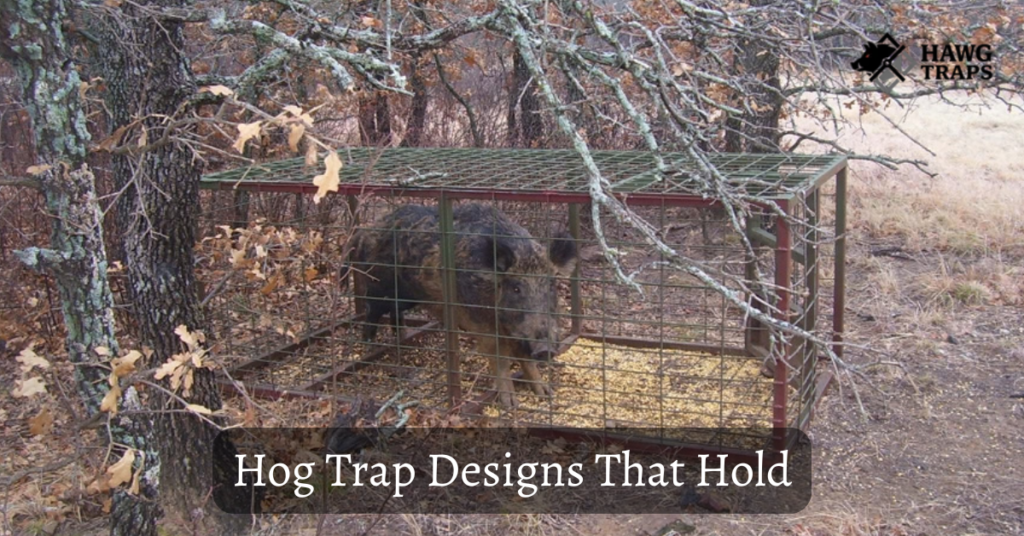
Search for hog trap designs and you’ll find hundreds of them. Box traps, corral traps, drop traps, saloon doors, rooter gates, root sticks, cattle panels, hog panels, and one fellow’s trap built entirely out of what was behind the barn. Most of them look fine in the photo. The real test comes at 2 a.m., when twelve hogs figure out they’re caught and start testing every corner of the trap.
This page does two jobs. First, it lays out which hog trap designs work and why, using what Texas A&M AgriLife and Mississippi State University have published. Then it shows how Boss Hawg builds each part of a trap, and the reason behind every choice. Spoiler: most of those reasons were learned the hard way with practical experience.
Key Takeaways
- Box traps catch one or two adult hogs; corral traps can catch a whole sounder. That’s the first design choice, and it matters most.
- Every Boss Hawg frame is 1½-inch, 14-gauge square steel tubing, braced throughout.
- The wire is 6-gauge, MIG welded to the frame, not clipped or tied on.
- All tubing is prime coated to keep the joints from rusting.
- Our traps are built for continuous loading: they keep catching after the first hog is in.
- The designs came from the field. The shop trapped hogs on its own land and for local ranchers for years before it sold a trap.
Why Trust Us: How We Put This Together
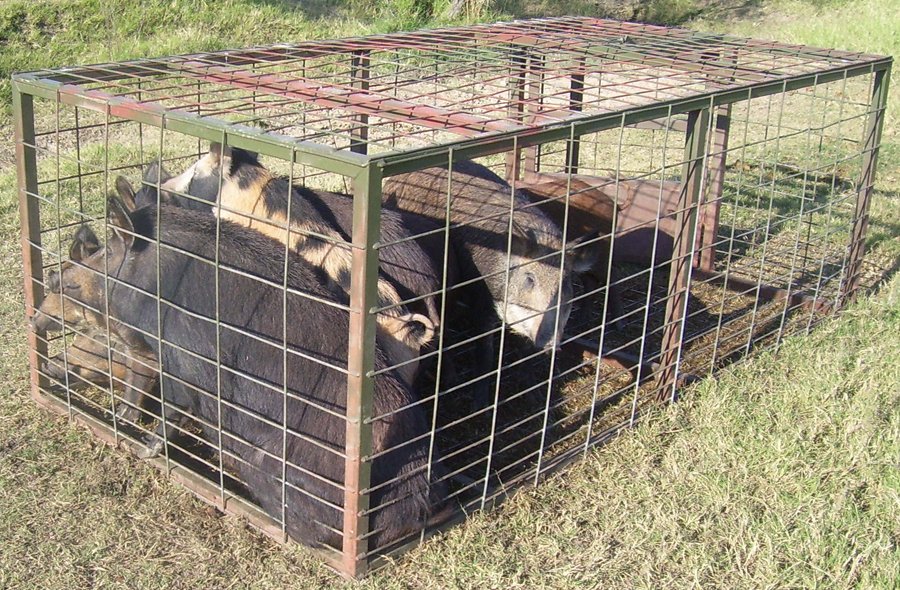
Boss Hawg’s traps weren’t designed at a desk. In the shop’s own words, the research and development “came about as the result of trapping of hogs that were destroying our property.” Then local ranchers, feeling the damage from large hog populations, began contracting with the shop to remove hogs from their land. After several years of hands-on work and testing different designs, the shop started building traps for other people. Our team in the US still works with these traps on real ranch ground, talks with the people who use them, reads what owners say about traps from different brands, and checks our designs against the extension-service guidance named on this page.
What makes a hog trap design work
A hog trap design works when the whole sounder walks in, the gate closes behind them, and nothing bends or opens when they spend last bit of enargy to break it. Size decides how many hogs you catch; steel and welds decide whether you keep them.
That gives you three tests for any design, whether you build it or buy it:
- Does it catch the group? A sounder is a family group of feral hogs, usually sows and their young. A trap too small for the group catches a few and educates the rest.
- Does the gate close every time? A gate that sticks, or needs resetting by hand after one hog, is doing half the job.
- Does it hold? A trapped hog pushes, roots and climbs. One weak joint is all it needs the hog to escape.
A trap is only as strong as its weakest joint. Hogs don’t attack the strong parts. They find the weak one, and once one hog finds it, the rest learn fast.
The main hog trap designs: box, corral and drop
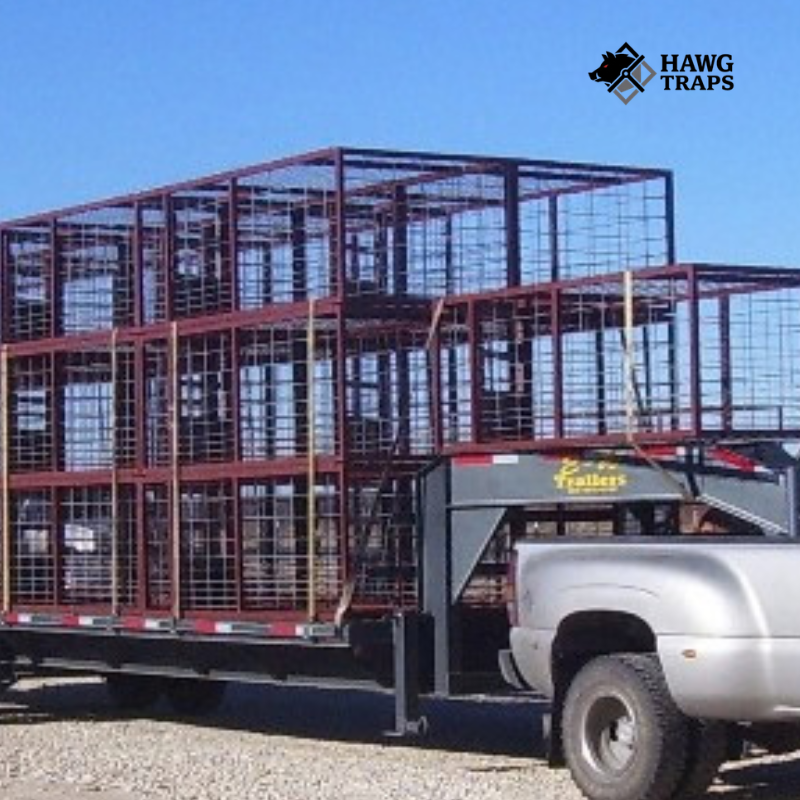
The three main hog trap designs are the box trap, which catches one or two adults; the corral trap, which can catch a whole sounder; and the drop trap, a raised pen that falls on the hogs.
| Design | Catches | Typical build (extension guidance) | Boss Hawg version |
|---|---|---|---|
| Box trap | One or two adult hogs | 4 × 8-foot cage, 3 to 4 feet tall, livestock panels on pipe or angle-iron frames, with a top | Standard hog trap: 4 × 8 × 3 ft, 14-ga tube frame, 6-ga welded wire |
| Corral trap | A whole sounder | 5-foot sheep and goat panels with 4 × 4-inch mesh on T-posts, teardrop shape | Big Pen corral hog trap and Pro Pen hog trap: welded steel panels |
| Drop trap | A group under a raised pen | Raised pen released from above | Built as a custom order |
Box traps catch a few hogs, corrals catch the sounder, and the steel decides whether either one can withstand.
Texas A&M AgriLife’s box trap publication describes “a common design” as a 4- by 8-foot heavy-duty cage, 3 to 4 feet tall, and notes these traps typically catch only one or two adult pigs. It also recommends a top, to keep hogs from crowding into the corners and climbing out. Mississippi State University calls corral traps “the most effective type of trap for catching large groups of pigs.”
For corrals, AgriLife’s design page is blunt about it: “Bigger is better!” A bigger pen lets hogs keep their distance from you as you approach, so they’re less likely to panic and hit the walls. It also says to “use small enough mesh to catch all hogs, even juveniles.”
So the first design choice is simple. Seeing one or two hogs? A box trap fits. Seeing a sounder? Build or buy a corral.
The frame: 1½-inch, 14-gauge braced square tubing
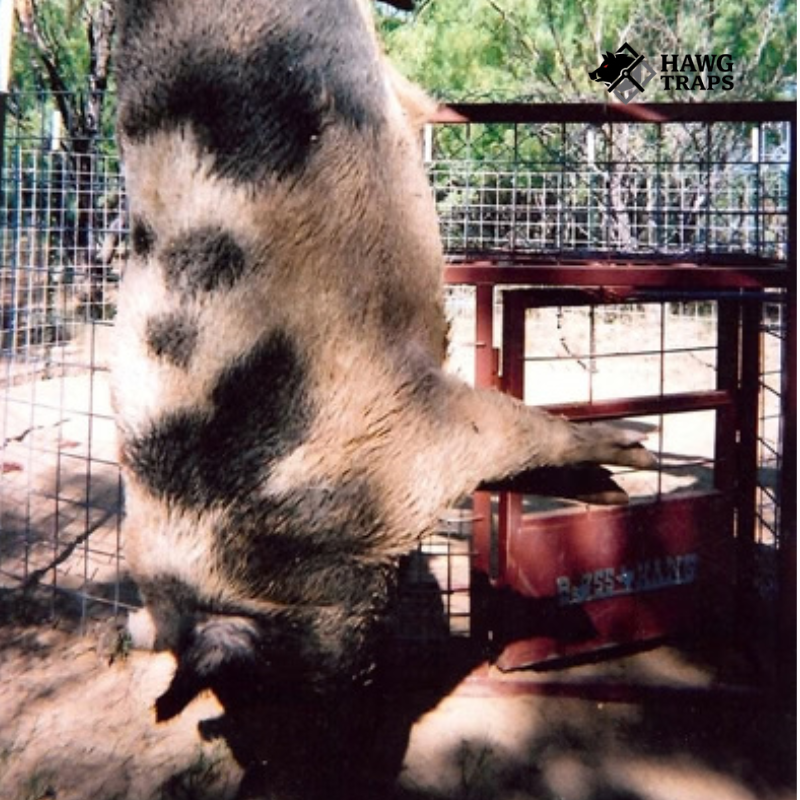
Every Boss Hawg trap frame is 1½-inch, 14-gauge square steel tubing with bracing throughout, because the frame takes the load when a penned sounder starts working the corners.
A quick word on gauge. With steel, a lower gauge number means thicker metal. It runs backwards, like golf scores. Fourteen-gauge tubing is heavier wall than many traps on the market use.
Many homemade box traps, AgriLife notes, are built from livestock panels with steel pipe or angle-iron frames, often from materials at hand. That can work. The difference is in how the frame handles a trapped hog that won’t quit. Square tubing gives flat faces to weld the wire to, and the bracing ties the corners together so they don’t rack when a hog hits one side and then the other.
| Part | Typical DIY plan | Boss Hawg build | Why |
|---|---|---|---|
| Frame | Pipe or angle iron, materials at hand | 1½-in, 14-ga square tubing, braced | Holds square when penned hogs work the corners |
| Wire | Livestock panels, often wired or clipped on | 6-ga wire, MIG welded to the frame | Welded wire can’t work loose |
| Finish | Often bare | Prime-coated tubing | Slows rust at the joints |
The plans tell you the shape; the build decides how long it lasts.
There’s a trade-off, and we’ll say it plainly: heavy steel is heavy. A Boss Hawg trap takes more muscle to move than a light one. That’s the price of a frame that stays straight.
The wire: 6-gauge panels, welded, not clipped
Boss Hawg traps use 6-gauge wire panels MIG welded directly to the frame, not clipped or wired on, because a fastened panel is the first thing to fail under sustained pressure.
MIG welding joins the wire to the steel frame with a continuous weld, so the wire and frame act as one piece. A clip or a twist of tie wire is a hinge waiting to happen. Every push from a hog works it a little looser, and a trapped sounder pushes all night.
Mesh size matters as much as wire thickness. AgriLife’s corral guidance calls for mesh “small enough … to catch all hogs, even juveniles,” and its corral design uses 4 × 4-inch openings for that reason. If small pigs are part of your problem, tell us. Custom wire sizes are something the shop has built before.
Gates, triggers and continuous loading
Boss Hawg gates are built for continuous loading: the trap keeps catching after the first hog is in, instead of needing a hand reset. The trip wire closes the gate when a hog roots for the bait.
Extension guidance describes three common box-trap gates: sliding drop gates, which a trip wire triggers to fall; lifting, top-hinged gates that a hog roots open; and spring-loaded swing gates that close behind a hog after it pushes in. Corral traps add saloon-style doors, which AgriLife describes with a 32- to 36-inch total opening.
Continuous loading is the part that separates a trap from a once-a-night trap. In the shop’s words, “a trap that catches once and then has to be reset by hand is doing half the job.” Our traps have been field tested for continuous loading, retention and durability. The shop’s old site even showed a “Continual Load” entrance chute built for a round pen.
The finish: prime coat for field life
All Boss Hawg trap tubing is prime coated, which keeps the joints from rusting after a few seasons sitting out in Texas weather.
A trap lives outdoors. Rain, dew, mud and the occasional hog wallow all work on the steel. Rust starts at the joints, where the welds are, and a rusted joint makes the trap weak. The prime coat is there so the trap you set this season is still sound next season.
Where our designs came from: field tested on Texas ranches
Boss Hawg’s designs came from trapping hogs that were destroying the shop’s own property, then removing hogs for local ranchers under contract, testing designs in the field for several years before selling traps.
That history explains nearly every choice on this page. When you’re the one getting called back to a ranch because the hogs got out, you stop building light. When you’re the one resetting a trap by hand every morning, you build for continuous loading. And when you’re the one loading hogs out, you want a loading ramp, which is the thinking behind the Pro Pen hog trap.
We’ll be straight about what “field tested” means here. It means the shop used and refined these designs on real ranches over several years.
Which Boss Hawg design fits your ground
For one or two hogs, the Standard box trap fits; for a whole sounder, the Big Pen corral; to catch and load out with one system, the Pro Pen. Anything else, the shop builds custom.
- Standard hog trap: 4 × 8 × 3 feet, fits a pickup bed, trip wire and swing gate. Best when you’re chasing a few hogs around a big place.
- Big Pen corral hog trap: welded panels sized to your site. Best when a sounder keeps coming back to one area.
- Pro Pen hog trap: the pen plus a loading ramp and panel gates. Best when you want to catch and load out with one system.
- Custom hog traps: for ground or hogs the standard models don’t fit, including drop traps.
Every model is built from the same steel, and you can compare them side by side on our hog traps for sale page. We ship anywhere in the US, with freight paid by the buyer and quoted to your ZIP code.
REQUEST A QUOTE: CALL (254) 725-4554
Tell us your ground and how many hogs you’re seeing. We’ll tell you which design fits.
Also check our partner products that go with a hog trap: – Cellular trail cameras to watch the trap from your phone – Hog attractants and bait – Tripod game feeders for pre-baiting
As an Amazon Associate we earn from qualifying purchases. Partner products are listed separately from our own and never replace them.
Frequently asked questions
What gauge wire should a hog trap have?
Heavier is better, and a lower gauge number means thicker wire. Boss Hawg uses 6-gauge wire, MIG welded to a 14-gauge square tube frame.
Does a hog trap need a top?
For box traps, Texas A&M AgriLife recommends a top to keep hogs from crowding the corners and climbing out.
What does “field tested” mean for Boss Hawg traps?
The shop used and refined its designs for several years while trapping hogs on its own land and for local ranchers. It isn’t a lab test.
Can I build my own hog trap?
Yes, you can. Texas A&M AgriLife publishes box and corral trap designs. Buying a built trap saves the time and gets you welded steel.
Does Boss Hawg build anything besides hog traps?
Yes. The same shop builds steel cattle guards to order.