
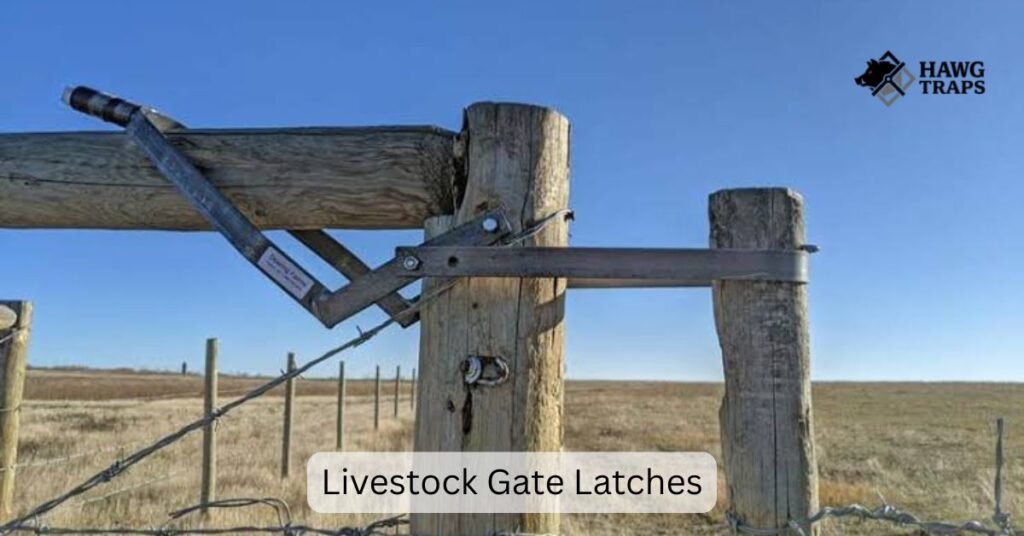
The farm-store tube gates we read up on all come with the same latch: a short chain and a snap.
It works. Loop the chain around the post, clip the snap shut, and the gate stays closed. But it takes two hands and a few seconds, and you rarely have both hands free when you need them. A bucket in one hand and a calf on your heels, so you flip the chain over the post “just for now.” That’s the gate that’s open in the morning.
A good livestock gate latch shuts the gate for you. This page covers five latch types, the two measurements that determine fit, and seven real latches with prices, pros, cons, and the worst review we found for each.
We’re a steel shop. We build cattle guards, H-posts and hog traps, and we don’t make or sell gate latches. Some links are affiliate links, and as an Amazon Associate we earn from qualifying purchases.
Key Takeaways
- Measure two things before you buy: your gate’s tube size and the gap between gate and post. Latches for the same 2-inch tube need gaps from 1 inch to 2 3/4 inches.
- Two-way or one-way: a two-way latch catches the gate whichever way it swings. Buy one-way only for a gate that swings one way.
- Kentucky’s extension guide calls a self-latching gate “ideal.” A chain isn’t self-latching.
- The best-reviewed latches here: Tarter’s two-way, 4.7 stars from 161 reviews at $49.99, and CountyLine’s two-way, 4.7 from 307 at $34.99.
- Keep the chain. Owners add a chain or snap as a backup where stock rub a gate.
- Riding through? Two latches here are sold as opening from horseback.
- The gate you open most might not need a latch at all. A cattle guard has none. That’s our product, so weigh our view accordingly.
Why Trust Us: How We Picked These Latches
Boss Hawg is a steel shop in Cross Plains, Texas. We build the H-posts that support ranch gates and their latches, as well as the cattle guards installed beside them. Our team builds a ranch fence and talks with the ranchers who use it.
We have not bench-tested these latches. We read each maker’s or seller’s listing, the public reviews and one long owners’ forum thread on 12 and 13 October 2026.
How a latch made this page: it’s built for round-tube livestock gates, its listing gives the tube size it fits, and you can buy it from a farm store, a farm supplier or the maker. We left our pool, garden and wooden-gate latches.
We don’t give these latches a score. Most have fewer than ten reviews, and a score built on five reviews would look precise and mean nothing. Instead, every pick shows its pros, its cons, its worst public review and the gate it suits best.
We sell no latch, and our editorial policy and affiliate disclosure explains how we handle those links.
What a livestock gate latch is, and what its parts are called
A livestock gate latch is the catch that holds a ranch gate shut against its post. Most have two parts: a latch body mounted on the post and a strike, also called a keeper, mounted on the gate tube.
You’ll see the same few words on every listing, so here is the list:
- Latch body: the part that bolts to the post and grabs the gate.
- Strike (or keeper, or catch): the piece on the gate that the latch grabs.
- Shims: spacers that let one latch fit a smaller tube.
- Gap: the space between the gate’s end and the post. It matters more than most people think.
- Lockable: a hole for a padlock.
Farm gate latch, cattle gate latch and livestock gate latch all mean the same thing. They’re all for steel tube gates like the ones on our page about heavy-duty cattle gates.
Types of livestock gate latches
Livestock gate latches come in five main types: the chain, the two-way gravity latch, the one-way latch, the slam latch and the drop rod for a pair of gates. Kentucky’s extension guide calls a self-latching gate ideal.
| Type | How it works | Hands | Shuts itself? | Best for | The catch |
|---|---|---|---|---|---|
| Chain and snap | A chain loops around the post and clips back | Two | No | Backup, or a gate you rarely open | Easy to leave unclipped |
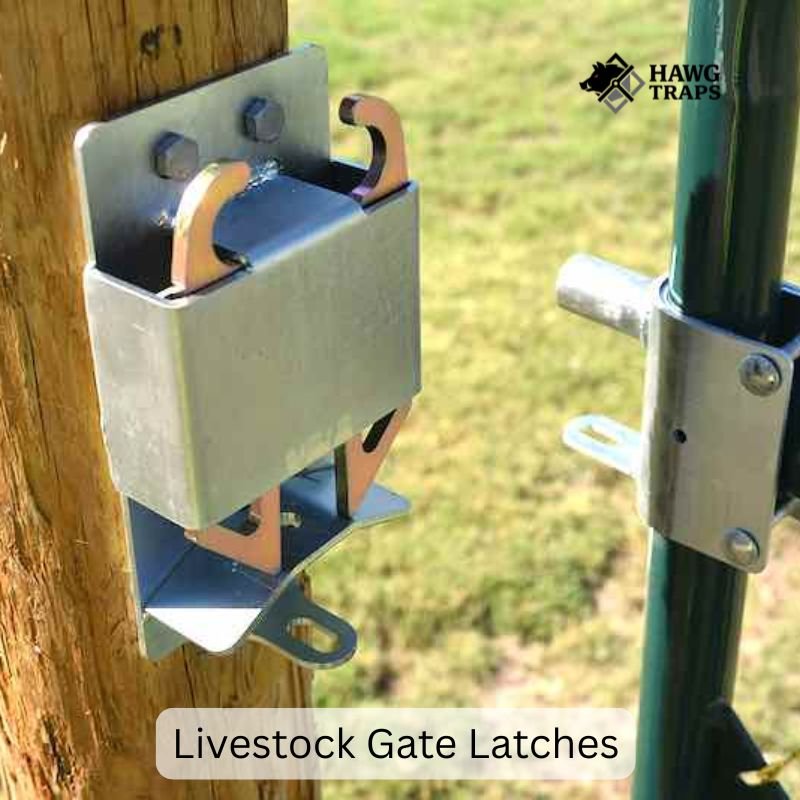
| Two-way gravity latch | The gate pushes a catch up; it drops back and holds | One | Yes | Pasture gates that swing both ways | Needs the right gap |
| One-way latch | Same idea, catches from one side only | One | Yes | Gates that only swing one way | Not double-acting |
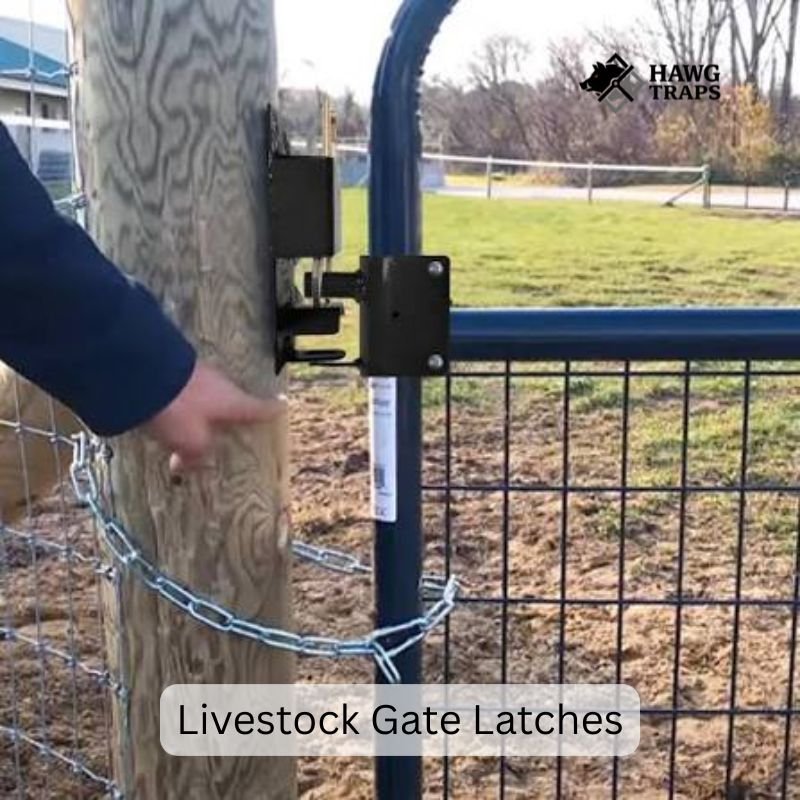
| Slam latch | A spring bolt snaps into a plate when the gate is pushed shut | One, or a knee | Yes | Pens and alleys where cattle push | Light-duty ones aren’t for big stock |
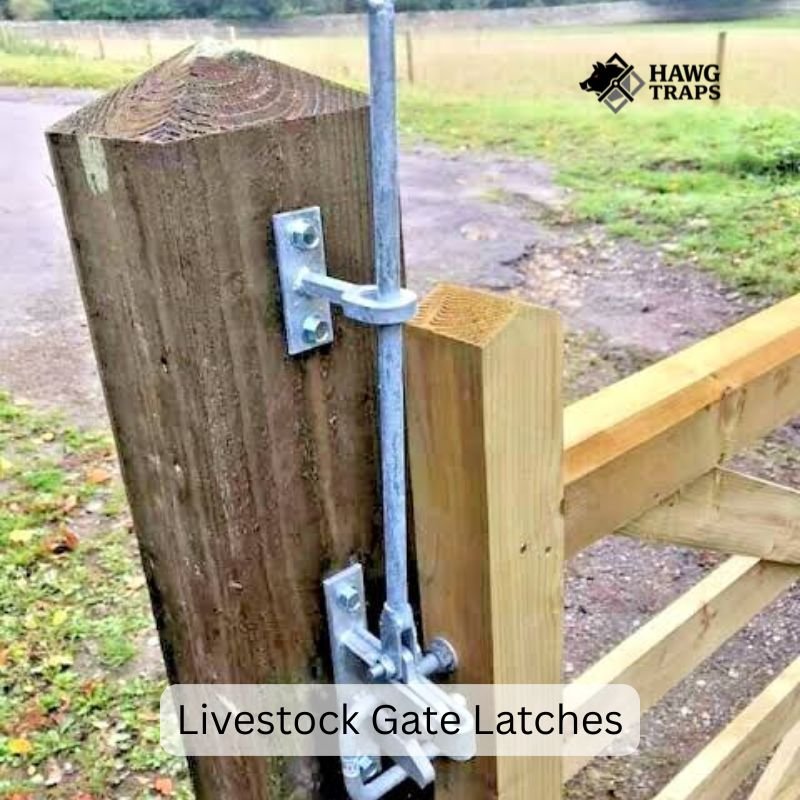
| Drop rod or drop-over catch | A rod drops into the ground, or a catch drops over the second gate | One | No | A pair of gates meeting in the middle | Won’t latch a single gate to a post |
The chain comes with the gate; the other latch types offer automatic closure or a more secure way to hold the gate shut.
The chain comes with the gate. The farm-store tube gates we read ship with “welded chain latch, snap chain,” so you already own one.
A gravity latch uses the gate’s own swing. Central Valley Gates, a gate company, describes gravity latches as “simple, self-latching mechanisms that use weight and motion to lock automatically.”
A slam latch uses a spring. The same writers say slam latches “lock the gate shut automatically when the gate is pushed closed.”
For a pair of gates, the University of Kentucky extension guide says “Ideally, a drop-over catch should be installed to secure a pair of opposing gates.” A drop-over catch drops over the meeting ends to hold the two gates together.
One-way or two-way?
Buy a two-way latch if the gate swings both ways, and a one-way latch if it only ever swings one way. A two-way latch catches the gate from either side, so stock and trucks can push through in both directions.
A pasture gate you walk and drive through from both sides requires a two-way latch.
One-way latches suit gates that must swing in only one direction, such as gates beside a fence line or building. HardwareSource’s one-way latch spells it out: it works on “either in-swinging or out-swinging gates (one way only, not double acting).”
There’s a trade-off with two-way latches. Central Valley Gates’ article says a two-way latch “requires precise installation to function correctly.” A horse owner on a long forum thread said the same: it needs careful fitting and the odd adjustment.
Will it fit? Measure the tube and the gap first
A latch must match two measurements: the diameter of the gate’s round tube and the gap between the closed gate and its post. Most latches here fit 1 5/8- to 2-inch tube, but their gaps run from 1 inch to 2 3/4 inches.
Grab a tape. Measure across the gate’s end tube, and measure the space between the gate and the post with the gate shut.
| Latch | Round tube | Gate gap | Post bolts in the box? |
|---|---|---|---|
| Tarter 2-Way Heavy-Duty | 1 5/8 to 2 in | Not listed; latch sits 3 in deep | Listing says hardware included |
| CountyLine 2-Way Lockable | 1 5/8 to 2 in | 1 to 1 5/8 in; shims to 2 in | No |
| AGRALINK 2-Way Lockable | 1 5/8 to 2 in | Not listed | Listing says hardware included |
| Co-Line Sure-Latch 2-Way | 1.625 to 2 in | Not listed | No |
| HardwareSource two-way (962030) | 1 5/8 or 2 in | 2 to 2 3/4 in | No |
| HardwareSource two-way (962005) | 1 1/4 to 1 1/2 in | 1 1/2 to 2 1/8 in | No |
| HardwareSource one-way (962035) | 1 5/8 or 2 in | Not listed | No |
Same tube, different gap: measure before you order.
The gate-gap measurement is the one buyers are most likely to overlook. CountyLine’s latch wants 1 to 1 5/8 inches. A Tractor Supply answer says shims help up to 2 inches, and a 4-inch gap is “likely too large.” HardwareSource’s latch for the same tube wants 2 to 2 3/4 inches. Order the wrong one and it won’t catch.
The best livestock gate latches, compared
Six livestock gate latches suited to ranch tube gates were listed from $24.99 to $150 in October 2026. The two-way latches cost $24.99 to $49.99; the seventh option, the chain, comes with your gate.
| Latch | Type | Lockable | Price, Oct 2026 | Public rating | Made in USA |
|---|---|---|---|---|---|
| Tarter 2-Way Heavy-Duty | Two-way | Yes | $49.99 | 4.7 of 5 (161) | Not stated |
| CountyLine 2-Way Lockable | Two-way | Yes | $34.99 | 4.7 of 5 (307) | Not stated |
| AGRALINK 2-Way Lockable | Two-way | Yes | $24.99 | 4.2 of 5 (5) | Not stated |
| Co-Line Sure-Latch 2-Way | Two-way | Yes | $29.99 | 7 reviews, all 5 stars | Yes |
| HardwareSource two-way | Two-way gravity | Yes | $37.48 | No reviews | Yes |
| Ulrich Heavy-Duty Slam Latch | Slam | Not stated | $150 | No reviews | Maker in North Dakota |
| Chain and snap | Chain | With a padlock | Ships with the gate | — | — |
The two best-reviewed latches cost $34.99 and $49.99; the cheapest has five reviews.
By our arithmetic, Tarter’s latch costs $15 more than CountyLine’s and $25 more than AGRALINK’s. Both Tarter and CountyLine hold 4.7 stars. CountyLine has nearly twice the reviews.
Livestock gate latch reviews: pros, cons and who each suits
Tarter 2-Way Heavy-Duty Lockable: best for most pasture tube gates
A 5-pound two-way latch with 161 reviews behind it.
- Pros: fits 1 5/8- to 2-inch round tube. Takes a padlock. 4.7 stars from 161 reviews, with 91% recommending it. One owner: “Easy to install, solid and sturdy, so much easier than using the chain.” $49.99 at Tractor Supply.
- Cons: the dearest two-way here. On a wood post it needs at least 4 1/2 inches of flat face. The listing says hardware is included, but its review summary says some buyers found it wasn’t there.
- Worst review we could read: the one-star reviews weren’t visible on the page.
CountyLine 2-Way Lockable: For best value
CountyLine matches Tarter’s 4.7-star rating, has nearly twice as many reviews, and costs $15 less.
- Pros: 307 reviews, 93% recommend. Fits 1 5/8- to 2-inch tube, with shims in the box. “Worked perfectly so I bought 3!” $34.99 at Tractor Supply.
- Cons: wants a tight gap, 1 to 1 5/8 inches. No post bolts in the box; owners suggest 1/4 x 3-inch lag bolts for a wood post.
- Worst review we found: “The bolts are too short for the matching gate I purchased also.”
AGRALINK 2-Way Lockable: cheapest two-way
A galvanized two-way latch for under $25, with very few reviews behind it.
- Pros: $24.99 at Tractor Supply, and $26.99 at Farm & Fleet. Galvanized. Fits 1 5/8- to 2-inch tube. Takes a padlock.
- Cons: five reviews, 4.2 stars. No gap was listed.
- Worst review we found: “Did not come complete with hardware.”
Co-Line Sure-Latch 2-Way: best for horse owners
A two-way latch horse owners on one forum report using for years, made in the USA and sold as opening from horseback.
- Pros: fits 1.625- to 2-inch tube. One-handed, and Jeffers says it opens from horseback. “Proudly made in the USA!” $29.99 at Jeffers. On a horse forum, one owner wrote: “They work as intended & it’s really nice to not fiddle with snaps in and out of the field.”
- Cons: post hardware not included. Seven reviews. Owners say it needs careful fitting and the odd adjustment.
- The worst review we found: “Good price, but with shipping added you can get it at a local fencing store for the same price.”
HardwareSource Two-Way Livestock Gate Latch: best for a wide gap
The only latch here listed for a 2- to 2 3/4-inch gap, and made in the USA.
- Pros: a gravity latch for 1 5/8- or 2-inch tube. The listing says it “latches automatically and can be unlatched with one hand and from horseback.” Shims and gate bolts included. $37.48 from HardwareSource. A smaller version fits 1 1/4- to 1 1/2-inch tube for $28.92.
- Cons: no reviews yet. You buy the 3/8-inch lag screws for the post.
- Worst review we found: none; there are no reviews.
Ulrich Heavy-Duty Slam Latch: best for pens and alleys
A slam latch from a North Dakota maker, for long gates where cattle push.
- Pros: the maker builds it for “10 to 20 foot high-traffic or high-pressure gates,” with a 37 1/2-inch pull rod. It says the heavy-duty bolt “always stops at the plate.” $150 from Ulrich Manufacturing.
- Cons: sold by request only, and out of stock when we looked. Not painted or primed. The maker says the $50 lite-duty version is for 3-foot gates, not large livestock.
- Worst review we found: none on the page.
The chain and snap: best as a backup
The latch you already own.
- Pros: free with the gate. Takes a padlock. Some horse owners keep one as a backup after fitting a latch.
- Cons: two hands, and easy to leave undone. Buy a better one and check the chain: one buyer of a 12-inch chain latch wrote, “The slightest bump to the gate and the chain breaks.”
Which latch for which gate?
For a pasture tube gate, fit a two-way lockable latch and keep the chain as a backup. Use a slam latch on pens and alleys, a drop rod on a pair of gates, and a horseback-rated latch where you ride through.
Quick picks:
- A 12- to 16-foot pasture gate on 2-inch tube: CountyLine 2-Way, if your gap is tight; Tarter 2-Way, the other 4.7-star pick.
- A gap over 2 inches: HardwareSource’s two-way.
- You ride through it: Co-Line Sure-Latch or HardwareSource’s two-way.
- A crowding pen or alley: a heavy-duty slam latch.
- Two gates meet in the middle: a drop rod or drop-over catch, as Kentucky’s guide suggests, with a latch where they meet.
- A gate swung by an opener: see our page on solar gate openers.
For the rest of your fencing kit, see our page of ranch tools and trapping gear.
Or get rid of the gate
Here’s our bias, said plainly: we build cattle guards.
A cattle guard is a grid of steel rails set across a road opening in a fence, so vehicles can drive through while cattle will not walk across it. No latch to fail, no chain to forget, no gate to leave open. Ours are welded from 2 7/8-inch pipe on 8-inch channel iron in Cross Plains, Texas, and shipped anywhere in the USA. Our cattle guards for sale page has the details.
Many ranches keep a cattle guard gate beside the guard for moving stock. That gate still needs a latch, so the advice above still applies.
REQUEST A QUOTE: CALL (254) 725-4554
Tell us the road width and what crosses it. We’ll quote the guard that fits, delivered. Need a post to hang the gate and latch on? Ask about our H-posts too.
Also check our partner products for latching a ranch gate: – Two-way lockable gate latches and heavy-duty farm gate latches – Slam latches for livestock gates – Gate chains with bolt snaps – Gate drop rods and anchors for a pair of gates – Weatherproof padlocks and 3/8-inch lag screws
As an Amazon Associate we earn from qualifying purchases. Partner products are listed separately from our own and never replace them.
How to fit a latch on a metal tube gate?
Hang and level the gate first, then fit the latch. The latch body bolts to the post, the strike bolts to the gate tube, and shims take up a smaller tube. Most kits leave the post bolts out.
Follow the instructions in your latch’s box. Here’s the order the listings above describe:
- Hang the gate right. Kentucky’s guide says a well-aligned gate “should swing closed gently and smoothly… and… latch itself securely.” If yours drags or drops, fix that first. Our page on heavy-duty cattle gates covers hanging.
- Check the post. A latch is only as steady as the post it’s bolted to. A leaning post opens the gap. Our page on H posts and H braces covers a post that stays put.
- Measure the gap against your latch’s range (see the fit table).
- Bolt the strike to the gate tube with the carriage bolts in the box. Add shims on 1 5/8-inch tube.
- Bolt the latch body to the post. HardwareSource’s latch takes 3/8-inch lag screws on a wood post. Tarter’s needs 4 1/2 inches of flat face on wood, or it can go on a round steel post.
- Swing the gate shut from both sides and watch it catch. Adjust before you tighten everything down.
Keep a hand on the gate while you work, and stay out of its swing. A 16-foot tube gate can weigh 136 pounds.
Why a gate latch keeps opening, rattles or fails?
A latch that keeps releasing often points to a problem with the gate itself: it may be sagging, flexing, or sitting too far from the post. Re-level the gate at the top hinge, shim or reset the latch, and add a chain or snap where stock rub it.
Here’s what owners and listings describe:
- The gate flexes out of the latch. One horse owner: “When the gate flexes the round projection on the gate itself pops back out of the latch on the post.” A sagging gate drops the strike below the catch. Check whether your top hinge adjusts; one Tarter gate listing at Lowe’s says “Bottom hinge fixed, top hinge is adjustable.”
- The gap is wrong. Too wide and the strike misses. Use shims, move the latch, or buy one made for your gap.
- It rattles. Often loose bolts or a gap at the top of its range. Tighten and shim. That’s our judgement, not a rule.
- The bolts are too short. Two CountyLine buyers said so. Buy longer ones before you start.
- Stock rub it open. A horse owner suggests adding a snap or lock at the bottom of the gate where horses rub.
- A slam latch sticks. Spring Creek’s slam latch has a grease fitting. Grease it.
One safety note from the same forum: “Any latch that has sharper metal pieces sticking out where horses may go through is an accident waiting to happen.” Fit the latch so no sharp edge faces where stock passes.
Frequently asked questions
What is the best latch for a livestock gate?
For most round-tube pasture gates, a two-way lockable latch. Tarter’s and CountyLine’s both hold 4.7 stars, from 161 and 307 reviews. Check the tube size and gap first.
What is a gravity gate latch?
A gravity latch uses the gate’s swing and the catch’s own weight to lock. In the usual design, the gate pushes the catch up, it drops back down, and the gate is held, with no spring.
How does a slam latch work?
A spring keeps the latch closed. An angled pin lets the gate push past as you slam it shut, then the spring snaps it back to hold. Ulrich says its heavy-duty bolt “always stops at the plate.”
What is the best lock for a farm gate?
A padlock on a latch built to take one. Every two-way latch on this page is listed as lockable. Tractor Supply’s guide suggests “a latch that can accept a chain or padlock.”
What is a self-latching gate?
A gate that latches itself when it swings shut, with a gravity or slam latch. Kentucky’s extension guide calls a self-latching gate ideal.
How high should a gate latch be?
We found no published rule for livestock gates. Our judgement: put it where you can reach it from where you’ll open it, on foot, from the saddle or from the truck, and on a tube the latch fits.
Can a horse open a gate latch?
Owners on one horse forum worried more about horses rubbing a gate loose. Best Gate Latch, a Texas maker, says its latch “can’t be opened by horses or other livestock.” That’s the maker’s claim. Horse owners add a snap at the bottom as backup.
What is a cowboy gate?
A wire gate. One ranch blog puts it as “Wire gates, also known as gap gates, Texas gates, or cowboy gates.” It closes with wire loops around the post, not a latch.
Before you buy
Go back to that chain and snap. It’s not wrong. It’s just easy to leave undone.
So measure the tube and the gap tonight. Pick the latch that fits both. Keep the chain on the gate as a backup. If you open the same gate twenty times a day, consider whether a cattle guard could eliminate the need to open it at all.