

The gate worked fine. You pull up at first light, coffee still too hot to drink, and there they are. Fourteen hogs in the pen, every one of them looking at you like this is your fault. For about four minutes you feel like the smartest person in the county.
Then the real question appears. How do fourteen angry hogs get r from that pen to somewhere else? They won’t walk to a trailer because you asked nicely.
That’s what this page is for. “Hog trap trailer” turns out to mean three different things: a trap built on wheels, a trailer that carries your trap, and a trailer that carries the hogs. We’ll sort out all, walk through loading step by step, cover the Texas rules, and help you pick the setup that fits your place.
Key Takeaways
- “Hog trap trailer” covers three things: a trap on wheels, a trailer for the trap, and a trailer for the hogs.
- A 4 × 8 box trap fits a full-size pickup bed. For that trap, you don’t need a trailer at all.
- Texas A&M AgriLife’s loading method is simple: back the trailer to the gate, block the gap underneath, and walk wide around the back.
- The Texas Animal Health Commission lets trapped hogs be held in an escape-proof cage or trailer for up to seven days.
- Load early. AgriLife warns that hogs left in an unshaded trap can die by late afternoon in Texas summer heat.
- The Boss Hawg Pro Pen comes with a loading ramp and panel gates, so the loading plan arrives with the pen.
Why Trust Us: How We Put This Together
Boss Hawg didn’t start out selling traps. The shop started out trapping hogs that were destroying its own property. Then local ranchers began contracting with the shop to remove hogs from their land. The traps we build came out of those years of hands-on work.
Our team in the US works with these traps on real ranch ground. We talk with the landowners and trappers who use them, and we read what owners say about traps and trailers from different brands. For this page we also studied what Texas A&M AgriLife and the Texas Animal Health Commission publish on loading and hauling feral hogs. Outside facts are named with their source.
What a hog trap trailer is: three jobs, one name
A hog trap trailer is one of three things: a hog trap built on wheels, a trailer that hauls a trap to the site, or an escape-proof trailer that hauls caught hogs away. Each does a different job.
People use the same three words for all of them, which is why buying one gets confusing fast. Two neighbors can both say “I need a hog trap trailer” and want completely different things. One wants a trap he can tow. The other already has a pen full of hogs and wants them gone.
| What people mean | What it is | Who needs it |
|---|---|---|
| A trap on wheels | A box-style trap built on its own axle | Trappers working several scattered sites |
| A trailer for the trap | A flatbed or utility trailer that carries a trap or its panels | Anyone whose trap won’t fit in a pickup bed |
| A trailer for the hogs | An escape-proof trailer or cage that carries live hogs off the property | Anyone hauling caught hogs to a buyer |
Most trappers need only one of the three, and some need none.
Whichever one you’re after, it starts with the trap. You can compare ours on the hog traps for sale page. The rest of this guide takes the three jobs one at a time.
Hog traps on wheels: how a trailer-mounted trap works
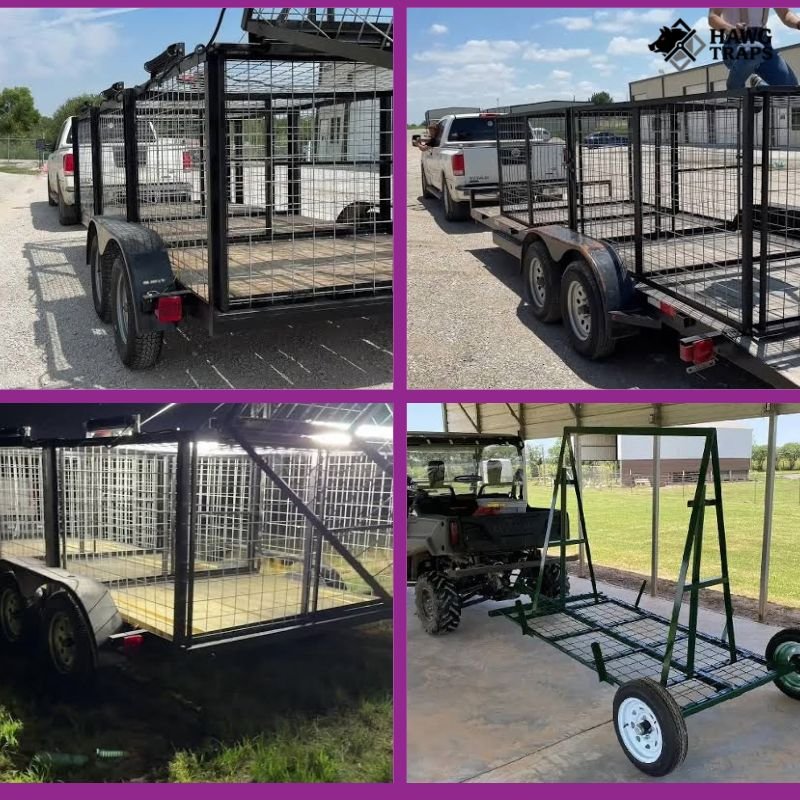
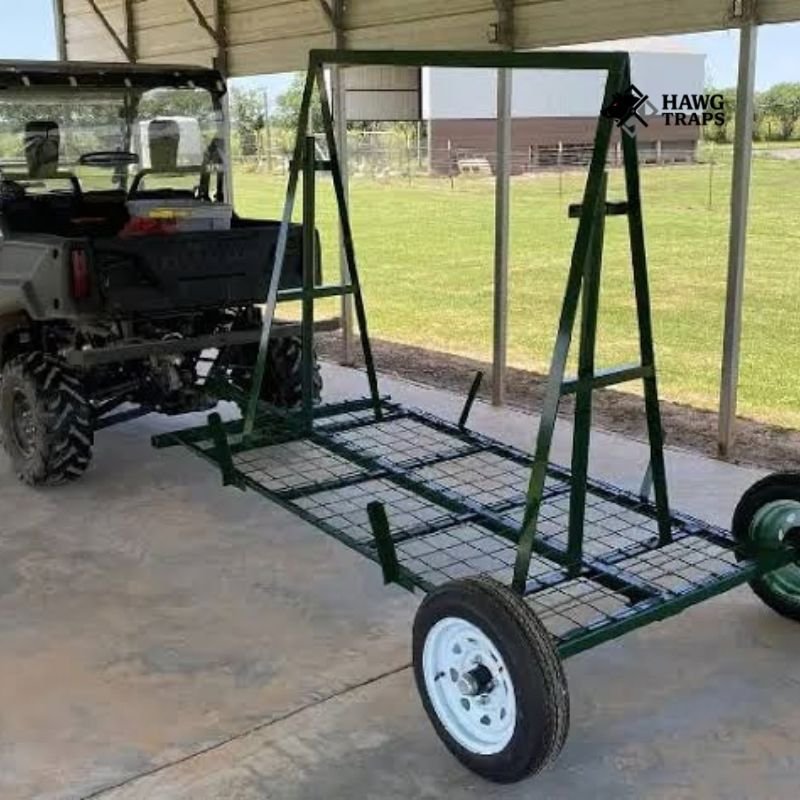
A trailer-mounted hog trap is a box-style trap on its own axle: you tow it in, lower it to the ground, bait it and tow the catch out. It moves fast but holds fewer hogs than a corral.
The idea is hard not to like. No unloading, no assembly, no second trip. You back it in, drop it and bait it.
FARM SHOW magazine has covered a couple of these over the years. One came from a welding shop in Cherokee, Oklahoma. In the magazine’s words, the trap “trailers into place, drops to the ground.” It came in 6 × 12-foot and 8 × 20-foot sizes, with 4-foot sides and a winch to raise and lower it. A San Antonio feeder company sold a smaller one. You cranked the pen down to trap, then cranked it up and it was ready for the road.
Here’s the honest part. Trailer traps are hard to find on a shelf today. When we checked in October 2026, that Oklahoma maker’s website listed portable cattle corrals and no hog trap. The ones we’ve read about were built by their owners or by small welding shops.
The bigger trade-off is size. Texas A&M AgriLife says a corral trap should be at least about 20 by 30 feet, and adds: “Bigger is better!” A 20 × 30 rectangle is 600 square feet. An 8 × 20 trailer trap is 160. AgriLife’s reason is simple. Larger traps give you a better chance to catch the most hogs at one time, while small traps hold only a few.
A sounder is a family group of feral hogs, usually sows and their young. If a whole sounder is tearing up one pasture, a trap on wheels will catch part of it and teach the rest. If you’re chasing small groups across several places, it’s the quickest tool there is.
Hauling a hog trap to the site
Hauling a hog trap depends on its size: a 4 × 8-foot box trap rides in a full-size pickup bed or on a small trailer, while corral panels come apart and travel flat on a flatbed trailer.
Start with the easy one. Texas A&M AgriLife lists it as a main advantage of box traps: they “easily fit in the bed of a pickup truck or on a small trailer.” Our Standard hog trap is 4 × 8 × 3 feet for exactly that reason. It fits a full-size pickup bed, and one person can load it, haul it and set it. Strap it down like you mean it. A steel trap sliding around a truck bed makes a noise you only want to hear once.
Corral traps are a different job. AgriLife’s trap design page says a panel corral is “still portable,” because the entire trap can be taken apart and “moved to another area on a flatbed trailer.” Its corral trap publication is less cheerful: “Corral traps are not easily disassembled and moved.” Both are true. The panels do come apart and ride flat. It’s also real work, and it goes better with a helper.
The Big Pen corral hog trap is panel built for this reason. When the hogs shift ground, the pen can follow them.
What a trailer needs to haul live hogs
In Texas, a trailer for live feral hogs must be escape-proof, the word the Texas Animal Health Commission uses. One Texas trapper’s home-built hog trailer has 4-foot screened sides and a wire cover so hogs can’t jump out.
The Commission’s rule talks about an “escape-proof cage on the vehicle or trailer.” It doesn’t hand you a blueprint, and we won’t invent one. What we can do is show you a trailer that a real trapper built for the job.
FARM SHOW magazine wrote up Harry Stracener of Buda, Texas. He was 81, he’d built his own corral trap, and he needed an easy way to move the hogs. So he built what he called a “transfer trailer.” A transfer trailer is a small trailer made only to carry hogs away from the pen. His is a two-wheeled, 6 × 8-foot trailer with:
- 4-foot sides made from heavy-duty gravel screen.
- A wire netting cover over the top, so hogs can’t jump over the sides.
- A loading ramp on the back, raised and lowered with a hand winch. It folds back on top of the trailer when it isn’t in use.
He backs up to a gate on the pen and cranks the ramp down to the ground. That’s one man’s design, not a standard. It does show the three things worth copying: sides, a top and a ramp.
How tall is tall enough? AgriLife’s corral design uses panels 5 feet high. It also warns that hogs pile into hard corners and “may go over the top.” That’s why the top on Mr. Stracener’s trailer matters as much as the sides. And remember AgriLife’s rule for traps, because it applies to trailers too: anything a hog can get its snout under, through or between is an opportunity for escape.
How to load hogs from a trap into a trailer
Loading hogs from a trap takes four moves: back the trailer to the gate, block the gap under it, open the gate, then walk wide around the back of the pen. Hogs move away from you and into the trailer.
That method comes from Texas A&M AgriLife, and it works because of one fact about hogs. They want to get away from you. Loading is just a matter of making the trailer the only place left to go.
Before you start, two things:
- Think about loading when you set the pen. AgriLife’s corral design is a teardrop with the gate at the narrow end. Its corral publication says that narrow end “also serves as a chute for loading the hogs into a trailer.”
- Load in the cool of the morning. In AgriLife’s own field demonstration, the team wrote that hogs left in an unshaded trap “will die by late afternoon in the Texas summer heat.”
Then the four moves:
- Back the trailer up to the trap gate. Get it as tight to the opening as you can.
- Block the gap underneath. AgriLife says to place a cross tie across the gate opening so hogs can’t go under the trailer. In its demonstration, the team called it “the all important board.”
- Open the gate and secure it. A gate that swings shut halfway through undoes everything.
- Circle wide around to the back of the pen. AgriLife again: “The hogs will move away from you and funnel toward the trailer.”
In that demonstration, twelve hogs loaded this way. AgriLife noted that only one person was needed to work the trailer gate once the hogs loaded themselves.
Where does a ramp come in? When the trailer floor sits well above the ground, hogs need a way up, and that’s the job of a loading ramp. A loading ramp is a sloped walkway from the ground to the trailer floor. The Pro Pen hog trap comes with one excatly this reason.
How steep can it be? For farm-raised market hogs, The Pig Site reports that recommended practice is a ramp angle under 20 degrees, with cleats and a non-slip surface. Nobody has published the same numbers for feral hogs, so treat that as a sensible starting point and not a rule.
Three mistakes that turn loading into a long morning:
- Leaving a gap under the trailer. A hog will find it before you do.
- Walking straight at them. AgriLife says hogs need room to move away from you so they don’t panic. Go wide and go slow.
- Waiting until afternoon. Heat is hard on trapped hogs, and on you.
A sorting board helps too. It’s a flat panel you carry to block the way you don’t want a hog to go. Farmers use them to move domestic pigs, and the idea is the same here.
Texas rules for hauling live feral hogs
In Texas, trapped feral hogs may be held in an escape-proof cage on the vehicle or trailer for up to seven days, and may go only to approved destinations such as a recognized slaughter facility or an approved holding facility.
That comes from the Texas Animal Health Commission, which regulates moving live feral swine. Its reason: “Feral swine carry diseases that pose a direct threat to domestic swine, cattle, humans, and other animal species.” (TAHC Program Reference, revised May 2022, read 3 October 2026.)
| Sows and gilts | Boars and barrows | |
|---|---|---|
| Held in an escape-proof cage or trailer | Up to 7 days | Up to 7 days |
| Recognized slaughter facility | Yes | Yes |
| Approved holding facility | Yes | Yes |
| Authorized hunting preserve | No | Yes |
| Released on other land | No | Only on an authorized preserve |
In Texas, the trailer is a waiting room with a seven-day limit, and only boars may go on to a hunting preserve.
An approved holding facility is a pen the Commission has approved to hold feral hogs for a short time. Most people call it a buying station. The Commission publishes a list of approved holding facilities by county.
Two more points. The Commission says penalties for breaking these rules can reach $5,000 a day. And Texas A&M AgriLife puts the main rule in five words: “Do not release trapped hogs.”
This is a summary, not legal advice. Rules change; check the Texas Animal Health Commission before you haul. Other states set their own rules, so check with your state’s animal health agency.
Trailer trap, box trap or pen with a ramp: which setup fits
Choose by hog count: a box trap in a pickup for small number usually, one or two hogs, a trailer trap for small groups on scattered sites, and a pen with a loading ramp for whole sounders you plan to haul.
Start with what your trail camera shows, not with what looks handy on a trailer.
| Box trap in a pickup | Trap on wheels | Pen with a loading ramp | |
|---|---|---|---|
| Catches | One or two adult hogs | A few hogs to a small group | A whole sounder |
| Moves by | Pickup bed | Tow hitch | Panels on a flatbed |
| Loading out | May ride in the trap, if it’s fully enclosed | The trap is the trailer | Ramp to a separate trailer |
| Who builds it | Boss Hawg Standard | Custom or home-built | Boss Hawg Pro Pen |
| Weak point | Small catch | Small catch for the money | Takes time to set up |
The trailer trap wins on speed, the pen with a ramp wins on numbers, and the pickup-bed trap wins on cost.
The numbers behind the first row come from Texas A&M AgriLife. Its box trap publication says these traps “may catch only one or two adult pigs.” Its corral publication says a large corral trap can capture an entire sounder.
So here’s the part a trailer salesman won’t tell you. You may not need a trailer trap at all. If you see one or two hogs, a box trap in the truck bed is cheaper and does the job. If you see a sounder, a trap on wheels is too small, and you want a pen. The trailer trap earns its keep in the middle: small groups, several sites, and one person doing all the work.
Loading ramps and custom builds from Hawg Traps
Hawg Traps builds the loading ramp that comes with the Pro Pen and builds custom hog traps to order. Call (254) 725-4554 with your trap, your trailer and your hog count for a quote with freight.
The Pro Pen is our answer to the morning-after problem. It’s the pen, the panel gates with the trip wire set, and the loading ramp, all in one order. Every part uses the same steel as the rest of our traps: 1½-inch, 14-gauge square tubing with 6-gauge wire, MIG welded and prime coated. The reasons behind that steel are on how Boss Hawg traps are built.
Already have a pen? Ask the shop about a ramp for it.
Need something we haven’t listed, like a trap on wheels or a hauling cage? Call and ask. We build custom hog traps to order, and custom work is quoted per build. Nothing gets cut until you’ve seen the plan and the price.
Have these ready when you call:
- Your trap or pen. What you have now, or what you’re planning.
- Your trailer. How high the floor sits and how wide the gate is.
- Your hog count. Your best number from the trail camera.
- Your delivery ZIP code. We ship anywhere in the US. Freight is paid by the buyer and quoted before you order.
Two honest trade-offs. We build to order, so ask about the current build time. And a trailer trap isn’t one of our standard models, so it would be a custom job with a custom price. What you get is steel built by a shop that knows what happens after the gate closes.
REQUEST A QUOTE: CALL (254) 725-4554
Tell us your trap, your trailer and how many hogs you’re seeing. We’ll tell you what fits and quote it with freight.
Also check our partner products that go with hauling a trap or loading hogs:
- Hand winches for raising and lowering a fold-up ramp
- Heavy-duty ratchet straps for hauling a trap in a pickup bed
- Hog sorting boards for moving hogs toward the trailer
- Trailer hitch pin locks for a trailer left at the trap site
- Cellular trail cameras to count the sounder before you choose a setup
As an Amazon Associate we earn from qualifying purchases. Partner products are listed separately from our own and never replace them.
Frequently asked questions
What do you do with wild hogs after you trap them?
In Texas, trapped hogs can go to a recognized slaughter facility or an approved holding facility, often called a buying station. Only boars may go to an authorized hunting preserve. Texas A&M AgriLife’s rule is plain: do not release trapped hogs.
How much is a feral hog worth?
Buying stations pay by weight. In AgriLife’s field demonstration, the landowner was paid by weight and got back some of his trapping costs. Prices change very often, so call an approved buying station for today’s price.
Can I haul a live hog inside a box trap?
Sometimes. Texas A&M AgriLife says that if a box trap is fully enclosed with a top and a floor, the trapper may be able to transport a live hog without removing it from the trap.
How long can feral hogs stay on a trailer in Texas?
Up to seven days in an escape-proof cage or trailer, according to the Texas Animal Health Commission. That’s the legal limit, not a target. In summer heat, move them the same morning.
Do I need a ramp to load feral hogs?
Not always. AgriLife’s demonstration loaded twelve hogs with a trailer backed tight to the gate and a board underneath. A ramp earns its place when the trailer floor sits well above the ground.
How much does a hog trap trailer cost?
We couldn’t find a current listed price for a trailer-mounted trap, so we won’t guess. For traps, listed US prices run from about $550 to $700 for a steel box trap to about $3,500 to $8,000 for corral systems (checked 1 October 2026).