
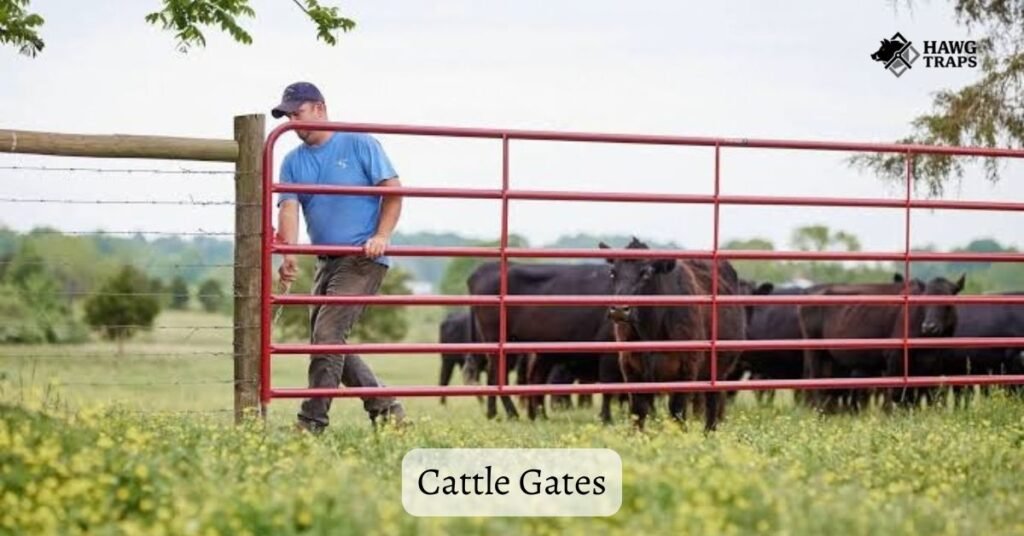
A gate needs to fit the job it’s meant to do. The wrong gate, a poorly supported post, or badly positioned hinges can lead to problems with alignment, movement, and durability.
Most of those problems can be avoided before installation by choosing the right gate in the first place. That starts with knowing how to read a product listing and what specifications actually matter.
We’re a steel shop, and we don’t sell cattle gates on this page. Some links to other products are partner or affiliate links, which means we may earn a commission from qualifying purchases.
Key Takeaways
- A 16-foot gate isn’t 16 feet. Makers build gates 2 1/2 to 4 inches shorter than the listed length, to leave room for the hardware.
- Fourteen feet is the modern standard gate opening, by University of Kentucky extension engineers.
- Weight tells you more than a label. Two 16-foot, 16-gauge gates at one store were listed at 136 pounds and 67 pounds.
- A 12-foot gate was listed at $219.99 and a 16-foot at $329.99 on 7 October 2026.
- A gate belongs on a braced post. The NRCS fence specification for Texas wants a gate attached directly to a brace assembly post.
- Boss Hawg builds what stands beside the gate: the H-posts it hangs on, and the cattle guard that can share the opening.
Why Trust Us: How We Put This Together
Boss Hawg is a steel shop in Cross Plains, Texas. We weld H-posts, cattle guards and hog traps. We work with these products on ranch ground.
We haven’t tested the gates on this page, and we don’t sell them. That’s the useful part. We don’t benefit from the decisions you make.
- Sizes, gauges and weights come from the sellers’ own listings, read on 7 October 2026. We name the seller every time.
- Width and post rules come from University of Kentucky extension engineers and from the NRCS fence specification for Texas. NRCS is the Natural Resources Conservation Service, part of the U.S. Department of Agriculture.
- Makers’ own words are quoted as makers’ words. When Tarter or Priefert says what a gate is for, we say who said it.
- Where we did arithmetic, we say so. Pounds per foot is ours. The pounds are theirs.
- Where a listing doesn’t add up, we tell you and leave it there.
What a cattle gate is
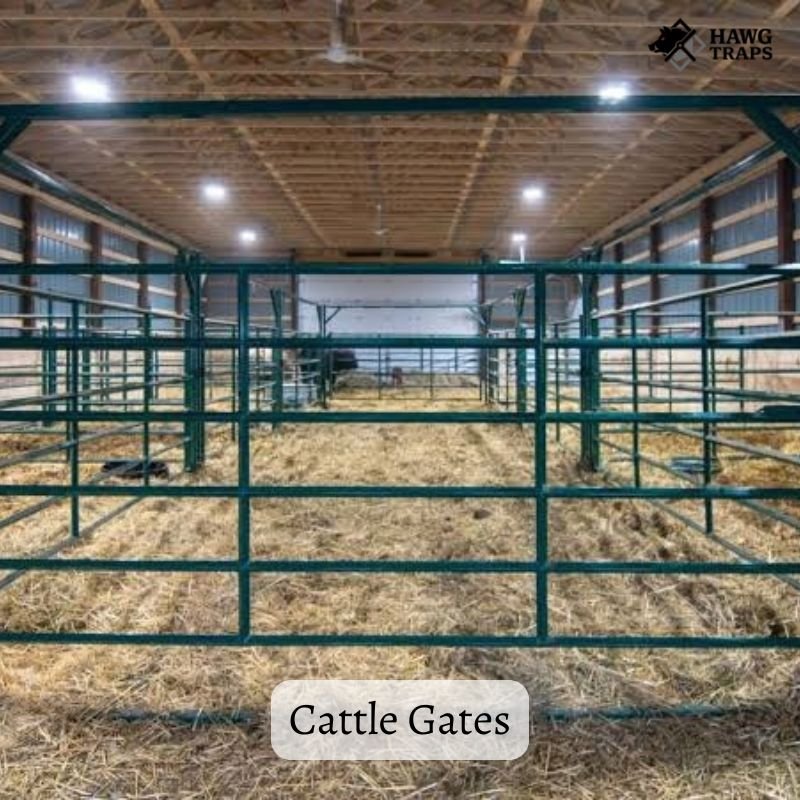
A cattle gate is a hinged steel gate that closes an opening in a livestock fence. The common farm-store kind is a tube gate: six horizontal steel tubes on a welded frame, 50 to 52 inches tall, in lengths from 4 to 20 feet.
You’ll hear it called a farm gate, a livestock gate, a cow gate or a tube gate. At the farm store they will point towards the same gate.
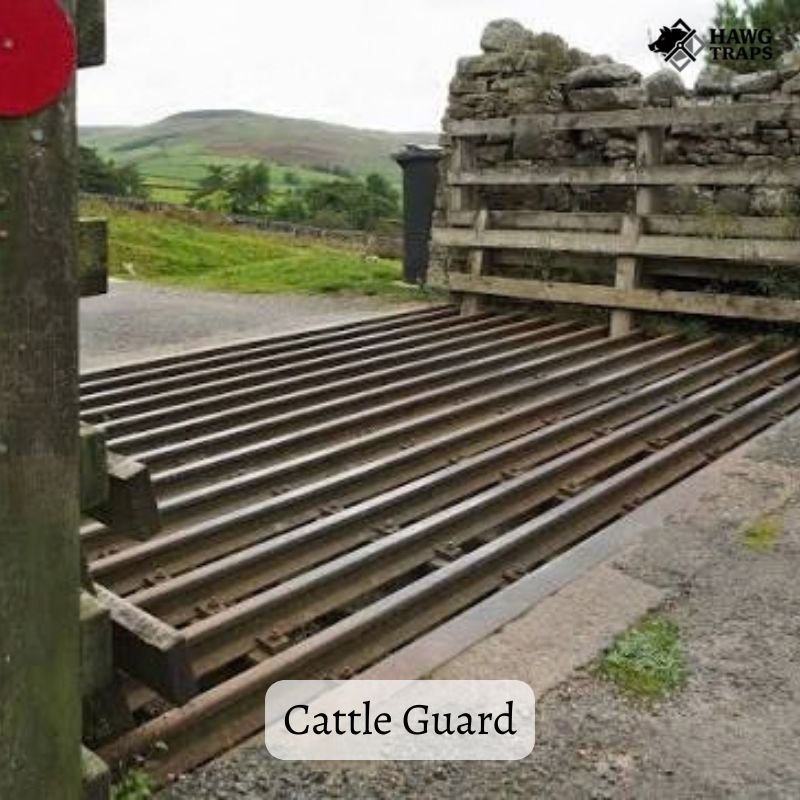
One mix-up is worth clearing early. Some people say “cattle gate” when they mean the steel grid in the road that cattle won’t cross. One farming magazine even defines it that way, as “a metal gate laid flat over a ditch in the ground.” That’s a cattle guard. If that’s what you came for, our cattle guards for sale page is the one you want.
This page is about the gate that swings. It’s fixed steel, the third group on our ranch equipment list: you hang it once and live with it for years.
Types of cattle gates
Cattle gates come in five main types: tube gates, bull gates, wire-filled gates, bow gates and corral panel gates. The tube gate is the standard pasture gate. Heavier types are built for populated pens.
| Type | What it is | What the maker says it suits | Limit |
|---|---|---|---|
| Tube gate | Horizontal steel tubes on a welded frame, with vertical braces | Tarter’s American gate: “access between pastures, entryways” and “light confinement” | Light versions aren’t sold for crowding pens |
| Bull gate | A tube gate sold for pressure | Priefert: “heavy crowding and/or high stress applications” | Heavier to hang. A 20-foot one weighs 201 pounds |
| Wire-filled gate | A frame filled with wire mesh | Tarter’s Watchman gates: “the perfect solution for small animal fencing” | Sold for small stock, not for crowding cattle |
| Bow gate | A gate inside its own overhead frame | Hi-Hog: “commonly used for access and sorting in corral systems” | A corral gate, not a pasture gate |
| Corral panel gate | A gate built into a corral panel | Sold by corral dealers as walk-through gates | Belongs to a panel system |
A tube gate handles a pasture opening; pens where cattle crowd call for a heavier gate.
Two more turn up on ranches and aren’t on that rack.
Pipe gates. Welded from round pipe by a local shop. They’re covered on our pipe ranch gate entrances page.
Wire gaps. Fence wire on loose sticks, unhooked by hand. The cheapest gate there is, and the slowest.
Notice whose words fill the third column. They’re the makers’. A maker telling you a gate is for “light confinement” is telling you where not to hang it.
Cattle gate sizes: length, height and the missing inches
Cattle gates are sold in 2-foot steps from 4 to 20 feet long and stand 50 to 52 inches tall. The gate itself is 2 1/2 to 4 inches shorter than its listed length, to leave room for hardware.
Length. Tarter lists its American gate at 4, 6, 8, 10, 12, 14, 16, 18 and 20 feet. CountyLine’s tube gates run from 4 to 18 feet in the same steps.
Height. The gates we read fall in a narrow band
- 52 inches: 2-inch tube gates from CountyLine and Tarter’s Bullmax.
- 50.5 inches: Priefert’s bull gate.
- 50 inches: 1 3/4-inch tube gates from Tarter and CountyLine, and Behlen’s gate at 4 feet 2 inches.
So “what’s the standard height?” has an honest answer: there isn’t a rule we could find, but the shelf says 50 to 52 inches.
The missing inches. Here’s the part that catches people at the checkout. The length written on the tag is not the size of the steel. Here is a table explaining it.
| Gate | Tube | Shorter than listed by |
|---|---|---|
| CountyLine tube gates; Tarter Bullmax | 2 inch | 2 1/2 inches |
| Tarter American and Steelmax | 1 3/4 inch | 3 inches |
| CountyLine Heritage galvanized | 1 3/4 inch | 4 inches |
A 16-foot gate is 15 feet 8 inches to 15 feet 9 1/2 inches of steel.
Tractor Supply’s listing gives the reason: the gap is there “to allow for gate hardware and proper clearance.” Its 14-foot gate measures 13 feet 9 inches without hardware. Lowe’s shows the same thing in a different way. Its 12-foot Tarter gate has an actual width of 11.75 feet.
That means the listed length is the opening between the posts, not the gate. It’s our own reading, so check the maker’s sheet before you set the second post. A post set 3 inches wrong take up your whole afternoon to fix.
How wide a cattle gate should be
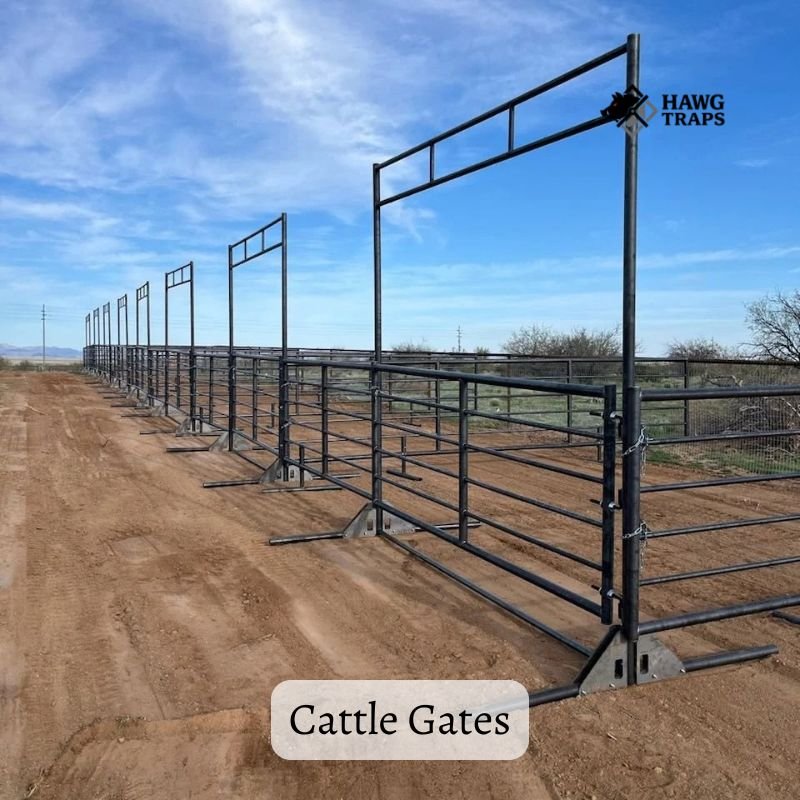
Fourteen feet is the modern standard for a farm gate opening, by University of Kentucky extension engineers. For openings wider than 14 feet, they describe two opposing gates that meet in the middle.
That’s from “Farm Gates: Design Considerations,” by Steve Higgins and Lee Moser, revised in April 2024. Equipment is the constraint. A gateway, they write, “must be able to accommodate machines and equipment that must be moved through the gate.”
Four more of their points belong in any gate plan.
- Put gates in corners. Gates into neighboring fields should sit close together, “preferably placed in a corner.”
- Go to two gates past 14 feet. They describe “two opposing, smaller gates that meet in the center,” held with a drop-over catch.
- Think about the swing. A gate that opens outward into a lane “can be strategically beneficial.”
- Have fewer gates. A producer, they write, “should try to limit the number of gates on a farm to only what is necessary.”
The aim behind all four, in their words, is to help livestock flow by “funneling them through the opening.”
The main gate at the road is different. You have trailers, turning room and a highway to think about. That’s covered in our ranch entrance gates guide.
Did you know? The Kentucky engineers also cover the mud. They describe a heavy-use pad that runs about 15 feet through a gateway, built from 8 to 12 inches of compacted aggregate. A gate is only as good as the swamp it opens onto.
How to read a cattle gate listing: tube, gauge and weight
There are three numbers to look at to understand how much steel was used: tube diameter, gauge and weight. A 16-foot gate in 2-inch, 16-gauge tube weighs 136 pounds. One in 1 3/4-inch tube weighs 67.
Tube diameter is the width of each rail. On these listings it runs from 1 5/8 inches to 2 inches.
Gauge is the thickness of the steel in the tube wall, and it runs backwards: a lower number is thicker. 16-gauge steel is 0.060 inch. 20-gauge is 0.036 inch.
Weight is the total, and it’s the hardest number to dress up.
Here are nine gates from four sellers, read on 7 October 2026. The last column is our division.
| Gate | Length | Tube | Gauge | Weight | Pounds per foot |
|---|---|---|---|---|---|
| CountyLine tube gate, green | 12 ft | 2 in | 16 | 105 lb | 8.8 |
| CountyLine tube gate, green | 14 ft | 2 in | 16 | 120 lb | 8.6 |
| CountyLine tube gate, green | 16 ft | 2 in | Not stated | 136 lb | 8.5 |
| CountyLine Heavy-Duty tube gate, red | 16 ft | 2 in | 16 | 136 lb | 8.5 |
| CountyLine Heritage galvanized | 16 ft | 1 3/4 in | 16 | 67 lb | 4.2 |
| Priefert bull gate | 14 ft | 2 in | 16 | 114 lb | 8.1 |
| Priefert bull gate | 20 ft | 2 in | 16 | 201 lb | 10.1 |
| Tarter gate at Lowe’s | 16 ft | Not stated | 19 | Not stated | |
| Behlen tube gate at Home Depot | 12 ft | 1 5/8 in | 20 | Not stated |
Two 16-foot, 16-gauge gates at the same store weigh 136 pounds and 67 pounds.
Three things in that table are worth a second look.
The label and the weight. The green 16-foot gate and the red “Heavy-Duty” 16-foot gate are both 2-inch tube, and both are listed at 136 pounds. The red one’s listing says 16 gauge. The green one’s doesn’t say. On the numbers shown, we can’t find the extra duty. It may be in the hardware: the red gate ships with 3/4-inch by 12-inch hinge pins, and the green one with 6-inch screw-in pins.
The bull gate and the store gate. At 14 feet, Priefert’s bull gate is listed at 114 pounds. CountyLine’s ordinary tube gate is listed at 120. Both say 2-inch tube and 16 gauge.
The 67-pound gate. The Heritage gate says 16 gauge, the same as the 136-pound gate beside it. Its tube is a quarter-inch smaller. By our arithmetic, that makes each rail about 12% lighter, not 50%. We can’t tell you where the rest of the steel went, and we won’t guess. We will tell you when the scale and gauge doesn’t match.
So here’s the rule this page exists to give you. When a listing shows a gauge and a weight, its reasonable to believe its weight.
How thin does it get? Lowe’s lists a 16-foot Tarter gate at 19 gauge, which is 0.042 inch. Home Depot lists a 12-foot Behlen gate at 20 gauge, 0.036 inch. By our division, 16-gauge steel is about two-thirds thicker than 20-gauge. We’re saying thicker, not stronger. None of these listings gives a strength test.
A five-line check for any listing:
- Tube diameter, in inches.
- Gauge, as a number.
- Weight, in pounds. Divide by the length.
- Actual length, not listed length.
- What the maker says it’s for, in the maker’s words.
What cattle gates cost
A 12-foot cattle gate was listed at $219.99, a 14-foot at $259.99 and a 16-foot at $329.99 on Tractor Supply’s site on 7 October 2026. A 20-foot bull gate was listed at $519.99.
| Gate | Listed price | Seller | Date checked |
|---|---|---|---|
| CountyLine 12-foot tube gate, 2-inch | $219.99 | Tractor Supply | 7 Oct 2026 |
| CountyLine 14-foot tube gate, 2-inch | $259.99 | Tractor Supply | 7 Oct 2026 |
| CountyLine 16-foot tube gate, 2-inch | $329.99 | Tractor Supply | 7 Oct 2026 |
| CountyLine 16-foot Heavy-Duty tube gate, red | $296.99 on sale; regular $329.99 | Tractor Supply | 7 Oct 2026 |
| CountyLine 16-foot Heritage galvanized, 1 3/4-inch | $249.99 | Tractor Supply | 7 Oct 2026 |
| Priefert 14-foot bull gate | $289.99 | Tractor Supply | 7 Oct 2026 |
| Priefert 20-foot bull gate | $519.99 | Tractor Supply | 7 Oct 2026 |
Length sets most of the price; a bull gate adds about $30 at 14 feet.
Price per foot climbs with length. This is our arithmetic. The 12-foot gate works out to $18.33 a foot, the 16-foot to $20.62, and the 20-foot bull gate to $26.00. Cost per foot is more in long gates.
Who sells them. All three big chains do.
- Tractor Supply lists CountyLine, Priefert and Tarter gates, including 14-foot ones.
- Lowe’s lists Tarter gates.
- Home Depot lists Behlen gates.
We could read the gauge on the Lowe’s and Home Depot listings but not a price, so we haven’t printed one.
The gate isn’t the whole expense. It needs a post that won’t lean, hinges that fit that post, and a latch you’ll actually use. You need to include all 3 in your budget and have plans for them.
How to hang a cattle gate
Hang a cattle gate on a braced post. University of Kentucky engineers call for gate posts at least 8 feet long, with a third below ground. One hinge kit points the top bolt down and the bottom up.
Start with the post. A hung gate is a weight on the end of a lever. A 16-foot tube gate is 136 pounds, and a 20-foot bull gate is 201. All of it pulls sideways on one post, every hour of every day.
That’s why the 2015 NRCS fence specification for Texas wants a gate “attached directly to a brace assembly post.” A brace assembly is an H-brace: the gate post tied to a second post by a rail. How wide and how deep to build one is on our H posts and H braces page.
What size post for a 12-foot or 16-foot gate? Nobody we read sizes the post by gate length. The sources give floors instead.
- Kentucky, AEN-137: gate posts “a minimum of 8 feet long, with one third of the post below ground, unless set in concrete.” A third of 8 feet is 2 feet 8 inches. For wood, “the preferred diameter is 8 to 10 inches.”
- NRCS Texas: steel pipe of at least 2 3/8 inches, with brace posts buried at least 3 feet.
Concrete or not? Kentucky’s rule treats concrete as the alternative to depth. Where rock stops a post from being driven deep enough, it notes, posts “are often set in concrete.”
Now the hinges. Farm-store gates ship with one of two kinds of pin.
- Screw-in pins, 6 inches long, that thread into a wood post.
- Threaded pins, 3/4 inch by 12 or 13 inches, long enough to bolt through a post.
Tarter builds its gates with “an adjustable top hinge and welded hinge on the bottom.” The adjustable top lets you level the gate after it’s hung.
Which way the pins point. One hinge kit’s instruction sheet is clear about it. “The top J Bolt faces down,” it says, and the bottom one goes in “with the J facing up.” With one pin up and one down, the gate can’t simply be lifted off its hinges. That’s our reading of why. The sheet doesn’t give a reason.
Then the swing. The Kentucky engineers describe the goal well. A correctly aligned gate “should swing closed gently and smoothly, with a slight push,” with enough momentum “to latch itself securely.”
A long gate is heavy and can swing hard; hang it with a second person and follow the maker’s instructions.
Gate, cattle guard or both, and what Boss Hawg builds
A gate suits openings you use now and then, and don’t mind coming down from the vehicle. A cattle guard suits a road you drive daily. Kentucky’s extension guide says a gate “provides more security.” Many ranches fit both.
We build cattle guards, so take this from people with a reason to say the opposite. The Kentucky guide is right. “A cattle guard is one option,” it says, “although a gate provides more security.” A guard stops cattle. It doesn’t stop a pickup, and it doesn’t lock.
A cattle guard is a grid of steel rails set across a road opening in a fence, so vehicles can drive through while cattle will not walk across it. What it buys you is time. On a road you cross four times a day, that’s eight times you don’t climb out of the truck.
It has limits of its own. The U.S. Forest Service calls cattle guards dangerous for horses. So plenty of working entrances use a guard in the road and a gate beside it for horses, loose stock and wide loads. That side gate has its own page: cattle guard bypass gates.
What Boss Hawg builds, and what we don’t
We haven’t listed a cattle gate of our own on this page. Every gate named above belongs to somebody else, and the farm store is a fine place to buy one.
What we weld is the steel on either side of it.
- H-posts and H-corners. The braced post your gate hangs on.
- Cattle guards. 2 7/8-inch pipe rails on an 8-inch channel iron frame, built to the length of your opening. The spec is on our cattle guards for sale page.
If you want a gate welded to match, ask. We’ll tell you straight whether it’s ours to build.
We ship by freight anywhere in the USA, quoted to your ZIP code before you order.
Have these ready when you call:
- The opening. Post to post, in feet.
- The gate you’re hanging, and what it weighs.
- The heaviest axle that will cross, if you want a guard.
- Your delivery ZIP code.
REQUEST A QUOTE: CALL (254) 725-4554
Tell us the opening and the gate. We’ll tell you what posts and what guard fit it, and what they cost to deliver.
Also check our partner products for hanging and latching a gate:
- Heavy-duty farm gate latches and gate chains
- J-bolt gate hinges and screw-in hinge pins
- Gate wheels for long gates
- Gate anchors and drop rods for a pair of gates
- Solar gate opener kits
As an Amazon Associate we earn from qualifying purchases. Partner products are listed separately from our own and never replace them.
Latches, chains and openers
The gates we read ship with hinge pins, a welded chain latch and a snap chain. Kentucky’s extension guide calls a self-latching gate ideal. Latches, wheels and openers are sold separately.
A chain works. It also needs two hands and a moment, and that’s when a gate gets left open. That’s our view, and it’s why the Kentucky line about self-latching gates is worth a second read.
We’ll take the hardware one piece at a time on its own pages: livestock gate latches and solar gate openers.
Frequently asked questions
How much does a cattle gate cost?
A 12-foot cattle gate was listed at $219.99 and a 16-foot at $329.99 on Tractor Supply’s site on 7 October 2026. A 14-foot gate was $259.99. A 20-foot bull gate was $519.99.
How much does a 12 ft cattle gate weigh?
A 12-foot CountyLine tube gate in 2-inch, 16-gauge tube weighs 105 pounds, by its Tractor Supply listing on 7 October 2026. That is 8.8 pounds per foot.
How much does a 16 foot cattle gate weigh?
A 16-foot CountyLine 2-inch tube gate weighs 136 pounds, by its Tractor Supply listing. A 16-foot gate in 1 3/4-inch tube at the same store weighs 67 pounds. Check the weight before you buy.
What is the standard height of a cattle gate?
Farm-store cattle gates stand 50 to 52 inches tall. Gates in 2-inch tube are listed at 52 inches, and gates in 1 3/4-inch tube at 50 inches. We found no published rule for gate height.
How wide should a cattle gate be?
Fourteen feet is the modern standard for a gate opening, by University of Kentucky extension engineers. For wider openings they describe two opposing gates that meet in the middle.
What size post do I need for a 12 or 16 foot gate?
Use a braced post. Kentucky’s extension guide asks for gate posts at least 8 feet long, with a third below ground, and wood posts 8 to 10 inches across. The NRCS fence specification for Texas sets pipe at 2 3/8 inches minimum.
Should gate posts be set in concrete?
Kentucky’s extension guide asks for a third of the post below ground “unless set in concrete.” It notes that posts are often set in concrete where rock stops them from being driven deep enough.
Do Tractor Supply, Lowe’s and Home Depot sell cattle gates?
Yes. Tractor Supply lists CountyLine, Priefert and Tarter gates, including 14-foot gates. Lowe’s lists Tarter gates. Home Depot lists Behlen gates.
Which is better, steel or aluminum gates?
It depends on the job. Hobby Farms magazine describes aluminum as lighter and more resistant to rust. One Texas ranch contractor says aluminum may not be as heavy-duty as steel. We found no test comparing the two under cattle.
Before you buy the gate
Go back to the gate that drags. You can now say why.
Maybe it was a 67-pound gate doing a 136-pound job. Maybe it hangs on a post with no brace behind it. Maybe the hinges were never leveled.
So before the next one goes in the truck, do three things. Measure the opening, post to post. Read the listing for tube, gauge and weight, and trust the weight. Then look hard at the post you plan to hang it on.
If that post needs help, that’s the part we build.