
You did everything right. You found fresh rooting, set the trap, poured in a whole sack of corn, and pointed a camera at it. Three days later you scroll through the photos: a raccoon, another raccoon, a doe and her yearling, a very confident possum, two more raccoons. Not one hog.
The hogs didn’t forget where you live. They just had a better offer somewhere else, maybe an acorn drop in the creek bottom or a neighbor’s milo field. Bait isn’t about finding a magic recipe. It’s about making your spot the best meal on the property, for hogs specifically, at that time of year.
This guide covers what works in a trap, what doesn’t, and why the answer changes with the season. It’s what our team has learned from setting traps, talking with ranchers who buy them, and reading the research Texas A&M and USDA scientists have done on wild pig baiting.
Key Takeaways
- Whole shelled corn is the default bait for good reason: it’s cheap, easy to handle, and hogs love it most of the year.
- Sour corn and sweeteners add pull, but cost time and mess. Use them when hogs ignore plain corn.
- In fall acorn season, corn can lose. Research at a Texas wildlife area found corn won every test in spring but not in fall.
- Bait placement matters as much as bait type. Trail it into the trap and pile most of it at the back.
- Never use poison as bait. The only registered hog toxicant in Texas is restricted to licensed pesticide applicators.
The Short Answer: Best Bait for Hog Traps
The best bait for hog traps is whole shelled corn. If hogs ignore plain corn, upgrade to soured corn or corn mixed with a sweetener like molasses or fruit-flavored gelatin. A store-bought hog attractant works best as a booster on top of corn, not a replacement. In fall, when acorns and pecans drop, add scent or protein, or be patient until the mast runs out.
That’s the version you can remember. The rest of this guide is the why and the how.
Why Trust Us: How We Put This Together
Our shop in Cross Plains, Texas, builds hog traps, and our team in the US uses them on real ranch ground. We talk regularly with landowners and trappers about what they put in their traps and what actually shows up on camera. For the science, we rely on published research from USDA’s National Wildlife Research Center and Texas A&M, and on extension guidance. For the store-bought attractants below, we looked at the product details and the public owner reviews we could find. Where we’re sharing an observation instead of a measured result, we say so.
Hog Bait Compared
Here’s how the common baits stack up from a trapper’s point of view. “Non-target pull” means how much it attracts deer, raccoons, birds and other animals you’re not trying to catch.
| Bait | Hog pull | Cost | Non-target pull | Mess and effort | Best season |
|---|---|---|---|---|---|
| Whole shelled corn | Strong | Low | High (deer, raccoons, birds) | Very low | Spring, summer, winter |
| Soured (fermented) corn | Strong, carries scent farther | Low | Moderate | High: buckets, smell, time | Any, especially when plain corn stalls |
| Sweetened corn (gelatin, drink mix, molasses) | Strong | Low | Moderate to high | Low | Any |
| Molasses or sweet feed | Strong | Moderate | High (deer, livestock) | Sticky | Fall, winter |
| Commercial hog attractant | Good booster | Moderate | Varies by product | Very low | Any, on top of corn |
| Ripe fruit | Moderate | Varies | High (raccoons, deer) | Spoils fast | Summer |
| Livestock range cubes | Moderate | Moderate | High (deer, cattle) | Low | Winter |
| Dog food | Moderate | Moderate | Very high (raccoons, coyotes) | Low | Not recommended |
Dog food and fruit sound clever, but in our experience they mostly feed raccoons. If a raccoon trips your trap at 9 p.m., the hogs arriving at midnight find a closed door.
How to Make Sour Corn
Sour corn (also called fermented corn) is whole corn soaked in water until it ferments and gives off a strong sour smell. The scent carries on the wind farther than dry corn, and many trappers swear hogs come to it faster. Fair warning: your truck bed will never smell the same.
What you need: a 5-gallon bucket or barrel with a lid, whole shelled corn, water, and something to kick-start fermentation, such as a packet of yeast, a cup or two of sugar, or a drink-mix packet.
How to make it:
- Fill the bucket about halfway with whole corn.
- Add water until the corn is covered by a few inches. The corn will swell, so leave room.
- Stir in the sugar, yeast or drink mix.
- Put the lid on loosely so gas can escape, and set it in the sun.
- Wait about 3 to 7 days, depending on heat. It’s ready when it smells sharply sour and you see bubbles.
- Pour it where hogs will root, mostly at the back of the trap.
Sour is the goal; moldy is not. If the corn grows fuzzy mold or goes slimy and gray, dump it somewhere away from the trap and start over. Moldy corn can carry aflatoxin, which we cover in the safety section below.
Does sour corn really beat plain corn? Honestly, trappers disagree. Texas A&M’s extension specialists note that some trappers swear by souring and others think it adds time and expense without improving results. Our take: start with plain corn. If hogs are visiting but not committing, or aren’t finding the site, try sour corn as a scent upgrade.
Partner products we recommend for sour corn:
- 5-gallon buckets with lids — Get a few food-grade buckets with lids, and you can keep one batch fermenting while you use another. Heavier-wall buckets hold up better sitting in the sun.
What to Mix With Corn to Attract Hogs
Hogs have a serious sweet tooth and an excellent nose. Adding a sweet or strong-smelling ingredient to corn makes your bait easier to find and harder to walk past. These are the mixers ranchers tell us they use most:
- Molasses. Drizzle it over corn or mix it into the bucket. Sweet, sticky and strong-smelling. Feed-grade molasses is cheaper than the grocery-store kind.
- Fruit-flavored gelatin powder. Strawberry and raspberry are favorites. Sprinkle a box over a pile of corn, and the sugar and scent cling to the kernels.
- Powdered drink mix. Same idea as gelatin, and cheap. The bright color doesn’t matter to hogs; the sugar and scent do.
- Vanilla extract or fruit scents. A strong scent on its own, good for helping hogs find a new site.
- Peanut butter. High in fat and smell. Smear it on a post or log inside the trap. It also draws raccoons, so watch your cameras.
These answer the common question “What food is irresistible to pigs?” too. The short version: anything sweet, fermented or high in fat, delivered in a way that keeps hogs busy at the site.
Partner products we recommend for mixers:
- Feed-grade molasses — A gallon goes a long way over corn, and feed-grade molasses costs less than the grocery-store kind. Jugs with a pour spout make less mess.
- Strawberry or raspberry gelatin, bulk — Buying it by the bulk bag beats grabbing single boxes at the store when you’re baiting several sites.
Season by Season: When Corn Stops Working
Here’s the part most bait guides skip: the best hog bait changes with the season, because hogs are always choosing between your bait and what nature is serving that month.
USDA and Texas researchers tested this directly. In captive trials at the Kerr Wildlife Management Area in Hunt, Texas, they offered wild pigs a choice between corn and other foods. In spring, pigs ate more corn than any alternative. In fall, things changed: earthworms were eaten more than corn, and pigs visited peanuts as often as corn. The researchers concluded that other baits may work as well as or better than corn at certain times of year.
What that means on your place:
- Spring and summer: Corn rules. Natural food is mostly green vegetation, and grain is a treat. Plain corn is usually all you need.
- Fall: Acorns, pecans and other mast drop, and hogs gorge on them. Corn becomes less special. This is the time to add sweeteners, scent or protein, or to keep a site going with a feeder and wait for the mast to run out.
- Winter: Food gets scarce, and bait works hardest. This is why many crews push trapping from late fall into early spring.
- Dry spells, any season: Drought makes bait more valuable. A study led by USDA researchers found wild pigs used bait sites more than twice as much in dry years.
How Far Can Hogs Smell Corn?
You’ll see claims online that hogs can smell bait from miles away. No study we know of gives a reliable distance, so we won’t make one up. What research does show is more useful anyway: a USDA study that tracked wild pigs with GPS collars found that 80% of pigs found a new bait site within about 9 days, and that pigs traveled farther to reach bait in poorer habitat.
Do hogs smell better than deer? Both have excellent noses, and pigs are famous for theirs; it’s why they’re used to find truffles. For trapping, the practical point is that hogs find bait by smell and roam their home range regularly, so bait that’s strong-smelling and put out consistently will get found.
How to Bait a Hog Trap
How you put bait out matters as much as what you put out. Here’s the method our team and most of the trappers we talk to use:
- Start bait before the trap goes up. Get hogs visiting the spot on a schedule. Our guide on how to trap hogs covers this pre-baiting step in detail.
- Trail it in. Lay a light line of corn from outside the gate into the trap.
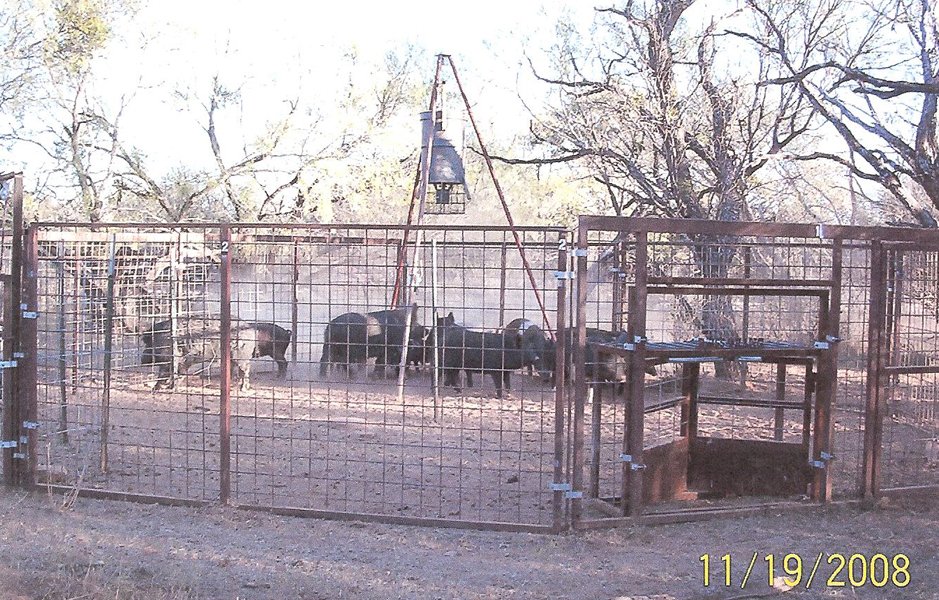
- Pile most of it at the back. Hogs eating at the far end are fully inside, and that’s where the trigger goes in a corral.
- Make them work for it. Bury some corn in shallow holes or dig a post hole and fill it with corn and molasses. Hogs root for it and stay longer, while deer can’t get to it as easily.
- Keep a schedule. Bait at the same time every day, ideally late afternoon, or use a timer feeder.
- Stop baiting outside once they commit. When hogs are walking in readily, put all the bait inside.
Partner products we recommend for baiting:
- Moultrie game feeder kits — A timer feeder throws corn at the same time every evening, so hogs learn the schedule without you visiting. Set it to go off after dark to cut down on deer and birds. Moultrie parts are easy to find at most farm stores.
- Post hole diggers — For the buried-bait trick. A basic manual digger is all you need.
Our guide to feeders for hog traps walks through timer settings for pre-baiting.
Store-Bought Hog Attractants: Our Take
Commercial hog attractants are powders, granules or liquids with strong sweet or fermented scents. They’re not a replacement for corn, but they’re a quick way to add scent and flavor without mixing buckets. We looked at the product descriptions and the public owner reviews we could find, and here’s what we observed. One honest note up front: published reviews for hog attractants are thin, so treat any single product as something to test on your own ground.
Evolved Hog Wild
Check Evolved Hog Wild on Amazon
A granular attractant with a berry-and-molasses scent, meant to be mixed with corn or spread on the ground. What reviewers report: the reviews we found on DoMyOwn were few but positive. One owner mixed it into trap bait with corn and peanut butter, and another spread it with dry corn and said hogs came back within an hour. Our observation: it’s a good booster for a new site, or when hogs are walking past plain corn. Best for: landowners who want a no-mess scent upgrade.
Wildgame Innovations Hog Heaven
Check Wildgame Innovations Hog Heaven on Amazon
Unlike a pure scent product, Hog Heaven is a granular feed: a grain mix with a fruit-punch flavor, sold in 20-pound bags, with a guaranteed analysis of at least 15% crude protein. What reviewers report: the retail listing we checked had no reviews yet. Our observation: the protein is the interesting part. In the Kerr WMA trials, earthworms out-ate corn in fall and peanuts drew as many visits, so a protein feed mixed with corn is a reasonable fall test. Best for: trappers who want an add-on with some food value, not just smell.
Liquid attractants
Browse liquid hog attractants on Amazon
Liquid attractants are sprayed or poured onto posts, logs or corn piles. Our observation: we haven’t found enough consistent review evidence to single one out. Use them to refresh scent on a site between corn refills, not as the main draw. Best for: topping up a bait site without hauling more feed.
No attractant will make up for a bad trap location, a bait site deer have taken over, or a sounder that’s already trap-shy. Use these as tools, not miracles.
Bait Safety: What Not to Put Out
“What food is toxic to pigs?” comes up a lot. For trapping, the real risks are these:
Moldy corn. Corn that gets wet can grow molds that produce aflatoxin, a toxin that’s especially hard on birds like wild turkeys and quail that visit bait sites. Texas wildlife specialists have long recommended feeding only corn labeled under 20 parts per billion aflatoxin, and Texas AgriLife guidance says corn at 100 ppb or more should not be fed to wildlife. Store corn dry, keep feeders from leaking, and toss anything moldy.
Poisons and toxicants. Never put poison in a hog trap or on a bait pile, and never “improvise” a toxicant. The only hog toxicant registered in Texas, a warfarin bait called Kaput, is a state-limited-use pesticide available only to licensed applicators. Homemade poisons kill deer, birds, pets and anything that eats a dead hog, and they’re illegal.
Fuel, chemicals or anything weird. You’ll find forum posts about diesel-soaked corn. Don’t. It contaminates soil and water and harms other wildlife.
What smells do hogs hate? That’s a deterrent question rather than a bait question, and the honest answer is that repellents rarely keep hogs away for long. We cover deterrents in our feral hog control guide.
The Best Bait Won’t Save a Weak Trap
Here’s the part where we admit our bias: we build hog traps, and we think ours are the best you can buy. Judge us on the specs. Every Boss Hawg trap uses a 1½-inch, 14-gauge square steel tube frame with 6-gauge wire panels MIG welded to it, and prime-coated tubing.
We say this because we’ve seen what happens when great bait meets a weak trap. A sounder that walks in, gets caught, and then pushes out through a bent panel or a gap at the bottom isn’t just lost. It’s educated, and it won’t come near a trap again for a long time. All that bait just paid for a lesson.
REQUEST A QUOTE: CALL (254) 725-4554
For whole sounders, see the Big Pen corral trap or the complete Pro Pen package with a loading ramp and panel gates. For single hogs, our Standard 4×8 box trap fits a pickup bed.
Also check our partner products: Evolved Hog Wild, Wildgame Innovations Hog Heaven, game feeders and cellular trail cameras.
As an Amazon Associate we earn from qualifying purchases. Partner products are listed separately from our own and never replace them.
Frequently Asked Questions
What attracts hogs fast?
Strong-smelling, sweet bait put out in a spot hogs already use. Soured corn, corn mixed with molasses or gelatin powder, and commercial attractants all add scent that helps hogs find a new site faster. Dry weather and scarce natural food speed things up too.
What is the best bait for a pig trap?
Whole shelled corn is the best all-around bait for a pig trap. It’s cheap, easy and effective most of the year. Upgrade to sour corn or sweetened corn when hogs ignore plain corn, especially in fall.
How much bait should I put out?
Enough that the hogs finish it but come back for more the next night, and adjust from there. If the bait is gone by morning, add more. If it’s sitting untouched, cut back and freshen it. A timer feeder makes this easier to control. Watch your camera: if deer are eating most of it, set the feeder to throw after dark.
Does bait need to be inside the trap?
During pre-baiting, start outside or at the open trap. Once hogs are coming in readily, put nearly all of it inside, mostly at the back, so the whole sounder has to walk in to eat.