

A T-post goes into the ground like a nail and comes out like a tooth.
Driving a T-post is usually the easier part. Getting it back out years later takes more effort. You grab it with both hands, plant your feet, and lift with every muscle your doctor has warned you about. The post doesn’t move. It was never going to move. There’s a steel plate down there, and you’d forgotten all about it.
So you go get the truck and a chain. Now you own a T-post shaped like a banana.
There is a tool for this. It costs somewhere between fifteen dollars and about a hundred and thirty, and it turns the whole fight into a few pumps of a handle. We compare ten pullers by price, features and buyer reviews, then we will explain which ones we’d choose for different jobs.
We’re a steel shop. We build hog traps, cattle guards and H-posts, and we don’t make a T-post puller. Some links are affiliate links, and as an Amazon Associate we earn from qualifying purchases.
Key Takeaways
- A T-post puller lifts the post straight up, which is how the post comes out unbent and ready to use again.
- The anchor plate holds the post firmly in the soil. Pulling by hand may not loosen it, while pulling sideways with a truck can bend the post. On one Tractor Supply listing it sits 8 inches from the bottom of the post.
- There are four types: a puller plate, a lever puller, a professional clamp-jaw puller and a tractor-mounted puller.
- Ten pullers were listed from $14.99 to $126.97 on 11 October 2026.
- The most-reviewed one we found was Tractor Supply’s Country Pro lever puller: $69.99, rated 4.8 out of 5 by 501 buyers.
- Harbor Freight listed no T-post puller when we searched its site on 11 October 2026.
- A $16 puller plate pays for itself in four saved posts, at $4.49 a post. That arithmetic is ours.
Why Trust Us: How We Chose These Pullers
Boss Hawg is a steel shop in Cross Plains, Texas. We weld H-posts and H-corners, along with cattle guards and hog traps. We built ranch fences many times, and we use these tools ourselves. We also discuss with ranchers who use them.
That’s experience as users, and we want to be exact about its limits. We have not run a side-by-side test of the pullers below. Nobody here pulled a hundred posts with each one and timed it. So this page has no star ratings of our own and no “winner” badge.
Here’s what it has instead.
- Prices, sizes and weights come from sellers’ own listings, read on 11 October 2026.
- The ratings come from customer reviews on those listings, with the number of reviews behind them.
- Complaints are quoted along with the praise. A rating without its worst review isn’t an honest one.
- Where we did arithmetic, we say so.
- Where a judgement is ours, we say that too.
We make no puller, so every one here is somebody else’s product, and some links pay us a commission. Our editorial policy and affiliate disclosure explains the rest.
What a T-post puller is
A T-post puller is a hand tool that grips a steel T-post and lifts it straight out of the ground. Most use a lever or a jack, so one person can pull a post without bending it.
You’ll see it sold under a few names: T-post puller, T-post remover, fence post puller, and in one maker’s case, “Post-Popper.” They all do the same job.
The word that matters in that definition is straight. A T-post is a long, thin piece of steel. Pull it sideways, with a truck or a tractor at an angle, and it folds. Pull it straight up and it slides out the way it went in.
That’s the difference between a post you throw on the scrap pile and one you drive again next week. One retailer’s listing for a Maasdam puller puts it plainly: the tool “does not bend the posts, which allows the option of reusing them after removal if desired.”
Why T-posts are hard to pull: the anchor plate
T-posts are hard to pull because of the anchor plate, a steel fin near the bottom that locks into the soil. On one Tractor Supply listing the plate sits 8 inches from the bottom of the post.
A T-post is the steel line post in a wire fence. The same Tractor Supply listing describes the plate’s job in one line: “The large anchor plate of this studded T-post provides greater stability.”
Stability is wonderful for seventeen years. Then you want the post out.
A seller’s answer on that listing gives the plate’s size as about 3.5 inches long by 1.75 inches wide. Another says to drive the post 18 to 24 inches deep. Put those together and you get a useful number, and this part is our arithmetic.
- Driven 18 inches, the plate sits about 10 inches below the ground.
- Driven 24 inches, the plate sits about 16 inches below the ground.
So when you pull on a T-post, you aren’t lifting a post.The buried plate has to push through the soil above it before the post can be free. After years in the ground, the soil can be packed tightly around the plate.
One more thing about where the pulling happens. T-posts are the line posts, the ones in the middle of the fence. The braces at the ends and corners are another matter. They’re set deep, often in concrete, and they’re meant to stay. Our page on H posts and H braces covers those.
Did you know? The NRCS fence specification for Texas asks for T-posts of at least 1.25 pounds per foot. By our arithmetic, a 6-foot post at that weight is about 7.5 pounds of steel before the plate. You can lift that with two fingers. Everything else you’re fighting is dirt.
The four types of T-post puller
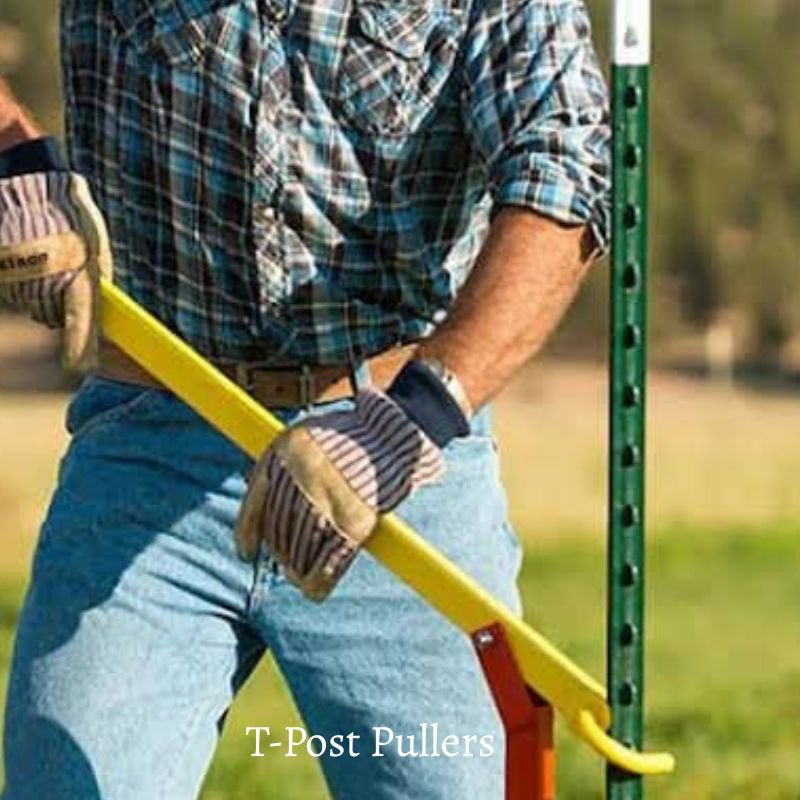
T-post pullers come in four types: a puller plate, a lever puller, a clamp-jaw puller and a tractor-mounted puller. They differ in what supplies the lift: a jack, your arms, a ratcheting jaw or a loader.
| Type | What supplies the lift | What else you need | Price seen, 11 Oct 2026 | Suits |
|---|---|---|---|---|
| Puller plate | A farm jack, a chain or a loader | The jack or the loader, and usually a chain | $14.99 to $20.99 | Anyone who already owns a farm jack |
| Lever puller | Your arms, on a long handle | Nothing | $49.75 to $126.97 | One person on foot, most ranch fence |
| Clamp-jaw puller (professional) | Your arms, through a ratcheting jaw | Nothing | About $300 and up | Crews pulling stakes and posts all day |
| Tractor-mounted | A front-end loader or three-point hitch | A plate and chain, or a bucket-mounted puller | The plate, from $14.99. Bucket-mounted pullers not priced here | Long fence lines with a tractor already running |
The plate is the cheapest type, and the only hand tool here that needs something else to do the lifting.
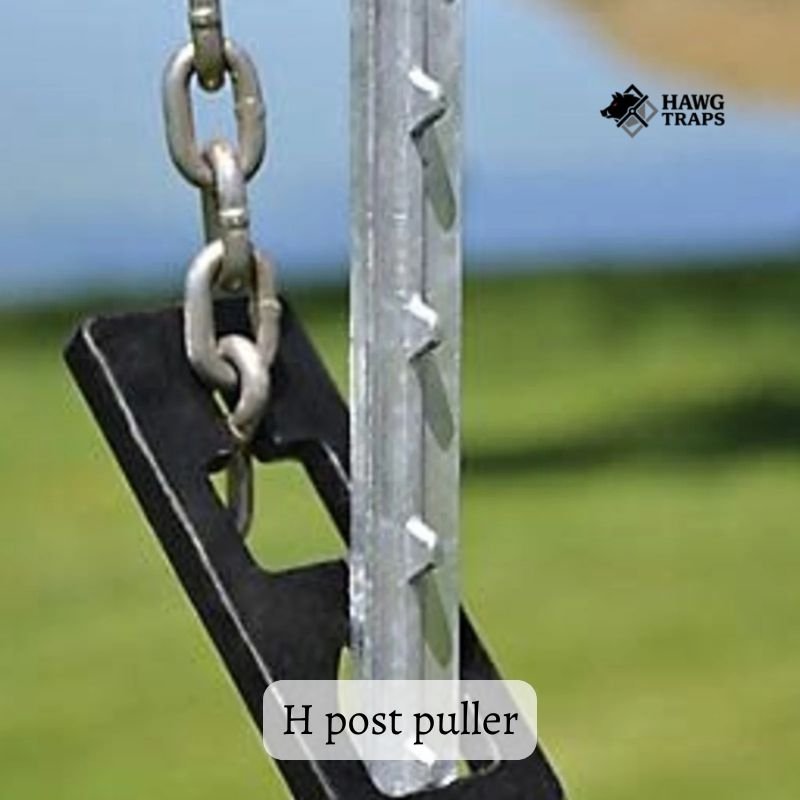
Puller plate
A flat piece of steel with a notch cut in it. The notch hooks onto the post, and something else does the lifting.
Gemplers explains its plate this way: “Simply hook the puller onto the T-post and ratchet up with a handyman jack.” A handyman jack and a farm jack are the same tool, the tall ratcheting jack that lives on half the trailers in Texas. Tractor Supply’s listing for its own plate says it “pairs seamlessly with a tractor bucket, chain, handyman jack, or S-hook.”
A puller plate is small enough to keep with your other fencing tools. On its own it pulls nothing.
Lever puller
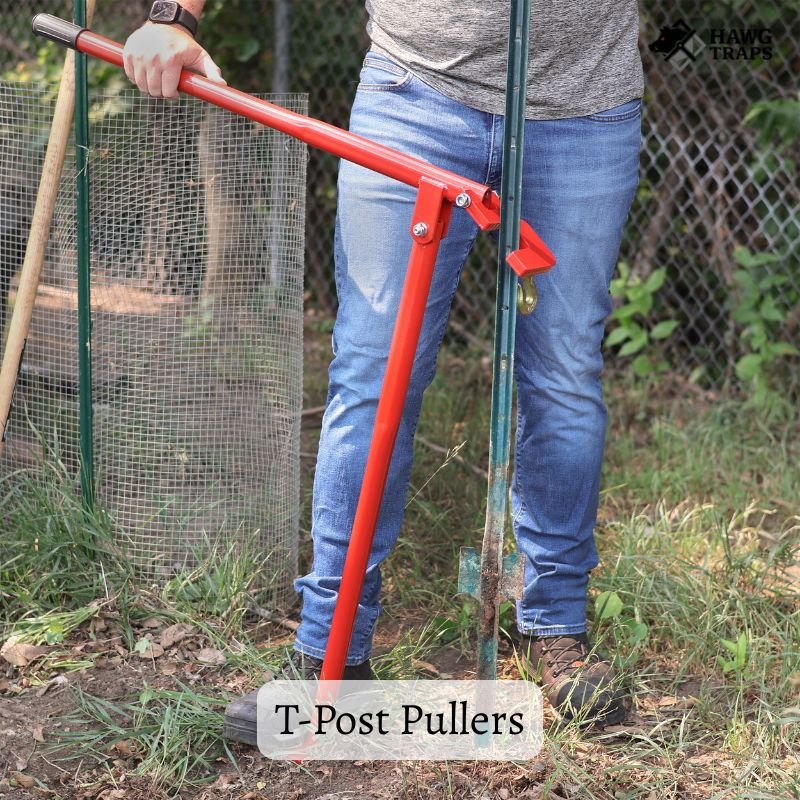
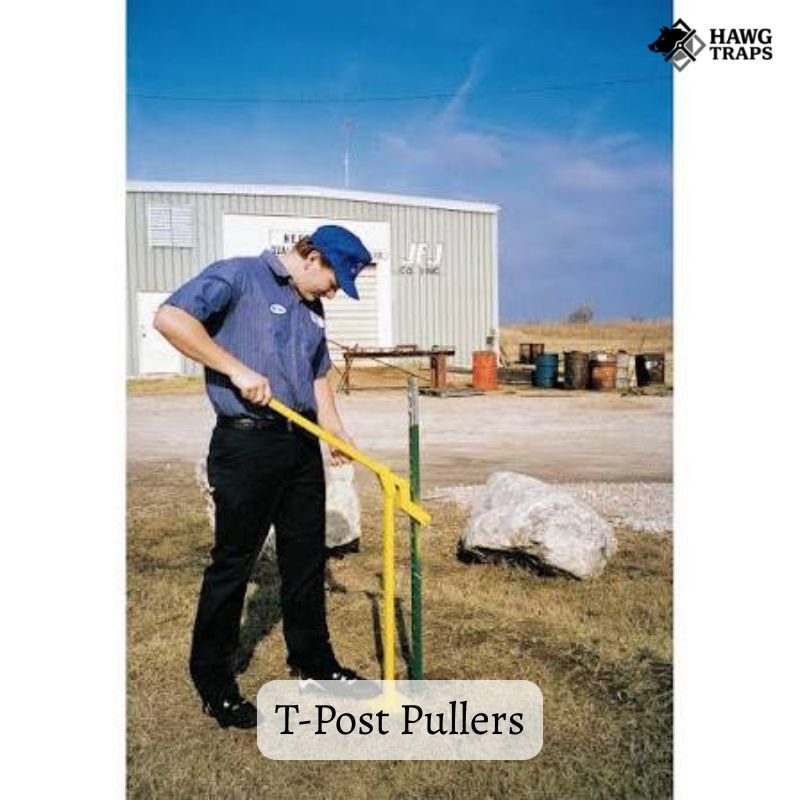
This is the one most people picture. It has a flat base that sits on the ground, a jaw that grabs the post, and a handle about three feet long. You push the handle down and the post comes up.
Tractor Supply says its Country Pro puller’s “lightweight design and stable base allow for easy, single-person operation.” Hi-Lift, which calls its version the Post-Popper, says its “balanced pivot system provides straight-up lifting force.”
No jack, no chain, no tractor. One person carries it down the fence line.
Clamp-jaw puller
The professional’s version. The jaw clamps the post as you push the handle, and a ratcheting action walks the post up.
Maker JackJaw publishes the numbers for its 21-pound puller. A 50-pound push on the handle, it says, creates 1,050 pounds of gripping force and 450 pounds of upward force. That’s nine times what you put in, by our arithmetic.
It’s a fine tool for a concrete crew pulling form stakes all day. JackJaw’s own store lists its pullers from $350 to $675. If you only pull posts occasionally, a basic lever puller may do everything you need and also be very cheap.
Tractor-mounted
Two versions exist. The simple one is a puller plate and a chain hung from a loader bucket. The other is a puller that mounts on the bucket itself.
The tractor makes the lift effortless. It also makes the mistakes bigger. We come back to that near the end of this page, with a few stories from people who learned it the expensive way.
T-post pullers compared: prices, sizes and ratings
Ten T-post pullers were listed from $14.99 to $126.97 on 11 October 2026. Where a retailer showed a public rating, it ran from 3.8 to 4.8 out of 5.
| Puller | Type | Listed price | Size or weight | Public rating | Seller |
|---|---|---|---|---|---|
| SpeeCo Steel T-Post Puller | Plate | $14.99 | About 2.3 lb | Not shown | Hemlock Hardware |
| 3 in. Metal T-Post Puller | Plate | $15.99 | 3 inches long | 4.8 of 5 (77 reviews) | Tractor Supply |
| Metal T-Post Puller Tool | Plate | $20.99 | 6-1/4 x 3 inches, 1.5 lb | 32 reviews, average not shown | Gemplers |
| Kencove T-Post Puller | Lever | $49.75 | 30-inch handle, 16.73 lb | None shown | Kencove |
| Red T-post puller | Not listed | $59.09 | Not listed | Not shown | American Fence & Supply |
| Country Pro T-Post Puller | Lever | $69.99 | 38-inch bar, 5 x 5 inch base | 4.8 of 5 (501 reviews) | Tractor Supply |
| Maasdam Pow’R Pull PP-100 | Lever | $79.98 | 36.5 inches | 4.6 of 5 (105 reviews) | Home Depot |
| Hi-Lift Post-Popper PP-300 | Lever | $95.66 | 39 inches, 21 lb | None yet | Hoover Fence |
| Tarter 2 in. T-Post Puller | Lever, folding | $119.99 | Weight disputed in reviews | 3.8 of 5 (21 reviews) | Tractor Supply |
| Manual T-Post Puller | Lever | $126.97 | 38 inches, about 15 lb | Not shown | US Netting |
Listed prices ran from $14.99 to $126.97, and the four pullers with a public rating scored 3.8 to 4.8 out of 5.
Notice what the table shows about price. The most expensive rated puller has the lowest rating. The best-rated lever puller sits in the middle of the price range, and a $15.99 plate ties it.
What buyers wrote
Here’s what buyers liked and disliked in the reviews we checked. Here’s what stood out.
Country Pro, Tractor Supply. 501 reviews, and 452 of them are five stars. Buyers wrote “Works great, should have gotten it years ago” and “I’m glad that I did as there is no bending.” One pulled posts “embedded deep within rocky soil.” Nine buyers gave it one star, and the listing showed no text for those. One limit is in the seller’s answers: this puller can’t grab an 18-inch T-post.
3 in. plate, Tractor Supply. 77 reviews, 65 of them five stars. “What a great tool. Sometimes simple is better.” The fair complaint: “Be nice for the money if they provided a short chain.” So budget for the chain.
Maasdam PP-100, Home Depot. 4.6 from 105 reviews. A home magazine, House Digest, went through those reviews in May 2025. It quoted one buyer: “No more wrenching your back trying to pull them out of the ground.” It also noted the small base can tip or sink in soft soil. One more thing to know: another retailer now flags the PP-100 as discontinued, so stock may thin out.
Tarter, Tractor Supply. The lowest rating here, 3.8 from 21 reviews, and a split crowd. Twelve buyers gave it five stars and four gave it one. On the good side: “Sturdy and well designed.” On the other: “Poor quality steel…..bent after pulling 20 T posts.” A third buyer weighed it at just under 14 pounds against a listed 21. That score is based on just 21 reviews, so a few low ratings can have a large effect on the average rating.
No rating shown. Kencove, Hi-Lift at Hoover Fence, US Netting, the SpeeCo plate and the red puller in Texas showed no public rating on the pages we read. That isn’t a mark against them. It means you’re buying on the spec.
How to use a T-post puller
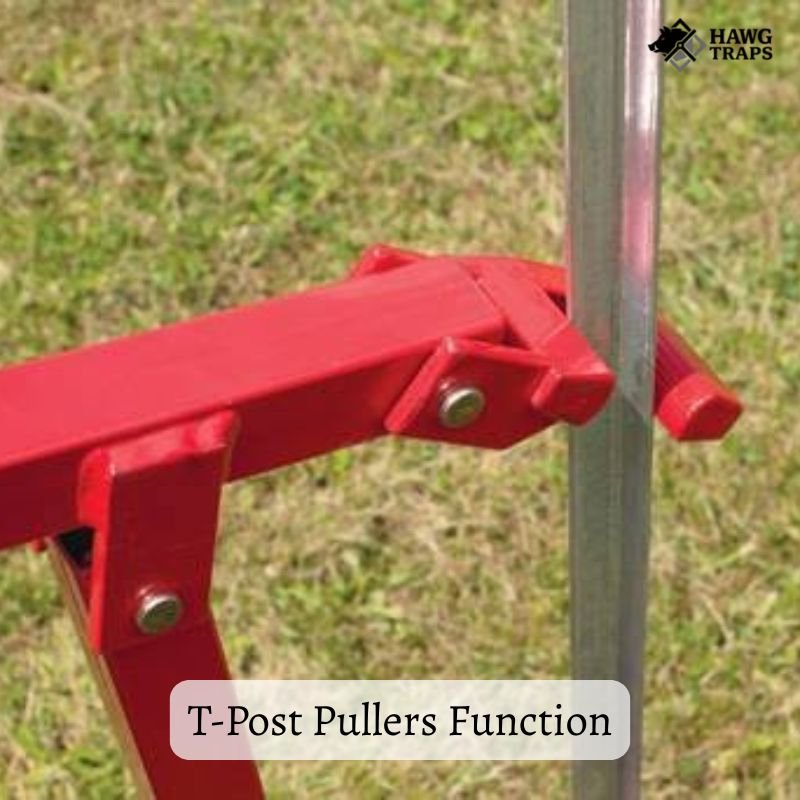
Using a lever T-post puller takes three steps: set the base beside the post, close the jaws around it, and push the handle down. In soft ground, put a board under the base so it doesn’t sink.
Those steps follow JackJaw’s own guide, and they hold for any lever-style puller.
- Set the base. Put it flat on the ground, tight against the post. On soft or wet ground, lay a board down first. JackJaw’s instruction: “Put the board against the base of the post and place the base of the T Post puller on top of the board.”
- Close the jaw. Lift the handle so the jaw opens, and settle it around the post.
- Push down. The handle goes down, the post comes up. Lift the handle and repeat until the post is free.
With a puller plate and a farm jack, it’s two moves. Hook the plate on the post, connect it to the jack, and ratchet up.
How long does it take? In an older thread on the TractorByNet forum, one member put a lever puller at “5-10 seconds to pull a T-post.”
When the post won’t come
Some posts have opinions. A forum member in heavy clay described posts driven deep and rusted to the ground as the hard ones. Here’s what the listings and the reviews suggest.
- Add a board. If the base is sinking, you’re pushing the tool down instead of pulling the post up.
- Add water. One Home Depot buyer, quoted by House Digest, soaked the ground before pulling posts set in concrete. They came out “with ease, concrete and all.”
- Keep the pull straight. A puller leaning to one side bends the post it was bought to save.
- Go find the plate. If nothing moves, dig. The anchor plate is 10 to 16 inches down by our arithmetic, and loosening the dirt above it takes away what the post is hanging on to.
Wear gloves and eye protection, keep your feet clear of the base, and follow the maker’s instructions for the tool you bought.
Posts that come out easily and undamaged can be reused in a new fence line. Our page on T-post drivers covers that half of the job.
What a T-post puller costs, and when it pays for itself
A T-post puller costs from about $15 for a puller plate to about $127 for a manual lever puller, by listings read on 11 October 2026. Professional clamp-jaw pullers run about $300 and up.
Is it worth buying one for a short fence? Here’s a way to think about it. Every post you can reuse is one less replacement to buy. Tractor Supply listed a 6-foot studded T-post at $4.49 on the same day.
| Puller | Listed price | Posts saved to pay for it, at $4.49 a post |
|---|---|---|
| 3 in. plate, Tractor Supply | $15.99 | 4 |
| Country Pro lever puller | $69.99 | 16 |
| Tarter lever puller | $119.99 | 27 |
A puller plate pays for itself in four saved posts and a $70 lever puller in sixteen.
The arithmetic is ours, and it leans on one assumption: If you could remove some posts without damaging them, the puller would take longer to pay for itself. That won’t be true of every post. It’s true of enough of them.
The plate’s number also hides a cost. It requires a farm jack or a loader, and a chain. If those are already on the place, four posts is the whole story. If they aren’t, the lever puller is the cheaper way in.
Many buyers wrote they bought a puller to avoid the strain of trying to remove posts by hand.
Where to buy one: Tractor Supply, Home Depot and Harbor Freight
Tractor Supply, Home Depot, Gemplers and fence suppliers all list T-post pullers. Harbor Freight did not: its site search for “T-post puller” returned no post puller on 11 October 2026.
Tractor Supply had the widest shelf of the stores we read: the Country Pro lever puller, the Tarter folding puller and a $15.99 plate.
Home Depot listed the Maasdam PP-100 at $79.98.
Gemplers listed a USA-made plate at $20.99.
Fence suppliers carry their own. Kencove listed a lever puller at $49.75, Hoover Fence listed the Hi-Lift Post-Popper at $95.66, and American Fence & Supply in Waco and Killeen, Texas listed a red puller at $59.09.
Does Harbor Freight have a T-post puller?
Not that we could find. We searched Harbor Freight’s site for “T-post puller” on 11 October 2026. It returned ten results, and none was a post puller. The closest was a 10-inch fence pliers and staple puller at $11.99. The rest were gear pullers, wheel pullers and a slide hammer.
A lot of people look for this one, and there’s a reason. In an older TractorByNet thread, members talk about a Harbor Freight lever puller that cost under $20. One said it had “never let me down.” Another wasn’t so lucky: “The main weld on my HF puller cracked on the 4th post.”
So it seems the tool existed. We didn’t find it for sale on the day we looked. Stock changes, so run the search yourself before you drive over. If it’s still missing, a $15.99 plate or a $49.75 lever puller fills the same gap.
Which T-post puller to buy
For routine ranch fencing work, our recommendation is a lever puller costing around $70, with a handle at least 36 inches long.
That’s our judgement, built on the listings and the reviews above. Here it is by situation, with the drawback attached to each, because every one of these has one.
For most ranch fence: the Country Pro T-Post Puller. $69.99, a 38-inch bar, a 5 by 5 inch base, a one-year warranty and the biggest pile of reviews we found. The drawback: the listing gives no weight, and the seller says it can’t grab an 18-inch T-post.
If you own a farm jack or a loader: a puller plate. The Tractor Supply plate at $15.99 has the rating. The Gemplers plate at $20.99 is labeled USA made and fits T-posts up to 2 inches wide. The drawback: neither comes with a chain, and neither lifts anything alone.
On a tight budget, no jack: the Kencove T-Post Puller. $49.75 with a wide base, from a fence supplier. The drawback: its 30-inch handle is the shortest one listed here, and the page showed no reviews.
For mixed posts: the Hi-Lift Post-Popper. $95.66, 39 inches, 21 pounds, built from 1 1/2-inch square tubing. With its chain and hook accessory it also takes on wood posts, U-channel posts and posts in concrete footings. The drawback: that accessory is another $26.42, and the page we read had no reviews yet.
One we’d think twice about: the Tarter. It costs the most of the rated pullers and has the lowest rating. Some buyers love it. With a 3.8 rating from 21 reviews and a report of bent steel, we’d make sure to check the return policy before buying.
One we’d skip for ranch work: the professional pullers. JackJaw’s tools start at $350. Tractor Supply lists a Titan PostJak at $299.99, and its small model takes posts only up to 1 inch wide. They’re built for crews. A ranch doesn’t need them.
For the rest of the fencing kit, our page on ranch tools and trapping gear has the full list.
The steel at the end of the fence
Pulling the old posts is half the job. The fence that goes back up needs something to pull against, and that’s the part we build.
Boss Hawg welds H-posts and H-corners in Cross Plains, Texas: the braces that hold a fence’s tension at every end, corner and gate. We ship by freight anywhere in the USA, quoted to your ZIP code before you order.
REQUEST A QUOTE: CALL (254) 725-4554
Tell us the fence height, the wire, and how many ends, corners and gates. We’ll tell you the pipe and what it costs delivered.
Also check our partner products for pulling and resetting T-posts: – T-post pullers and T-post puller plates – Hi-Lift Post-Popper and its chain and hook accessory – Farm jacks and grade 70 chain with hooks – T-post drivers for putting them back – Leather work gloves
As an Amazon Associate we earn from qualifying purchases. Partner products are listed separately from our own and never replace them.
Pulling T-posts without a puller
A T-post can come out without a puller. The common ways are a farm jack with a chain, a loader bucket with a chain, or digging down to the anchor plate with a shovel. Each is slower or riskier.
Farm jack and chain. Chain the post to the jack and ratchet up. One TractorByNet member does it with a C-clamp in place of the chain, and admits to having bent a C-clamp that way. A puller plate is the tidy version of this trick.
Loader bucket and chain. The favorite of anyone with a tractor. As one forum member put it, it “Sure costs a whole lot less than buying a T post puller.” It works. It also goes wrong in ways a hand tool can’t.
- One member hooked the chain about 6 inches off center, and the lift picked up the tractor’s rear wheel.
- The same member warned that a puller mounted on one side of the bucket “puts unbalanced forces on the FEL arms.” FEL is the front-end loader.
- His summary was that a $3 T-post isn’t worth damaging a loader over.
So if the tractor does the pulling, center the chain on the bucket, lift straight up and slowly, and keep people away from the chain.
A shovel. Dig beside the post until you reach the anchor plate, 10 to 16 inches down by our arithmetic. Free the plate and the post lifts out. It’s honest work. It’s also the reason pullers were invented.
A homemade puller. Plenty of people weld one. We don’t publish plans. If you already own a suitable jack or loader, buying a $15.99 plate may make more sense than spending a long time trying to weld a puller.
You may also need to pull T-posts when moving a panel-built hog trap. Texas A&M AgriLife Extension lists T-posts among the main parts of a corral hog trap built from panels. Move that trap to the next field and every one of those posts has to come out and go back in. If hogs are the reason you’re moving posts, our traps are on the hog traps for sale page.
Frequently asked questions
What is the best way to remove a T-post?
The best way to remove a T-post is to pull it straight up with a T-post puller. A lever puller or a puller plate with a farm jack lifts the post without bending it, so it can be used again.
What is the best T-post puller?
For most ranch fence, we’d pick a lever puller around $70 with a handle of 36 inches or more. Tractor Supply’s Country Pro was the most-reviewed one we found, rated 4.8 of 5 by 501 buyers.
Does Harbor Freight have a T-post puller?
Harbor Freight’s site search for “T-post puller” returned no post puller on 11 October 2026. The closest result was a fence pliers and staple puller at $11.99. Check again before you go, since stock changes.
How much does a T-post puller cost?
A T-post puller costs about $15 to $21 for a puller plate and about $50 to $127 for a manual lever puller, by listings read on 11 October 2026. Professional pullers run about $300 and up.
Does Home Depot sell a T-post puller?
Yes. Home Depot listed the Maasdam Pow’R Pull PP-100, a 36.5-inch lever puller, at $79.98 on 11 October 2026. It was rated 4.6 of 5 from 105 reviews.
Can you rent a T-post puller?
We found no rental listing for a hand T-post puller when we looked on 11 October 2026. With plates at about $16 and lever pullers from about $50, buying one is a small outlay.
How do you remove a T-post with a shovel?
Dig beside the post until you reach the anchor plate, then free the plate and lift. On one Tractor Supply listing the plate sits 8 inches from the bottom, so by our arithmetic it is about 10 to 16 inches underground.
How do you pull a stuck T-post?
Put a board under the puller’s base, wet the ground, and pull straight up in short bites. If the post still won’t move, dig down to the anchor plate and loosen the soil above it.
What is a good tool for removing 4×4 posts?
A lever puller with a chain accessory can pull wood posts. Hi-Lift says its Post-Popper, fitted with the chain and hook accessory, handles wood posts and posts set in concrete footings.
Why is it called a T-post?
A T-post is named for its shape. Cut across the post and the steel forms the letter T. The studs along the front hold the fence wire in place.
Before you grab the chain
Go back to that post, the one that wouldn’t move.
This time you set a base beside it, close a jaw around it, and lean on a handle. The post rises a few inches. You take another bite. It rises again, and then it’s lying on the grass, straight as the day it went in, with the plate still wearing a little hat of dirt.
No truck. No banana. No call to the chiropractor.
Buy the plate if the jack is already hanging on the trailer. Buy the lever puller if it isn’t. Then put those straight posts back to work, between braces that won’t lean.
That last part is ours.
REQUEST A QUOTE: CALL (254) 725-4554