
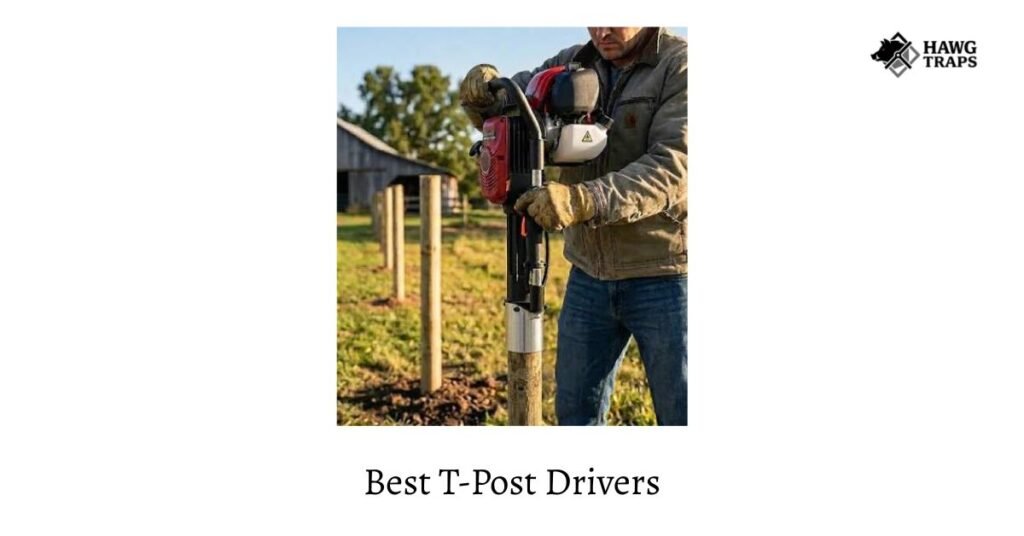
The first T-post of the day feels different.
You set it, drop the driver over the top, and give it a dozen good strokes. The post sinks, the plate disappears, and you stand back like someone who has built something.
The fortieth post will give you a different experience. By then your shoulders are already aching. Your ears are ringing. You’ve started counting how many posts are left, and the answer doesn’t feel exciting.
That’s the whole question with T-post drivers. A steel tube with two handles costs about forty-five dollars and will drive every post you own. A gas-powered one can cost close to fifty times that, and it does the pounding for you. Somewhere between the first post and the four-hundredth, the second one starts to look cheap.
This page sorts out the five kinds, puts fourteen of them side by side with prices, and helps you find where that line is for your fence.
We’re a steel shop. We build hog traps, cattle guards and H-posts, and we don’t make a T-post driver. Some links are affiliate links, and as an Amazon Associate we earn from qualifying purchases.
Key Takeaways
- There are five types of T-post driver: manual, spring-loaded, gas-powered, air-powered and battery-powered.
- The best-reviewed driver we found was a plain manual one. Tractor Supply’s 18.5-pound Country Pro was $44.99 and rated 4.8 of 5 by 553 buyers.
- The spring-loaded driver had the worst rating: 2.1 of 5 from 41 reviews, with 28 one-star reviews.
- One gas driver showed three prices. The Honda-powered Titan PGD3200X was $2,089.41, $2,109.99 and $2,999.99 at three sellers on the same day.
- A hundred feet of fence takes ten to fourteen T-posts. A mile takes 441 to 661. That arithmetic is ours.
- Drive a T-post 18 to 24 inches, until the anchor plate is buried, with the studs facing the livestock.
- Home Depot and Sunbelt Rentals list a gas post driver for rent. Harbor Freight’s site search showed no post driver on 11 October 2026.
Why Trust Us: How We Chose These Drivers
Boss Hawg is a steel shop in Cross Plains, Texas. We weld the H-posts and H-corners that stand at the ends of a fence, along with cattle guards and hog traps. Our team has built ranch fences for a long time, and we use these tools all the time. We also talk with ranchers who use them.
That is experience as users, and it has limits. We have not run a side-by-side test of the drivers on this page. Nobody here drove a hundred posts with each one and timed it. So you’ll find no star ratings of our own and no “winner” badge.
Here’s what you will find.
- Prices, weights and specs come from sellers’ own listings, read on 11 October 2026.
- Ratings are the public ones on those listings, with the star counts behind them.
- The complaints are quoted beside the praise.
- Driving guidance comes from Tractor Supply’s own T-post guide and from fence supplier PowerFlex.
- Where we did arithmetic, or made a judgement, we say so.
We make no driver, so every one here is somebody else’s, and some links pay us a commission. Our editorial policy and affiliate disclosure explains the rest.
What a T-post driver is
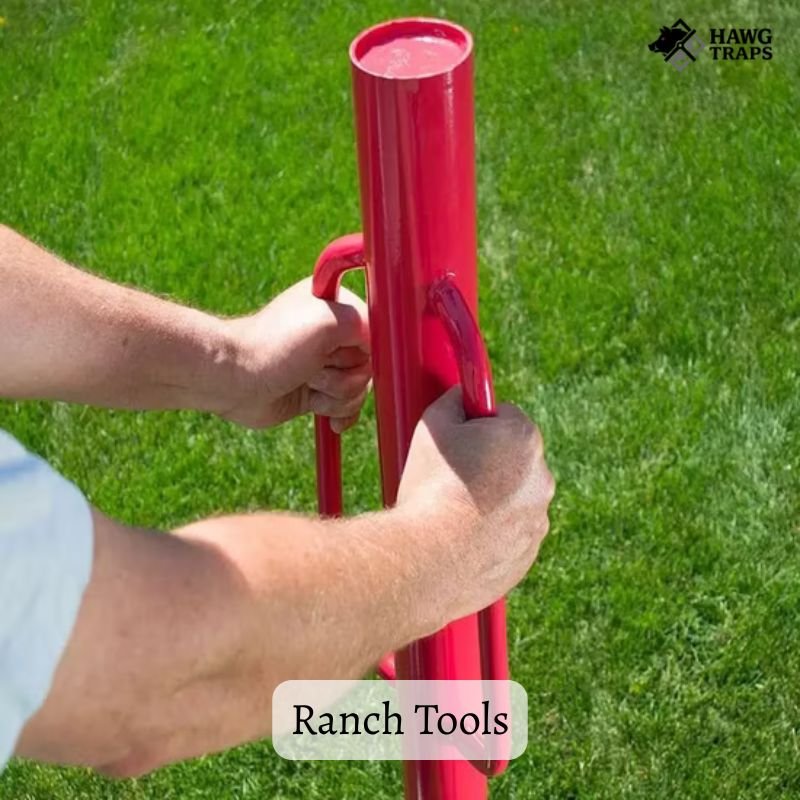
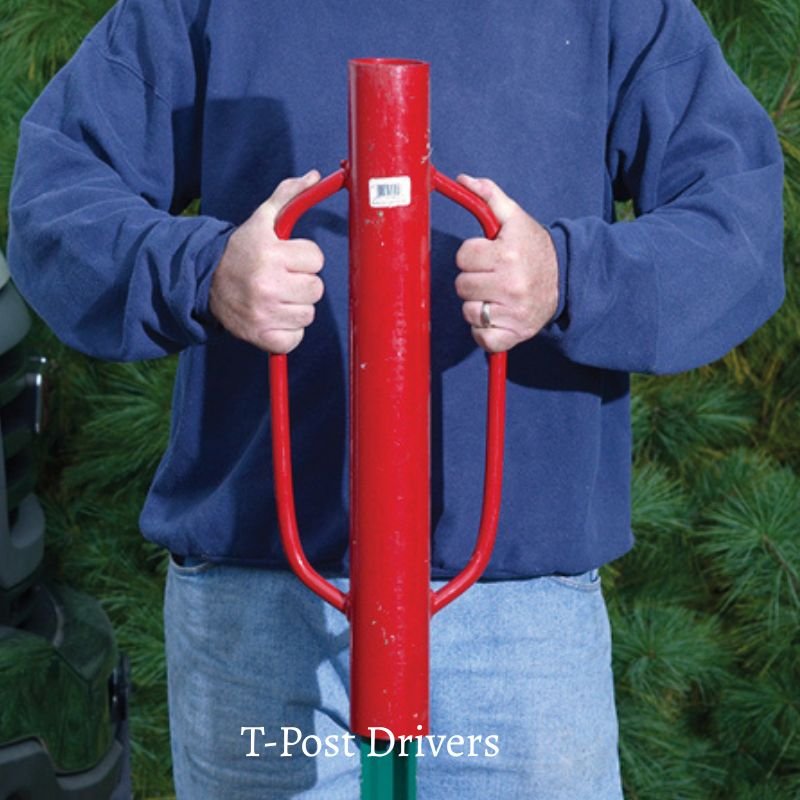
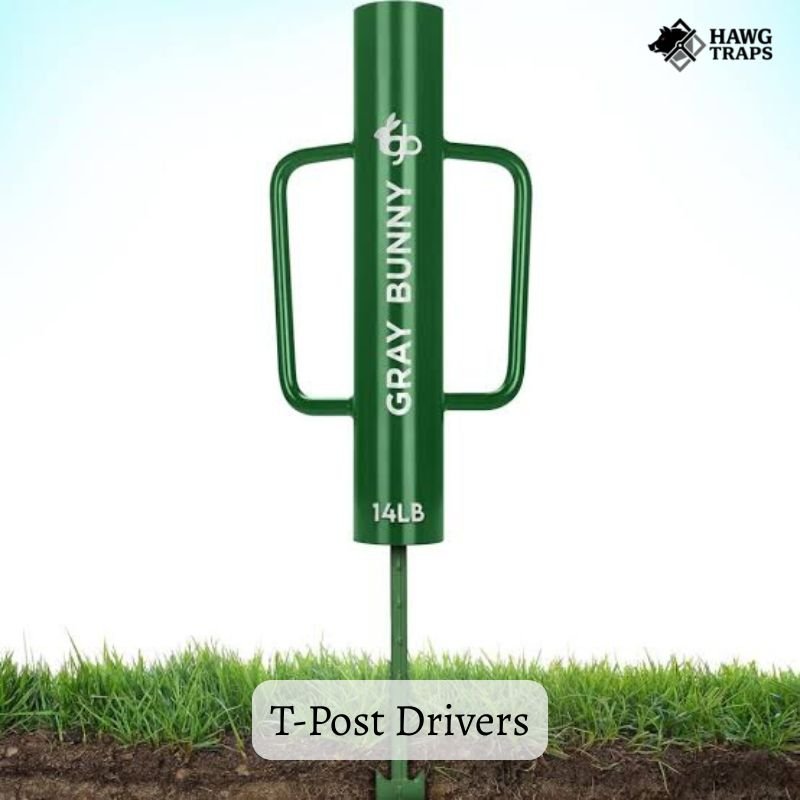
A T-post driver is a weighted steel tube with handles that slides over the top of a T-post. You lift it and drop it, and its weight drives the post into the ground. Powered versions do the hammering automatically.
Tractor Supply’s own fencing guide describes it in a line: “a weighted pipe that slides over the top of a T-post.” You’ll also hear it called a post pounder, a T-post pounder or “the pounder.”
Notice what does the work. It isn’t your arms. Your arms only lift the tube, and gravity and the weight inside it do the hitting. That’s why it’s better than a sledgehammer. The tube can’t miss, because it’s already wrapped around the post.
A T-post is the steel line post in a wire fence, the one with the studs down its face and the anchor plate near the bottom. It’s an inexpensive post, and a driver is what makes it quick to set.

The five types of T-post driver
T-post drivers come in five types: manual, spring-loaded, gas-powered, air-powered and battery-powered. Manual drivers cost $27 to $130, and powered ones ran from $96 on sale to about $3,000 on 11 October 2026.
| Type | What does the hammering | What else you need | Price seen, 11 Oct 2026 | Suits |
|---|---|---|---|---|
| Manual | You, lifting a 15 to 30 pound tube | Nothing | $26.99 to $129.99 | Tens to a few hundred posts |
| Spring-loaded | You, with a spring to bounce the tube back | Nothing | $44.99 to $79.99 | Read the reviews first |
| Gas-powered | A small engine on top of the post | Fuel, and ear protection | $95.99 on sale to $2,999.99 | Hundreds of posts, hard ground |
| Air-powered | Compressed air | An air compressor at the fence line | $479.99 and up | Fence crews with a compressor on the truck |
| Battery-powered | An electric hammer | Charged batteries | $1,299.99 | Buyers who want no fuel and no air hose |
Only the manual and spring-loaded drivers need nothing but you; every powered type needs fuel, air or a charged battery.
Manual
The tube with two handles. The ones we read weigh from 15.5 to 18.5 pounds, with one heavyweight at 30. There is nothing to break and nothing to start.
Spring-loaded
A manual driver with a spring inside. A seller’s answer on Tractor Supply’s listing explains the idea: “the compressed spring is released, bouncing the driver back into position for the next blow.” So the spring is meant to do some of your lifting.
It’s a nice theory. The reviews tell a story from the surface, and we’ll get to them.
Gas-powered
A small engine and a hammer in one unit. You set it onto the post, squeeze the throttle, and hold on while it pounds.
The National AgrAbility Project, which reviews tools for farmers with physical limits, says these drivers are “designed to sink metal T or round posts 3 feet into the ground in as little as 30 seconds.” It adds that they “weigh between 30 and 40 pounds.” Some weigh more. The Honda-powered Titan on this page is 45.
They come in two families. The cheaper ones run a two-stroke engine on mixed fuel. The contractor models run a four-stroke Honda on straight gas.
Air-powered
An air hammer that fits over the post and runs off a compressor. A name that comes up on the farm forums is the Man Saver, made by Rohrer. On the TractorByNet forum, one owner of a well-used Man Saver reports no complaints. His tip is to wait for moist ground, because dry, hard-packed soil makes any driver’s life difficult.
The catch is the compressor. It has to come to the fence with you.
Battery-powered
No engine and no air hose. Tractor Supply listed a Titan residential driver with a 40-volt battery pack at $1,299.99. It had no reviews yet, so all we can tell you is that it exists.
Two more kinds exist that we don’t cover here: hydraulic drivers that mount on a tractor or skid steer, and adapters that turn a demolition hammer into a post driver. We haven’t read enough on either to point you anywhere.
T-post drivers compared: prices, weights and ratings
Fourteen T-post drivers were listed from $26.99 to $2,999.99 on 11 October 2026. The best-reviewed was a manual driver: Tractor Supply’s 18.5-pound Country Pro, rated 4.8 of 5 by 553 buyers.
| Driver | Type | Listed price | Weight | Public rating | Seller |
|---|---|---|---|---|---|
| SpeeCo Deluxe T-Post Driver | Manual | $26.99 | Not read | 4.8 of 5 (151 reviews) | Tractor Supply |
| Country Pro Deluxe Fence Post Driver | Manual | $44.99 | 18.5 lb | 4.8 of 5 (553 reviews) | Tractor Supply |
| CountyLine T-Post Pounder | Manual | $52.99 | 16 lb | 4.6 of 5 (248 reviews) | Tractor Supply |
| Manual Fence Post Driver | Manual | $65.00 | 15.5 lb | None shown | Sandbaggy |
| Ashman Post Driver, Medium | Manual | $66.14 | Not read | 5.0 of 5 (2 reviews) | Tractor Supply |
| Tarter Post Driver, Dual Handle | Manual | $69.99 | Not read | No reviews yet | Tractor Supply |
| Ashman Heavy-Duty Post Driver, Large | Manual | $129.99 | 30 lb | No reviews yet | Tractor Supply |
| SpeeCo Spring-Loaded Post Driver | Spring-loaded | $44.99 | 17 lb | 2.1 of 5 (41 reviews) | Tractor Supply |
| CountyLine Spring T-Post Pounder | Spring-loaded | $79.99 | 15 lb | 4.7 of 5 (9 reviews) | Tractor Supply |
| Sportsman Gas-Powered T-Post Driver | Gas, two-stroke | $95.99 on sale, was $399.99 | 34 lb | 4.3 of 5 (166 reviews) | Tractor Supply |
| Field Tuff Gas-Powered Post Driver | Gas, two-stroke | $699.99 | 41 lb | 3.3 of 5 (11 reviews) | Tractor Supply |
| Titan PGD3200X | Gas, four-stroke Honda | $2,089.41 to $2,999.99 | 45 lb | None shown for this model | Home Depot, Gemplers, Tractor Supply |
| Striker Air-Operated Post Driver | Air | $479.99 | Not read | 5.0 of 5 (3 reviews) | Tractor Supply |
| Titan Residential 40V Post Driver | Battery | $1,299.99 | Not read | No reviews yet | Tractor Supply |
Listed prices ran from $26.99 to $2,999.99, and the three most-reviewed manual drivers all scored 4.6 or higher.
Three things in that table you might want to double check.
The simple tube is the most popular one. The three manual drivers with the most reviews have 952 reviews between them, and none scores below 4.6. It’s hard to build a bad steel tube, and people seem to know it.
Spring is the weak spot. The SpeeCo spring-loaded driver has the lowest score on the page by a long way. Twenty-eight of its 41 reviews are one star.
The same gas driver comes with three prices. The Titan PGD3200X was $2,089.41 at Home Depot, $2,109.99 at Gemplers and $2,999.99 at Tractor Supply on the same day. By our arithmetic that’s a $910.58 spread for one machine. If you buy one, shop three tabs.
What buyers wrote
Country Pro Deluxe weighs 18.5 pounds. 491 five-star reviews out of 553. One buyer wrote that it “drives the post into the ground like a charm!” Another said it “made a laborious job easy.” Seventeen buyers gave it one or two stars, and the listing showed no text for those. Its handles are set out from the tube, which the listing says is to keep fingers from being pinched.
CountyLine T-Post Pounder weighs 16 pounds. 209 five-star reviews out of 248. “This tool works great, and isn’t too heavy.” The complaints are specific. One buyer measured the bore narrower than listed and found “this one will not fit standard U-post.” Another reported a handle that “pulled right out of the side wall.”
SpeeCo Spring-Loaded. The one-star reviews are blunt. “We just bought this today, attempted to use it, and it’s not functional.” Another: “There is a giant weld inside that you have to maneuver the post around.” It also has ten five-star reviews, so some buyers got a good one. A forum member on TractorByNet describes the spring experience from the handle end: “The spring loaded one sends shock waves through my body and does not have enough weight to do the job.”
Sportsman gas driver. 113 five-star reviews out of 166. “Helped us put 70 posts in very quickly and easily!” Another buyer said it “cut our post driving into a third of what it used to take.” The seventeen one-star reviews include this: “Only use for really soft ground. Won’t work if the ground is somewhat hard.”
Field Tuff gas driver. A small, split sample of eleven. On one side: “Drives in fast and in tough, compacted ground.” On the other hand: “On my first attempt it wouldn’t even start to sink the pole.”
Titan. The current PGD3200X showed no reviews on the pages we read. Its discontinued older brother, the PGD3200, has ten reviews at Home Depot and a 4.1 rating. One owner wrote “Works great for t-posts even in hard ground.” Another found the catch: “It’s heavy and you need someone to hold the t post or pound it in a way before using this.” Those reviews are for the older model, so treat them as family history.
What weight of manual driver to use
Most manual T-post drivers weigh 15 to 18.5 pounds, by the listings we read. A heavier driver does more of the work on each stroke and saves your energy, so 16 to 18.5 pounds is where we’d start.
The weights on the shelf cluster tightly: 15.5, 16, 17 and 18.5 pounds. One seller goes so far as to call 16 pounds “the ideal weight,” which is the kind of thing you’d expect the seller of a 16-pound driver to say.
Here’s the trade, as plainly as we can put it.
Heavier hits harder. A forum member who built his own driver, with extra weight welded on top, says the weight “does about half the work.” He recommends going heavier for hard soil.
Heavier also wears you out. Another member, describing his dad’s heavy homemade pounder, says it “really gives your arms a workout.” Every stroke is a lift, and lifting that a few hundred times isn’t an easy job.
The 30-pound driver is a different tool for different work. The one we found is 6.5 inches across, sized for much bigger posts than a T-post.
So our judgement, and it is only that: buy in the 16 to 18.5 pound range. If you’re strong and the ground is hard, go to the top of it. If you’ll be driving posts all afternoon, a pound or two lighter can have a real positive effect on your experience.
One more thing that isn’t on any spec sheet: length. A tall forum member found that short drivers “will come off of the post if I try to really whale on it.” If you’re tall, look for a longer tube. The CountyLine’s listing gives its length as 26-3/4 inches. Most listings don’t say.
When a gas-powered driver is worth it
A gas-powered driver is worth it when you have to work with hundreds of posts. One fence builder’s rule is that a few hundred posts can be done by hand, and a few thousand justify a powered driver.
That rule comes from a TractorByNet thread, and it’s a good one. To use it, first consider how many posts you need for the fence. Tractor Supply’s guide puts T-posts 8 to 12 feet apart, and says 10 to 12 feet is enough for a five- or six-strand barbed wire fence. Here’s what that works out to.
| Fence length | Posts at 12 ft apart | Posts at 10 ft apart | Posts at 8 ft apart |
|---|---|---|---|
| 100 feet | 10 | 11 | 14 |
| A quarter mile (1,320 feet) | 111 | 133 | 166 |
| Around a square 2 acres (1,181 feet) | 100 | 120 | 149 |
| A mile (5,280 feet) | 441 | 529 | 661 |
A hundred feet of fence takes ten to fourteen T-posts; a mile takes 441 to 661.
The arithmetic is ours. It counts line posts only and ignores corners, gates and braces, which take a different kind of post. Use the table for sizing the job, not for ordering to the last post.
Now put a price on it. Say you buy the Titan at $2,089.41 and build one mile of fence with posts every 10 feet.
- One mile, 529 posts: the driver costs about $3.95 a post. A 6-foot T-post was $4.49 at Tractor Supply. So the machine nearly doubles the cost of every post you set.
- A quarter mile, 133 posts: the driver costs about $15.71 a post.
Those are our calculations, and they assume you will never have to use the driver again. Use it on a second mile and the cost per post becomes halved.
That’s the money. The other half is ground. One buyer of the $96 driver says to use it only “for really soft ground.” An owner of the older Titan says his drove T-posts “even in hard ground.” Two reviews aren’t a test, but they point the same way: if your ground is hard, the cheap gas driver may not be the bargain it looks.
So renting can be a better option before you buy one. More on that below.
Did you know? A gas post driver does not make the job silent or weightless. Home Depot’s rental listing puts its unit at 45 pounds and 85 decibels. You still have to lift it onto every post, and you still want ear protection.
How to drive a T-post
Drive a T-post 18 to 24 inches deep, until the anchor plate is fully buried. Face the studs toward the livestock, set the driver over the post, and keep the post plumb for the first few strokes.
Before the first stroke
Pick the post length. Tractor Supply’s rule is posts “between 18 inches to three feet longer than the intended height of the fence.” PowerFlex is more specific: “A 48-in. fence wants roughly a 6.5–7 ft post.” By our arithmetic, a 4-foot fence plus 18 to 24 inches in the ground is 5.5 to 6 feet at the very least, so a 6-foot post is the floor and 6.5 gives you room.
Face the studs the right way. The studs are the bumps that hold the wire. PowerFlex: “Studs face the livestock side so wire pulls against the post.” Tractor Supply says the same thing from the other direction: studs inward if the animals push from the inside.
Know what’s under you. The Rhino driver manual says to have underground utilities located before you drive anything. This is a vital step before you take any diction. In the US that’s a free call to 811. Thy will let you know the underground utilities.
Driving it
- Stand the post on its mark, studs facing the stock.
- Lower the driver over the top. Don’t drop it on from a height.
- Start with short strokes. The first few set the direction, so check the post is plumb. A TractorByNet member uses a pipe wrench to twist a post back into line while it’s still shallow.
- Drive to depth. Tractor Supply: “deep enough to completely bury the anchor, about 18-24 inches deep.” PowerFlex says to go deeper in sandy or soft ground.
- If you hit rock, move. The same forum thread: shift a few inches and try again.
- Lift the driver straight off.
Keep the driver on the post the whole time. The stroke only needs to be long enough to do the work, and a tube that clears the top of the post on the way up has nowhere good to land.
Safety
For a manual driver, Tractor Supply’s guide says to wear “pants, a long-sleeve shirt, work gloves, and eye protection.” For a powered one, the Rhino manual adds safety shoes and hearing protection, and it wants bystanders in safety glasses and hearing protection too. It also says never to run the driver unless it’s sitting on a post.
What the driver doesn’t do
T-posts are line posts. They hold the wire up. They don’t hold the tension. Tractor Supply’s guide says corners and gates are “best built with a solid wood fence post set in concrete and braced.” In pipe, that’s an H-brace, and our page on H posts and H braces covers how to size one.
And if a post goes in the wrong place, the anchor plate will make you regret it. Our page on T-post pullers covers getting it back out.
Where to buy or rent one
Tractor Supply listed seventeen post drivers on 11 October 2026. Home Depot and Sunbelt Rentals both list a gas post driver for rent, with rates by location. Harbor Freight’s site search returned no post driver.
Does Tractor Supply sell a T-post driver? Yes, and plenty of them. Its post driver category showed 22 products that day. Five were pullers and adapters, which leaves seventeen drivers: manual, spring-loaded, gas, air and battery.
Can you rent a T-post driver? A gas one, yes. Home Depot lists a “Gas Post Driver Rental,” a 45-pound unit, and tells you to call your local store. Sunbelt Rentals lists a gas-powered post driver too. Neither page showed a price when we looked, so we can’t give you one. Call with your ZIP code and ask for the four-hour and daily rates.
Renting makes the most sense if you have to work with a lot of posts. It’s also the cheapest way to find out whether a gas driver will sink a post in your ground before you spend $2,000 on the answer.
Does Harbor Freight have a T-post driver? Not that we could find. We searched its site for “T Post Driver” on 11 October 2026 and got three results, none of them a post driver. Stock changes, so we recommend researching yourself before you drive over.
Buying a gas driver direct. AgrAbility names four makers of hand-held gas drivers: Titan, Skidril, Rhino and Redi-Driver. Its 2024 listing put the price range at $560 to $2,400.
The best T-post driver for your fence
For most ranch fence, we’d buy an 18.5-pound manual driver for about $45. For several hundred posts or hard ground, we’d rent a Honda-powered gas driver before buying one at $2,100 or more.
That’s our judgement, built on the listings and reviews above. Here it is by situation, with the drawback on each.
For most people: the Country Pro Deluxe, 18.5 pounds. $44.99, a 2-3/4 inch tube, a one-year warranty and 553 reviews at 4.8. The drawback: 18.5 pounds is the heaviest of the standard drivers here, and the listing gives no length.
For a lighter lift: the CountyLine T-Post Pounder, 16 pounds. $52.99 and 248 reviews at 4.6. The drawback: a narrower tube that one buyer says won’t take a standard U-post, and one report of a handle pulling out.
On the tightest budget: the SpeeCo Deluxe. $26.99 with 151 reviews at 4.8. The drawback: we read it on the category page only, so we can’t tell you its weight.
One we’d leave for the later: the SpeeCo Spring-Loaded. A 2.1 rating from 41 buyers is hard to argue with. If you want a spring, the CountyLine spring pounder had a 4.7, though from only nine reviews.
For a few hundred posts in soft ground: the Sportsman gas driver. At a sale price of $95.99 it costs about the same as two manual drivers, with 166 reviews at 4.3. The drawbacks: it’s a two-stroke, so you mix fuel. It weighs 34 pounds. Buyers on hard ground say it won’t sink a post, and the listing says it isn’t shipped to California.
For serious fence and hard ground: a Honda-powered driver such as the Titan PGD3200X. A four-stroke Honda engine, up to 1,850 blows a minute, a lifetime warranty on the hammer and a “USA Made” badge. The drawbacks: $2,089 at the cheapest seller we found, 45 pounds to lift onto every post, and no public reviews of this model on the pages we read. Rent one first.
If you already own a compressor: an air driver. The Striker was $479.99 with three five-star reviews. The drawback: three reviews is not a track record, and the compressor has to follow you down the fence.
Once the posts are in, the wire needs tightening. Our page on fence stretchers covers that, and the full fencing kit is on our page of ranch tools and trapping gear.
The posts a driver can’t set
A driver sets the line posts. The posts at the ends, corners and gates carry the pull of every wire on the fence, and they need to be built, not pounded.
Boss Hawg welds H-posts and H-corners in Cross Plains, Texas, for exactly those spots. We ship by freight anywhere in the USA, quoted to your ZIP code before you order.
REQUEST A QUOTE: CALL (254) 725-4554
Tell us the fence height, the wire, and how many ends, corners and gates. We’ll tell you the pipe and what it costs delivered.
Also check our partner products for driving T-posts: – Manual T-post drivers and gas-powered post drivers – Titan post drivers and air-powered post drivers – T-post clips and a T-post clip tool – Hearing protection, safety glasses and leather work gloves – T-post pullers for the ones that went in wrong
As an Amazon Associate we earn from qualifying purchases. Partner products are listed separately from our own and never replace them.
Driving T-posts without a driver
A T-post can be driven without a driver. Tractor Supply’s own guide says a sledgehammer can be used if needed, and some people press posts in with a loader bucket. Both are harder to do safely.
A sledgehammer. It works for a post or two. The top of a new 6-foot post is above most people’s shoulders, so the hammer ends up swung from a ladder or a truck bed, and that’s where the trouble starts.
A loader bucket. A TractorByNet member presses T-posts in with a front-end loader, then finishes with a hammer. He slides a pipe over the post so it doesn’t bend, and he has a warning for anyone trying it: the “front of tractor can and will raise off of ground and slip to the side, bending post.” Keep any helper well clear of the bucket and the post.
A homemade driver. Plenty of people build one. On the Yesterday’s Tractors forum, the usual recipe is a length of 2-1/2 inch pipe with weight added at the top. One member used a section of forklift mast. Another warns that a T-post eventually punched through the cap on his. We don’t publish plans. If you have a well-reviewed driver at $26.99, a homemade one is a welding project more than a saving, and we say that as people who like a welding project.
Frequently asked questions
What is the best way to drive T-posts?
The best way to drive T-posts is with a T-post driver, a weighted tube that slides over the post. Tractor Supply’s guide says it “works best.” For several hundred posts, a gas-powered driver saves your arms.
What weight T-post driver should I use?
Most manual T-post drivers weigh 15 to 18.5 pounds. We’d start between 16 and 18.5 pounds. Heavier drives harder on each stroke and makes you tired sooner, so choose by your strength, ground and capability of work.
Are gas-powered T-post drivers worth it?
Gas-powered drivers are worth it when the job runs to several hundred posts or the ground is hard. A Honda-powered driver was listed from $2,089.41 on 11 October 2026, so rent one first if you can.
How deep should I drive a T-post?
Drive a T-post about 18 to 24 inches deep, far enough to bury the anchor plate completely. Tractor Supply’s guide and fence supplier PowerFlex both give that figure. Go deeper in sandy or soft ground.
How many T-posts do I need for a 100-foot fence?
A 100-foot fence takes 10 to 14 T-posts at 8 to 12 feet apart, by our arithmetic. That includes line posts only. Corners, ends and gates need braced posts on top of that.
How far apart should T-posts be?
Tractor Supply’s guide says 8 to 12 feet apart, with 10 to 12 feet enough for a five- or six-strand barbed wire fence. PowerFlex gives 8 to 12 feet for woven wire and wider for cattle on barbed wire.
Can you rent a T-post driver?
Yes, a gas-powered one. Home Depot and Sunbelt Rentals each list a gas post driver for rent. Neither page showed a rate on 11 October 2026, so call your local store for the price.
Does Tractor Supply sell a T-post driver?
Yes. Tractor Supply’s post driver category showed seventeen drivers on 11 October 2026, from a $26.99 manual driver to a $2,999.99 gas-powered one.
Which way are T-posts supposed to face?
T-post studs face the livestock side, so the wire pulls against the post. Tractor Supply’s guide says to face the studs inward if animals will press on the fence from the inside.
How tall should a T-post be for a 4-foot fence?
A 4-foot fence takes a T-post of 6 to 7 feet. PowerFlex recommends roughly 6.5 to 7 feet for a 48-inch fence. The extra length is the 18 to 24 inches that goes in the ground.
Before you lift that tube
Think back to the fortieth post, and the arithmetic you were doing in your head.
Now before you start, you can do it on paper. Count the posts. If the number is in the dozens, buy the forty-five dollar tube and enjoy the exercise. If it’s in the hundreds, make a phone call to a rental counter. If it’s in the thousands, you already know.
Then drive them straight, studs to the stock, plate out of sight.
The posts in between are yours to pound. The ones at the ends are ours to build.
REQUEST A QUOTE: CALL (254) 725-4554