
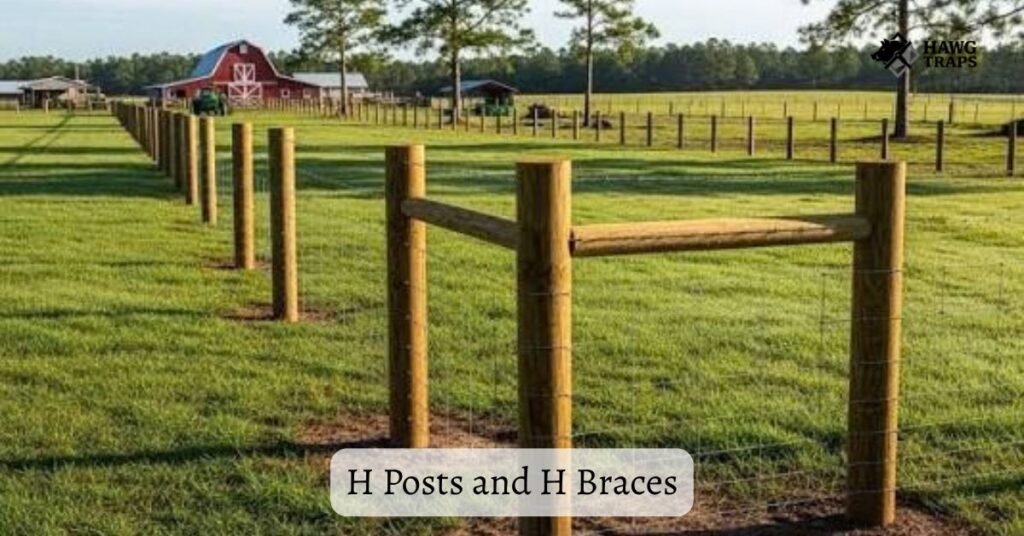
Fences doesn’t hide where it’s weak. Go and look at the corner.
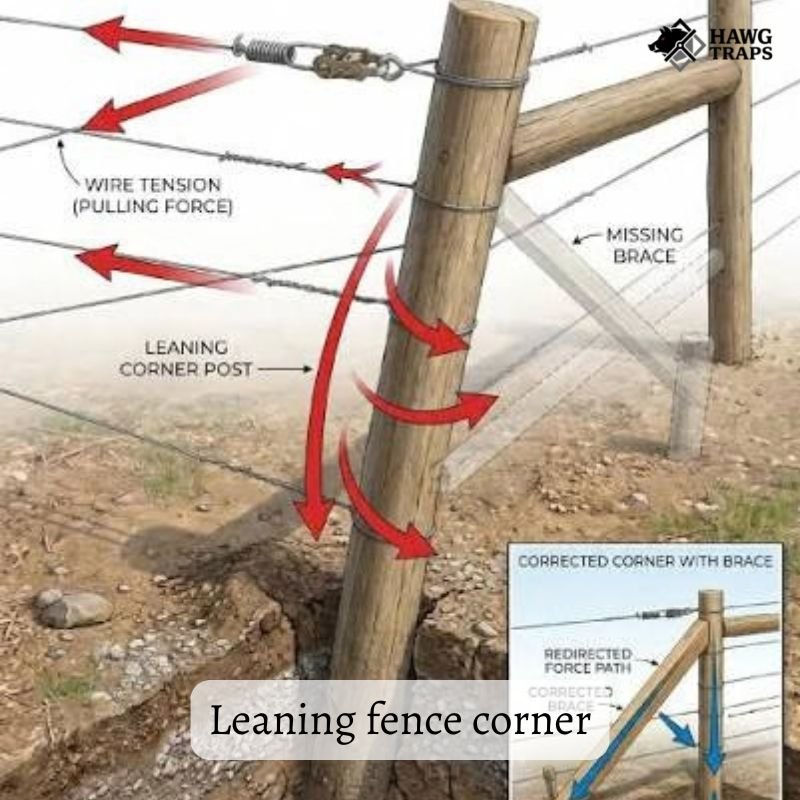
If the corner post is leaning in toward the wire, like a man pulling on a stuck rope, the fence is already lost. The wire didn’t fail. The staples didn’t fail. The corner gave up one wet winter at a time, and every strand was affected by it.
The cure is shaped like a letter of the alphabet. It’s two posts and a crosspiece. Ranchers call it an H-brace, an H post, or just “an H.”
It looks too simple to get wrong. It can go wrong three ways: it can be too narrow, it can be too shallow, or it can be wired backwards. This page lays out the numbers that keep it standing.
We’re a steel shop, and we weld H-posts and H-corners. Some links to other products are affiliate links, and we may earn from qualifying purchases.
Key Takeaways
- An H post is a fence brace: two upright posts joined by a horizontal rail. It’s the same thing as an H-brace.
- A fence needs one wherever it starts, stops or turns. The NRCS fence specification for Texas counts any change in direction of 20 degrees or more.
- Width matters most. Fence suppliers’ guides ask for at least twice the fence height between posts, which is 8 feet for a 4-foot fence.
- Depth comes next. The Texas specification sets a minimum of 3 feet. University Lands in Texas sets 4 feet, in cement.
- Pipe starts at 2 3/8 inches in the NRCS documents and 2 7/8 inches at University Lands.
- A ready-welded pipe H-brace was listed from $90 to $219.99 on 7 October 2026.
- Boss Hawg builds H-posts and H-corners to order in Cross Plains, Texas.
Why Trust Us: How We Put This Together
Boss Hawg is a steel shop in Cross Plains, Texas. We weld H-posts and H-corners, along with cattle guards and hog traps. We work with these products on ranch ground.
We haven’t pull-tested any brace on this page, ours included. So the numbers here aren’t ours. They belong to the people who wrote them down.
- The rules come from two NRCS documents and one Texas land office. NRCS is the Natural Resources Conservation Service, part of the U.S. Department of Agriculture. The land office is University Lands, part of the University of Texas System.
- The wood-brace guidance comes from three published guides, in The Cattleman, Progressive Cattle and a fence supplier’s blog. We name each one.
- Prices come from sellers’ own listings, read on 7 October 2026.
- Where we did arithmetic, we say so.
- Where sources disagree, we show both. We do not make up numbers.
What an H post is
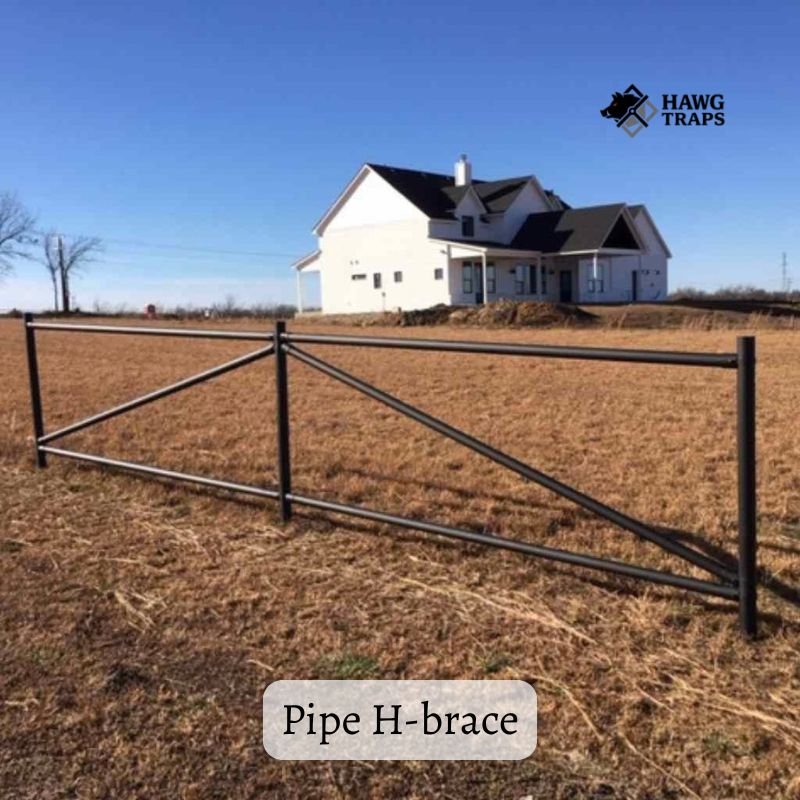
An H post is a fence brace shaped like the letter H: two upright posts joined by a horizontal rail. Fence builders also call it an H-brace. It anchors the end, corner or gate of a wire fence.
The names pile up fast, so here they are in one place.
- H post, H-brace, an H. All the same thing. One Texas steel yard sells them by the letter. Pioneer Steel & Pipe in Waco lists “standard H’s, half H’s, Corner H’s, and H’s with kickers.”
- End post or anchor post. The upright the fence wire ties off to.
- Brace post. The second upright, a few feet down the fence line.
- Rail, cross member or horizontal brace. The crosspiece between them.
On this page an H post is a fence brace. It is not the slotted H-shaped post that holds vinyl or aluminum fence panels, and it is not the wire H-stake that holds a yard sign. Search for “H post” and you’ll get all three.
An H-brace is fixed steel: you set it once and it stays. That puts it in the third group on our ranch equipment list, the group where the spec matters more than the price.
What an H-brace does
An H-brace holds a fence’s tension. Stretched wire pulls the end post toward the fence line, and the brace passes that pull to a second post. One fence maker rates a single H-brace at 1,500 to 3,000 pounds.
A wire fence is a row of posts with one long pull running through it. The line posts in the middle don’t feel that pull, because the wire doesn’t pull them in any direction. It maintains tension from both directions. The last post gets it all from one side.
Left alone, that post behaves like a lever with the ground as its hinge. It tips, slowly. The H-brace gives it a partner. The rail pushes against the brace post, and the two posts resist together.
How much pull are we talking about? Wire maker Stay-Tuff puts a number on it. A single H end brace, it says, “can withstand a force of between 1,500 and 3,000 pounds, depending on width, depth of posts, and soil type.”
Read the second half of that sentence again. Width, depth and soil can double the figure or halve it. Stay-Tuff doesn’t publish how it tested, so treat it as one maker’s range. The rest of this page is about the two things on that list you control.
Where a fence needs an H-brace
A fence needs an H-brace wherever it starts, stops or turns. The NRCS fence specification for Texas requires a brace assembly at each of those points, counting any change in direction of 20 degrees or more.
That’s the March 2021 edition of the Texas specification. Walk your fence line with it and the list gets specific.
- Every end. Where the fence starts and where it stops.
- Every corner. Any turn of 20 degrees or more.
- Both sides of every gate. A gate is a place where the fence stops and starts again. The Cattleman, the magazine of the Texas and Southwestern Cattle Raisers Association, says it plainly: “on either side of a gate.”
- Either side of a cattle guard. By the same logic, the fence stops at the guard and starts again past it. That’s our reading of the rule. Our cattle guards for sale page covers the guard itself.
The 2015 edition of the Texas specification adds one more line worth knowing. A gate should hang directly on a brace assembly post, not on a lone post beside one. Gate width and entrance posts are covered in our ranch entrance gates guide.
What about a short fence? It’s a common question people ask. One of the search results for “H brace” is a homesteader asking, “Do I need H braces on short lengths of fence?” Stay-Tuff’s answer is yes. A brace is required, it says, “every time a fence starts, stops, or changes direction, regardless of the length of the run.”
What about a long one? Here the sources are part company, and we’ll show you both.
- Stay-Tuff: single H-braces “can be up to 1320′ apart.”
- Tractor Supply, on the listing for its 4-foot pipe H-brace: set them in concrete and space them “100 to 150 ft. apart.”
That isn’t a small disagreement. One is a wire maker describing a full-size brace on tensioned wire. The other is a retailer describing a light, narrow unit that supports T-posts. They aren’t describing the same brace, and none of them is a law. The 2021 Texas specification gave no interval that we could find.
Did you know? 1,320 feet is exactly a quarter of a mile. On Stay-Tuff’s figure, a mile of straight fence needs a brace at each end and three in between.
H-brace dimensions: width, depth and post size
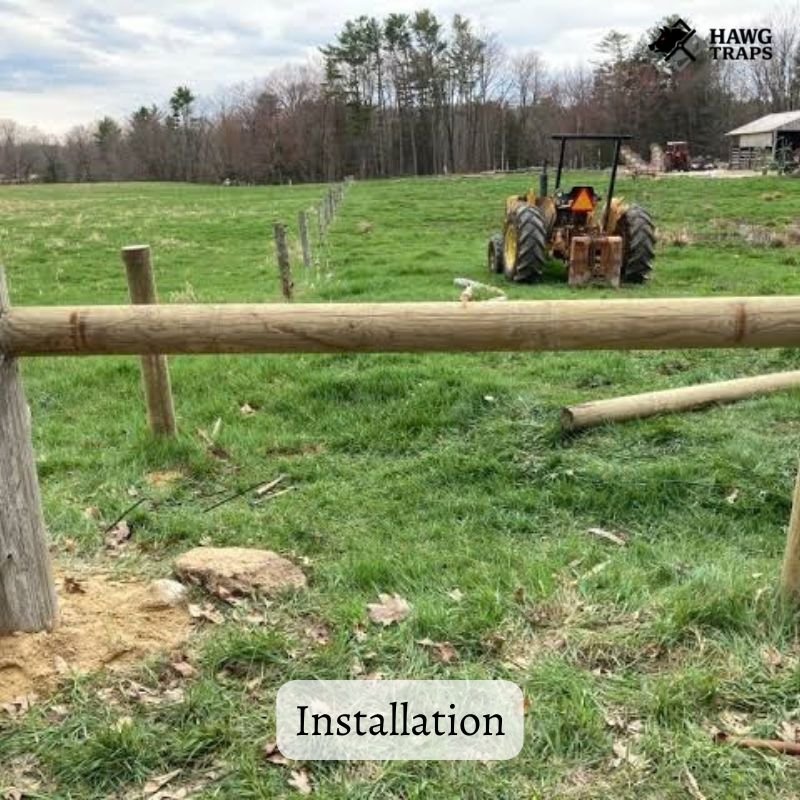
Fence suppliers’ guides set an H-brace at least twice as wide as the fence is tall: 8 feet for a 4-foot fence. NRCS specifications put posts at least 3 feet deep and pipe at 2 3/8 inches or more.
Here are six published sources, side by side. We couldn’t find a clean sheet about it, so we made it.
| Source | Width between posts | Depth in the ground | Post size |
|---|---|---|---|
| NRCS Texas fence specification (2015 and 2021 editions) | 6-foot brace, for steel pipe | At least 3 feet | Pipe: 2 3/8 inches minimum |
| University Lands, Texas (pipe H-brace) | Holes 8 feet apart | 4 feet, in cement | Pipe: 2 7/8 inches minimum |
| NRCS Arkansas H-brace fact sheet (2009) | 6 to 10 feet | Wood: at least 36 inches | Wood: 5-inch top. Pipe: 2 3/8 inches |
| The Cattleman, TSCRA (2017) | At least 2 times fence height; 2.5 times is better | 3.5 to 4 feet for a 4-foot fence | Treated round posts |
| Progressive Cattle (2016) | 2 times post height; never under 8 feet | 3 to 5 feet | Wood: 5 inches minimum |
| Kencove Farm Fence (2021) | 2 times fence height; 8 feet minimum | 42 inches if hand-dug | Wood: 6 to 7 inches at the corner |
Six published sources ask for 6 to 10 feet between posts and at least 3 feet in the ground.
The width rule is simple arithmetic. For a 4-foot fence, twice the height is 8 feet and 2.5 times is 10. None of these guides argues for a narrower brace. Where they give a preference, it’s for wider.
The full pipe spec. University Lands publishes the most complete pipe H-brace design we found. Here it is.
- All pipes are at least 2 7/8 inches, with every joint welded.
- Three holes, each at least 12 inches across and 4 feet deep, centers 8 feet apart.
- Two uprights 9 feet long: 4 feet buried, 5 feet above ground.
- One horizontal rail welded 48 inches above the ground.
- A short third post it calls the “stob/kicker”: 5 feet long, with 1 foot showing.
- A diagonal welded from the rail height down to the top of that stob.
- Everything is buried in cement and capped at the top. The cap is cheap but protects it effectively.
Add it up and that’s about 39.5 feet of pipe. At 5.8 pounds a foot, a common weight for 2 7/8-inch pipe, the steel alone comes to roughly 230 pounds. That’s our arithmetic, and the wall thickness is our assumption. University Lands doesn’t state one.
Now the store-bought ones. Here are five ready-welded units, from three sellers’ listings.
| Unit | Pipe or tube | Width | Height | Weight |
|---|---|---|---|---|
| Tractor Supply Fence H-Brace with 1 Rail | 2 3/8-inch pipe | 48 inches | 7 feet | 65 lb |
| Priefert H-brace, 4-foot | 2.87-inch, 11-gauge tube | 48 inches | 96 inches | 70 lb |
| Priefert H-brace, 8-foot | 2.87-inch, 11-gauge tube | 96 inches | 96 inches | 78 lb |
| Mountain Country HD H-brace, 4-foot | 2 3/8-inch pipe | 4 feet | Not listed | Not listed |
| Mountain Country HD H-brace, 6-foot | 2 3/8-inch pipe | 6 feet | Not listed | Not listed |
Three of the five store units are 4 feet wide, which is narrower than any figure in the table above.
Why 4 feet? Tractor Supply’s listing answers that one honestly. The 48-inch width, it says, allows “easy loading into the bed of a standard size pickup truck.” The width was set by the truck, not by the fence.
Here’s what we can and can’t tell you about that. We found no published test of a 4-foot welded H against an 8-foot one, so we won’t say the short one fails. A welded pipe H set in concrete isn’t the same animal as a wood one held by wire. What we can say is that it’s half the 8 feet several guides ask for. By our arithmetic, it’s also a little over a quarter of the weight of the University Lands design.
One more piece of arithmetic, because it’s useful. The Tractor Supply unit has two 7-foot posts and a 4-foot rail. That’s 18 feet of pipe weighing 65 pounds, or 3.6 pounds a foot. A supplier’s chart puts 2 3/8-inch pipe with a 0.154-inch wall at 3.66 pounds a foot. Pipe sizes, walls and weights are laid out on our pipe ranch gate entrances page.
Wood and pipe H-braces, and the brace wire
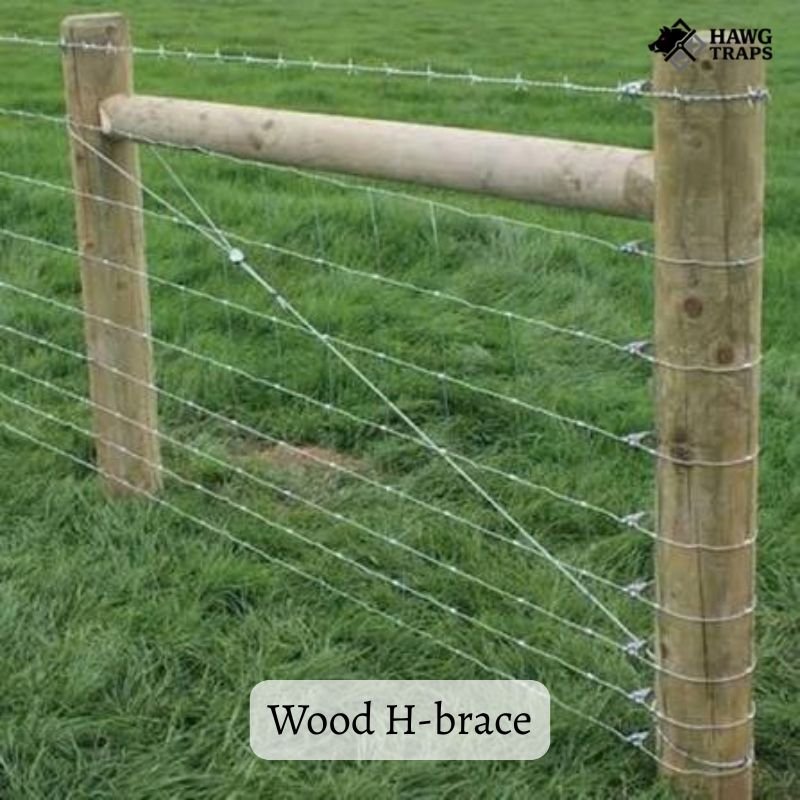
A wood H-brace needs a diagonal brace wire to work. The NRCS specification for Texas asks for two loops of wire on wooden assemblies, and for all steel brace assemblies to be welded.
In wood, the rail only pushes. Something has to pull, and that’s the wire. Without it, a wood H is nothing but two posts and a stick.
- What wire. The Texas specification asks for two loops of 9-gauge smooth wire or 12 1/2-gauge high tensile smooth wire. The Cattleman’s guide agrees on the lighter of the two: “Two wraps of 12.5-gauge high tensile smooth wire work best.”
- Which way it runs. This is the part people get backwards. In Progressive Cattle, engineer James Falbo runs the wire around the bottom of the corner post and the top of the brace post. Put it on the opposite way, he warns, and it “makes this three-post H-structure weaker.”
- How it’s tightened. The loops are twisted until tight, which is why NRCS calls it a “twitch wire.” One supplier’s guide uses an in-line strainer instead.
- What posts. The Cattleman’s guide is blunt: “never use milled lumber such as landscape timbers or 4x4s.” Its instruction is “Always use treated round posts.”
An easy way to remember the wire: it starts low on the post the fence is pulling, and climbs toward the fence. The posts are more stable at the bottom.
In pipe, the joints can do what the wire does. A weld holds in both directions, push and pull. That’s our reading of why the specifications treat the two differently. The Texas specification says “All steel brace assemblies will be welded,” and its wire rule sits under wooden assemblies. University Lands uses no wire at all. It welds in a pipe diagonal instead.
That doesn’t mean pipe never gets wire. Fence maker Bekaert sells bolt-together pipe brace kits, and it describes a pipe H-brace as “three posts and bracing wire.” If the joints aren’t welded, the wire is back on the job.
Set in concrete, or driven? The Cattleman’s guide prefers driven posts, saying a driven post “can withstand greater force than one placed in a drilled hole.” University Lands and Tractor Supply both specify concrete for pipe. Wood guides lean one way and pipe specifications lean the other. Follow the instructions for the brace you actually have.
Whatever the material, cap the tops. The Texas specification wants steel pipe “permanently capped.” An open pipe post is a rain gauge you never wanted.
Single H, double H, corner H and the kicker
H-braces come as a single H, a double H, a corner H and an H with a kicker. One fence maker says a double H supports 40 to 50% more force than a single.
Single H. Two posts, one rail. The standard end brace.
Double H. Three posts in a row with two rails. A University of Wisconsin-Extension guide prefers adding a second brace post over stretching one long rail. It says double H’s are “more common in taller multi-wire fences, such as deer fence.”
Corner H. Two braces sharing one corner post, one down each fence line. Tractor Supply’s version has three capped posts set at 90 degrees.
H with a kicker. An H plus a diagonal running down to a short post in the ground. That’s the University Lands design. It calls the short post a “stob.”
Half H. Pioneer Steel & Pipe lists these too. We haven’t seen its definition, so we won’t guess at one. Ask before you buy.
When do you need a double? Three guides give a threshold, and they roughly agree.
- Kencove: fences under 54 inches with one to six strands need a single H. Taller fences with seven or more strands “will require double H braces.”
- Progressive Cattle: with six or more high-tensile wires, “you may need two H-braces side by side.”
- Stay-Tuff: a double H “will support 40 to 50% more force than a Single-H Brace.”
So which bracing is strongest? Among the designs with a published figure, the double H. We found no published test that sets an H-brace against a plain diagonal brace, so that question stays open here.
What H-braces cost
A ready-welded pipe H-brace was listed from $90 to $219.99 on 7 October 2026, depending on pipe size, width and seller. Corner units ran $219.99 to $330. A no-weld hardware kit started at $22.95.
| Product | Listed price | Seller | Date checked |
|---|---|---|---|
| H-brace, 2 3/8-inch pipe | $90.00 | Wheeler Metals | 7 Oct 2026 |
| H-brace, 2 7/8-inch pipe | $120.00 | Wheeler Metals | 7 Oct 2026 |
| H-brace, 3 1/2-inch pipe | $168.00 | Wheeler Metals | 7 Oct 2026 |
| H-brace, 4 1/2-inch pipe | $175.00 | Wheeler Metals | 7 Oct 2026 |
| HD H-brace, dual rail, 2 3/8-inch, 4-foot | $155.00 | Mountain Country Equipment | 7 Oct 2026 |
| HD H-brace, dual rail, 2 3/8-inch, 6-foot | $165.00 | Mountain Country Equipment | 7 Oct 2026 |
| Priefert H-brace, 2.87-inch tube, 4-foot or 8-foot | $198.00 | FarmRanchStore | 7 Oct 2026 |
| Fence H-Brace with 1 Rail, 2 3/8-inch, 4-foot | $219.99 | Tractor Supply | 7 Oct 2026 |
| Fence Corner Brace with 1 Rail | $219.99 | Tractor Supply | 7 Oct 2026 |
| HD corner H-brace, 90 or 135 degrees | $310.00 to $330.00 | Mountain Country Equipment | 7 Oct 2026 |
| No-weld H brace kit (hardware only) | $22.95 to $27.35 | Bullet Fence Systems | 7 Oct 2026 |
Pipe size and width move the price more than the brand does.
Three things to read into that table.
The kit price isn’t the brace price. The Bullet Fence kit is bands, sleeves and bolts. You still buy the pipe, and you still dig the holes.
The cheapest listing tells you the least. Wheeler Metals lists four sizes and no dimensions. Before you compare its $90 to anyone’s $219.99, don’t forget to ask how wide and how tall.
The brace isn’t the whole bill. Tractor Supply’s units are meant to be set in concrete. Count the bags, the auger and the Saturday.
A quick worked example, and it’s our arithmetic. Say a square pasture needs four corners and one gate. That’s four corner units and two H-braces. At Tractor Supply’s listed prices, that’s six units at $219.99, or $1,319.94 before concrete.
We don’t post Boss Hawg prices. Every H-post is quoted to your size and your ZIP code.
How to choose an H-brace, and what Boss Hawg builds
Choose an H-brace by settling five things: the fence height, the wire, the pipe size and wall, the width, and how it will be set. Boss Hawg builds H-posts and H-corners to order in Cross Plains, Texas.
Write these five down before you shop. They turn “I need some H’s” into something a seller can quote easily.
- Fence height. It sets the width. Twice the height is the floor in the guides.
- The wire. Barbed, woven or high tensile, and how many strands. More strands is the usual reason for a double H.
- Pipe size and wall. Outside diameter and wall thickness, in inches. The NRCS floor is 2 3/8 inches.
- Width between posts. In feet. Don’t let the pickup bed decide it.
- How it’s set. Depth, and concrete or driven.
Three ways to get one.
- Buy a store unit. Quick, and it rides home in the truck. Check the width against your fence height first.
- Bolt one together. A no-weld kit and your own pipe. No welder needed, and wire may be.
- Have one welded to your numbers. That’s the part we do.
What Boss Hawg builds, and what we haven’t published
We weld two things for a fence line.
- H-posts. The ready-welded brace for ends, gates and long runs.
- H-corners. The corner version, for where the fence turns.
Here’s the honest gap. We haven’t published our pipe size, wall or widths on this page yet. Ask for them when you call, in inches, and hold us to the same five questions above. A shop that tells you to check everyone’s steel should expect to have its own checked.
We ship by freight anywhere in the USA, quoted to your ZIP code before you order.
Have these ready when you call:
- Fence height and wire type.
- How many ends, corners and gates.
- The width you want between posts.
- Your delivery ZIP code.
REQUEST A QUOTE: CALL (254) 725-4554
Tell us the fence and the count. We’ll tell you the pipe, the width and what it costs to deliver it.
Also check our partner products for building the fence between the braces:
- T-post drivers and T-post pullers
- Fence stretchers and fencing pliers
- 12.5-gauge high tensile brace wire and in-line wire strainers
- Steel pipe post caps for 2 3/8-inch posts and 2 7/8-inch post caps
- Post hole diggers
As an Amazon Associate we earn from qualifying purchases. Partner products are listed separately from our own and never replace them.
T-posts: the line posts between the braces
T-posts are the steel line posts between the braces. The NRCS specification for Texas asks for steel posts weighing at least 1.25 pounds per foot. The braces carry the tension, and the line posts hold the wire up.
That division of labor is why a T-post can be so light. It only has to stand there.
How deep to drive one. Fence supplier PowerFlex gives 18 to 24 inches. It adds that the anchor plate, the fin near the bottom, “must be fully below grade.”
One limit. A University of Missouri Extension guide notes that steel posts “can be bent or forced out of line by livestock crowding.” The Texas specification suggests avoiding steel T-posts for horses where possible.
The tools for the job have their own pages on the way: T-post drivers, T-post pullers and fence stretchers.
Frequently asked questions
How much do H braces cost?
A ready-welded pipe H-brace was listed from $90 to $219.99 on 7 October 2026. Price depends on pipe size, width and seller. Corner units ran $219.99 to $330.
What is an H brace used for?
An H-brace anchors a wire fence at its ends, corners and gates. It keeps the end post upright against the pull of stretched wire, so the fence stays tight.
How long should an H brace be?
Fence suppliers’ guides say at least twice the fence height, and 2.5 times is better. For a 4-foot fence, that is 8 to 10 feet. One guide says never under 8 feet.
How deep do H braces need to be?
At least 3 feet, by the NRCS fence specification for Texas. University Lands in Texas specifies 4 feet, in cement, for pipe H-braces. The Cattleman gives 3.5 to 4 feet for a 4-foot fence.
How far apart do H braces need to be?
It depends on the brace and the fence. Wire maker Stay-Tuff says single H-braces can be up to 1,320 feet apart. Tractor Supply’s listing for its 4-foot pipe H-brace says 100 to 150 feet.
What size post do I need for an H brace?
For pipe, an NRCS fact sheet sets a minimum of 2 3/8 inches, and University Lands in Texas sets 2 7/8 inches. For wood, the same fact sheet asks for a top diameter of at least 5 inches.
What kind of wire do I use for an H brace?
Two loops of 9-gauge smooth wire or 12 1/2-gauge high tensile smooth wire, by the NRCS fence specification for Texas. That rule applies to wooden brace assemblies.
How long does a pressure treated fence post last?
25 to 30 years, by a University of Missouri Extension table of post life. The same table gives untreated southern pine 2 to 7 years. For braces, The Cattleman says to use treated round posts, never 4x4s.
What is the difference between an H-brace and a diagonal brace?
An H-brace uses two set posts and a horizontal rail. A diagonal brace uses one post and an angled member running to the ground. University Lands’ pipe design uses both: an H with a welded diagonal.
Before you set a post
Go back to that leaning corner. Now you know what to measure.
Measure the fence height and double it. That’s the least your H should span. Measure 3 feet down, and plan to go deeper. Then put a tape across the pipe and ask what the wall is.
If the numbers on the brace in front of you come up short, you’ve found your leaning corner before it leans.
And if you’d rather have the H built to the fence than the fence built around the H, that’s a phone call.