
There’s a debate that shows up wherever ranchers gather. Somebody says concrete guards last forever. Somebody else says steel is the only thing worth buying. Maybe a third person says he just leaves the gate open and lets the dog handle it. Everybody’s sure, and nobody agrees.
Look it up online and it doesn’t get much clearer. Concrete sellers tell you concrete is best. Steel sellers tell you steel is best. You’re left trying to referee a fight where both sides are also the ones selling their products.
So here’s our promise before we start. We build steel cattle guards in Cross Plains, Texas. That’s all we build, so you’d expect us to argue for steel. We will, where steel wins. But there are sites where a precast concrete guard is the smarter buy, and we’ll tell you exactly which ones, and where to buy. By the end of this page, you’ll know which one fits your road. You’ll also be able to settle the next argument at the feed store.
Key Takeaways
- Neither material wins everywhere. The right guard depends on your site, your delivery access and whether the guard will move or be locked in place forever.
- Concrete is heavy. One maker’s 14-foot precast section weighs 6,500 pounds, carries an H-20 rating, and has its footers built in. it leads to a significant increase in weight.
- Steel is flexible. Boss Hawg guards use 2 7/8” steel pipe rails on an 8” channel iron frame, built to whatever length your opening needs.
- Rust is steel’s fair knock; weight and fixed sizes are concrete’s.
- Price the whole job, not just the guard. Freight, lifting equipment and the base change the math more than the sticker does.
- Can’t decide? A steel guard on a poured concrete base gives you some of both.
Why Trust Us: How We Put This Together
We build steel guards for a living, and we don’t pretend concrete doesn’t exist. Our team in the US works with cattle guards on real ranch and lease roads, both steel and concrete. We talk with the ranchers and road crews who live with them every day. We read what owners say about both types and the brands behind them, and we study what the precast makers themselves publish. Where we quote a concrete guard’s weight, rating or install time, those are the maker’s own numbers, and we say so.
That’s the deal: our steel, their concrete, and the honest comparison in between. And we will not make steel look like a better choice where it’s not.
Concrete or steel: the short answer
Precast concrete suits a fixed site with easy heavy delivery: one maker’s 14-foot section weighs 6,500 pounds and has built-in footers. Steel suits custom lengths and custom fabrication.
Think of it like choosing between a safe and a toolbox. A safe is heavy and permanent, and once it’s in place, nobody’s moving it, including you. A toolbox goes where the job is. Both are good at what they do. If you think your farm entrance will never move, concrete will be the best. If your farm needs custom sizes and may need to move in the future, steel ones are for you.
Lean toward precast concrete if:
- The guard will never move.
- A truck with a crane can drive right up to the opening.
- Rust is your number-one worry.
- Your opening happens to match a standard precast size.
Lean toward steel if:
- Your opening is an odd length. Ranch roads rarely are standard.
- The site is remote, soft or hard to reach with heavy equipment.
- You might move the guard later, like when a lease road closes or a pasture gets rearranged.
- You want the guard built to your exact road instead of the other way around.
Concrete vs steel cattle guards side by side
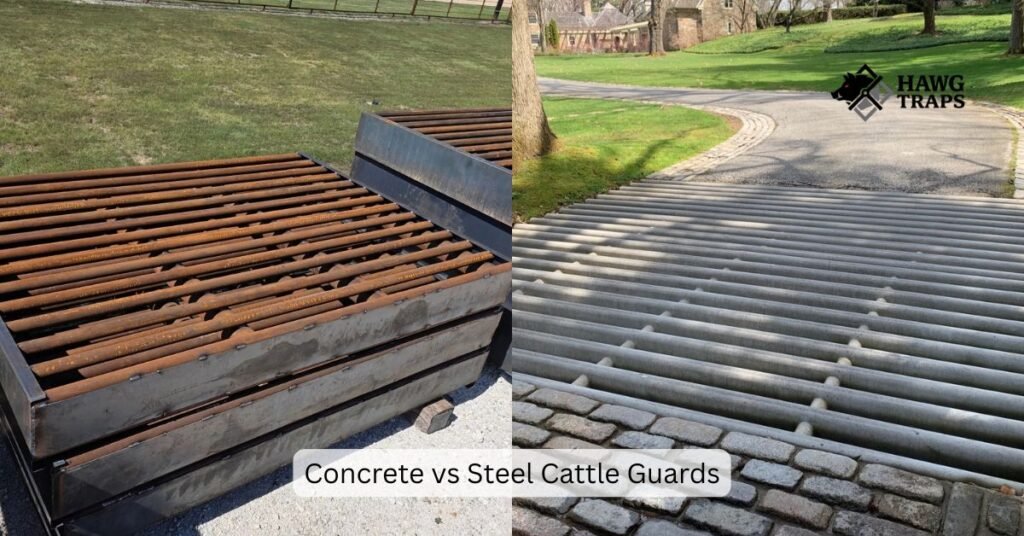
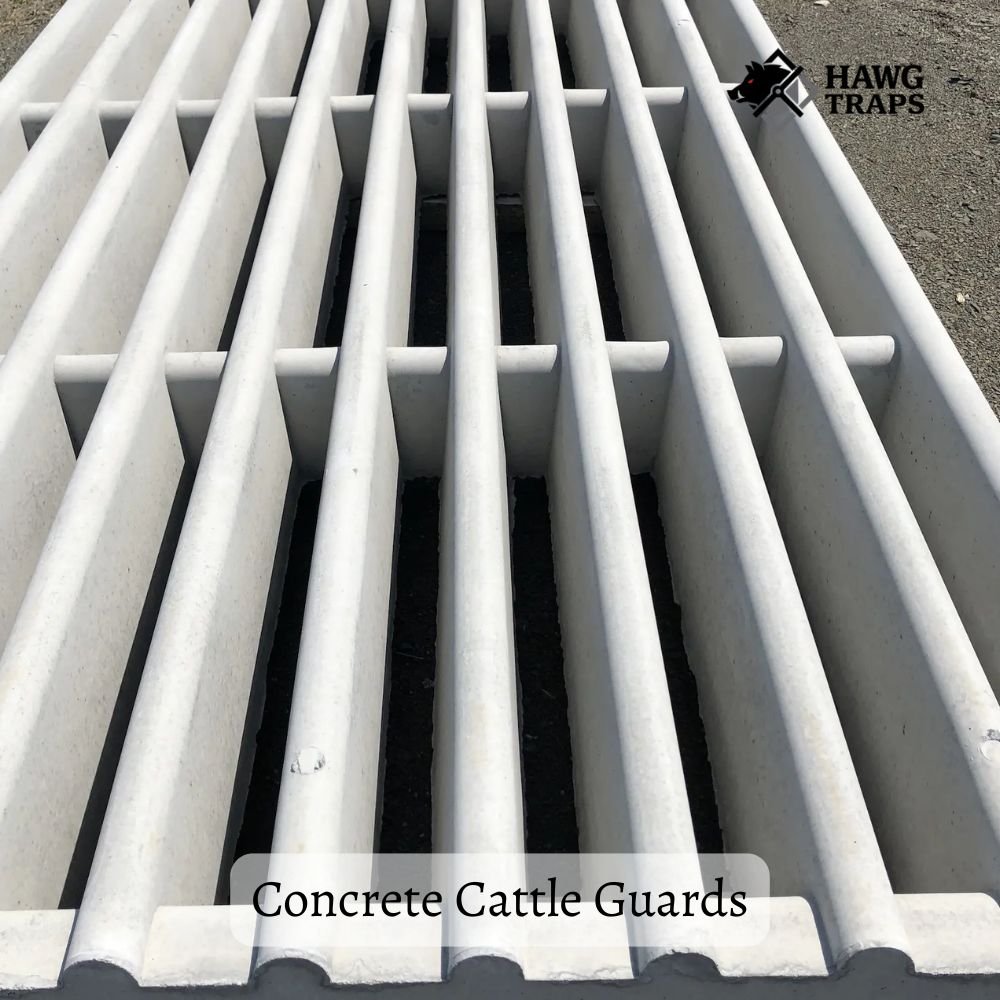
A 14-foot precast concrete guard weighs 6,500 pounds and carries an H-20 rating, according to its maker. A Boss Hawg steel guard is built to custom size with 2 7/8” steel pipe rails and an 8” channel iron frame.
Here’s the head-to-head. The concrete column uses the published figures for one precast guard, L.B. Foster’s CXT line. The steel column is ours.
| What you’re comparing | Precast concrete (CXT, maker’s figures) | Boss Hawg steel |
|---|---|---|
| Size | 14 ft × 6 ft 6 in | 7’5” wide, built to any length |
| Depth | 12 in | Depends on the installation design |
| Weight | 6,500 lb per section | Depends on the final size |
| Load rating | H-20 | No third-party rating; built for your heaviest axle |
| Rails | 3 in wide at 5 in spacing | 2 7/8” steel pipe |
| Footing | Built in; maker says no separate foundation needed | Base designed for your site |
| Install time | 2–4 hours, maker states | Depends on site and scope |
| Rust | Maker states “impervious to rust” | Finish chosen for your site |
| Custom length | Set by the precast mold | Welded to your measurement |
Concrete brings the weight and the built-in footing; steel brings the custom length and the lighter lift.
What those load classes mean in pounds per axle is on cattle guard sizes and load ratings.
A quick bit of ranch-yard math. 6,500 pounds is about what a heavy-duty pickup weighs, for one section of guard. Before you fall in love with concrete, ask yourself one honest question: what’s going to lift that off the truck, and can it reach my gate?
How each type is installed
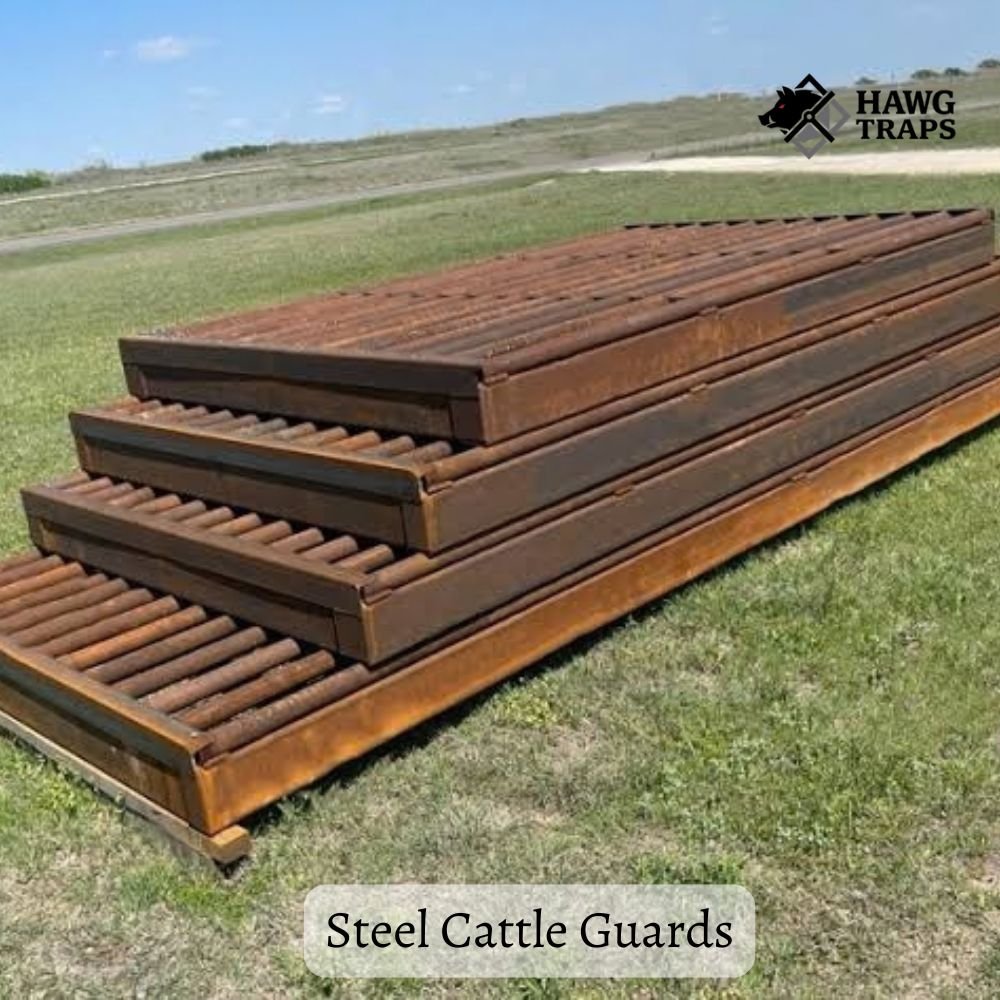
The CXT precast guard arrives with built-in footers and, its maker says, installs in two to four hours. Boss Hawg steel guards sit on a base designed for your site, and install time depends on the job.
Precast concrete: fast to set, heavy to handle. The section comes off the truck ready to go. According to the maker, no additional footers or foundation are needed, which is a real advantage. The catch is the lift. You still need a crane or a machine that can handle 6,500 pounds per section, positioned where it can reach. If your gate is at the end of a muddy two-track with a low-water crossing, that’s the whole conversation.
Steel: needs a base, handles easier. A Boss Hawg guard is set on a properly prepared base designed for your ground and traffic. The weight depends on the size you order, so it can be lifted with equipment suited to that size. It’s the difference between delivering a piano and delivering a pool table. Both take planning. One takes a lot more of it.
Base options are covered on cattle guard wings and bases.
Maintenance, rust and clean-out
Steel needs finish care depending on the finish and the site; one concrete maker states its guards are impervious to rust. Both types need debris cleared from the pit.
Rust is the fair knock on steel, and we won’t pretend otherwise. Bare steel left in wet ground will rust. The answer is the finish, chosen with you for your site’s weather and soil. Hog trap tubing, for example, leaves our shop prime-coated.
Clean-out applies to everyone. This is the chore nobody mentions at the sale. Dirt, gravel, leaves and whatever the last rainstorm washed downhill fall between the rails and slowly fill the pit. As the pit fills, the gap under the rails shrinks, and a shallow gap is a less convincing gap. Cows aren’t geniuses, but they’re patient observers. Whichever material you choose, cleaning and maintanance will be needed.
Concrete vs steel cattle guard cost
Steel and concrete guards cost differently depending on size, installation, transport and options. At one retailer, a concrete casting set was listed at $1,874 on 27 September 2026, before concrete, labor and freight.
The sticker price is the least interesting number here. What changes the total is everything around it:
- Freight. Concrete’s weight raises the freight bill, and it may call for a crane at the site.
- The base. Precast has its footing built in. Steel usually needs a base prepared for it.
- Lifting at the site. Renting a crane for a day is a line item. So is hiring someone with a big enough loader.
- Fit. If a standard precast size doesn’t match your opening, you’re paying for extra fence work to close the gap.
Price the whole job, not the guard alone. The full breakdown is on cattle guard cost.
When a concrete cattle guard is the better choice
A precast concrete guard is the better buy when the site is fixed, a 6,500-pound delivery is easy, and rust is the main worry. Precast makers such as L.B. Foster’s CXT line sell them; Boss Hawg does not.
Yes, a steel shop just told you to buy concrete. If your site checks all three boxes, it’s the honest answer. Other precast makers selling cattle guards include Wieser Concrete and Stewart Concrete. Ask each one for its load rating, its delivery terms and how the guard gets lifted into place.
Did you know? Concrete cattle guards have been in use since the 1940s. They’re not a new idea, and they’ve earned their spot.
When a steel cattle guard wins
A steel cattle guard wins when the length is non-standard, the site is remote, or the guard may move. Boss Hawg builds steel guards to your length, with build time depending on size, options and the shop schedule.
- Odd openings. We weld to the length you measure. Your fence line doesn’t have to bend to fit our catalogue, because we don’t have one.
- Remote or awkward sites. When the gate is somewhere a crane truck would rather not go, a guard built for the site makes more sense than one built for a mold.
- Moving it later. Lease roads change and pastures get rearranged. A steel guard can be lifted and reset with suitable equipment.
- Custom jobs. Need something that doesn’t exist in a standard size? That’s what a fabrication shop is for.
Send us the opening width, the heaviest vehicle that will cross and your ZIP code. See sizes and specs on cattle guards for sale.
REQUEST A QUOTE — or call the shop at (254) 725-4554. Every guard is built to your opening.
Also check our partner products that go with this job: [PARTNER LINKS — e.g. rust-preventive metal primer and paint for steel, heavy-duty T-post driver for the fence tie-in]
As an Amazon Associate we earn from qualifying purchases. Partner products are listed separately from our own and never replace them.
A steel guard on a concrete base
The two materials don’t have to fight. A steel guard can sit on poured concrete footings, which pairs steel’s custom length with a concrete foundation. It’s the peace treaty of cattle guards. This way you can move the guard and also enjoy the benefits of concrete.
Boss Hawg guards can be installed on base designs chosen for your site and traffic. If you like the idea of concrete underneath and steel on top, tell us when you request a quote, and we’ll plan the guard and the base together.
Frequently asked questions
Is concrete or steel better for a cattle guard? Neither wins everywhere. Precast concrete suits a fixed site with easy heavy delivery. Steel suits custom lengths, remote sites and guards that may move later.
How heavy is a concrete cattle guard? One maker lists 6,500 pounds for a 14-foot precast section. Plan your lifting equipment around that.
Do concrete cattle guards need a footing? According to the CXT maker, their precast guard has footers built in and needs no additional foundation.
Will a steel cattle guard rust? Bare steel in wet ground will. The finish is what protects it, and it should be chosen for your site.
Can I move a steel cattle guard later? Yes. A steel guard can be lifted and reset with equipment suited to its size.