
It’s a little after six in the morning, and the coffee hasn’t kicked in yet. You walk out to check the hay meadow and stop at the gate. Overnight, somebody plowed it. Not neatly, either. There are craters you could lose a boot in, the water trough has been shoved off its blocks, and the tracks lead off toward the creek like a gang leaving a crime scene.
Last month you caught one hog in a little box trap and felt pretty good about it. Then the trail camera showed eleven more at the same spot, three nights in a row, walking past that trap like it had a “Closed” sign on it.
That’s a story we hear a lot from ranchers who call our shop in Cross Plains, Texas. The good news is that it’s fixable. Hog trapping works, but it works as a process, not a product you drop in a pasture. This guide walks through that process the way we’d explain it across the tailgate: scout, pre-bait, pick the right trap, set it, wait for the whole family, and know what to do once they’re in.
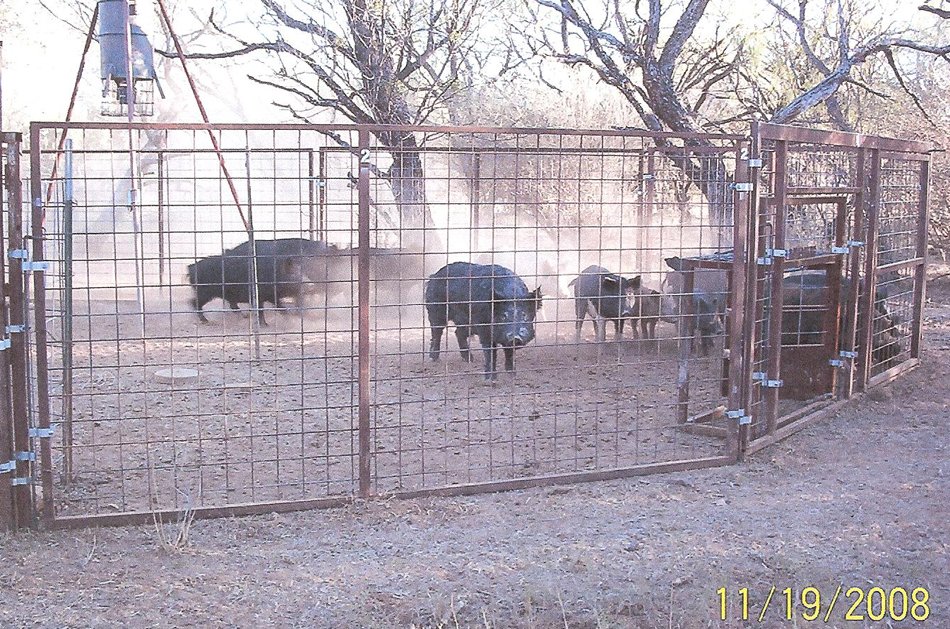
Key Takeaways
- Trapping is a process, not a product. Most failed trapping jobs fail in the first week, before a gate is ever set.
- Count the sounder before you build anything. The number of hogs on your trail camera decides the trap.
- Pre-bait first, trap second. Get hogs feeding at a spot for days before the trap shows up, then condition them to eat inside it with the gate open.
- Match the trap to the group. Box traps suit single boars and small groups; corral traps catch whole sounders.
- Trigger only when every hog is inside. Catching half the group teaches the other half to avoid traps.
- Know the rules before the catch. In Texas you don’t need a hunting license to trap hogs on private land with the owner’s permission, but moving live hogs is tightly limited.
Why Trust Us: How We Put This Together
We build hog traps for a living. Our shop in Cross Plains welds box traps, corral panels and complete pen packages from 1½-inch, 14-gauge square steel tubing and 6-gauge wire, so we see firsthand how hogs test a trap and where weak traps give out. Our team in the US sets traps on real ranch ground, talks with the landowners and trappers who run them, and reads what owners say about the gear they use. For the science, we lean on Texas A&M AgriLife Extension, USDA research and the Texas Parks and Wildlife Department, and we name sources where we use them.
Before You Start: Is It Legal to Trap Hogs?
Yes. In Texas, trapping feral hogs on private land is legal, and since September 2019 you don’t need a hunting license to hunt or trap them there as long as you’re the landowner or have the landowner’s permission, according to Texas A&M’s Natural Resources Institute. On public land, a hunting license is still required.
The part people trip over is what happens after the catch. The Texas Animal Health Commission (TAHC) regulates moving live feral hogs. Trapped hogs can only be hauled alive from the property where they were caught to a recognized slaughter plant, a TAHC-approved holding facility (often called a buying station), or an authorized hunting preserve. You can’t catch hogs on your place and turn them loose somewhere else.
That covers the common question “Can I shoot wild hogs on my property?” too: in Texas, yes, the same no-license rule applies on private land with the owner’s consent. Other states set their own rules, so if you’re outside Texas, check with your state wildlife agency first.
Step 1: Scout and Count the Sounder
Scouting tells you three things: where the hogs travel, when they move, and how many you’re dealing with. The last one matters most, because the size of the group decides the size of the trap.
Hog sign worth knowing
You don’t need to be a tracker to read hog sign. Here’s what to look for and what each one tells you:
- Rooting. Torn-up ground, often in patches, where hogs have dug for roots, grubs and seeds. Fresh rooting has dark, moist soil turned up.
- Wallows. Muddy depressions near water where hogs roll to cool off and shed parasites. A busy wallow means a home base is close by.
- Rubs. Mud smeared on fence posts, power poles and tree trunks at about knee height, often with coarse hair stuck in it. Hogs rub after wallowing, so rubs mark their regular route.
- Tracks. Rounder and blunter than deer tracks, with the toes more spread out.
- Trails and crawls. Beaten paths through brush, and gaps under fences where the bottom wire has been pushed up. Hogs are creatures of habit and reuse these.
When are hogs most active?
Feral hogs move mostly at night when they’re under pressure from hunting, dogs or people, and more in daylight when they’re left alone. Texas A&M’s extension specialists note that summer heat also pushes hogs toward nighttime activity. That’s why most trail-camera photos at a bait site come in between dusk and dawn.
Where do hogs go during the day?
During the day, hogs usually bed down in thick cover close to water: creek bottoms, brushy draws and dense thickets. That’s why you’ll often find their feeding sign in open fields and their bedding sign somewhere you’d rather not crawl into.
Count them with a trail camera
Put a trail camera on the busiest sign and leave it for at least a week. You want a head count, a rough idea of sizes (sows, young hogs, piglets), and whether a big boar travels with them or alone. A cellular trail camera sends pictures to your phone, so you don’t have to walk in and leave your scent around the site every day.
Partner products we recommend for scouting:
- Tactacam Reveal cellular trail cameras — A widely sold cellular camera line. We recommend a cellular camera for hog work because it sends nighttime photos to your phone, so you can count the sounder without visiting the site. Check coverage for your carrier before you buy.
- SPYPOINT cellular trail cameras — A lower-cost cellular line. A sensible pick if you want two or three cameras running on different bait sites at once.
For a full rundown, see our guide to the best cellular trail cameras for hog traps.
Step 2: Pre-Bait Before the Trap Shows Up
Pre-baiting means feeding hogs at a spot for days, without any trap, until they come back to it on a schedule. It’s the step people want to skip and the one that makes everything else work.
Start with bait at two or three places with fresh sign. Hogs usually find new bait faster than you’d expect: a USDA study that tracked wild pigs with GPS collars found that 80% of pigs first visited a new bait site within 8.9 days. Dry weather helps too. A study led by USDA researchers found that wild pigs used bait sites well over twice as much in dry years.
Once one site gets steady visits, that’s your trap site. If it’s buried in a thicket where you can’t get a trap in, don’t fight the brush. Move the bait in small steps, a few yards every couple of days, toward an open spot where a trap will fit. Texas A&M AgriLife Extension puts it simply: the trap goes to the hogs, not the other way around.
What bait? Whole shelled corn is the standard, and it works most of the year. We cover sour corn, sweeteners, seasonal switches and store-bought attractants in our full guide to what bait works in a hog trap.
Partner products we recommend for pre-baiting:
- Moultrie directional and spin-cast feeders — A timer feeder throws corn at the same time every evening, which trains hogs to show up on a schedule without you driving out daily. Moultrie is one of the most common feeder brands at farm stores, so parts are easy to find.
- Tripod game feeders — Handy for pre-baiting inside a corral, since the legs stand over the bait spot. Pick a sturdy one and stake the legs; hogs will rub on them.
Our guide to feeders for hog traps explains how to set a timer feeder for pre-baiting.
Step 3: Pick the Right Trap for Your Sounder
The right trap is the one big enough to hold every hog you counted, plus a few you didn’t. Texas Farm Bureau, summarizing extension guidance, puts it plainly: box traps work for groups smaller than about six hogs or for single boars, while bigger sounders call for corral traps, drop nets or remote-triggered systems.
| Trap type | Best for | Typical group size | Moves easily? | Main weakness |
|---|---|---|---|---|
| Box or cage trap | Single boars, small groups, small properties | 1–5 hogs | Yes, fits a pickup bed | Too small for a full sounder; leaves educated hogs outside |
| Corral trap | Whole sounders | 6 to 20+ hogs | Panels move, but it’s a setup job | Takes time to build and condition hogs |
| Drop trap or net | Whole sounders in open ground | Large groups | Moderate | Higher cost; trickier in heavy timber |
| Cellular or remote-triggered corral | Trap-shy hogs, large sounders | Large groups | Moderate | Needs cell signal and a power source |
For a deeper comparison, see the best hog trap for every situation and how much a hog trap costs.
Building or buying a corral trap
A corral trap is a ring of strong panels with a one-way gate, big enough for the whole sounder to walk in and eat together. Texas A&M AgriLife recommends a teardrop or rounded shape, because hogs pile into corners and climb over each other to get out. The bottom edge matters most: any gap at ground level is an exit for piglets and a lever point for a big hog.
From the shop side, here’s where we see cheap traps give out:
- Tie-wire joints. Panels wired to T-posts work loose when a penned sounder starts testing them all at once.
- The bottom edge. A big hog gets its snout under a panel and lifts. If the panel isn’t anchored, it rises.
- Gate frames. A light frame racks out of square, and once a gate binds, it stops closing reliably.
That’s why our traps use welded joints instead of tie wire. You can read the details in how Boss Hawg traps are built.
Choosing a gate
The gate is where most trapping jobs succeed or fail. The common choices are a drop (guillotine) gate, which falls when triggered; a rooter gate, which hogs push open to get in; and continuous-catch or saloon gates, which let more hogs push in after the first ones are caught. Each has trade-offs, which we lay out in hog trap door designs and hog trap triggers.
Trapping hogs in wooded areas
Trapping in the woods works, but the setup changes. Look for a clearing on or near a hog trail, use a slightly smaller corral that fits the open space, and keep the gate clear of brush and low limbs so it can swing or drop freely. You can tie panels to sturdy trees for extra bracing. Net traps can be awkward under a heavy canopy, so a panel corral or a box trap is usually the easier choice in timber.
REQUEST A QUOTE: CALL (254) 725-4554
The Boss Hawg Pro Pen is our complete package: the pen, a loading ramp and panel gates, with the trip wire set for the gates. Prefer just the catching part? The Big Pen corral trap is sized to your site. Seeing one or two hogs? Our Standard 4×8 box trap fits a pickup bed. Tell us your ground, your hog count and your ZIP code, and we’ll quote the right setup with freight.
Step 4: Set the Trap at the Bait Site
Set the trap right where the hogs are already eating, with the gate wired or tied open so it can’t close. For the next several days, the trap is just a strange-looking dinner table.
A few habits make this step go faster:
- Bait the inside, mostly at the back. Leave a light trail of corn from outside the gate into the trap, with most of the bait at the far end. Hogs that eat at the back are fully inside.
- Check cameras, not the trap. Every visit leaves scent and noise. Let the trail camera do the checking.
- Mind the wind. When you do visit, approach from downwind and keep it short.
- Build in stages for wary hogs. For trap-shy hogs, set up a few panels first, let them get used to it, then add the rest and the gate over a week or two.
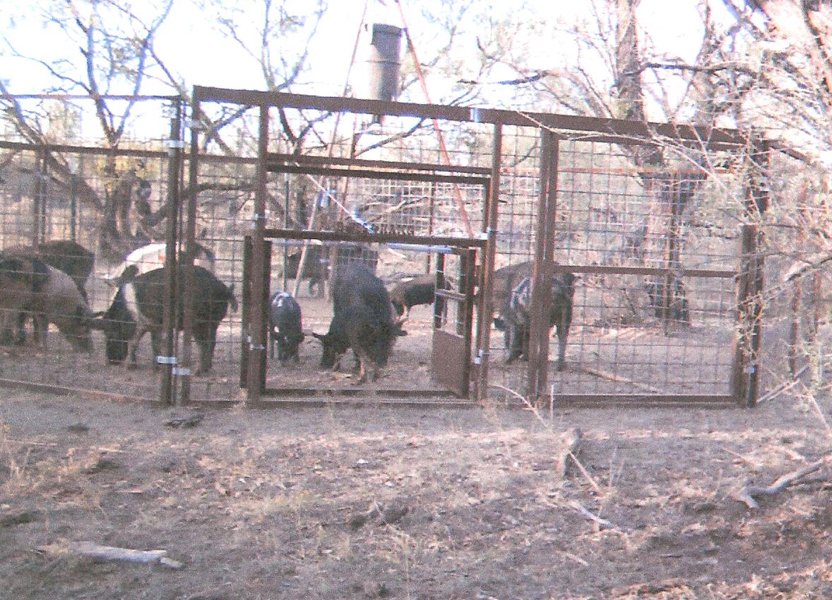
Sometimes hogs walk in the first night. Sometimes it takes weeks. Either way, the rule is the same: don’t arm the gate until the camera says the whole group is eating inside.
Step 5: Trigger Only When Every Hog Is Inside
Arm and trigger the gate only when every hog in the sounder is entering the trap, quickly and calmly. Trigger on the first two hogs and you’ll catch two and educate the rest.
In a large corral, Texas A&M AgriLife recommends putting the trigger at the back of the trap, away from the door, so the hogs bumping it are the ones that walked all the way in. Triggers come in a few forms: a root stick or trip wire the hogs set off themselves, a manual remote you fire while watching, or a cellular system that sends you live photos or video so you can close the gate from your phone when the last hog walks in. Read more in our guide to cellular hog trap gates.
Why so strict? Because hogs learn. University of Florida researchers found that hogs that have seen a trap remember it, and USDA researchers have observed that hogs left outside a tripped trap become harder to catch later. We explain the full method in whole sounder trapping.
The 14-Day Trapping Calendar
Here’s a realistic timeline for a first trapping job on a sounder that hasn’t been trapped before. Hogs that have dodged traps before can stretch this to several weeks.
| Days | What you do | What you’re watching for |
|---|---|---|
| 1–3 | Scout sign, set cameras, put out bait at 2–3 spots | Which spot gets the first visits |
| 4–7 | Keep the busiest spot baited; move bait toward an open trap site if needed | Same hogs returning at the same time each night |
| 8–10 | Build or set the trap at the bait site, gate tied open, bait inside | Hogs walking in and feeding at the back |
| 11–14 | Keep baiting; check cameras daily; arm the trap only when the whole group feeds inside together | Your full head count in one photo, inside the trap |
After the Catch: What Happens to Trapped Hogs
Once the gate drops, you have a trap full of very unhappy hogs, and two jobs: stay safe and follow the law. In Texas, most landowners either dispatch the hogs on site or sell them alive to a TAHC-approved holding facility.
Safety first. Never step into a trap with live hogs. A penned hog, especially a big boar, can hurt you badly, and the panels that hold them in will also hold you in with them.
Selling hogs alive. Approved holding facilities buy trapped hogs by weight and send them on to processing. Prices move a lot with the market and the size of the hog. Farm Progress reported live prices ranging from about 20 cents a pound for small hogs to around 60 cents for larger ones, so at those rates a 300-pound hog might bring somewhere around $60 to $180. Treat that as a dated example and call your nearest buying station for today’s price. Hauling them there takes a stock trailer and a way to load them, which is why our Pro Pen includes a loading ramp; see hog trap trailers and loading ramps.
Dispatching on site. Many landowners dispatch trapped hogs where they’re caught and dispose of or process them. Follow local rules, and handle carcasses carefully: feral hogs can carry diseases such as swine brucellosis, which can spread to people through blood and body fluids. The CDC advises hunters to wear eye protection and rubber or latex gloves when handling feral hog carcasses and to clean tools with a disinfectant.
Partner products we recommend for handling:
- Heavy-duty nitrile gloves — Thicker gloves (look for 8 mil) hold up better than thin exam gloves when you’re working with carcasses. Buy a box; you’ll use them.
- Safety glasses — Cheap, light, and recommended by the CDC for this exact job.
Seven Trapping Mistakes That Educate Hogs
Every one of these turns a catchable sounder into a trap-shy one:
- Shooting hogs near the trap site. The survivors connect the place with danger.
- Triggering on the first few hogs. You catch two, and the other ten learn what a trap is.
- Using a trap that’s too small. If the whole sounder can’t fit, the whole sounder can’t be caught.
- Walking the site every day. Your scent and noise make hogs nervous. Use a camera.
- Feeding the whole neighborhood. Deer, raccoons and birds can clean out your bait before hogs arrive. Adjust feeder timing to after dark.
- Giving up during acorn season. When the mast drops, hogs may ignore corn for a few weeks. Keep the site going or switch baits.
- Trusting a weak gate or panel bottom. One escape teaches the whole group.
Trap It Yourself or Hire a Trapper?
You can absolutely trap hogs yourself, and plenty of landowners do. Hiring a professional trapper makes sense if you don’t have time to check cameras and bait for a couple of weeks, if you have a big sounder that’s already trap-shy, or if you need hogs gone fast before planting.
What do hog trappers charge? Rates vary by region and job. As one example, a full-time trapper in New Braunfels told a reporter in 2022 that he charged a $150 setup fee plus at least $35 per trap per day, including scouting, baiting, monitoring and removal. Get quotes from trappers near you.
If you have hogs every year, owning a trap usually pays for itself. Many ranchers keep a trap working season after season, because hogs from the neighbors’ places keep moving in.
Frequently Asked Questions
What is the best way to trap hogs?
The best way to trap hogs is to catch the whole sounder at once in a trap large enough to hold every hog. Scout and count the group with a trail camera, pre-bait until they visit on a schedule, condition them to eat inside an open trap, and trigger only when every hog is inside.
How long does it take before hogs go into a trap?
It varies. Some hogs walk in the first night; trap-shy hogs can take weeks. A first trapping job on unpressured hogs commonly takes about one to two weeks from first bait to a full catch, as in our 14-day calendar above.
What is the best time of year to trap hogs?
Late fall through early spring is usually the easiest, especially in dry stretches, because natural food is scarcer and hogs come to bait more readily. During heavy acorn or pecan drops, hogs may ignore corn for a while. You can trap hogs year-round in Texas; the bait plan just changes with the season.
Can you trap just one hog?
Yes, and a box trap is the right tool for a single boar or a small group. Just make sure it really is one hog. If the camera shows a sounder, catching one usually makes the rest harder to catch.
REQUEST A QUOTE: CALL (254) 725-4554
Tell us your ground, how many hogs you’re seeing and how you plan to haul them. We build to order in Cross Plains, Texas, and ship anywhere in the US.
Also check our partner products for trapping: cellular trail cameras, game feeders, T-post drivers and heavy-duty nitrile gloves.
As an Amazon Associate we earn from qualifying purchases. Partner products are listed separately from our own and never replace them.