
One night is all it takes. You go to bed with a clean hay meadow and wake up to a field that looks like somebody went over it with a disc harrow and a grudge. The water trough is tipped, a fence corner is pushed out, and the feeder you filled for the deer is licked clean. You do the mental math on reseeding, fixing fence, and the hay you won’t cut, and then the worst part hits you: they’ll be back tomorrow night.
If that sounds familiar, you’re in good company. We hear versions of that story every week at our shop in Cross Plains, Texas. This guide is what we tell ranchers who ask, “What actually works?” We’ll compare every major feral hog control method honestly, including the ones we don’t sell, and help you build a plan for your place.
Key Takeaways
- You control feral hogs; you rarely eliminate them. The goal is fewer hogs and less damage, kept up year after year.
- Removal has to be big. Holding a population steady takes removing roughly two-thirds of it every year.
- Trapping whole sounders is the backbone of most successful programs.
- Shooting and dogs handle the leftovers, like lone boars and trap-shy survivors.
- Fences protect small, high-value areas, such as feeders, gardens and orchards.
- Deterrents and repellents rarely hold for long. Don’t build a plan around them.
Why Trust Us: How We Put This Together
Boss Hawg builds hog traps and ranch steel in Cross Plains, Texas. Our team in the US works on real ranch ground and talks with landowners, trappers and ranch managers about what’s working on their places. We know we have a stake in trapping, so we’ve leaned hard on independent sources: Texas A&M AgriLife Extension, USDA, the Texas Parks and Wildlife Department and peer-reviewed research. Sources are linked where we use them.
Why Feral Hogs Are So Hard to Control
Texas has the biggest feral hog problem in the country. Texas A&M’s Natural Resources Institute estimates the state’s population at more than 3 million, and hogs are found in nearly every county.
They’re hard to control for three reasons:
- They breed fast. Females have been documented breeding as young as 6 months, and sows can produce two litters every 12 to 15 months, according to Texas A&M.
- Removal has to be heavy. The Texas Parks and Wildlife Department estimates that control efforts need to remove 66 to 70% of the population every year just to hold it steady. Current efforts in Texas remove about 29%.
- They learn. Hogs that survive a close call get warier, more nocturnal and harder to trap.
The damage adds up. A USDA survey of farmers in 13 states found feral hogs caused about $1.6 billion in agricultural losses in a single year, with Texas accounting for about $871 million. That includes crop losses, pasture damage, broken fences and water troughs, and the cost of control itself.
What states don’t have feral hogs? A handful have wiped out small populations. The Associated Press reported in 2022 that 11 states, including Idaho, New York, Maine, Colorado and Wisconsin, had eliminated their feral hogs since USDA’s national program began in 2014. In Texas, elimination isn’t on the table. Control is.
Feral Hog Control Methods Compared
Here’s every major method, scored the way a rancher would want to see it. “Population impact” means how much the method can actually reduce hog numbers on a property, not just move them around.
| Method | Population impact | Cost | Labor | Texas legal notes | Best use |
|---|---|---|---|---|---|
| Whole-sounder trapping (corral, drop or smart trap) | High | Moderate to high up front; low per hog over time | Moderate: baiting, monitoring | Legal on private land with owner’s consent; live transport limited | Backbone of any program |
| Box trapping | Low to moderate | Low | Moderate | Same as above | Single boars, small groups |
| Night shooting | Low | Low to moderate | High | No hunting license needed on private land with owner’s consent | Lone hogs, survivors |
| Hunting with dogs | Low to moderate | Varies | High | Same as above | Clean-up, brushy country |
| Aerial removal (helicopter) | High in open country | High | Done by permitted operators | Requires a TPWD aerial permit | Large, open properties |
| Exclusion fencing | None (protects areas) | Moderate to high | Moderate upkeep | No special rules | Feeders, gardens, high-value crops |
| Deterrents and repellents | Very low | Low | Low | No special rules | Not a plan on their own |
| Toxicant bait | Potentially high, but restricted | High | Specialized | Licensed applicators only | Not a landowner tool |
The verdict: build your program around trapping whole sounders, use shooting and dogs to clean up what traps miss, and fence only what you can’t afford to lose. The rest are minor tools at best.
Trapping: The Backbone
Trapping is the most effective hog control method available to most landowners, because a well-run trap can remove an entire family group at once. The key word is “entire.” A USDA study found that trapping whole sounders with remote-triggered traps cut hog density about 53%, versus about 30% for traditional trapping.
We’ve written three detailed guides on this:
- How to trap hogs — the full step-by-step process, from scouting to after the catch.
- Whole sounder trapping — why catching the entire family matters and how to do it.
- Hog bait — what to put in the trap, season by season.
REQUEST A QUOTE: CALL (254) 725-4554
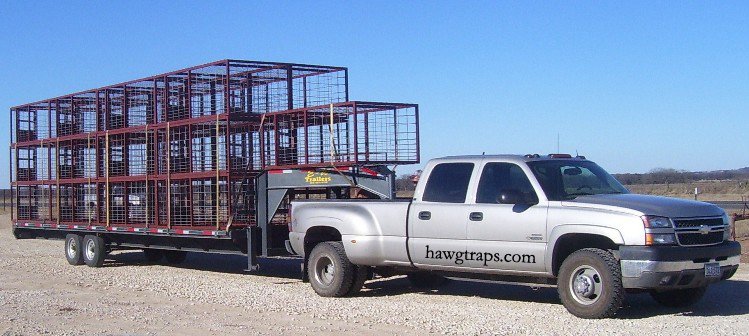
Our traps use 1½-inch, 14-gauge square steel tube frames with 6-gauge wire panels MIG welded on. The Pro Pen is our complete package with a loading ramp and panel gates. Compare every model on our hog traps for sale page.
Shooting, Night Hunting and Dogs
Shooting and hunting with dogs are good for removing individual hogs, especially lone boars and trap-shy survivors. On their own, they’re too slow to make a dent in a population. Extension specialists note that hunting, night shooting and dogs are rarely effective at removing enough hogs to control a population, though they work well for small groups and individual nuisance hogs.
In Texas, you don’t need a hunting license to take feral hogs on private land if you’re the landowner or have the landowner’s permission, under Texas Parks and Wildlife Code 42.002. You do need a license on public land.
One caution if you trap too: don’t shoot hogs at or near your trap site. Survivors connect the spot with danger and stop coming in.
Aerial Control
Helicopter removal can take a lot of hogs fast in open country. In Texas it’s done under an aerial wildlife management permit from the Texas Parks and Wildlife Department, and landowners and their agents can take part as hunters or observers under that permit. It’s effective, but expensive and impractical in heavy brush or near houses, so it’s mostly a tool for large, open ranches.
Fencing and Exclusion
Fencing doesn’t reduce hog numbers. It protects specific areas from them, and for some areas, that’s exactly what you need.
- Around feeders: Texas A&M AgriLife recommends a short panel fence of about 28 to 34 inches around deer feeders. Hogs can’t get over it, but deer can jump in. Use 28 inches if you want fawns to get in too.
- Around gardens, orchards and crops: Texas A&M notes that a strong 6-foot net-wire perimeter fence will keep out most feral hogs. Electric fencing can work too, as long as you keep vegetation cleared so it doesn’t ground out.
- USDA’s tips: for hog-proof fencing, USDA recommends anchoring fences into the ground to stop digging and weaving electrified wire through non-electric fencing, and inspecting regularly for gaps at ground level.
Fencing large pastures to keep hogs out is usually too expensive to be practical. Hogs also find the weak spots. If you fence, plan on checking the bottom edge often.
At gates and driveways, a steel pipe cattle guard keeps livestock in while letting vehicles through, so a gate isn’t left open for anything to wander through. For heavy-duty fence corners that hold up when hogs push on them, see our H posts and H braces.
Partner products we recommend for exclusion fencing:
- Solar electric fence chargers — A solar charger runs an electric strand without running power to the field. Buy one rated well above your fence length, because weeds touching the wire drain the charge.
- Polywire and polytape — Easy to string at hog snout height on step-in posts around a garden or food plot, and easy to move later.
- Fence stretchers — If you’re tightening woven wire, a good stretcher makes the bottom edge tight enough that hogs can’t push under it easily.
Deterrents, Repellents and “Natural” Methods
This is where we have to be blunt. Deterrents and repellents are among the most searched hog control topics, and among the least effective.
Extension specialists summarizing the research found that most nonlethal methods, including habitat changes, frightening devices and guard animals, are ineffective at preventing feral hog problems. Hogs get used to lights, noises and smells quickly, especially when there’s good food on the other side.
That covers a lot of common questions:
- What is the best deterrent for feral hogs? A well-built fence around a small area. Beyond that, nothing holds up reliably.
- What smells do hogs hate? People try ammonia, mothballs, hot pepper and predator urine. We haven’t seen good evidence that any of them keep hogs away for long, and some, like mothballs, are pesticides that shouldn’t be scattered outdoors.
- What repels hogs but not deer? A short panel fence around a feeder, at 28 to 34 inches, is the closest thing to a repellent that works: deer jump it, hogs don’t.
- How do you get rid of feral pigs naturally? Removing easy food and water helps a little. Texas A&M suggests securing pet food, garbage and fallen fruit, and draining standing water. It makes your place less inviting, but it won’t remove hogs that are already there.
Toxicants and Poison Bait
You may have heard about hog poison. In Texas, a warfarin-based bait called Kaput was registered in February 2024 as a state-limited-use pesticide, which means only licensed pesticide applicators can buy and use it, and only through special feeders with weighted lids designed to keep other animals out.
Toxicants are controversial. Supporters, including Texas agriculture officials, see them as a much-needed tool against an exploding problem. Critics, including hog hunters and meat processors, worry about effects on other wildlife and on the safety of hog meat. For landowners, the practical point is simple: this isn’t a do-it-yourself tool, and homemade poisons are illegal and dangerous to everything else on your land.
Building a Control Plan for Your Place
The right plan depends on your property and your neighbors. Here’s how we’d approach the most common situations:
| Situation | First step | Main tool | Follow-up | Realistic goal |
|---|---|---|---|---|
| Small acreage or edge of town | Trail camera to confirm numbers | Box trap or small corral | Fence the garden or feeder | Stop repeat damage to key areas |
| Working ranch (a few hundred to a few thousand acres) | Scout and bait several sites | Corral or remote-triggered traps for whole sounders | Night shooting for survivors; fence feeders | Keep numbers low year-round |
| Large farm with hog-heavy neighbors | Talk to neighbors and coordinate | Multiple traps running in rotation | Aerial removal in open country | Cut damage before planting and harvest |
Neighbors matter more than most people think. Hogs don’t respect property lines, and one ranch’s leftovers become the next ranch’s sounder. Texas A&M AgriLife even suggests sharing trap gates with neighbors to spread the cost.
Texas Hog Laws in Brief
- License: None needed to hunt or trap feral hogs on private land with the landowner’s permission; a hunting license is required on public land.
- Transport: Live feral hogs can only be moved from where they’re trapped to a recognized slaughter plant, a Texas Animal Health Commission-approved holding facility, or an authorized hunting preserve, according to Texas A&M’s Natural Resources Institute.
- Selling live hogs: Approved holding facilities, often called buying stations, buy trapped hogs by weight.
Rules change, so check with the TAHC and the Texas Parks and Wildlife Department before you haul or sell hogs.
Staying Safe Around Feral Hogs
Most feral hogs avoid people and run when they see or smell you. But they’re strong, fast and armed with sharp tusks, and they can be dangerous when cornered, wounded, trapped or protecting piglets.
- What are feral hogs afraid of? People, mostly. Hogs usually flee from human scent and activity, which is one reason they turn nocturnal under pressure.
- Will wild hogs chase you? Usually not, but a cornered, wounded or protective hog can charge.
- Can you outrun a wild hog? Don’t count on it. Hogs are quicker than they look over short distances. If one charges, get on top of something solid, like a truck, a tree or a stout fence, instead of running across open ground.
- Has a feral hog ever killed anyone? Yes, though it’s rare. In November 2019, a 59-year-old caretaker in Anahuac, Texas, died after a feral hog attack outside the home where she worked, according to the Chambers County sheriff and medical examiner.
Around traps, the rule is simple: never step into a trap with live hogs inside, and handle carcasses with gloves, because hogs can carry diseases like swine brucellosis that spread to people.
Frequently Asked Questions
What is the most effective way to get rid of feral hogs?
Trapping whole sounders, meaning catching the entire family group at once in a corral, drop or remote-triggered trap. Follow up with shooting or dogs for hogs that escape, and fence small high-value areas.
What kills feral hogs?
People are their main cause of death. Coyotes, bobcats and other predators take some piglets, but adult hogs have few natural predators. That’s why human control, mainly trapping, shooting and aerial removal, is what keeps numbers in check.
Can you get rid of feral hogs for good?
On a single property in Texas, not permanently. Hogs from surrounding land keep moving in. You can cut numbers and damage sharply and keep them low with ongoing trapping, especially if your neighbors join in.
Who can help me with feral hogs in Texas?
Start with your county’s Texas A&M AgriLife Extension agent, who can point you to training and local resources. Texas Wildlife Services also works with landowners on hog damage. For traps, call us.
REQUEST A QUOTE: CALL (254) 725-4554
Tell us your ground, how many hogs you’re seeing and how you plan to haul them. We build to order in Cross Plains, Texas, and ship anywhere in the US.
Also check our partner products: cellular trail cameras, feeders for hog traps, solar electric fence chargers and Evolved Hog Wild attractant.
As an Amazon Associate we earn from qualifying purchases. Partner products are listed separately from our own and never replace them.
Hog Control Guides
- How to Trap Hogs — The step-by-step trapping process, from scouting to after the catch.
- Whole Sounder Trapping — Why catching the entire family matters, and how to do it.
- Hog Bait: What Works in a Trap — Corn, sour corn, mixers and attractants, season by season.
- Hog Traps for Sale — Box, corral and complete pen packages built in Texas.