
Catching one hog out of eight feels like a win. It isn’t. It’s a free lesson for the other seven, and hogs are quick studies.
That’s the whole idea behind whole sounder trapping in one sentence. The rest of this page explains what a sounder is, why partial catches backfire, what the research says, and how to catch the entire family at once.
Key Takeaways
- A sounder is a family group of related sows and their young. Catch them together, or don’t set the gate.
- Partial catches teach the survivors to avoid traps, making them harder to catch later.
- Whole-sounder trapping cut hog density about 53% in a USDA study, compared with about 30% for traditional trapping.
- It takes counting, patience and a trap big enough for every hog in the group.
What Is Whole Sounder Trapping?
Whole sounder trapping means catching every member of a feral hog family group in a single trapping event, so no hogs are left outside the trap to learn to avoid it. It relies on counting the group with trail cameras, conditioning them to feed inside a large trap with the gate open, and closing the gate only when the last hog is inside.
Who’s in a Sounder?
A sounder is a family group of feral hogs, usually several related sows (often three generations) and their piglets. Texas A&M AgriLife wildlife specialist Billy Higginbotham has described how most young females stay with the sounder while young males leave at about 16 to 18 months. Mature boars mostly travel alone and check in with sounders when sows are ready to breed.
For trapping, that means two things:
- The sounder is your main target. It’s where the breeding happens and where most of the hogs are.
- A lone boar is a separate job. He may not follow the sounder into a corral. A box trap or a different setup is often the better tool for him. See our Standard 4×8 box trap.
Why Catching Hogs One at a Time Fails
The math
Feral hogs breed fast. Texas A&M AgriLife reports that sows can produce two litters every 12 to 15 months, with four to eight piglets per litter. That’s why the question “How many litters can a feral hog have in a year?” has an uncomfortable answer: more than one.
To keep a hog population from growing, you have to remove a lot of it every year. The Texas Parks and Wildlife Department estimates that control efforts need to remove 66 to 70% of the population annually just to hold it steady, while current efforts in Texas remove about 29%. Picking off one or two hogs at a time doesn’t come close.
Educated hogs
The second problem is worse. When part of a sounder is caught and part isn’t, the hogs left outside watch it happen. USDA researchers have noted that hogs left outside a tripped trap become harder to catch in the future, and University of Florida researchers found that hogs that have seen a trap remember it.
That’s also the answer to “Will hogs come back after you shoot one?” Often, yes, but warier. A study led by USDA researchers found that wild pigs exposed to negative experiences, such as near-misses in trapping or shooting, used bait sites less than unpressured pigs. They tend to come back at different times, more at night, and with a lot more caution around anything new.
What the Research Shows
The strongest evidence comes from a USDA study comparing trapping approaches. USDA Forest Service researcher John Kilgo reported that whole-sounder trapping with remote-triggered smart traps reduced hog density about 53%, compared with about 30% for traditional traps. That’s not elimination, but it’s nearly double the result.
State agencies have reached the same conclusion. Georgia’s Department of Natural Resources calls whole sounder trapping the most efficient way to remove hogs, and USDA’s Wildlife Services lists comprehensive programs built around trapping as the most successful approach to managing feral swine.
How to Trap the Whole Sounder
Here’s the method in five steps. For the full trapping process, from scouting to what to do after the catch, see our guide on how to trap hogs.
- Count and learn each hog. Run a trail camera on the bait site for at least a week. Count the group and look for markings, size and color so you can recognize individuals. You want to know the last hog before you set the trap.
- Size the trap for the group, plus growth. A trap that holds eight comfortably won’t hold eight plus a litter of piglets next month. A corral trap like our Big Pen is built for sounders.
- Condition them with the gate open. Let the whole group feed inside the trap for days, with the gate tied open, until they walk in without hesitating.
- Use a gate the group trusts. Some sounders balk at certain gates. Our guides to hog trap door designs and hog trap triggers explain the options.
- Trigger only when the last hog is inside. This is where a cellular hog trap gate earns its cost: you watch the photos or video on your phone and close the gate when everyone is in.
Checking the trap at night
If you check a trap at night, use a dim red or green light instead of a bright white one. Pigs, like most mammals, see color with two types of cones instead of the three humans have, so they’re less sensitive to red light. That answers “What color can hogs not see?” in practice: red is the hardest for them to pick out. Any bright light still gets noticed, though, so keep it dim and brief, and rely on your camera whenever you can.
Partner products we recommend for whole-sounder trapping:
- Tactacam Reveal cellular trail cameras — For whole-sounder work, getting nighttime photos on your phone is how you count the group without disturbing it. Check coverage for your carrier before you buy.
- Red and green hunting lights — A light with red and green settings lets you check the trap at night without blasting it with white light. A model with a dimmer is worth the few extra dollars.
See our full guide to the best cellular trail cameras for hog traps.
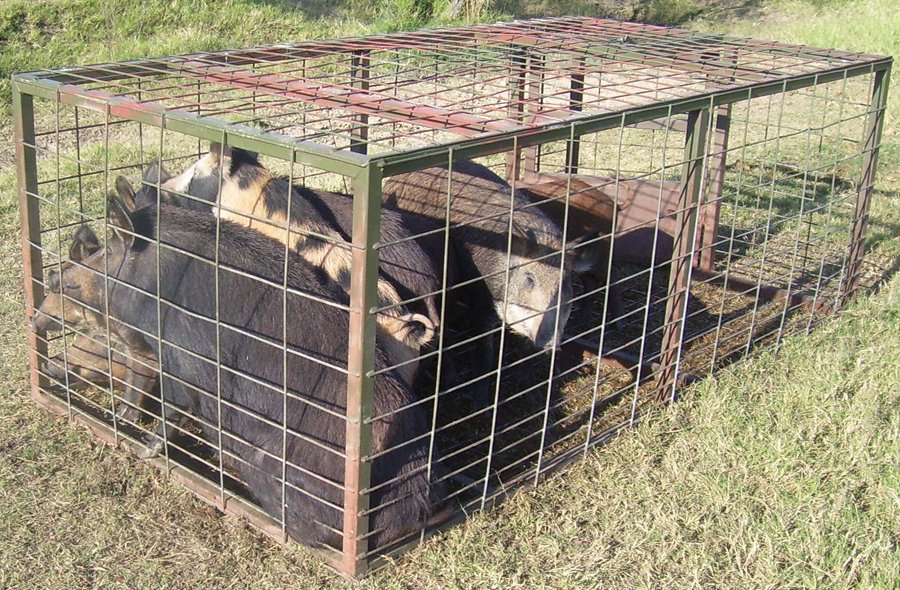
What About the Ones That Got Away?
Even careful trappers miss a hog now and then. Trap-shy survivors and lone boars need a different approach: a fresh trap site, a different trap style, a box trap for a single boar, or follow-up removal by other legal methods. Our feral hog control guide compares the options and where each one fits.
REQUEST A QUOTE: CALL (254) 725-4554
Our corral traps are built for whole sounders: 1½-inch, 14-gauge square steel tube frames with 6-gauge wire MIG welded on, so the panels hold when a penned group tests them. The Pro Pen adds a loading ramp and panel gates with the trip wire set. Tell us how many hogs you’re seeing, and we’ll size the trap.
Also check our partner products: cellular trail cameras, red and green hunting lights and game feeders.
As an Amazon Associate we earn from qualifying purchases. Partner products are listed separately from our own and never replace them.
Frequently Asked Questions
How many hogs are in a sounder?
It varies with food and habitat. A sounder can be a few hogs or 20 or more, since it includes several sows and their piglets. That’s why counting on a trail camera matters more than any average.
How long does whole sounder trapping take?
Usually one to two weeks for hogs that haven’t been trapped before, from first bait to a full catch. Trap-shy sounders can take several weeks. The waiting is the method.
Can a box trap catch a whole sounder?
Only a small one. Extension guidance suggests box traps for groups of fewer than about six hogs or for single boars. Bigger sounders need a corral, drop trap or other large trap.