
Here’s a story every trapper knows. You set a trap, you wait, and one morning there are three hogs in it. Good day, right? Then you check the trail camera and count fourteen hogs at the feeder that night. Three went in. Eleven stood outside and watched. And those eleven just got a free lesson in what a trap looks like.
That’s why corral traps exist. A corral is big enough for the whole family to walk in and eat dinner together, so the gate closes on all of them at once. This page covers how a corral hog trap works, how big it should be, whether to build one yourself or buy one welded, and how the Boss Hawg Big Pen fits in.
Key Takeaways
- Corral traps catch whole sounders. Texas A&M AgriLife says a large corral trap can capture an entire group.
- The Big Pen is welded steel panels: 1½-inch, 14-gauge square tube frames with 6-gauge wire.
- It’s sized to your site, and because it’s panel built, you can move it or reconfigure it.
- Most sounders fit a corral of three or four 16 × 5-foot panels, according to Mississippi State University.
- Leave no gap at the bottom, and pre-bait until the whole sounder feeds inside before you set the gate.
- Want the loading ramp and gates too? That’s the Pro Pen.
Why Trust Us: How We Put This Together
We weld panel pens in our shop in Cross Plains, Texas, and we sell into the same market as the do-it-yourself corral, so we’ve thought hard about when each one makes sense. Our team in the US works with corral traps on real ranch ground. We talk with the landowners and trappers who run them, read what owners say about pens and panels from different brands, and study the corral trap guidance published by Texas A&M AgriLife and Mississippi State University. Sources are named where we use them. The photos on this page are Boss Hawg pens.
What the Big Pen corral hog trap is
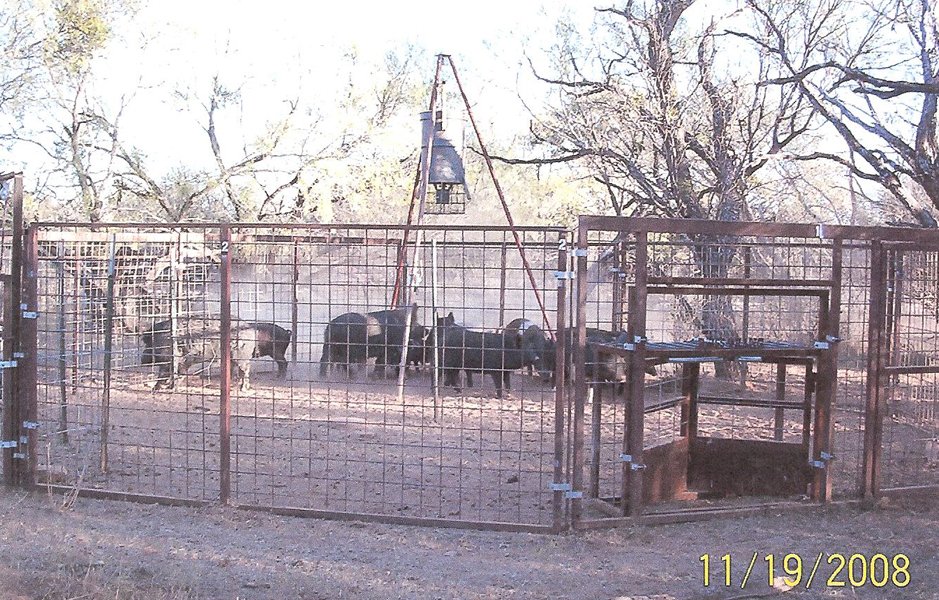
The Boss Hawg Big Pen is a corral hog trap of welded steel panels, 1½-inch 14-gauge tube frames with 6-gauge wire, set up on site and sized to hold a whole sounder rather than one or two hogs.
A corral trap is a large pen of panels with a one-way gate, built to catch a whole sounder at once. Think of a box trap as a booth for two. A corral is the banquet hall.
The Big Pen is for landowners who’ve stopped trying to catch hogs one at a time. It’s built from the same heavy tubing and wire as every trap in our line of hog traps for sale, just spread across a pen big enough for the whole family. Because it’s panel built, it goes up on site, and you can reconfigure it or move it when the hogs shift ground.
Why a corral trap catches the whole sounder
A corral trap catches whole sounders because the entire family group fits inside to feed before the gate closes. Texas A&M AgriLife says a large corral trap can catch an entire sounder at once.
A sounder is a family group of feral hogs, usually sows and their young. Texas A&M AgriLife notes that feral hogs typically travel in these family groups, and that a large corral trap can capture an entire group. Mississippi State University calls corral traps the most effective type of trap for catching large groups of pigs.
The reason is simple math with a mean streak. Hogs breed fast. The Texas Parks and Wildlife Department puts the average litter at 4 to 6 young, with adult sows averaging about 1.57 litters a year. Leave part of a sounder behind and it refills the gap. Worse, the ones that got away now know what a trap looks like. Catch three out of twelve and you haven’t reduced the problem. You’ve educated it.
A corral flips that. The pen is big enough that the whole group gets comfortable feeding inside. When the gate closes, it closes on everybody, the cautious old sow included.
Big Pen specifications
Big Pen panels use the same steel as every regular trap: 1½-inch 14-gauge square tube frames with bracing, 6-gauge wire MIG welded to the frame, and prime-coated tubing. Panel count and layout depend on your site.
| Part | Spec | Why it matters |
|---|---|---|
| Frame | 1½-inch, 14-gauge square steel tubing, braced throughout | When a penned sounder starts working the corners, the frame takes the load. |
| Wire | 6-gauge wire panels, MIG welded to the frame | Welded, not clipped or wired on. Fastened panels are the first thing to give under steady pressure. |
| Finish | Prime-coated tubing | Fights rust at the joints after seasons in the weather. |
| Configuration | Panel built, sized to the site | Fits your ground and your sounder, and can be moved or reconfigured. |
The Big Pen uses the same steel as the Standard, spread across a pen large enough for a sounder.
Why so much fuss about the corners? A calm hog in a pen is no trouble. A dozen excited hogs in a pen will test every panel, every joint and every gap at once. That’s when you find out whether the wire was welded or just clipped on.
Every Boss Hawg trap has been field tested by our shop for continuous loading, retention and durability. Here’s what each part of the build is doing and why: how Boss Hawg traps are built.
How big should a corral hog trap be?
Most sounders fit a corral of three or four 16 × 5-foot panels, according to Mississippi State University. Boss Hawg sizes each Big Pen to your site and the number of hogs you’re seeing.
There’s no single right size, and anyone who tells you otherwise is selling one size. Here’s what the research folks say:
- Mississippi State University: three or four 16-foot by 5-foot panels make a trap big enough for most sounder groups, and you can add panels to enlarge it for bigger ones.
- Texas A&M AgriLife: a large teardrop-shaped trap is best for big groups, and it should leave no gaps along the bottom.
- JAGER PRO, a company that sells corral trapping systems, reports that its most efficient design in its own research was a corral at least 35 feet across. That’s a vendor’s study, so weigh it like one.
Our approach: tell us how many hogs you’re seeing and what your ground looks like, and we size the Big Pen to fit. Photos can be helpful. A creek-bottom clearing and an open pasture call for different pens. So does a sounder of eight compared with a sounder of twenty.
Big Pen vs a DIY panel corral vs a box trap
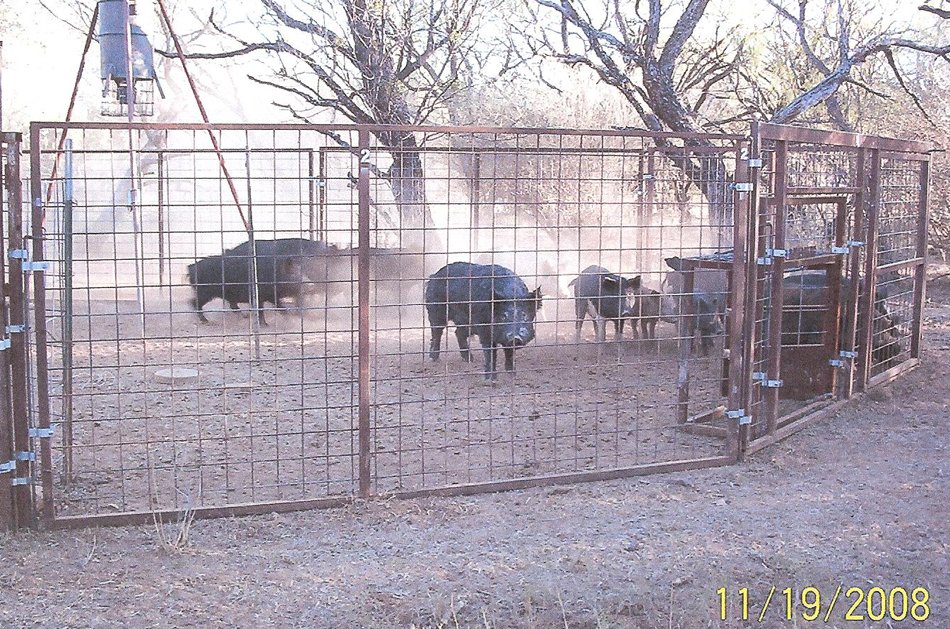
A DIY corral of livestock panels on T-posts costs least to build; a welded steel pen like the Big Pen costs more but has its wire welded to the frame, not clipped; a box trap catches far fewer hogs.
| Big Pen (welded panel pen) | DIY livestock-panel corral | Box trap (Standard) | |
|---|---|---|---|
| Catches | Whole sounders | Whole sounders | Single hogs and small groups |
| Build | Welded steel panels from our shop | Sheep/goat panels with 4 × 4-inch mesh, T-posts every 4 feet | One welded steel box |
| How the wire is held | MIG welded to a steel frame | Tied to T-posts | MIG welded to a steel frame |
| Moves by | Panels | Pulling posts and panels | Pickup bed |
| Relative cost | Higher; corral and panel systems list at about $3,500–$8,000 (checked 1 Oct 2026) | Lowest; materials plus your time | Steel 4 × 8 box traps list at about $550–$700 |
The DIY corral wins on cost, the welded pen on strength, and the box trap on how easy it is to move.
Let’s be fair to the DIY corral, because it’s a good design. Texas A&M AgriLife’s corral trap guide uses sheep and goat panels with 4 × 4-inch mesh, because that mesh keeps smaller pigs from escaping, held up by T-posts every 4 feet. If you’ve got the time, a T-post driver and a strong back, it works, and it costs less than anything we sell.
Where a welded pen earns its price is in the joints and the setup. The Big Pen’s wire is welded to a steel frame, so there’s no tie wire to work loose, and the panels go up as panels instead of a weekend of posts. If the DIY route fits your budget and your weekend, take it. If you’d rather buy it once and set it, call us.
And if you’re seeing one or two hogs, not a sounder? Skip the corral and look at the Standard hog trap.
Setting up the Big Pen
Setting up a Big Pen takes four steps: choose a spot on fresh hog sign, stand and join the panels with no gap at the bottom, fit the gate, then pre-bait until the whole sounder feeds inside.
- Pick the spot. Go where the rooting and tracks are fresh. Texas A&M AgriLife suggests a layout that lets hogs back away as you approach the trap.
- Stand and join the panels. Check the bottom edge all the way around. AgriLife’s rule is to leave no gaps along the bottom, because piglets will find any gap you miss.
- Fit the gate. Corral traps use saloon-style gates, drop gates or rooter gates. Set it open for now.
- Pre-bait, then wait. Pre-baiting means feeding the hogs at the open trap before you set the gate. AgriLife’s advice is to keep pre-baiting until hogs are consistently feeding inside and the whole sounder appears to be visiting.
Step four is where people lose. It’s tempting to set the gate the first night you see hogs inside. Don’t. A trail camera tells you when the whole family is coming in, and patience turns a three-hog morning into a sounder.
Big Pen or Pro Pen
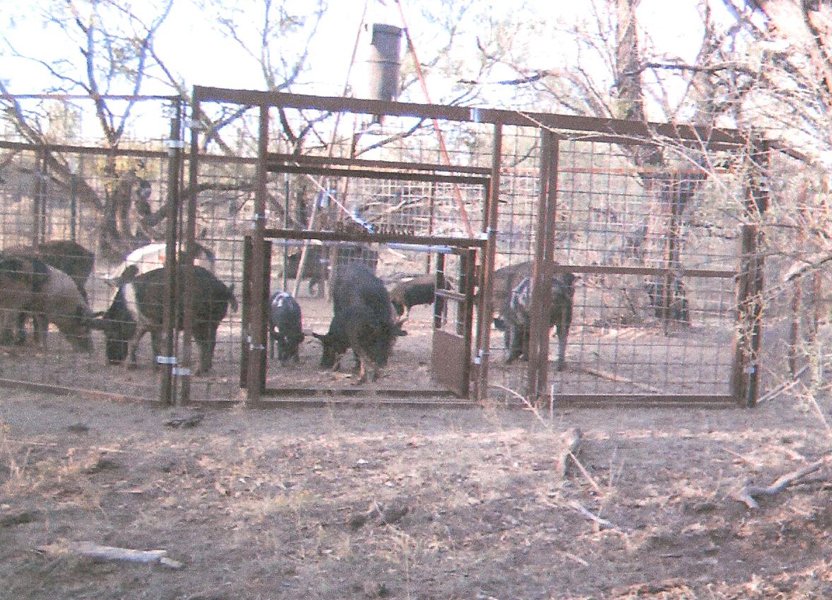
Choose the Big Pen when you already have a way to load hogs out; choose the Pro Pen when you want the pen, a loading ramp and panel gates as one package.
Catching the sounder is half the job. Getting the hogs out of the pen and onto a trailer is the other half, and that half goes badly without the right gear. The Pro Pen hog trap includes the loading ramp and panel gates, with the trip wire set for the gates, so there’s nothing left to source separately. If you’ve already got your own loading setup, the Big Pen alone does the catching.
Order a Big Pen corral trap
To order a Big Pen, call the shop at (254) 725-4554 with your ground, the number of hogs you’re seeing and how you’ll haul it. You get a quote with panel count, build time and freight.
Have these ready:
- Your ground: clearing, pasture, brush or creek bottom.
- How many hogs: your best count from the trail camera.
- How you’ll haul it: trailer, or pickup at the shop in Cross Plains.
- Your delivery ZIP code, for the freight quote.
We ship anywhere in the US. Freight is paid by the buyer and quoted before you order. Two honest trade-offs: we build to order, so ask about current build time, and a welded steel pen costs more up front than a DIY corral. What you get for it is a pen that goes up as panels and stays straight when the sounder tests it.
REQUEST A QUOTE: CALL (254) 725-4554
Tell us your ground, your hog count and your ZIP code. We’ll size the pen and quote it with freight.
Also check our partner products that go with a corral trap:
- Cellular trail cameras to see when the whole sounder is coming in
- Tripod game feeders for pre-baiting inside the pen
- T-post drivers and steel T-posts if you build a DIY corral
As an Amazon Associate we earn from qualifying purchases. Partner products are listed separately from our own and never replace them.
Frequently asked questions
Can the Big Pen be moved?
Yes. It’s panel built, so it can be taken down, moved and reconfigured when the hogs shift ground.
How much does a corral hog trap cost?
Corral and panel trap systems list at about $3,500–$8,000 in the US (checked 1 October 2026). A DIY livestock-panel corral costs less. Call us for a Big Pen quote.
Do I need to pre-bait a corral trap?
Yes. Texas A&M AgriLife advises pre-baiting until hogs feed inside consistently and the whole sounder is visiting, then setting the gate.
What steel is the Big Pen made of?
1½-inch, 14-gauge square steel tubing with 6-gauge wire MIG welded to the frame, and prime-coated tubing.