
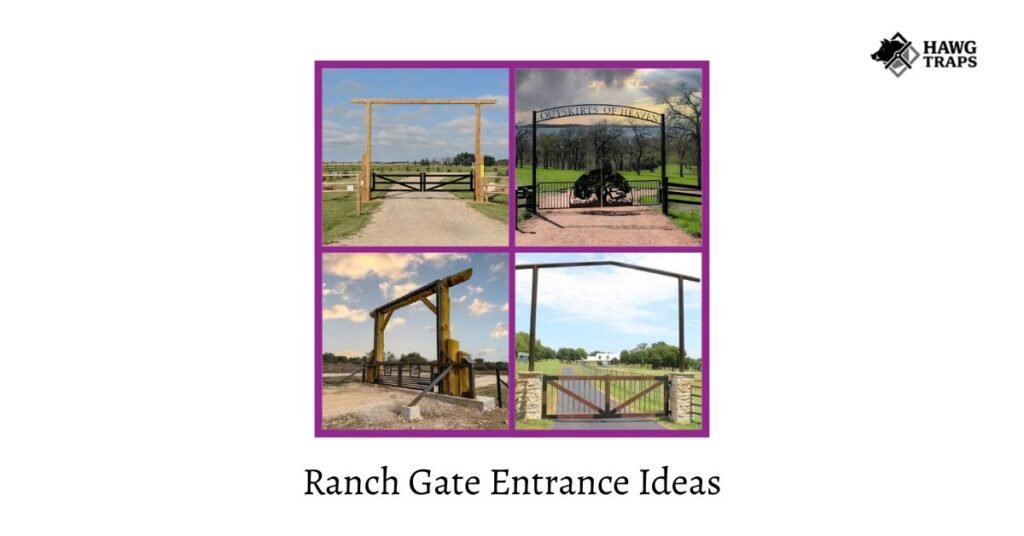
There’s a folder on your phone. It has forty photos of other people’s ranch entrances in it. A stone one from the Hill Country. A pipe arch with a longhorn on top. One with a wagon wheel, saved at 1 a.m. for reasons you can no longer explain. Understandable.
Every one of them looks great and doable. But none of the pictures tell you the exact size and requirements.
That’s the trouble with borrowed ideas. The photo shows the gate. It doesn’t show the cattle trailer that has to fit under it, or the wind that leans on it.
So here are 21 ranch gate entrance ideas. Each one comes with a line called Check first. It’s the one thing to measure or ask before you copy it.
We build cattle guards and H-posts. We don’t build gates, arches or columns, so we have no gate to sell you. Some links to other products are affiliate links, and we may earn from qualifying purchases.
Key Takeaways
- A ranch entrance has five parts you can design: the overhead, the gate, the sides, the ground and the details.
- Check height before anything else. Texas allows a vehicle and its load to stand 14 feet high.
- Steel artwork adds weight and wind. One widely sold gate opener is rated only for gates under 30% solid surface.
- Timber arches are heavy. One maker’s entrance kits weigh from 904 to 6,024 pounds.
- A cattle guard is a design choice too. Two posts and a guard is the classic working-ranch entrance.
- Plain is allowed. Some of the largest ranches choose gates with nothing on them at all.
Why Trust Us: How We Put This Together
Boss Hawg is a steel shop in Cross Plains, Texas. We weld cattle guards, H-posts and H-corners. We haven’t built the gates on this page, and we haven’t seen them in person.
Here’s what we did instead.
- We read what Texas builders publish about their own work, and we name the builder and the date each time.
- The measurements come from Texas law and named makers. Our ranch entrance gates guide covers them in full.
- Prices are dated. If a figure has no source, it isn’t here.
- Forum advice is labelled as forum advice.
The three cattle guard ideas are the ones we know first-hand. That’s the part we build.
The five parts of a ranch entrance you can design
A ranch entrance has five parts you can design: the overhead, the gate, the columns and fence beside it, the ground you drive over, and the finishing details. Most ideas change one or two of them.
That’s good news for your budget. You don’t have to do all five.
- The overhead. The beam or arch across the top. Builders also call it a header.
- The gate. The part that moves.
- The sides. Columns, fence wings and whatever grows there.
- The ground. Gravel, concrete, or a cattle guard.
- The details. The name, the lights and the finish.
Pick the part that matters most to you and spend there. The ideas below are sorted the same way.
Overhead and arch ideas
Overhead ideas come in five forms: a straight header, an arched header, a peaked or twin-beam header, a timber arch, and no overhead at all. Texas allows loads up to 14 feet high, so measure before you copy.
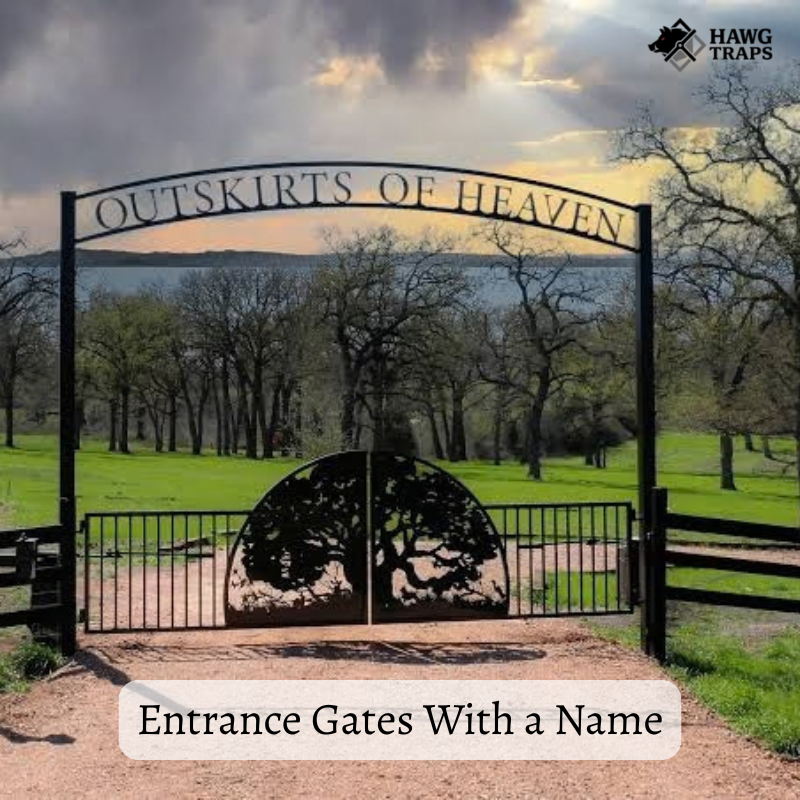
1. A straight header with the ranch name
One beam across two posts, with the name on it or hanging under it. It’s the plainest looking overhead, and that’s why it looks right almost everywhere.
Texas builder Trails West Gate Company lists the straight header first among its styles. Texas Ranch Resources describes a 2026 project with a heavy-duty square pipe overhead and matching square metal fencing.
Check first: clearance. A legal load in Texas can be 14 feet tall. Trails West calls 12 to 16 feet typical for an overhead, and the low end of that range won’t pass a legal load.
2. An arched header
The same beam, curved up in the middle. A 2015 Farm Credit article says arches “rule the day” in West Texas and the Panhandle.
Check first: the low point. An arch is tallest in the middle and lowest at the posts. Measure where the widest part of your load meets the lowest part of the curve. In the forum threads we read, one poster passed on his fire department’s request: 15 feet at the lowest point.
3. A peaked or twin-beam header
A peaked header rises to a point, like a roofline. A twin-beam header uses two beams where a single-span header uses one. Trails West lists both, along with overhead sign panels in laser-cut lettering or 3/16-inch steel artwork.
Check first: wind. A sign panel up high is a sail. Trails West says its overheads use structural steel “sized to span and wind.” Ask your builder how yours is sized for both.
4. A timber or log arch
When people see thick, heavy wooden posts and beams framing an entrance, they instantly associate them with rustic, traditional ranch life, much faster than they would with modern steel structures. Texas Ranch Resources describes one entrance near Bee Cave built from giant pine timbers, and others in rough cedar.
You can also buy the timbers as a kit. One maker, American Timber & Steel, lists treated Southern Yellow Pine poles. Its uprights are 10 or 12 inches thick and 21 or 24 feet long. Its cross poles run from 16 to 28 feet.
A word on recycled poles. In the forum threads we read, one landowner asked about using old telephone poles. A reply warned they would look, and smell, like telephone poles.
Check first: weight. That maker’s kits weigh from 904 to 6,024 pounds. The heavy one is three tons. You’ll need equipment to stand it up. And a 24-foot pole isn’t 24 feet of clearance, because part of it goes in the ground.
5. No overhead at all
Two solid posts and a gate. That’s a real choice, and a respected one.
Texas Monthly wrote in 1983 that a working ranch gate may be little more than “two cedar king posts flanking a cattle guard.” Gate maker Aberdeen wrote in 2019 that some of the largest ranches choose completely nondescript gates.
In the forum threads we read, one rancher said he’d avoid any arch, because it limits what can come through.
Check first: nothing. That’s the appeal. Put the name on the gate or on a sign by the fence.
Ranch gate design ideas
Ranch gate designs range from a plain pipe gate to a full scene cut from steel plate. The more solid steel a gate carries, the more it weighs and the more wind it catches.
6. Your brand cut in steel
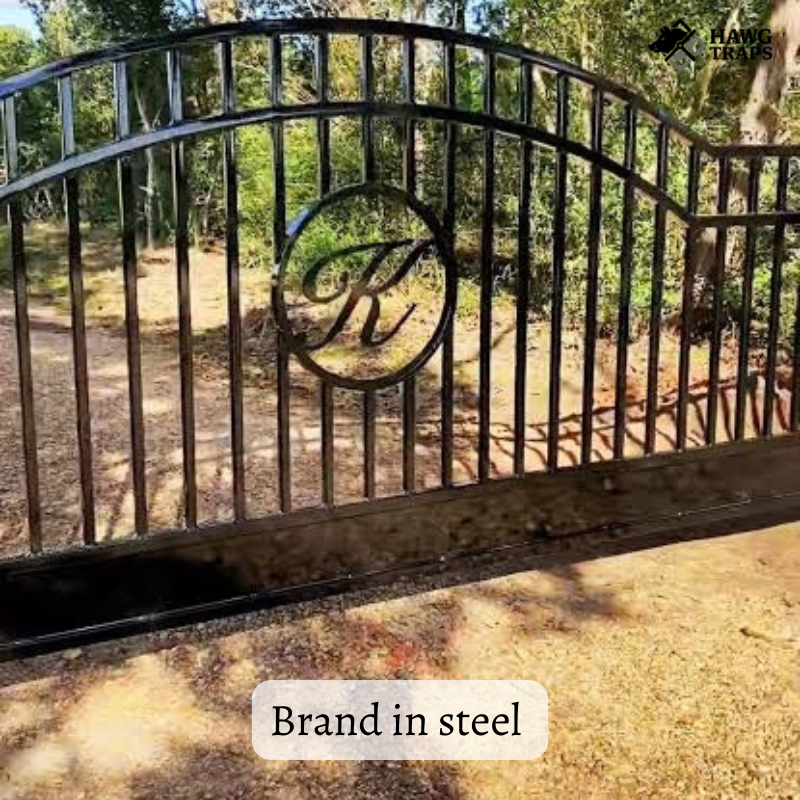
A ranch brand is its signature, and nothing makes an entrance gate more personal. In that 2015 Farm Credit article, a Texas land banker credits the plasma cutter: “If you can dream it, they can cut it.”
Texas Ranch Resources says custom gates often carry a laser-cut ranch name, cattle brand, family name or logo. Trails West cuts its artwork from 3/16-inch plate.
Check first: the opener. One widely sold opener, the Mighty Mule MM571W, is rated for gates with less than 30% solid surface. A cutout panel adds solid steel quickly. Work out the percentage before you buy the motor.
7. A full scene across the gate
This is the showpiece: horses, longhorns, oak trees, the whole place in silhouette.
Trails West described five of its themed gates in 2021. One, Almosta Ranch, is a full artwork gate with horses, a donkey, plants and trees. Another, Brushwood Rose Ranch, is a double swing gate under an overhead. Its longhorns were drawn from the customer’s own photos.
Check first: time and money. Aberdeen Custom Gate & Iron lists its most intricate gates from about $35,000. It quotes 12 to 20 weeks from design agreement to delivery. Both figures were checked on 5 October 2026.
8. One emblem in the middle
You don’t need a whole herd. One emblem on the center, that’s it. This style does most of the work for a fraction of the steel.
Two of those Trails West gates take this route. Rabbit Hill Farm is a single swing gate with an oval and a raised logo, visible from both sides. The Linegar gate is minimalist, with a custom logo in the center.
Check first: the back. A brand reads backwards from the other side unless it’s built to be seen from both. Ask before the steel is cut.
9. A shaped top line
Change the top edge of the gate and you change its character. Aberdeen lists flat, arched, dipped, tapered, rolling dip and bell profiles. Texas Ranch Resources describes a 2026 entrance near Rosanky with “a gentle downward arch.”
Check first: the square footage. Trails West prices its ranch gates from $65 a square foot, measured as width times overall gate height. So a tall arch is likely billed at its tallest point. Ask.
10. A plain pipe gate in a good color
Here’s the budget idea, and it’s a good one. A straight, well-hung gate in a fresh coat of paint. It easily beats a fancy gate that sags.
Texas Ranch Resources calls its standard ranch gates “less ornamental and more about function.” It says black and brown are the typical colors. Aberdeen’s trend list, updated in 2026, notes owners now matching the gate to the house and trim. For scale, a 16-foot farm-store tube gate was listed at $329.99 on 5 October 2026.
Texas builders often frame these in steel pipe. Our pipe ranch gate entrances page will cover that.
Check first: the finish. Ask what’s under the color. Trails West lists double-coat industrial paint. Texas Ranch Resources offers powder coating, or primer and paint.
11. The wood look, without the wood
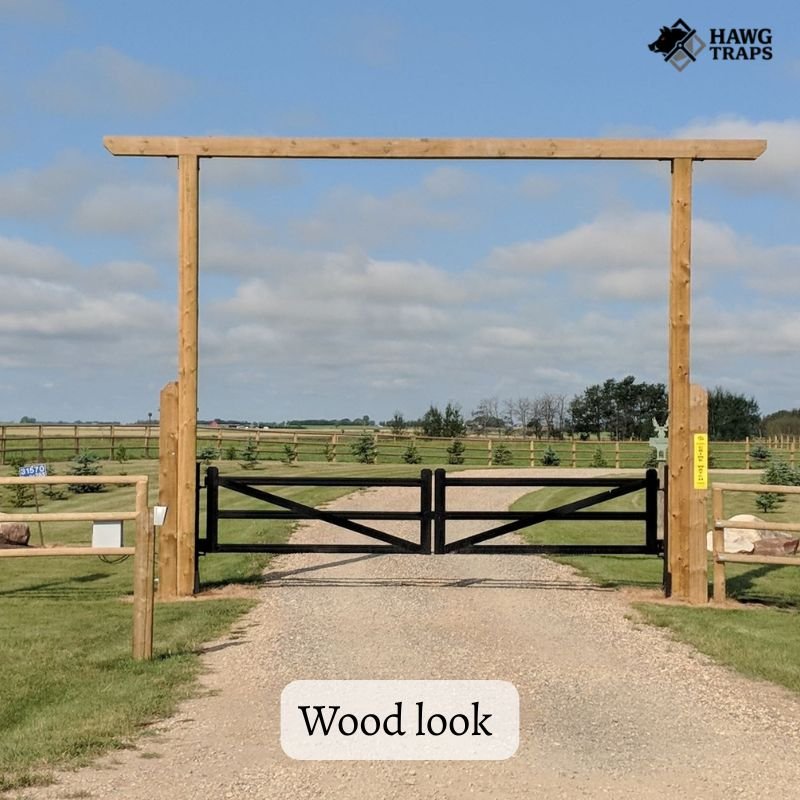
Wood is warm. Wood also weathers. One answer is a metal gate painted to look like wood.
Aberdeen builds mostly in aluminum and offers faux-wood painting. It listed its ranch-style and faux-painted gates at $25,000 to $35,000 on 5 October 2026. It says aluminum is lighter and resists rust. Keep in mind that Aberdeen sells aluminum gates.
Texas Ranch Resources gives the other side. It says aluminum may not be as heavy-duty as steel for large ranch entrances, and that real wood is often set in a steel frame.
Check first: who installs it. Aberdeen ships gates and says installation is handled by your local contractor. Line one up before you order.
Column, fence and landscaping ideas
Columns, fence and planting frame the gate and do most of the visual work. Stone or brick columns need concrete under them, and pipe-fence wings can set the gate back from the road.
12. Stone columns
Stone columns are the Hill Country signature. That Farm Credit article describes “decorative gates flanked by stone walls” there, built over generations.
Texas Ranch Resources’ Rosanky project pairs steel gates with tall limestone columns. One Trails West gate adds stone columns with custom branded canister lights.
Check first: what’s underneath. Texas Ranch Resources says heavy pillars may need a concrete pad. The Rosanky entrance sits on reinforced concrete footers. Also measure the opening between the columns, not between the posts. Columns are thicker than they look in a photo.
13. Brick columns with board fence
This is the East Texas look. The same article says farms and ranches there “frequently boast brick columns and board or pipe fencing.” It adds that a board fence is typical at horse farms.
Check first: what you keep. If the answer is horses, plan a gate here and not a cattle guard. The U.S. Forest Service calls cattle guards dangerous for horses.
14. Pipe-fence wings and a set-back gate
Wings are the short runs of fence that angle from the gate out to the fence line. They make a funnel.
That funnel has a working history. Texas Monthly noted in 1983 that the shape helped cowboys move cattle through. It also looked like open arms to a visitor.
In the forum threads we read, one rancher described wings made of two horizontal pipes with cedar stays tied upright between them, tight enough to make a wall.
Check first: the setback. This is the one idea that does both things at once. It fixes a problem while it decorates. For driveways onto state highways, the Texas Department of Transportation says a gate must sit far enough from the pavement to store the longest vehicle using the property. Wings give you that room.
15. Trees and native planting
The cheapest material on this list grows by itself. The Farm Credit article says South Texas entrances are often landscaped with rugged native plants. A Mississippi land banker in the same piece says a drive lined with live oaks or magnolias tells you the property is historic.
Check first: twenty years from now. A limb over the drive is an overhead you didn’t design. And if the entrance meets a public road, talk to the road agency early. A Texas A&M transportation engineer gives exactly that advice in the article.
Cattle guard entrance ideas
A cattle guard entrance uses a steel grid in the road, so vehicles drive in without opening a gate. It suits working ranches with cattle. It does not suit horses, and it does not lock.
A cattle guard is a grid of steel rails set across a road opening in a fence, so vehicles can drive through while cattle will not walk across it.
Idea lists usually leave these out. We think they’re the most honest ranch entrances in this list.
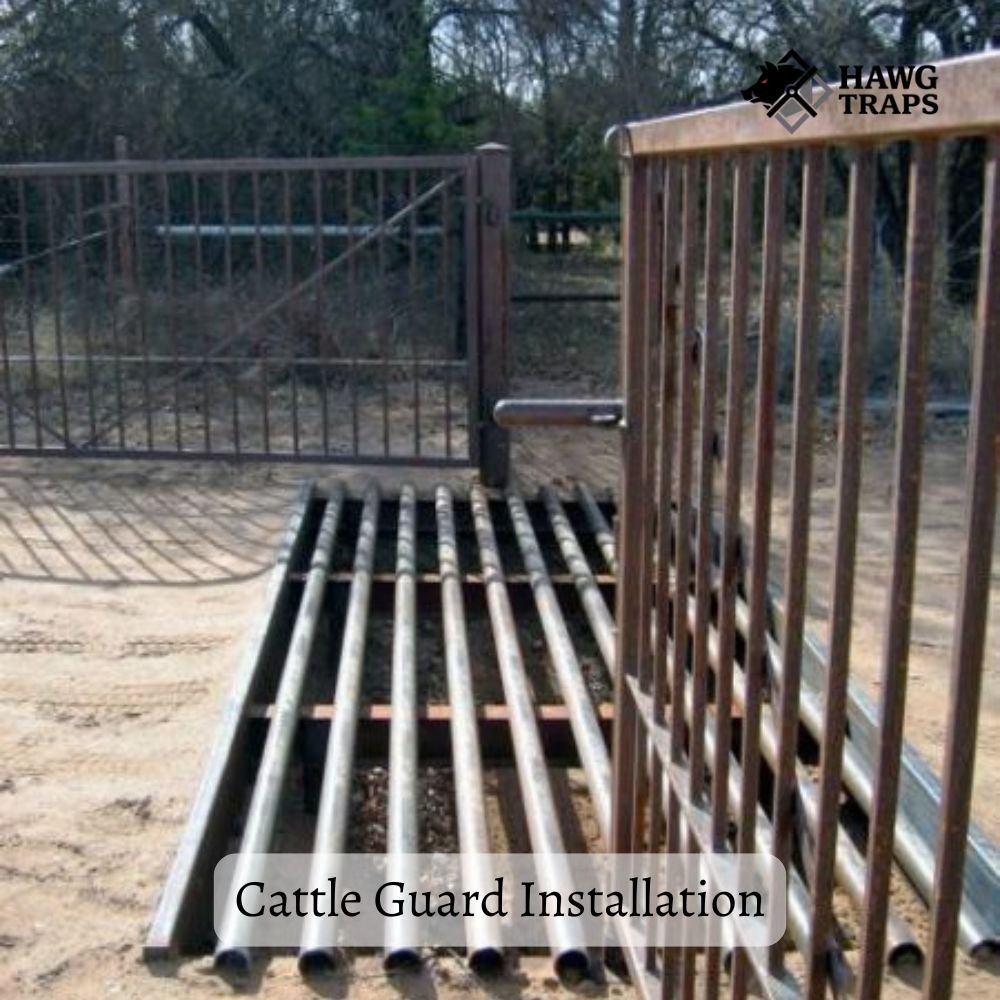
16. Two posts and a cattle guard
No gate. Two posts, a guard between them, and maybe a sign. Texas Monthly’s “two cedar king posts flanking a cattle guard” is this entrance exactly.
It’s still common. One Texas fence contractor’s blog, from 2023, describes a metal gate with a cattle guard in front of it as a regular sight on working ranches. The Farm Credit article says the same of plain cattle guards in New Mexico.
A Boss Hawg guard has 2 7/8-inch pipe rails on an 8-inch channel iron frame. It’s 7 feet 5 inches in the direction of travel, and we build it to the length of your opening. They’re on our cattle guards for sale page.
Check first: three things. A guard isn’t for horses. It doesn’t lock. And ours carry no third-party load rating, so tell us the heaviest axle that will cross.
17. A guard with a gate beside it
This is the working ranch’s full set. The guard takes the daily traffic. The gate beside it takes horses, loose stock and anything too wide for the guard.
Here’s the design idea. Put your brand on the side gate. It doesn’t need to open often, so it can be as heavy and good looking as you like. The guard does the commuting.
That side gate has its own page: cattle guard bypass gates.
Check first: room for both. The guard and the gate each need their own width, plus a post between them.
18. Two entrances: one for show, one for work
Build a handsome entrance for the house and a plain one for the equipment. The Farm Credit article describes larger operations doing this, with the working side treated “almost like a service entrance.”
In the forum threads we read, one rancher runs it the other way round. His main entrance crosses a cattle guard. A second one, with two gates, takes combines and sprayers.
Check first: the road. A second driveway onto a Texas state highway is a new access, and it needs a TxDOT driveway permit.
Sign, lighting and finishing ideas
The sign, the lights and the finish cost the least but can improve the look dramatically. A ranch name, a brand and a founding date are the traditional three things to put on an entrance.
19. Name, brand and date
Texas Monthly listed what the old ranch entrances displayed: the name of the ranch, its brand, and the date it was established. The earlier the date, the article says, the greater the rancher’s clout.
There are newer versions. Trails West builds address plates into its overheads. The Rosanky entrance has lighted metal sconces with the street information cut into the steel.
Check first: where it hangs. Letters cut from plate count as solid surfaces if they’re on a powered gate. On the header or a post, they don’t trouble the opener.
20. Lights, a keypad and a camera
An entrance you can find in the dark is a kindness to every delivery driver you’ll ever have. Texas Ranch Resources lists everything from floodlights to decorative pillar lights, electric or solar.
The Farm Credit article was already describing gate cameras and separate access codes in 2015.
Check first: power. If there’s no electricity on the road, plan for solar from the start.
21. Found objects
This is where ranch entrances began. Texas Monthly says early ranchers marked the main gate with whatever was handy: broken wheels, cow skulls and rocks.
It hasn’t gone away. Texas Ranch Resources built a timber entrance for a display at the State Fair of Texas, complete with faux cow skulls.
A wagon wheel costs almost nothing and tells people something about you. Go easy, though. One wheel is a charm. Six is a yard sale.
Check first: where it’s bolted. Anything hung on the gate adds weight and catches wind. Hang it on the posts or the fence.
Ranch entrance ideas by Texas region
A 2015 Farm Credit article describes four regional entrance styles in Texas. They are stone-flanked gates in the Hill Country, arches in West Texas and the Panhandle, native planting in South Texas, and brick columns in East Texas.
The matches in the last column are our suggestions.
| Region | Typical look | Ideas on this page that match |
|---|---|---|
| Hill Country | Decorative gates flanked by stone walls | 6, 9, 12 |
| West Texas and the Panhandle | Arches | 1, 2, 3, 16 |
| South Texas | Entrances landscaped with native plants | 5, 10, 15 |
| East Texas | Brick columns with board or pipe fencing | 13, 14 |
Texas entrances change with the country: stone in the Hill Country, arches out west, plants in the south, brick in the east.
Nobody will stop you building a Panhandle arch in the Piney Woods. An entrance that matches its country usually looks like it has always been there.
How to choose a ranch entrance idea, and what Boss Hawg builds
Choose a ranch entrance idea with three tests. Your tallest and widest load fits. You can keep the finish up. The cost matches how long you will own the place. Looks come after those.
Test 1: the truck. Every Check first line above comes back to this. Width, height and setback are worked through in our ranch entrance gates guide.
Test 2: the upkeep. Paint fades and hinges want grease. Pick a finish you’ll actually maintain.
Test 3: the money. That 2015 Farm Credit article put entrances between about $3,000 and $75,000 or more. The low end was a utility gate with an automatic opener. The high end was custom masonry and metalwork. Our own price check in October 2026 found the same kind of spread.
It may help to know which owner you are. Aberdeen described three kinds in 2019. Long-time ranching families want the name and the brand. Newer owners want a gate that suits the house. Some of the largest ranches want a gate nobody notices.
The Farm Credit article quotes a staffer’s granddad on the subject: “The bigger the gate, the smaller the ranch.”
Four mistakes the photos don’t show:
- An overhead lower than a legal load.
- A gate wide enough for the truck and too narrow for the turn.
- A gate at the fence line, with the trailer parked in the road.
- Heavy columns with no concrete under them.
What Boss Hawg builds, and what we don’t
We build the parts of an entrance that sit in the ground and in the road.
- Cattle guards. 2 7/8-inch pipe rails on an 8-inch channel iron frame, MIG welded, 7 feet 5 inches wide, any length.
- H-posts and H-corners. The braced steel a gate and a fence pull against. Details will be on our H posts and H braces page.
We don’t build gates, arches, columns or artwork. For those, call a gate fabricator near you. The Texas builders named on this page publish their work, which makes comparing easy.
We ship by freight, quoted to your ZIP code before you order. You can also pick up at the shop in Cross Plains.
Have these ready when you call:
- The opening. Width between the posts, or the width you plan.
- The heaviest axle that will cross the guard.
- Your stock. Cattle only, or horses too.
- Your delivery ZIP code.
REQUEST A QUOTE: CALL (254) 725-4554
Tell us which idea you’re building around. We’ll tell you what guard and posts fit under it.
The finishing touches come from other people’s shelves, and a few are worth a look.
Also check our partner products for finishing a ranch entrance:
- Custom metal ranch signs and metal address plaques
- Solar gate post lights and solar flood lights
- Wireless gate keypads and solar gate opener kits. Our solar gate openers page will compare models
- Cellular trail cameras for watching the gate
- Rust-preventive metal paint for idea 10
As an Amazon Associate we earn from qualifying purchases. We only list gear that fits the job; our own products are listed separately.
Frequently asked questions
What are some creative ideas for a ranch gate?
Creative ranch gate ideas include a brand cut into steel plate and a wildlife scene across a double gate. Others are a timber arch, stone columns with pipe-fence wings, and a cattle guard between two posts.
Why do ranches have tall gates?
Ranches have tall entrances so loaded trucks can pass under the overhead and so the name can be read from the road. Texas law allows a vehicle and its load to stand 14 feet high.
What are the latest trends in ranch gate design for 2026?
One Texas gate maker updated its trend list in April 2026. It names aluminum in place of steel, modern shapes with larger profiles, low-maintenance hardware, and colors other than black.
What can you use instead of a gate at a ranch entrance?
A cattle guard. It is a grid of steel rails in the road that vehicles cross and cattle will not. Many ranches keep a gate beside it for horses, loose stock and wide loads.
What are common ranch gate design mistakes?
The common mistakes are an overhead lower than a legal load and a gate too narrow for the turn. Two more are a gate hung at the fence line and heavy columns without concrete under them.
How much does a ranch gate entrance cost?
A 16-foot farm-store tube gate was listed at $329.99 on 5 October 2026. A 2015 Farm Credit article put entrances between about $3,000 and $75,000 or more.
What is the entrance to a ranch called?
It is called a ranch gate, an entry gate or a ranch entrance. The structure over the top is an arch, a header or an overhead.
Before you save one more photo
Go back to that folder on your phone. Pick your three favorites.
Now run each one past its Check first line. Probably it fails on height and one costs more than the truck. The one that’s left is your entrance.
If you want to see where these looks came from, find the photo book Ranch Gates of the Southwest, from Trinity University Press. It’s a better folder than yours or ours.
Then measure your opening and call us about the part that goes in the road.