
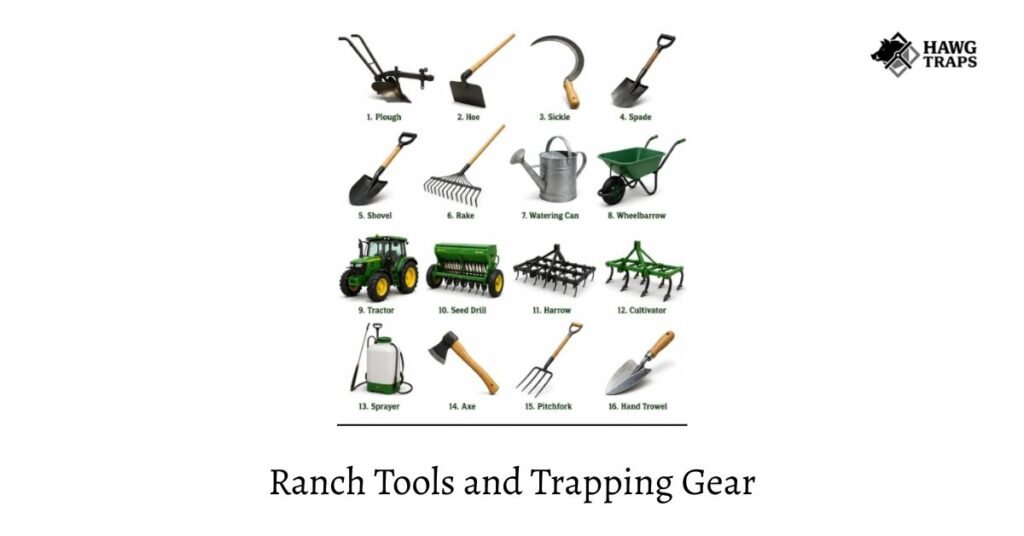
There’s a moment on every fence job when you find out you are missing some tool.
You’re a mile from the barn. A staple has been sitting in that cedar post since the Carter years, and it likes it there. You are working on a pair of ordinary pliers. In your head is a very clear picture of the right tool, hanging on a nail back at the shop.
Most ranch work have some basic similarities. The job itself is rarely the hard part. The wrong tool is.
So this page is a list, and it’s sorted the way the work is sorted: fence, gates, hog traps, the shop and the truck. Each tool has its dedicated role. Where we found a price in print, it’s here with the date.
We’re a steel shop. We build hog traps, cattle guards and H-posts, and we don’t make a single tool on this page. Some links are affiliate links, and as an Amazon Associate we earn from qualifying purchases.
Key Takeaways
- Ranch tools sort into five jobs: fencing, gates and entrances, hog trapping, shop and repair, and what rides in the truck.
- Fencing tools are the biggest group. Wire maker Red Brand’s tool list runs from a post driver and fence pliers to a spinning jenny and a crimp tool.
- The “fencing tool” has a name. It’s fencing pliers: one plier maker calls it a combination plier that both bends and cuts wire.
- Six fencing hand tools came to $270.62 at one Texas fence supplier on 11 October 2026. A T-post driver and a stretcher are extra.
- A corral hog trap needs cattle panels, T-posts, a headgate and a trigger, by Texas A&M AgriLife Extension’s list. Bait and a game camera come before any of it.
- T-posts show up on both lists. The NRCS fence specification for Texas asks for steel posts of at least 1.25 pounds per foot.
- Boss Hawg builds the steel, not the tools: hog traps, cattle guards and H-posts, welded in Cross Plains, Texas.
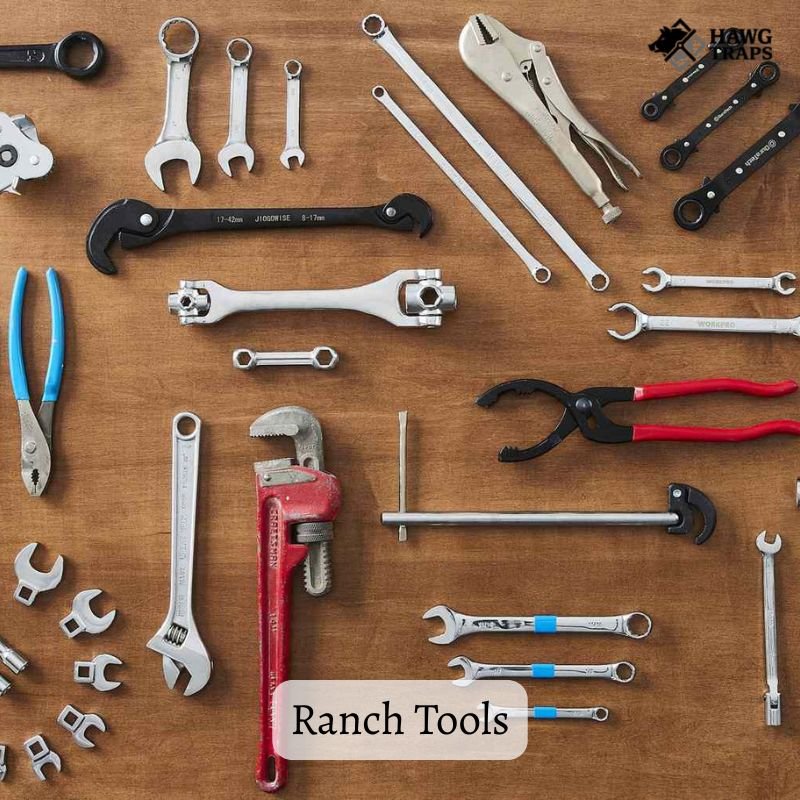
Why Trust Us: How We Chose This Gear
Boss Hawg is a steel shop in Cross Plains, Texas. We weld hog traps, cattle guards and H-posts. Our team has built ranch fences for a long time, and we use these tools ourselves. We also talk with ranchers and trappers who actually use them.
That’s experience as users. It isn’t a lab. We haven’t run a side-by-side test of any product here, so you won’t find star ratings or a “winner” badge on this page.
Here’s how a tool or a product earned its place.
- A tool is here because of the job it does on a fence, a gate or a trap. That’s the basis for every entry.
- What each tool does comes from people who make them. We quote Red Brand, a wire maker, and Maun, a plier maker, and we name them each time.
- Trapping facts come from Texas A&M AgriLife Extension.
- Prices come from sellers’ own listings, read on 11 October 2026.
- Named products come from the maker’s or seller’s own listing. Each one carries a drawback, because every tool has one.
- Where a judgement is ours, we say so.
One more thing you should know. We make none of these tools, so every product link here is someone else’s product, and some of them pay us a commission. Our editorial policy and affiliate disclosure explains how that works.
What counts as a ranch tool
Ranch tools are the hand and small power tools a ranch uses to build, mend and check its fences, gates, traps and pens. Ranch equipment is the bigger iron: tractors, trailers, chutes and steel set in the ground.
The line between the two gets a bit confusing around the size of a chainsaw. Here’s the rule of thumb we use for it: if you can carry it to the fence, it’s a tool. If it carries you to the fence, it’s equipment.
A tractor is equipment. The post hole digger hanging on its fender is a tool. A cattle guard is equipment, and the pliers you used on the fence beside it are a tool.
Why does a steel shop care? Because the tool and the steel meet at the same spot. A fence stretcher is only as good as the brace it pulls against. A T-post driver is only as good as the post under it. We build one half of that handshake, so we pay attention to the other half.
Ranch tools by job: the working list
Ranch tools sort into five jobs: fencing, gates and entrances, hog trapping, shop and repair, and what rides in the truck. Fencing has a long list, so it gets its own section below.
| Job | Tools | Steel it works on | Where we cover it |
|---|---|---|---|
| Building and mending fence | T-post driver, T-post puller, post hole digger, fencing pliers, fence stretcher, come-along, spinning jenny, crimp tool | H-braces and T-posts | Fencing tools, below |
| Gates and entrances | Solar gate opener, gate latch, chain | Gates and cattle guards | Gate and entrance gear, below |
| Hog trapping | Game camera, feeder, bait, T-posts and a driver | Traps and panels | Hog trapping gear, below |
| Shop and repair | Welder, hammer, wrench set, shovel | Whatever broke this week | Truck and shop tools, below |
| The truck | Leather gloves, fencing pliers, fixed-blade knife, flashlight | None. This is the kit that gets you home | Truck and shop tools, below |
Three of the five jobs end at a piece of fixed steel, which is why a steel shop keeps a tool list.
If you came for a quick list of common ranch tools, that table is it. Print it, stick it on the shop wall, and cross things off as you find them under the truck seat.
You’ll notice what isn’t there: no tractor, no baler, no squeeze chute. Those are equipment, and we come back to them near the end.
Did you know? Texas A&M AgriLife’s Dr. Jason Banta once listed the equipment ranches routinely own, as Progressive Cattle reported in 2013. All-terrain vehicles made the list, and the uses given for them started with “stretching fence wire.” On a ranch, even the four-wheeler is a fencing tool.
Fencing tools: the kit that builds and mends wire fence
Fencing tools are the tools that set posts, pay out wire, stretch it, join it and fasten it. The core set is a post driver, a post hole digger, fencing pliers, a wire stretcher and a hammer for staples.
On our own fence jobs we never change the order: posts, wire, stretch, fasten. The tools follow the same order, so that’s how we’ll walk through them.
Setting posts
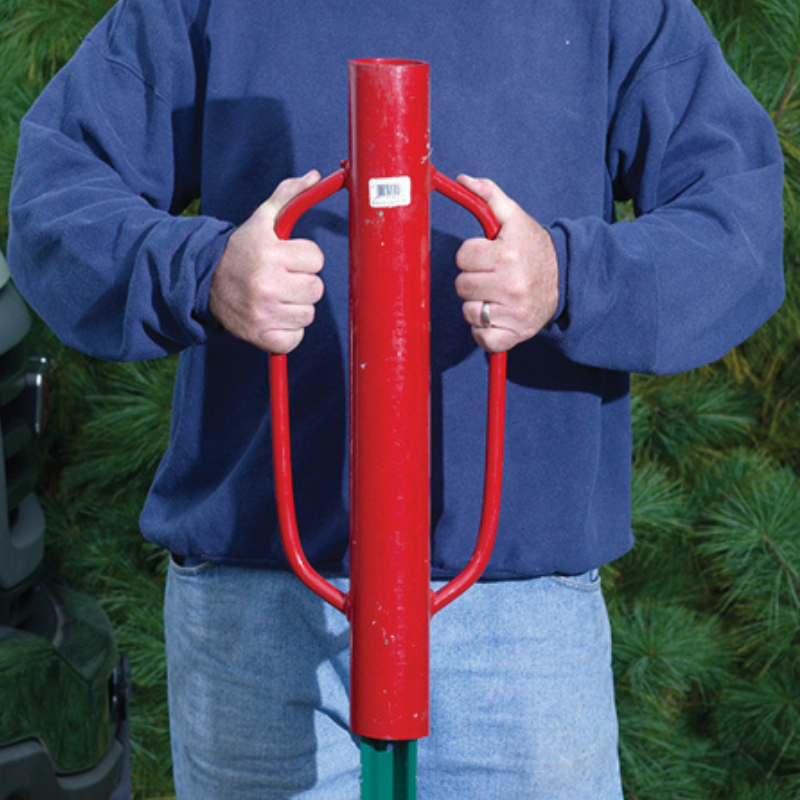
T-post driver. A heavy steel tube with handles. Plier maker Maun describes how post drivers work: they “sit on top of the post, where you then lift and drive them down onto the post.” Red Brand’s version of the advice is one line long: “Drive posts into the ground using a post driver with handles.”
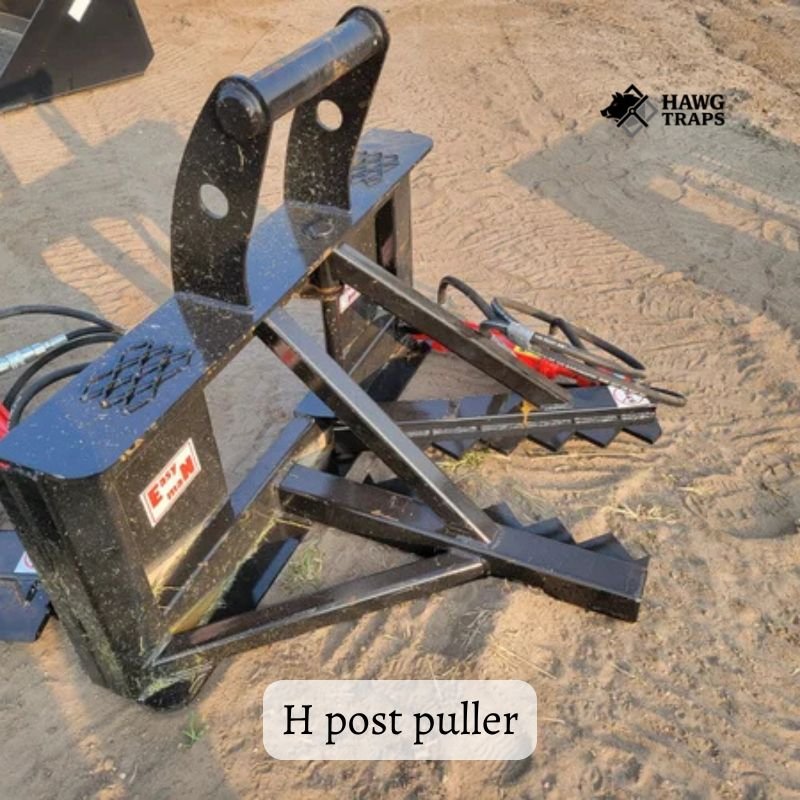
T-post puller. The driver’s opposite number. It gets a T-post back out of the ground when the fence moves or the post bends. One Texas supplier listed a puller at $59.09.
Post hole digger. In Maun’s words, it “is used to pre-dig the holes your fence posts will go in.” T-posts get driven. A post you set by hand gets a hole first.
A T-post itself is worth one sentence. It’s the steel line post in a wire fence, and the NRCS fence specification for Texas asks for posts of at least 1.25 pounds per foot. Fence supplier PowerFlex says to drive them 18 to 24 inches.
Our pages on T-post drivers and T-post pullers go into which ones to buy.
Paying out and stretching wire
Spinning jenny. A turntable that holds the roll of wire so it unwinds without turning into a slinky. Red Brand’s line is that “a spinning jenny distributes the wire with ease.”
Fence stretcher. This is the tool people mean when they ask for “a good fence tightening tool.” Red Brand names three tools for the job: “A fence wire stretcher, stretcher bar and wire gripper will get the job done right.”
Stretcher bar. A long bar with wedges that grips the wire for the pull. Fence maker Bekaert listed a 4-foot bar with five wedges at $282 and a 5-foot bar with six wedges at $392.
Come-along. A hand ratchet that pulls cable. One Texas fence supplier shelves hand pullers with its fencing tools, and listed a 1-ton model at $44.95.
Here’s where the steel comes in. A stretcher pulls the wire tight, and all of that pull lands on the brace at the end of the fence. Wire maker Stay-Tuff rates a single H-brace at 1,500 to 3,000 pounds. Stretching a fence against a weak corner doesn’t solve the problem. Our page on H posts and H braces covers the brace, and our page on fence stretchers covers the stretcher.
Stretched wire stores force; wear eye protection and gloves, and follow the tool maker’s instructions.
Joining and fastening
Fencing pliers. This is “the fencing tool” people ask about. Maun calls it “a combination plier that both bends and cuts metal wire in one easy to use hand tool.” Many, like the one further down this page, also carry a hammer face and a staple claw.
Crimp tool. It squeezes a metal sleeve around two wire ends to join them. Red Brand’s advice: “choose a top quality crimp tool and sleeves to secure the joints.”
Hammer and staples. Maun again: “you will need a solid hammer and fencing staples to attach the wire to the posts.”
So do you need the special pliers, or will ordinary ones do? Ordinary pliers will cut soft wire. They won’t pull a staple, start one, or hammer it home. Fencing pliers do all of that from one hip pocket, which is the whole argument for them.
| Tool | What it does | Listed price, 11 Oct 2026 | Our review |
|---|---|---|---|
| T-post driver | Sits on the post; you lift it and drive it down | Not priced here | T-post drivers page |
| T-post puller | Pulls a T-post back out of the ground | $59.09 | T-post pullers page |
| Post hole digger | Pre-digs the holes for posts | $99.99 | This page |
| Fencing pliers | Bends and cuts wire in one hand tool | $23.99 (8-inch), $29.99 (10-inch) | This page |
| Fence stretcher and stretcher bar | Tensions the wire | $282 to $392 for a stretcher bar | Fence stretchers page |
| Come-along (hand puller) | A hand ratchet that pulls cable | $44.95 (1-ton) | This page |
| Spinning jenny | Pays out wire from the roll | Not priced here | This page |
| Crimp tool | Joins wire ends with sleeves | Not priced here | This page |
A hand tool for wire fence ran from $23.99 to $392 at two suppliers on 11 October 2026.
Prices are from American Fence & Supply in Waco and Killeen, Texas, except the stretcher bars, which are from Bekaert.
Three fencing tools we’d point you to
These three have no review page of their own on this site, so they get a short note here. Each comes from the maker’s or seller’s listing. We haven’t bench-tested them.
Fencing pliers: Channellock 85 Fence Tool. Channellock lists it as “6 TOOLS in 1”: cutting shears, a hammer, a staple starter, a staple claw and puller, a crimping nest and a wire splicer. It’s forged from high-carbon U.S. steel and made in the USA. The drawback: it weighs 1.46 pounds, which is a lot of plier, and a plier’s hammer face is a hammer of last resort.
Post hole digger: Seymour S400 Jobsite Atlas. It has 48-inch fiberglass handles and was listed at $79.99 at True Value. The drawback: that listing says it is “Perfect for home repairs and improvement tasks” and gives no weight or blade size. For a long fence line, look hard at a heavier digger. The Texas supplier above listed one at $99.99.
Come-along: Maasdam Pow’R-Pull, 1-ton. Gemplers listed model 144S-6-LS at $70.99, with 3/16-inch cable and a weight of 7.5 pounds. The drawback: one ton is the limit, and that listing doesn’t give the cable length. Make sure to check it before you plan a long pull.
People also ask which fencing brands are best. We don’t rank brands. The makers whose listings we read for this page were Bekaert, Red Brand, Channellock, Maasdam, Gripple and Knipex, and that is a reading list, not a podium.
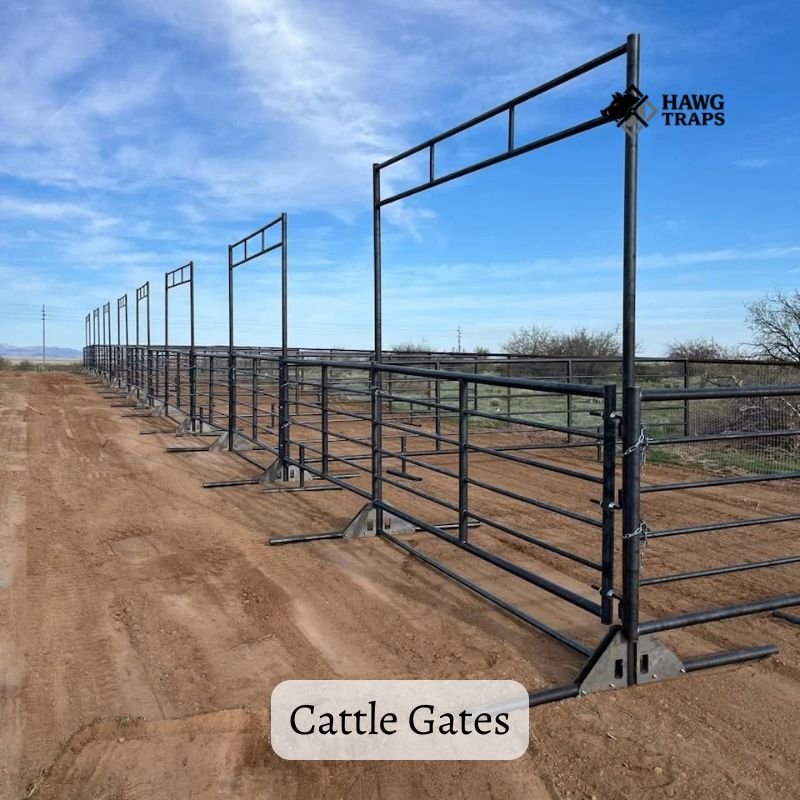
Gate and entrance gear
Gate gear is what makes a ranch gate open, close and stay shut: an opener, a latch and a chain. Boss Hawg builds the cattle guard beside the gate, not the gate or the opener.
That second sentence is the trade-off on this page, so let’s be straight about it. We weld cattle guards from 2 7/8-inch pipe on 8-inch channel iron. We don’t build gates, archways or gate openers. For those, we send you to people who do, and we say which pages earn us a commission.
Gate openers. An opener swings the gate so you don’t have to climb out of the truck every time you pass it. We cover the solar kind, since a ranch entrance can be a long way from a power pole. Our page on solar gate openers covers which ones fit a heavy ranch gate.
Latches and chains. A small part, and the one you touch every single time. A cow has all day to lean on a gate, so the latch matters. Our page on livestock gate latches covers them.
The entrance itself. Posts, width and the overhead are covered in our guide to ranch entrance gates.
Did you know? Some gate gear works on a clock. The Noble Research Institute, an Oklahoma ranching research group, described a “solar-charged gate release timer” used on a project where cattle were moved four times a day. The gate opened at 7 p.m. and the cattle moved themselves. The staff member who ran it added: “As far as I know, we’ve never changed the battery on this one.”
Hog trapping gear
Hog trapping gear is everything around the trap: bait, a game camera, a feeder and T-posts. Texas A&M AgriLife Extension lists cattle panels, T-posts, a headgate and a trigger as the primary components of a corral trap.
Here are AgriLife’s own words: “The primary components of a corral trap are cattle panels, t-posts, a headgate, and a trigger mechanism.”
Check that list again and look at the second item. T-posts. The same post that holds up your fence holds a corral trap in place, which means the driver and the puller in your fencing kit are trapping tools too. Trapping gear isn’t a separate hobby with its own catalog. It’s ranch gear, pointed at a different animal.
Bait. It comes first. AgriLife’s list: “Commonly used baits include deer corn, soured corn, manufactured baits.” Baiting before the trap is set has a name, pre-baiting, and AgriLife is firm that bait should be there before, during and after trapping.
Game camera. Also called a trail camera. AgriLife says “bait and game cameras can be used to confirm the trap location is regularly visited by pigs.” A camera can also save you the drive. Traps can be checked in person, the same page says, “or with cameras that provide monitoring information to your phone.” Our page on trail cameras for hog traps sticks to that one use.
Feeder. A feeder is one way to keep bait going out on the days you can’t. AgriLife’s trapping page doesn’t mention feeders, so we won’t put the idea in its mouth. Feeders for hog traps get their own page later.
The trap. A trap built from cattle panels is held up by T-posts. A welded trap brings its own frame. Ours are built on 1 1/2-inch, 14-gauge square tube, and they’re on our hog traps for sale page.
One thing this section leaves out on purpose: thermal scopes, night vision and hunting rifles. That’s hog hunting. This page is about trapping, and a steel shop should know which side of that line it stands on.
Truck and shop tools
Truck tools are the few a rancher carries every day: leather gloves, fencing pliers, a fixed-blade knife and a flashlight. That list is our opinion, drawn from what ranch writers repeat, not from a survey.
This list is our expert’s opinion, and you’re welcome to argue with it. Most people do, usually about the knife.
Leather gloves. Barbed wire has an opinion about bare hands. One glove we’d point you to is the Kinco 1927KW, listed at $35.99 on Kinco’s own site. It has a grain pigskin palm, which Kinco says stays soft after getting wet. The drawback: it’s lined with thermal insulation.
Fixed-blade knife. For baling twine, feed sacks and everything else. The usual answer from ranch writers is a fixed blade that holds an edge. One example is the Morakniv Companion HeavyDuty. One retailer’s listing gives it a 4.09-inch carbon steel blade, 3.2 millimeters thick, with a polymer sheath and a belt clip. The drawback is printed on that listing: “Carbon steel rusts, so wipe and oil the blade after use.”
Flashlight. Because the gate chain always breaks after dark. We name no model here.
The shop. A welder stays on that same AgriLife list of routinely owned ranch equipment. Around it go the tools every toolbox list repeats: a hammer, a wrench set, screwdrivers and a shovel. If a shop has those and a welder, most broken things on a ranch can be fixed until Saturday.
What a starter fencing kit costs
Six fencing hand tools were listed for $270.62 in total at one Texas fence supplier on 11 October 2026: a post hole digger, T-post puller, fence pliers, one-ton puller, hammer and tape measure. A T-post driver is extra.
| Tool | Listed price | Seller |
|---|---|---|
| Post hole digger, heavy | $99.99 | American Fence & Supply |
| T-post puller | $59.09 | American Fence & Supply |
| Fence pliers, 8-inch | $23.99 | American Fence & Supply |
| Hand puller, 1-ton | $44.95 | American Fence & Supply |
| Rip hammer, 16-ounce | $24.95 | American Fence & Supply |
| Tape measure, 25-foot | $17.65 | American Fence & Supply |
| Total | $270.62 |
Six hand tools came to $270.62 at one Texas supplier; the driver and the stretcher are the two extras.
The total is our arithmetic, from that supplier’s listed prices on that day. It is not a complete set, and we don’t want you to read it as one.
What it leaves out. There’s no T-post driver, because that page didn’t list one. There’s no stretcher either. A stretcher bar alone ran $282 to $392 at Bekaert, which is more than the other six tools put together.
If the fence is electric, add a tester. The same Texas supplier listed a five-light fence voltage indicator at $24.99. At the other end of the shelf, Gallagher’s Fence Volt/Current Meter and Fault Finder carries a list price of $139.99. It reads voltage and current, and an arrow on the display shows the direction of the fault. The drawback: it costs more than five times what the simple indicator does, and Gallagher’s own store showed it out of stock on the day we looked.
So a fair number for a first fencing kit is “under $300 for the hand tools, and then the stretcher.” That sentence is ours too.
Which gear to buy first, and what Boss Hawg builds
We recommend to buy fencing tools first, gate gear second, and trapping gear when hogs show up. That order is our reasoning, not a survey. Boss Hawg builds the steel these tools work on, in Cross Plains, Texas.
Here’s the thinking behind it.
- Fencing tools first. A ranch with livestock has a fence, and a fence needs mending whether you planned on it or not.
- Gate gear second. A gate without an opener still works fine. It just costs you a walk.
- Trapping gear when the hogs arrive. Nobody needs a game camera on a trap until there’s a reason to set the trap.
Those tools are reviewed separately. Seven of them do: T-post drivers, T-post pullers, fence stretchers, solar gate openers, livestock gate latches, trail cameras for hog traps, and feeders for hog traps. Those are the purchases where models can differ and one can argue about it.
Which don’t. Pliers, a post hole digger, a come-along, gloves and a knife get a short note on this page and nothing more. There are not much difference in term of functionality between a good one and a great one.
Where to shop the full catalog. We’re not a tool store, and for the whole range you want one. Tractor Supply, American Fence & Supply, Bekaert and Red Brand all sell or list far more than this page covers.
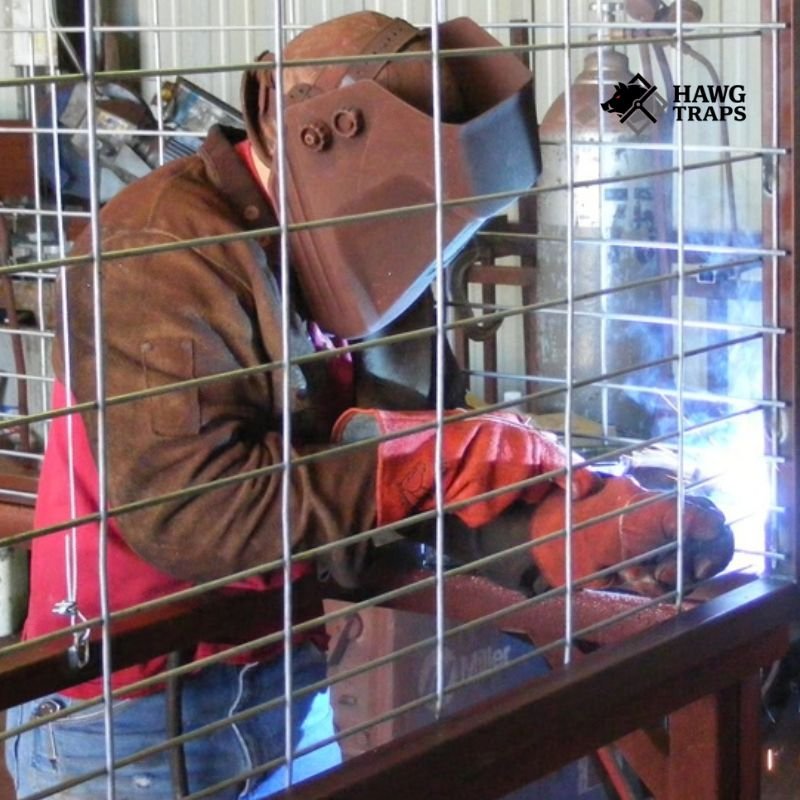
What Boss Hawg builds
Boss Hawg builds the things the tools on this page work on and around.
- Hog traps, on a 1 1/2-inch, 14-gauge square tube frame.
- Cattle guards, with 2 7/8-inch pipe rails on 8-inch channel iron.
- H-posts and H-corners, the braces your fence stretcher pulls against.
Each one is welded to order and shipped by freight anywhere in the USA, quoted to your ZIP code before you order.
REQUEST A QUOTE: CALL (254) 725-4554
Tell us the job: the trap, the guard or the fence line. We’ll tell you the steel and what it costs to deliver it.
You can also check our partner products for the tools on this page that have no review page of their own: – Fencing pliers and a crimp tool with sleeves – Post hole diggers – Come-alongs – Leather work gloves and a fixed-blade knife – Electric fence voltage testers – Spinning jennies
As an Amazon Associate we earn from qualifying purchases. Partner products are listed separately from our own and never replace them.
What this page leaves out
This page leaves out tractors, implements, chainsaws, cattle chutes and hunting optics. Those are ranch equipment or a different trade, and our ranch equipment guide covers the first group.
A list is only useful if it stops somewhere. Here’s where this one stops, and why.
- Tractors, loaders, trailers and chutes. They’re equipment, not tools. Our ranch equipment guide sorts them into what to buy, rent and hire.
- Chainsaws and brush tools. Real ranch tools, and a trade of their own. We don’t know them well enough to point you anywhere.
- Thermal scopes and hunting gear. That’s hunting. We build traps.
- Tools for backyard fences. Picket nailers and vinyl-fence tools belong to a different fence.
Frequently asked questions
What are common ranch tools?
Common ranch tools are a T-post driver, a post hole digger, fencing pliers, a wire stretcher, a hammer, a shovel, a wrench set and a welder. Fencing tools are the largest group on this list.
What tools are used for fencing?
Wire fencing uses a post driver, fencing pliers, a wire stretcher with a stretcher bar, a crimp tool and a spinning jenny that pays out the wire. Those names come from Red Brand’s own tool list.
What is the fencing tool called?
The fencing tool is usually called fencing pliers. It is also known as fence pliers. One plier maker describes it as a combination plier that both bends and cuts wire in one hand tool.
What is a good fence tightening tool?
A fence stretcher is the tool that tightens fence wire. Red Brand names three tools for the job: a fence wire stretcher, a stretcher bar and a wire gripper.
What tool cuts fence wire?
Fencing pliers with a built-in cutter cut fence wire. One plier maker advises a shear-type cutter hardened to at least HRC 62, which is that maker’s own recommendation.
How much does a fencing tool kit cost?
Six fencing hand tools came to $270.62 at one Texas fence supplier on 11 October 2026. A T-post driver and a wire stretcher are extra.
What gear do you need to trap hogs?
A corral trap needs cattle panels, T-posts, a headgate and a trigger, according to Texas A&M AgriLife Extension’s list. Bait and a game camera confirm that hogs are visiting the site.
What is the best knife for ranching?
A fixed-blade knife that holds an edge is the usual answer from ranch writers. We name no best brand here because we have run no knife test.
Before you head back out
Go back to that staple in the cedar post.
Next time, the right pliers are on your belt, the driver is in the truck bed, and the stretcher is hooked to a corner that won’t move. The staple comes out. The wire goes tight. You’re home before the coffee’s cold.
That’s all a tool list is for. Pick the job you’re doing this month and buy for that job. The rest of the list will still be here when the next thing breaks, and on a ranch the next thing is never far off. You can always come back to check it out.
And when the job needs steel that stays put, whether that’s a trap, a cattle guard or the H at the end of the fence, that part is ours.
REQUEST A QUOTE: CALL (254) 725-4554