
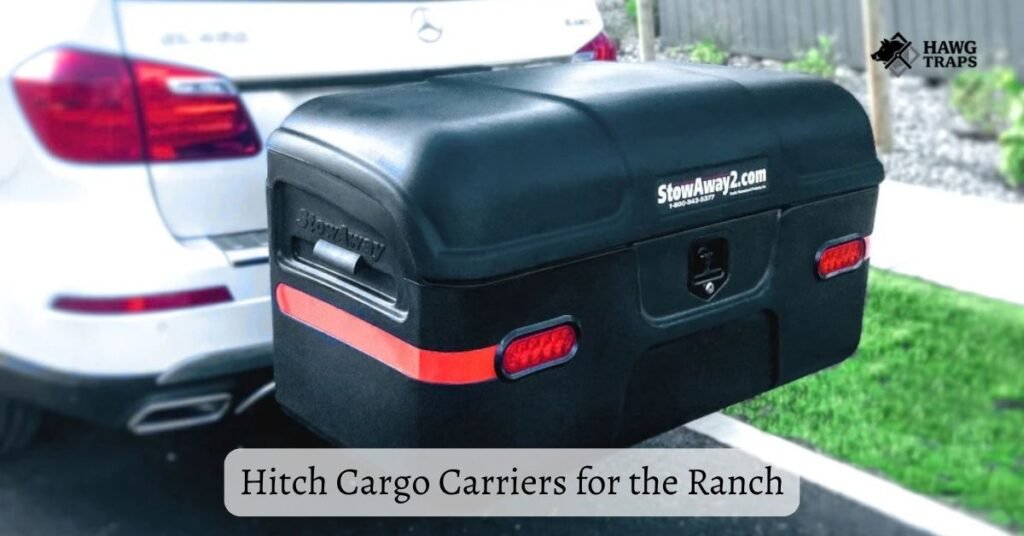
There are loads you don’t want in the cab.
A dead hog is one. So is a leaking sack of deer corn, a chainsaw that smells like a chainsaw, or forty muddy T-posts. The truck bed is the common answer, until the bed is already full of the things you came out here to do.
That’s the job of a hitch cargo carrier. It’s a steel shelf that which is connected with the back of the truck and takes the dirty work.
Most of them have a number on the box, and it’s often 500 pounds. That number is true, and it’s also not the whole truth. What you can load depends on your hitch, and on what the carrier itself weighs. This page help you with all the arithmetic.
We’re a steel shop, and we weld cargo carriers to order. Some links on this page are affiliate links to other makers’ carriers, and we may earn from qualifying purchases.
Key Takeaways
- The real limit is the lowest rating in the chain, minus the carrier’s own weight.
- On a Class 2 hitch rated for 350 pounds, a 70-pound steel carrier leaves 280 pounds for cargo.
- Aluminum weighs about half as much. One 60-inch steel basket weighs 70 pounds. Two aluminum carriers weigh 33 and 37.
- Aim for 12 inches of ground clearance, one hitch specialist advises, with 8 inches as the minimum on level ground.
- Texas requires two taillamps visible from 1,000 feet and a license plate that isn’t covered.
- Listed prices ran from $59.99 to $269.99 on 7 October 2026 for the five carriers we picked out.
Why Trust Us: How We Put This Together
Boss Hawg is a steel shop in Cross Plains, Texas. We weld hog traps, cattle guards, H-posts and cargo carriers. Our team in the US works with these products on ranch ground.
We haven’t load-tested the carriers on this page, and we haven’t road-tested them either. So nothing here is called “tested” or “best.”
- Hitch ratings come from Lippert, the company behind CURT hitches.
- The capacity rule and the clearance figures come from named hitch specialists at etrailer.
- Sizes, weights and prices come from makers’ and retailers’ listings, read on 7 October 2026.
- Owner ratings are reported as the retailer shows them, with the number of reviews.
- The Texas rules are quoted from the Transportation Code.
- The arithmetic is ours, and we show it.
What a hitch cargo carrier is
A hitch cargo carrier is a steel or aluminum platform on a square shank that slides into a vehicle’s hitch receiver. It carries loads behind the bumper. Most of the ones we read are rated at 500 pounds and fit a 2-inch receiver.
You’ll also hear it called a hitch hauler or a hitch rack. Three words do most of the work.
- Receiver. The square tube under your bumper.
- Shank. The square bar on the carrier that slides into it.
- Tongue weight. The downward load your hitch is rated to hold.
It isn’t a roof box, and it isn’t a trailer. It has no wheels of its own. Every pound on it hangs off your hitch.
Nearly everything written about these carriers is about luggage and road trips. On a ranch it’s a different tool. It hauls what’s wet, sharp, heavy or smelly, and it does that without a trailer to back up. That puts it in the first group on our ranch equipment list: the gear that rolls.
How much a hitch cargo carrier really carries
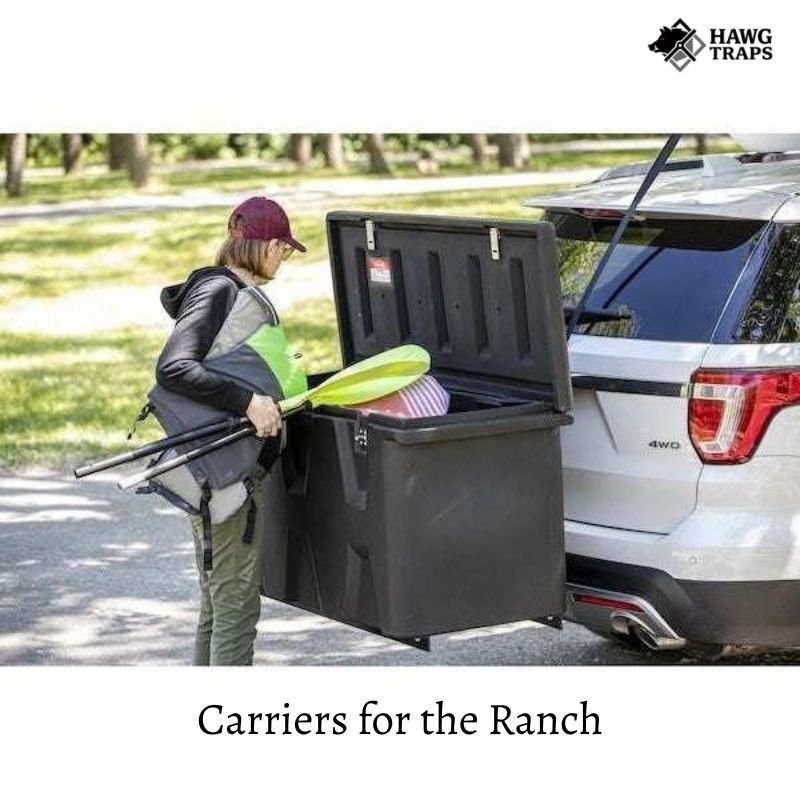
A hitch cargo carrier carries the lowest rating in the chain, minus its own weight. On a Class 2 hitch rated for 350 pounds of tongue weight, a 70-pound steel carrier leaves 280 pounds for cargo.
There are three ratings in that chain.
- The hitch’s tongue weight rating. It’s on a label on the hitch.
- The vehicle’s own limit. It’s in the owner’s manual.
- The carrier’s rated capacity. It’s on the box.
Lippert, the company behind CURT hitches, puts the rule in one sentence. Capacity, it says, “is always limited to the lowest-rated towing component, whether it’s your hitch, an accessory, the vehicle, your trailer, or any other component.”
Then comes the part the box leaves out. The carrier itself counts. An etrailer hitch specialist spells it out: the tongue weight is “the weight of the carrier plus the weight of the cargo loaded on it.”
So the sum is simple. Take the lowest rating. Subtract the carrier. What’s left is yours.
Here it is by hitch class, using Lippert’s maximums. The last two columns are our arithmetic, for a carrier rated at 500 pounds.
| Hitch class | Receiver | Tongue weight, up to | Cargo with a 70-lb steel carrier | Cargo with a 33-lb aluminum carrier |
|---|---|---|---|---|
| Class 1 | 1 1/4 inch | 200 lb | 130 lb | 167 lb |
| Class 2 | 1 1/4 inch | 350 lb | 280 lb | 317 lb |
| Class 3 | 2 inch | 800 lb | 500 lb | 500 lb |
| Class 4 | 2 inch | 1,000 lb | 500 lb | 500 lb |
On a small hitch the hitch sets the limit; on a truck hitch the carrier does.
Two things to read out of that table.
On a truck, the carrier is the weak link. A Class 3 or Class 4 hitch can hold more than a 500-pound carrier is rated for. The box number wins.
On a small SUV, the hitch is. With a Class 1 hitch, that same 500-pound carrier is good for 130 pounds. The number on the box hasn’t changed. Your hitch just never agreed to it.
Notice the words “up to.” These are class maximums. Your hitch may be rated lower, and your vehicle lower still.
Your hitch label and your vehicle’s manual set the real limit; these are the class maximums.
One fitting note. Class 1 and Class 2 hitches have a 1 1/4-inch receiver. Many truck carriers have a 2-inch shank. Check that the carrier fits your receiver before you check anything else.
Steel or aluminum, basket or tray
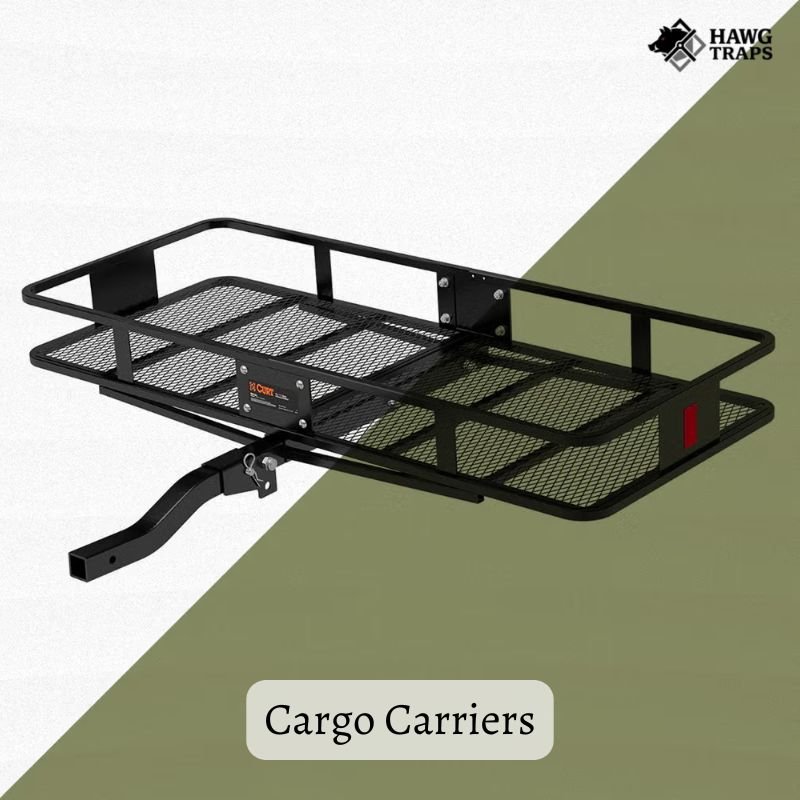
Steel is affordable and heavy. One 60-inch steel basket weighs 70 pounds, and two aluminum carriers weigh 33 and 37. Baskets have sides, 6 inches on one model, and trays are flat.
| Carrier | Material | Platform | Weight | Listed price |
|---|---|---|---|---|
| CURT 18153 basket | Steel | 60 x 24 x 6 in | 70 lb | $269.99 at Tractor Supply |
| Tow Tuff TTF-2260A | Aluminum | 60 x 22.5 x 7 in | 37 lb | $199.99 at Tractor Supply |
| Traveller foldable | Aluminum | Not printed | 33 lb | $179.99 at Tractor Supply |
| Haul-Master 500 lb | Steel | Not listed | Not listed | $59.99 at Harbor Freight |
| Haul-Master 500 lb | Aluminum | Not listed | Not listed | $119.99 at Harbor Freight |
Aluminum carriers weigh about half as much as steel ones of similar size.
What the weight costs you. Go back to the Class 2 row. The steel carrier leaves 280 pounds. The aluminum one leaves 317. Those 37 pounds are free cargo, every trip.
It also costs your back. A 70-pound carrier is a two-handed lift onto a hitch at knee height. A 33-pound one weighs less than a sack of feed.
What the weight buys you. At Harbor Freight the steel carrier is half the price of the aluminum one with the same rating. Steel is also one of our specialties.
We haven’t seen a published test showing one material outlasting the other under ranch loads. So we’ll stop at pounds and dollars.
Basket or tray. A basket has sides. CURT’s are 6 inches tall, and its listing says they “keep items more secure during travel.” A tray is a flat deck with a lip. Loose things want a basket. Long things want a tray.
Folding or fixed. A folding shank lets the carrier tilt up against the tailgate when it’s empty. It’s one more joint to rattle. It’s also the difference between just leaving the carrier on and wrestling it off everyday.
Ranch loads: feed, T-posts and game
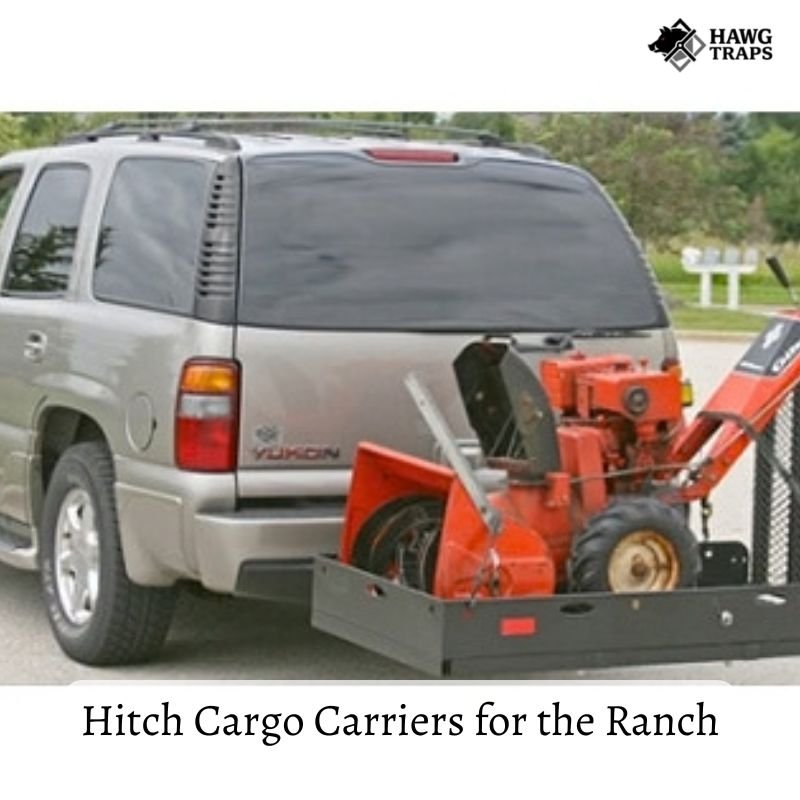
A 500-pound carrier on a truck hitch holds ten 50-pound feed sacks. On a Class 2 hitch with a 70-pound carrier, the limit is five. T-posts weigh at least 1.25 pounds per foot under the Texas fence specification.
Feed. Ten 50-pound sacks is 500 pounds, the full rating of most carriers. With 280 pounds to spend, you get five sacks and change. Leave the change.
T-posts. The NRCS fence specification for Texas asks for steel posts of at least 1.25 pounds per foot. A 6-foot post is at least 7.5 pounds. So 280 pounds is about 37 posts, and 500 pounds is about 66. Whether 66 posts will stay on a 60-inch platform is a separate question, and the answer involves straps. The brace those posts run between is on our H posts and H braces page.
Game. This is where a carrier earns its keep, and the search numbers show it. Searches for deer hitch carriers more than double in October and nearly triple in November.
There are carriers built for the exact job. Kill Shot’s hitch-mounted deer hoist and carrier is rated at 600 pounds and, by its listing, “rotates from hoist to carrier with a locking pin.” You winch the animal up, swing it over and drive.
A hog off one of your traps rides the same way. One caution: Texas restricts moving live feral hogs, so check the rules before you haul a live one. A carrier is for the kind that isn’t arguing. Trap sizes are on our hog traps for sale page.
How to load it. Thule’s packing guide gives the rule in a line: “Place your heaviest items at the bottom and as close to the vehicle’s bumper as possible.” The further back the weight sits, the harder it works on the hitch.
Did you know? The same Lippert table that rates a Class 3 hitch for 800 pounds of tongue weight rates it for 8,000 pounds of trailer. In every class, the tongue rating is a tenth of the trailer rating.
Clearance, exhaust and rattle
Aim for 12 inches of ground clearance under a hitch cargo carrier, one hitch specialist suggests, with 8 inches as the minimum on level ground. Check the gap to the exhaust, and expect some rattle without a clamp.
Clearance. A carrier hangs low and well behind the rear axle. An etrailer specialist, Jason S, puts numbers on it. On level ground, “a minimum height of 8 inches is enough for the suspension travel.” His own advice is to shoot “for 12 inches to account for speed bumps, pot holes, etc.”
He also wrote about speed bumps. A ranch has creek crossings, washed-out two-tracks and the hump on either side of a cattle guard. Twelve inches is the figure to start from, not finish at. That’s our view.
If yours sits low, there’s a fix. Some carriers have a raised shank. The same site points to a Reese model with a 2 1/2-inch rise built in.
Exhaust. Some tailpipes point straight at the platform. Thule’s guide says to “check the distance between your pipe and carrier.” Another etrailer specialist notes that PVC cargo bags near an exhaust “normally would only melt if they got too hot,” and that catching fire “would not be likely.”
That’s about bags. Use your own judgment about what else you park in front of a tailpipe. A fuel can would be a bad choice.
Rattle. A shank in a receiver has a little play, and on a washboard road you’ll hear it all. Carrier maker Let’s Go Aero advises to use “anti-wobble devices.” They’re small clamps that pinch the shank tight in the receiver.
Extensions. Be careful adding anything that moves the load further out. The same maker warns that swing-away adapters “add a ‘twisting’ force to the vehicle hitch.”
Lights and license plates: the Texas rules
Texas requires two taillamps visible from 1,000 feet and a license plate must not be covered or unreadable. The statute’s exceptions name trailer hitches, wheelchair carriers and bike racks. A cargo carrier is not on that list.
A loaded carrier creates a specific problem. It stays before your number plate and backlight. On the ranch that’s nobody’s business. On the county road it is.
Taillamps. Section 547.322 of the Texas Transportation Code asks for “at least two taillamps.” Each must show “a red light plainly visible at a distance of 1,000 feet from the rear.” The same section wants the plate lit so it’s “clearly legible at a distance of 50 feet.”
The plate. Section 504.945 makes it an offense to display a plate with any covering or material that “alters, covers, or obscures the letters or numbers.” A first offense carries a fine of up to $300.
The exceptions. The same section says it doesn’t apply to three things:
- “a trailer hitch installed on a vehicle in a normal or customary manner”
- “a wheelchair lift or wheelchair carrier”
- “a bicycle or motorcycle rack that is attached to a vehicle in a normal or customary manner”
A cargo carrier isn’t named. We’re not going to tell you what a court would make of that. Here is what we would do: keep the plate and both lamps in plain view, or add a light kit and move the plate.
This is a summary of the statute, not legal advice; ask your local law enforcement office how they treat a loaded carrier.
If you are not in Texas, make sure you know about the rules of your state.
Five hitch cargo carriers worth a look
Five carriers cover most ranch jobs: a steel basket, a light aluminum carrier, a 750-pound steel carrier, a budget steel tray and a combined game hoist and carrier. Listed prices ran from $59.99 to $269.99 on 7 October 2026.
How we chose. We didn’t test these. We picked each one for a single stated reason from its listing, and we give each a drawback. Some of the links are affiliate links, and we may earn from qualifying purchases. Our own carrier is at the bottom, with its cells empty until we publish its numbers.
| Pick | Why it’s here | Capacity | Carrier weight | Listed price, 7 Oct 2026 | Drawback |
|---|---|---|---|---|---|
| CURT 18153 steel basket | The maker publishes every number, including the weight | 500 lb | 70 lb | $269.99, Tractor Supply | Heaviest and dearest of the five |
| Traveller aluminum foldable | Lightest we found, with the most owner ratings: 4.4 of 5 from 436 | 500 lb | 33 lb | $179.99, Tractor Supply | A store brand. A few owners report quality complaints |
| Uriah Products 750 lb steel | Highest rating we found at a farm store | 750 lb | Not listed | $159.99 on sale (regular $199.99), Tractor Supply | No owner reviews yet, and no weight listed |
| Haul-Master 500 lb steel | Lowest price we found | 500 lb | Not listed | $59.99, Harbor Freight | No size or weight on the page we read |
| Kill Shot deer hoist and carrier | The only one of the five that lifts and carries | 600 lb | 52 lb | $139.99 on sale (list $289.99), Discount Ramps | Small platform: 40 1/4 by 18 1/2 inches. Gambrel and straps sold separately |
| Boss Hawg cargo carrier | Welded to order in Cross Plains, Texas | Ask the shop | Ask the shop | Quoted to your size | We haven’t published its numbers yet |
Every pick has a drawback, and the right one depends on your hitch and your load.
CURT 18153. A 60 by 24 inch steel basket with 6-inch sides, a mesh floor and a folding 2-inch shank. There is one reason for putting it at first: CURT prints the carrier’s weight. You can do the subtraction before you buy.
Traveller aluminum. Tractor Supply’s own brand. At 33 pounds it’s the easiest to lift on and off. One owner on the listing wrote that they were “looking for something light weight and it has been easy to take on and off.” Not every review is that happy. There’s a one-star among them about the quality of the build.
If you’d rather a named brand in aluminum, the Tow Tuff TTF-2260A is 37 pounds, 60 by 22.5 inches and $199.99 at Tractor Supply. It’s rated 4.5 of 5 from 59 owners there. It doesn’t fold, and owners mention “lots of nut/bolt assembly.”
Uriah Products 750. A 60 by 20 inch folding steel carrier rated for 750 pounds. Read the table in the capacity section again before you get excited. Spending extra 250 pounds only exists if your hitch and your truck both allow it.
Haul-Master. It’s $59.99. At that price you’re buying a steel tray and a weekend of finding out. Measure it, weigh it and look at the welds before you load it.
Kill Shot. It’s the specialist. It weighs 52 pounds and turns from a hoist into a carrier with one pin. On 11 owner ratings at Discount Ramps it averages 4.5 of 5.
The Boss Hawg cargo carrier, and how to choose
Boss Hawg welds cargo carriers to order in Cross Plains, Texas. Choose any carrier by four numbers: your hitch’s tongue weight rating, the carrier’s own weight, its rated capacity and its platform size.
Here’s our honest position. We build carriers, and we haven’t put their size, steel, weight or rated capacity on this page yet. So ours sits at the bottom of that table with empty cells.
That doesn’t mean you can’t have the numbers. Call and ask for them, in writing. Ask us the same four things you’d ask anyone.
- What does it weigh?
- What is it rated to carry?
- What size is the platform?
- What receiver does it fit?
When a shop-built carrier makes sense. When the store sizes don’t fit the job. A platform sized to your feed tubs. Higher sides. Tie-down points where your load needs them.
When it doesn’t. When a $180 aluminum carrier already does what you need. Buy that one.
We ship anywhere in the USA, with freight quoted to your ZIP code before you order.
Have these ready when you call:
- Your hitch class and its tongue weight rating, from the label.
- What you haul. Feed, posts, tools, game.
- The platform size you want.
- Your delivery ZIP code.
REQUEST A QUOTE: CALL (254) 725-4554
Tell us the hitch and the load. We will help you with the steel, the size and what it weighs and how we deliver it.
Also check our partner products for loading and running a carrier:
- Ratchet straps and cargo nets
- Anti-rattle hitch clamps
- Hitch carrier light kits and license plate relocation brackets
- Locking hitch pins
- Game gambrels
As an Amazon Associate we earn from qualifying purchases. Partner products are listed separately from our own and never replace them.
When you need a trailer instead
A hitch cargo carrier stops making sense when the load passes your tongue weight rating. A trailer carries its weight on its own axle and puts only a share on the hitch.
The Lippert table shows the gap. A Class 3 hitch is rated for up to 800 pounds straight down and up to 8,000 pounds towed. A carrier uses the small number. A trailer uses the big one.
So the carrier is for the load that’s awkward, not the load that’s enormous. Ten sacks of feed, yes. A pallet of it, hook up the trailer.
Frequently asked questions
How much weight can a hitch cargo carrier hold?
Most carriers we read are rated at 500 pounds. The real limit is the lowest of three ratings, the hitch, the vehicle and the carrier, minus the carrier’s own weight. On a 350-pound hitch, a 70-pound carrier leaves 280 pounds.
Are hitch cargo carriers safe?
Stay under the lowest rating in the chain, pack heavy items low and close to the bumper, strap the load down, and keep the plate and taillamps visible.
Is a steel or aluminum hitch cargo carrier better?
It depends on your hitch. One steel basket weighs 70 pounds and two aluminum carriers weigh 33 and 37, so aluminum leaves more room for cargo on a small hitch. Steel was half the price at one store.
How high should a hitch cargo carrier be off the ground?
One etrailer hitch specialist gives 8 inches as the minimum on level ground and recommends 12 inches. He notes there is no official height requirement. Rough ranch roads argue for more.
Do hitch cargo carriers block the license plate or taillights?
A loaded carrier can block both. Texas requires two taillamps visible from 1,000 feet and a plate that is not covered or obscured. A light kit and a plate bracket solve it. This is not legal advice.
Can you haul a deer or a hog on a hitch cargo carrier?
Yes, within the weight limits. Some carriers are built for it. Kill Shot’s hitch-mounted hoist and carrier is rated at 600 pounds and swings from hoist to carrier. Texas restricts moving live feral hogs.
Can I use a hitch cargo carrier on a Class 1 or Class 2 hitch?
Yes, if the shank fits the 1 1/4-inch receiver. The load is small. Class 1 hitches are rated up to 200 pounds of tongue weight and Class 2 up to 350, and the carrier’s weight comes out of that.
Does Boss Hawg make a cargo carrier?
Yes. Boss Hawg welds cargo carriers to order in Cross Plains, Texas. Its size, weight and rated capacity are not published on this page yet, so ask the shop for them in writing.
Before you load it
Find the label on your hitch. It’s usually dirty. Wipe it and read the tongue weight.
Then find the weight of the carrier. If the box doesn’t say, a bathroom scale will.
Subtract one from the other. That’s your number. It’s not the one on the box, and now you know why.
If no carrier on the shelf fits what you haul, tell us what does.