
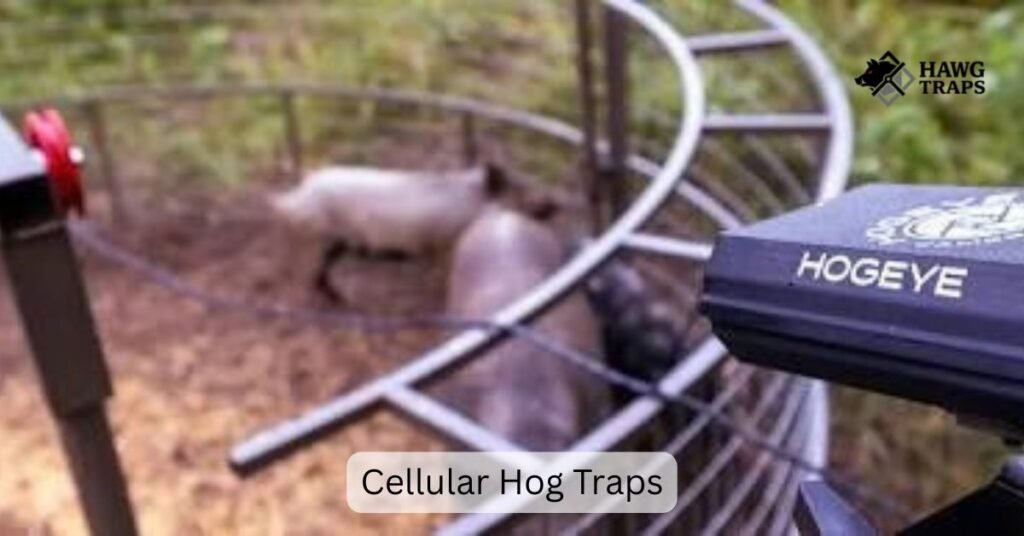
It’s 1:40 in the morning. Your phone buzzes on the nightstand. The picture shows eleven hogs in the pen and two more standing at the gate, thinking it over.
If you had a trip wire, the gate would have dropped ten minutes ago on the first three. Tonight you wait. The last two walk in. You tap the screen, and a gate falls in a pasture six miles away while you’re still in your socks.
That’s the promise of a cellular hog trap. It’s a good one. It also costs real money, needs a cell signal, and will ruin your sleep. But is it worth it? This page will cover everything.
We build steel hog traps. We don’t build the electronics, so we have no brand to push here. Some links to other products are affiliate links, and we may earn from qualifying purchases.
Key Takeaways
- A cellular hog trap is closed by a person, not a hog. You watch a camera and drop the gate by phone.
- It fixes the one big problem: You close only when the whole sounder is inside.
- A 2023 U.S. Forest Service study found it works. Pig density fell 53% in a year where whole sounders were removed with cellular traps.
- It took more labor, not less. That study logged about 1.5 person-hours per pig, against 1.1 for traditional methods.
- Prices run in three tiers: conversion kits from $599.99, gate and trigger sets from $1,350, and complete systems from $3,250 to $8,995.
- You need cell service at the trap, a charged battery, and somebody awake.
Why Trust Us: How We Put This Together
Boss Hawg is a steel shop in Cross Plains, Texas. We build traps, pens and gates. We don’t make cameras, control boxes or apps. So this is the one page on our site where we’re mostly pointing at other people’s products.
That’s useful to you. We have no cellular system to defend.
- The evidence comes from published research, chiefly a 2023 U.S. Forest Service study and a three-year Oklahoma study.
- Prices come from maker and dealer pages, checked on 4 October 2026. A few were checked on 3 October and are marked.
- Sellers’ own statistics are labelled as sellers’ statistics. There are a lot of them in this market.
- Owner experience comes from hunting forums. When we say “from the forum posts we read,” that’s what we mean. We have not run these systems ourselves.
The shop started by trapping hogs off its own land, then removing hogs for local ranchers under contract.
What is a cellular hog trap?
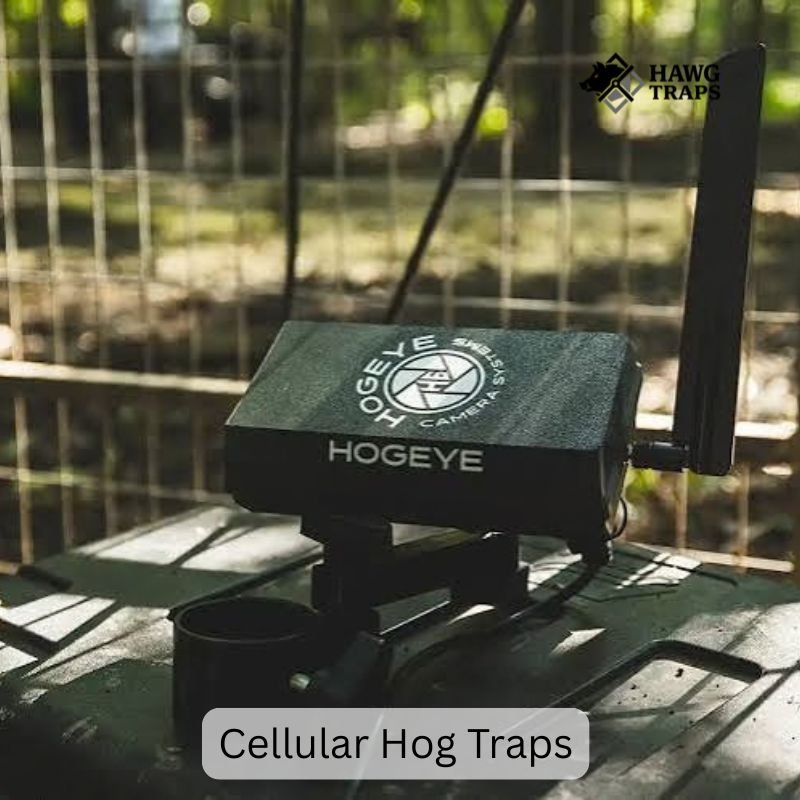
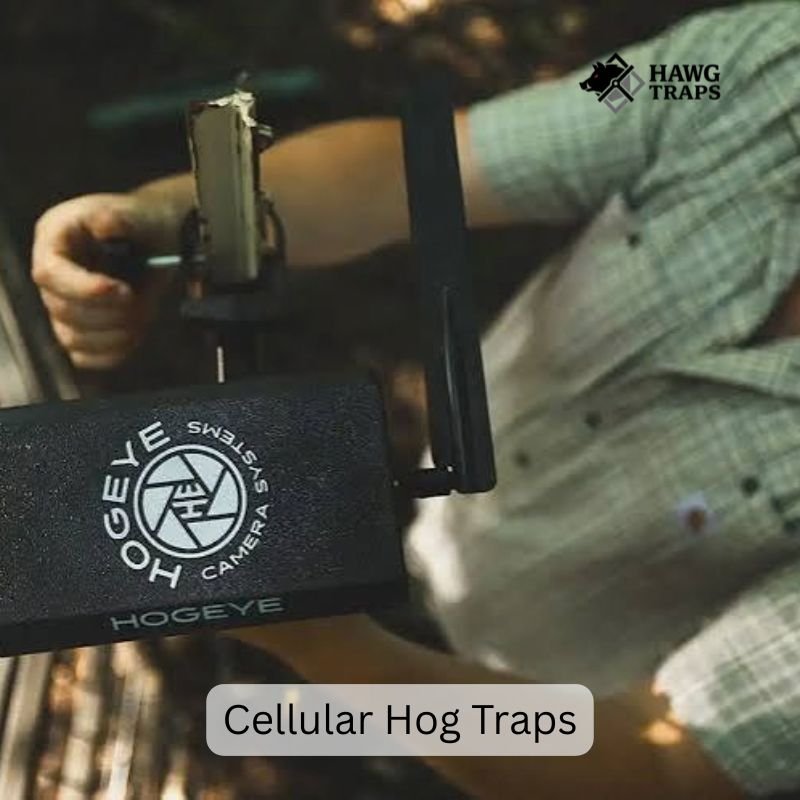
A cellular hog trap is a trap whose gate is released by a signal over the cell phone network. A camera at the trap sends you pictures or video, and you close the gate by app, text or phone call.
You may hear names like remote hog trap, cell phone hog trap, or a wireless hog trap. All of them are the same thing.
Every one of them is three parts.
- Something to hold hogs. A corral of panels with a drop gate, or a pen that hangs in the air and drops whole.
- A camera with a cell connection. It shows you who’s inside.
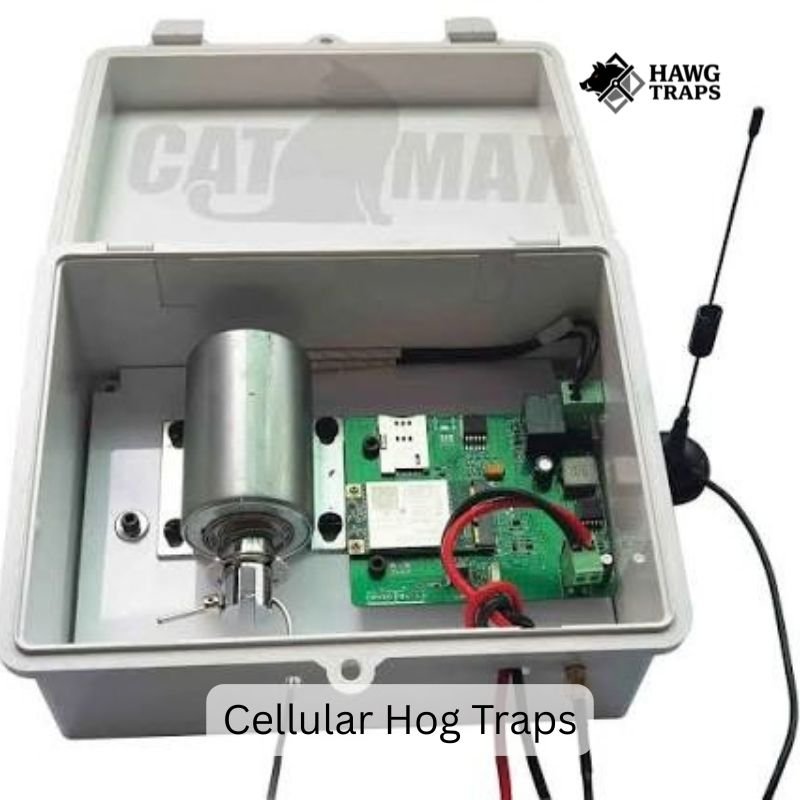
- A trigger you control. A small box with a SIM card, a battery and an electric latch. When it gets your signal, the latch lets go.
That third part is what people mean by a cellular hog trap trigger. It can be bought alone and fitted to a trap you already own. More on that below.
Texas A&M AgriLife sums up the idea in one line. A remote trigger “is typically more costly and does require cell service, but can allow managers to see exactly how many pigs are present before closing the gate.”
How does a cellular hog trap work?
A cellular hog trap works in four steps: hogs enter, the camera alerts your phone, you check that the whole sounder is inside, and you send the signal that drops the gate.
Here’s a normal night.
- Pre-bait with the gate locked open. Same as any trap. Days of free meals.
- The camera learns the group. You count hogs in the pictures until you know the sounder by number.
- Arm the trigger. Now the gate hangs on its electric latch.
- The phone buzzes. Motion at the trap. You look.
- You wait for the last one. This is the whole point.
- You send it. An app button, a text or a call, depending on the system. The latch releases and the gate falls.
Systems differ in how you send the signal. One maker’s units drop when you simply call the trap’s phone number. Another offers an app, a text command, and a handheld remote that works from over 300 yards away for when you’re sitting nearby.
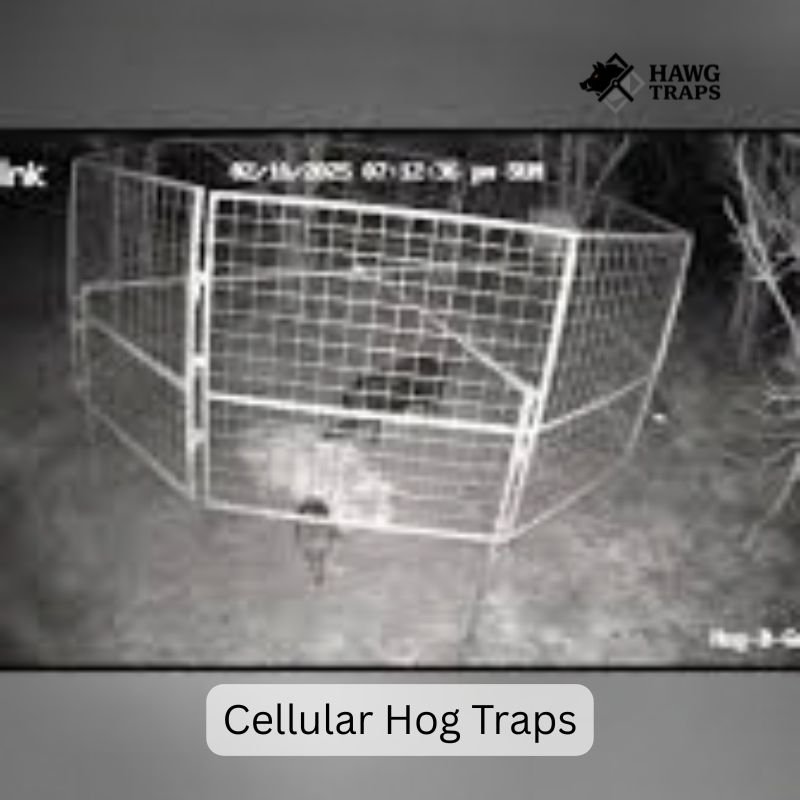
They also differ in what you see. Some cameras send still photos by text. Others stream live video. Live is better for timing, and it costs more. From the forum posts we read, one trapper using a live-stream trail camera reported a delay of 3 to 5 seconds. One purpose-built trap camera claims notifications “in under a second.”
This delay is quite ignorable and doesn’t actually matter. Hogs with their heads down at the bait usually aren’t going anywhere fast.
Do cellular hog traps work? What the research says
Yes. In a 2023 U.S. Forest Service study, removing whole sounders with cellular traps cut wild pig density by 53% in one year. It also took more labor per pig than traditional trapping.
Most claims are from the people who sell traps. Lets look at some neutral sources.
The Forest Service study. Kilgo and colleagues compared two approaches on separate units of land. They published it in Pest Management Science in 2023.
| Whole-sounder removal | Traditional control | |
|---|---|---|
| Traps used | JAGER PRO and BoarBuster traps with cellular cameras | Box and corral traps with root-stick or trip-wire triggers, plus dogs and shooting |
| When the gate closed | Only when the whole target sounder was inside | When a hog tripped it |
| Pig density after one year | Down 53% | The authors report it “did not differ after trapping, although it declined 33%” |
| Labor | About 1.5 person-hours per pig | About 1.1 person-hours per pig |
Read both halves. Cellular trapping decreased the population more. It was not the lazy way. Watching, waiting and closing on whole groups took more hours for each pig removed.
The authors also set expectations. On land that has been trapped before, they say managers should expect reductions of no more than about 50 to 60%. A cellular trap is a better tool. It isn’t a magic one.
The Oklahoma study. Over three years, remotely triggered suspended traps had a removal rate of 88.1%. Corral traps had 48.5%. Our drop hog trap page covers it.
Why it works. An Alabama study explains the mechanism. When a trap closed on part of a sounder, the pigs left outside had 222 chances to push in through doors built for that. Only 11 did. Hog you missed, is probably not coming anywhere near to any suspicious trap. So its best to not to miss any.
What sellers say. JAGER PRO publishes its own examples: “100% capture success” when a person closes the gate, against a “42% failure rate” with animal-tripped triggers. Those are a maker’s figures about its own product. The direction matches the research. The exact numbers aren’t independent.
What does a cellular hog trap cost?
A cellular hog trap costs from about $600 to about $9,000. Conversion kits for a trap you own were listed from $599.99. Gate and trigger sets started at $1,350. Complete systems ran from $3,250 to $8,995.
Which tier you’re in depends on what you already have.
Tier 1: Convert a trap you own
| Product | Listed price | You still need |
|---|---|---|
| Hogg Boss Conversion Unit | $599.99 | Gate latch, battery, camera. $5 a month service |
| Hogg Boss Conversion Pro | $799.99 | Battery, camera. $5 a month service. Electronic latch included |
| Hog Trap Trigger, standard unit | $799 | Camera. Service renewal listed at $125 a year |
| Hog Trap Trigger with solar charger | $999 | Camera. Service renewal listed at $125 a year |
| TrackSide Trapping Wireless Trigger | $975 | Camera. Service after the first 30 days |
Tier 2: A gate with a trigger on it
| Product | Listed price | You still need |
|---|---|---|
| J4 Welding 6-foot Boar Door gate and trigger | $1,350 | Panels, posts, camera. One year of service included |
| Hogg Boss single gate | $1,599.99 at one dealer | Panels, battery, camera. That dealer lists service at $100 a year |
Tier 3: A complete system
| Product | Listed price | What it is |
|---|---|---|
| J4 Welding 6-panel trap | $3,250 | Six 8 × 5-foot panels, 6-foot drop gate, trigger, camera |
| Big Pig drop trap | $4,499 | 12-foot suspended steel trap with camera. Shown sold out when we checked |
| JAGER PRO Sergeant package | $4,800 to $6,300 | Two 8-foot gates, 6 to 12 rigid panels, camera, remote. 20 to 32 feet across |
| Hogg Boss gate with corral | $5,199.99 | Gate, electronics and a 10-panel corral. Battery extra |
| BoarBuster | $7,895, plus $500 shipping | 18-foot suspended trap with camera |
| Game Changer Pro | $8,995 (3 October) | 29-foot trailer-mounted trap with four gates and a camera |
Listed prices on 4 October 2026 unless marked. Check before you buy.
The running costs. These are easy to miss.
- Service. From $5 a month at the low end. BoarBuster says its data charge “will not be more than $70” a month.
- A camera, if the kit has none. Purpose-built trap cameras cost real money. One was listed at $1,299, or $2,999 in a satellite version for places with no cell signal. Ordinary cellular trail cameras cost far less.
- A battery. Several kits leave it out.
- Bait. More than you think. You’re feeding a whole sounder for days.
Here’s one worked example. A Hogg Boss Conversion Pro at $799.99 plus twelve months of service at $5 comes to $859.99 for the first year. Add a battery and a cellular trail camera, and you’ve made a cellular trap out of the one you had.
For traps without electronics, see our hog trap cost page.
Can you convert a hog trap you already own?
Yes. Conversion kits put a cellular trigger on an existing gate. You need a gate that falls or swings shut when released, a place to mount an electric latch, a battery, and a cellular camera watching the trap.
Makers say their kits fit existing traps, and one says any hog trap. That’s a claim to test before you pay. Ask the maker three things.
- What kind of gate does it suit? A drop gate is the simple case. The latch holds the gate up, and gravity closes it.
- How does the latch mount? Some kits include the latch. One doesn’t.
- How strong is the latch? It has to hold the gate’s weight for days, then let go cleanly.
One maker notes that fitting its newer unit to its own older gates may take some fabrication work. That means drilling and maybe welding. Believe it.
A plain guillotine or drop door is the easy gate to convert. Our hog trap door designs page shows how one is built.
Can you build a DIY cellular hog trap trigger?
Yes, and people do. A home-built cellular trigger is a GSM relay switch, a 12-volt latch, a battery, a SIM card and a cellular camera. Builders on one forum reported relay units at $100 and $135 in 2020.
From the forum posts we read, the home-built route has real fans. One Georgia trapper wrote in 2022: “Cheapest route for me was cell phone trigger…also has been the most reliable.”
The parts list builders describe:
- A GSM relay switch. A small box that takes a SIM card. Call or text it and it closes a relay.
- A 12-volt latch or “door popper.” One builder used a unit with a 60-pound pull.
- A 12-volt battery, and usually a small solar panel to keep it up.
- A SIM card with service on a network that covers the trap.
- A cellular trail camera on a tree or post, looking into the pen.
- A weatherproof box to keep it all dry.
One of those builders said he had “right at 200.00 dollars” in his converted gate.
We’re not going to print a wiring diagram. We haven’t built one, and a wrong diagram from a steel shop helps nobody. Here’s what we will say.
- Check the network. Older 2G and 3G relay units may not connect anymore. Buy a 4G unit, and confirm the carrier covers your pasture.
- Test it twenty times before you bait. Drop the gate from the house. Drop it from town. Drop it at night.
- Respect the gate. An armed gate can fall when you don’t expect it. Pin it open whenever you’re under it.
- Know your limits. One builder on that forum admitted, “I’m on the electrically challenged side.” If that’s you, a ready-made kit costs more and saves a weekend of swearing.
Parts for a cellular trigger, from our partners:
- 4G GSM relay switch on Amazon. Check today’s price, reviews and which networks it supports
- Cellular trail cameras, and live-view cellular trail cameras for real-time checks
- 12-volt deep-cycle batteries and 12-volt solar battery chargers
- 12-volt latches and weatherproof electrical boxes
As an Amazon Associate we earn from qualifying purchases. Partner products are listed separately from our own and never replace them.
The downsides of cellular hog traps
The main downsides of cellular hog traps are cost, the need for cell signal at the trap, batteries to maintain, and the fact that a person must be watching when the hogs arrive.
Sellers don’t dwell on these, so we will.
Signal. No bars, no trap. BoarBuster says plainly that the location “needs access to the AT&T or Verizon cellular network.” Visit the trap site and make sure your phone have mobile network at the spot. Weak signal means late pictures and late drops.
Power. A battery runs the camera and the latch. Solar panels help. Shade, short winter days and old batteries don’t.
Your sleep. Hogs come at night. From the forum posts we read, one trapper named the “main downside” as “getting woken up in the middle of the night from text alerts.” He added that with poor signal you may get “delayed drops.”
There’s a fix for that one. Some cameras let several people share access. As another trapper put it, “the same person does not have to monitor the trap all the time.” Take turns.
More to break. A trip wire is a string. A cellular trigger is a camera, an app, a SIM card, a control box, a battery, a latch and a network. One competitor’s sales page asks, “What happens when your battery dies? When a tree blocks your signal? Or when your app freezes and the hogs leave?” It’s a seller’s pitch for a different trap. They’re still fair questions.
Time. Remember the study. More hours per pig, not fewer.
The next morning. A phone closes the gate. It doesn’t empty the trap. You still have a pen full of hogs to deal with, and rules on handling or moving live feral hogs differ by state. Check with your state wildlife or animal health agency first.
Common mistakes with cellular hog traps
The most common cellular trap mistakes are closing the gate too early, skipping the test drops, and never checking signal at the trap site. The technology doesn’t replace patience.
- Dropping on the first good group. The camera’s whole value is waiting for the last hog. Use it.
- Not knowing the count. If you haven’t counted the sounder over several nights, you can’t know who’s missing.
- Arming too soon. Pre-bait first. The fanciest gate still needs hogs that trust the pen.
- Skipping test drops. Find the dead battery in daylight.
- Trusting one bar of signal. Check it at the trap, at night, more than once.
- A pen too small for the sounder. Our hog trap panels page has the sizes.
- Forgetting the service renewal. A lapsed SIM turns it back into a fence.
Who needs a cellular hog trap, and who doesn’t?
You need a cellular hog trap if you face large or trap-shy sounders, have cell signal at the site, and can watch a phone at night. For one or two hogs, a trip wire does the job for far less.
It’s worth the money if:
- Your sounders are big. A dozen hogs won’t all be inside when the first one bumps a wire.
- Your hogs have been trapped at before. Wary hogs hang back. You need to wait them out.
- The trap is far away. You can just look at the camera and know if anything was caught.
- Raccoons and deer keep springing your trap. A person doesn’t close a gate on a raccoon.
Save your money if:
- It’s one boar or a pair. A box trap or small pen with a trip wire is enough.
- There’s no signal. Signals are vital for the cellular hot traps.
- Nobody will watch the phone. An armed gate nobody triggers is an open gate.
The middle road. This one costs the least. Put an ordinary cellular trail camera on a trap with a manual trigger. Watch for a week. Set the trip wire only when the pictures show the whole group feeding inside every night. You get the counting without the control box.
Where Boss Hawg fits
Boss Hawg does not build cellular triggers or cameras. We build the steel part: welded pens, panels and gates that a cellular trigger can be fitted to. For the electronics, use one of the makers above.
A cellular system is two purchases wearing one price tag. There’s the electronics, and there’s the steel that actually holds the hogs. The complete systems bundle both. You don’t have to buy them together.
What we build:
- Big Pen hog trap A panel pen sized to your site and your sounder.
- Pro Pen hog trap A welded panel pen with panel gates, a trip wire and a loading ramp.
- Custom hog traps If you plan to add a cellular trigger, say so when you call. We can talk through the gate before it’s built.
Our steel is 1½-inch, 14-gauge square tubing, braced, with 6-gauge wire MIG welded on.
Now the honest limits. We can’t promise that a given conversion kit fits one of our gates. Ask the kit maker, and ask us, before you order either. If you want one box with everything in it and one number to call, a complete system from a cellular trap maker is the simpler buy. And we don’t post prices, so ours take a phone call.
Have these ready when you call:
- Your hog count. The biggest group your camera has shown.
- Your trigger plan. Trip wire now, cellular later, or cellular from day one.
- Your ground. Pasture, brush or creek bottom, and whether the pen will move.
- Your delivery ZIP code. We ship anywhere in the US. Freight is paid by the buyer and quoted before you order.
REQUEST A QUOTE: CALL (254) 725-4554
Tell us how many hogs and how you plan to close the gate. We’ll tell you what pen fits, and what it costs delivered.
Also check our partner products for watching and powering a trap:
- Cellular trail cameras to count the sounder, with or without a cellular trigger
- Solar panels for trail cameras to keep the camera running
- Cell signal antennas for trail cameras for weak-signal sites
- Game feeders to pre-bait on a schedule
As an Amazon Associate we earn from qualifying purchases. Partner products are listed separately from our own and never replace them.
Frequently asked questions
How much does a cellular hog trap cost?
Conversion kits for an existing trap were listed from $599.99 on 4 October 2026. Gate and trigger sets started at $1,350. Complete systems ran from $3,250 to $8,995. Cell service, a camera and a battery are often extra.
Are cellular hog traps the most effective hog trap?
They are the most effective way to catch whole sounders. In a 2023 U.S. Forest Service study, whole-sounder removal with cellular traps cut pig density 53% in a year. It also took more labor per pig.
Do cellular hog traps need a monthly fee?
Yes. The trigger and the camera each need cell service. Fees we found ran from $5 a month for a trigger to as much as $70 a month for one complete system’s data plan.
Will a cellular hog trap work without cell service?
No. The trap site needs a usable signal from the carrier the unit runs on, usually AT&T or Verizon. At least one maker sells a satellite camera for sites with no cell coverage.
What are the disadvantages of a cellular hog trap?
Cost, dependence on cell signal, batteries to maintain, more parts that can fail, and night-time alerts. Somebody has to watch the camera and send the signal when the hogs are inside.
What is the most affordable cellular hog trap?
The cheapest route is converting a trap you already own. Ready-made conversion kits were listed from $599.99. Home builders on one forum reported GSM relay units at $100 to $135 in 2020, plus a latch, battery and camera.