
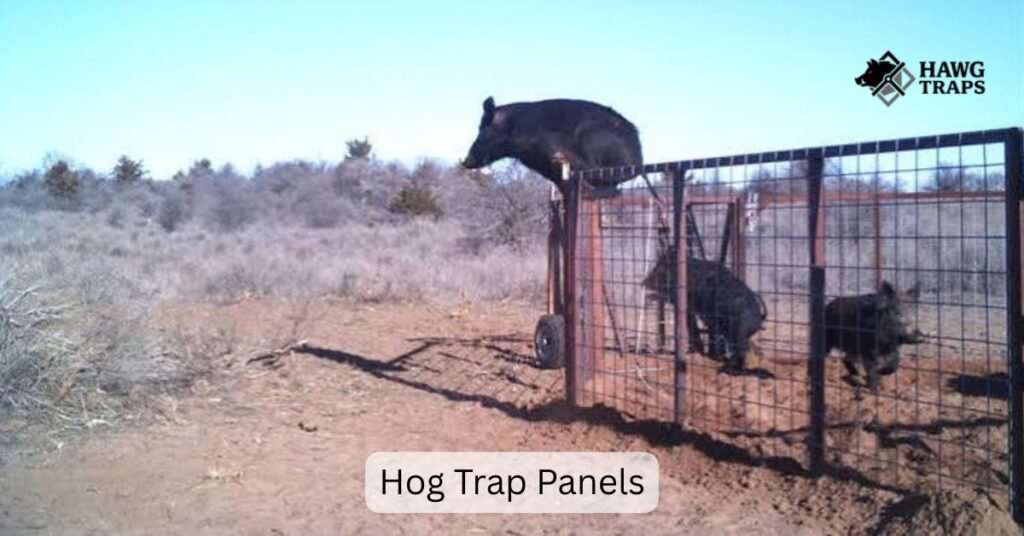
Walk down the panel aisle at a farm store and you’ll see a stack of wire rectangles that all look alike. Hog panel. Cattle panel. Combo panel. Utility panel. Horse panel. Same length, same shine, five different prices.
Here is the irony, the one called a hog panel is the worst one for trapping wild hogs.
Pick wrong and the trap still looks fine. It just leaks. The little ones walk out through the squares, and the big ones go over the top. This page sorts out which panel to buy, how many, and what to drive in the ground to hold them.
We build hog traps with welded steel panels. Some links to other products are affiliate links, and we may earn from qualifying purchases.
Key Takeaways
- The extension standard is a utility panel at least 5 feet tall with mesh no bigger than 4 × 4 inches.
- A “hog panel” is only 34 inches tall. It’s made for pens of farm pigs, and it’s too short for a trap.
- A plain cattle panel has openings up to 8 × 6 inches. Small pigs go through them.
- You need at least four 20-foot panels or five 16-foot panels, according to University of Arkansas Extension.
- Set a T-post about every 4 feet. That’s 20 posts for a 25-foot trap.
- A 5 × 16-foot utility panel was listed at $99.99 at Tractor Supply on 4 October 2026.
Why Trust Us: How We Put This Together
Boss Hawg is a steel shop in Cross Plains, Texas. We weld our own trap panels, so you might expect us to tell you farm-store panels are junk. We won’t, because they aren’t. Extension services build corral traps from them.
Here’s what this page is built on.
- Extension guides from Texas A&M AgriLife and the University of Arkansas for panel size, mesh, posts and tying.
- Store listings for prices, weights and wire gauge, all checked on 4 October 2026.
- One trap maker’s published view on why store panels fail. We label it as a seller’s view.
- Forum posts from trappers. When we say “from the forum posts we read,” that’s what we mean. We did not run our own panel trials.
- Simple arithmetic for how many panels and posts a trap takes. We show the sums.
Our shop began by trapping hogs off its own land, then removing hogs for local ranchers under contract.
What are hog trap panels?
Hog trap panels are the welded wire sections that form the walls of a corral trap. Most are 16 or 20 feet long and stand on steel T-posts. Some makers build shorter, framed steel panels that pin together without posts.
So there are two families.
- Livestock wire panels. These are the farm-store kind. One long sheet of welded rod, bent into a curve and wired to T-posts. Affordable, and easy to build.
- Framed trap panels. These are built for trapping. Wire or bars are welded inside a steel frame. They’re shorter, heavier and stiffer, and they cost more.
Most of this page is about the first kind, because that’s where people go wrong. We get to framed panels further down.
Panels are one of three parts in a corral trap. The other two are the gate and the trigger.
Which panel is best for a hog trap?
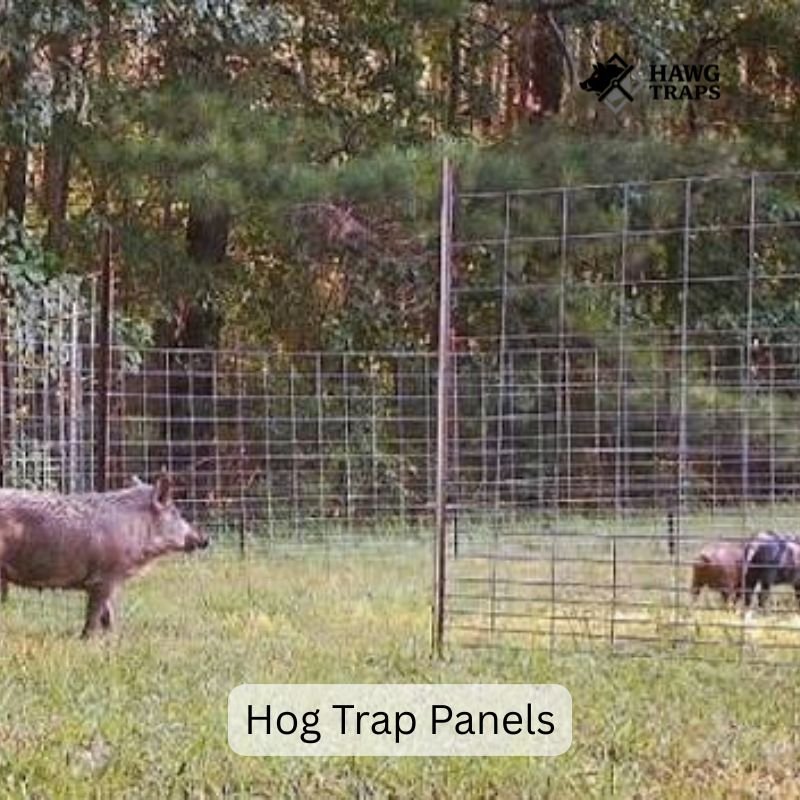
The best farm-store panel for a hog trap is a utility panel 5 feet tall with 4 × 4-inch mesh. Extension guides specify it. A horse panel with 2 × 4-inch mesh holds smaller pigs but costs and weighs more.
Here are six panels from one store, side by side. All are 16 feet long.
| Panel | Height | Openings | Wire | Listed price, 4 Oct 2026 | For a hog trap |
|---|---|---|---|---|---|
| Hog panel | 34 in | Small at the bottom, larger above | 5 and 4 gauge | $44.99 | No. Too short |
| Cattle panel | 50 in | Up to 8 × 6 in | 4 gauge | $39.99 on sale | No. Small pigs walk through |
| Combo panel | 52 in | 4 in high at the bottom, 6 in above | 4 gauge | $69.99 | Budget choice. Openings are still large |
| Sheep and goat panel | 48 in | 4 × 4 in | 4 gauge | $99.99 | Right mesh, a foot short |
| Utility panel | 60 in | 4 × 4 in | 6 gauge | $99.99 | Yes. The extension standard |
| Horse panel | 60 in | 2 in wide × 4 in high | 6 gauge | $129.99 | Yes. Tightest mesh, heaviest |
Prices and specs from Tractor Supply listings on 4 October 2026. Prices vary by store.
The store’s own description of that utility panel lists hog traps among its uses. The University of Arkansas says the same thing in plainer words: “Purchase utility livestock panels at least 5 feet high by 16 to 20 feet in length.”
Texas A&M AgriLife describes most corral traps as built from “20- by 5-foot” panels “with 4- by 4-inch square mesh and steel T-posts.”
Why the hog panel loses. It’s 34 inches tall. It was made to keep farm pigs in a pen, not to hold wild hogs that want out. One trap maker, JAGER PRO, puts it bluntly: “wild pigs will easily escape over the top.”
Why the cattle panel loses. It’s the cheapest, and it’s tempting. But the holes are the problem. Read on.
Mesh size: the holes matter more than the wire
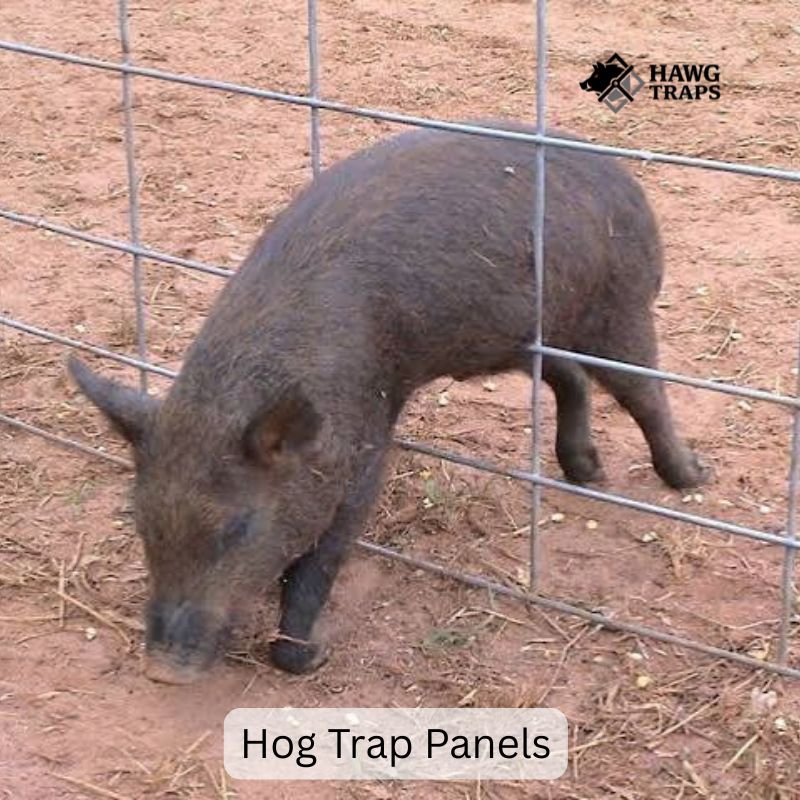
Hog trap panel mesh should be no larger than 4 × 4 inches, especially along the bottom. Bigger openings let small pigs escape. Hogs are very intelligent animals, once they escape a trap, its vary hard to catch them again.
That number comes from the University of Arkansas: “no greater than a 4-inch by 4-inch square, particularly along the bottom, to prevent piglets from escaping.” AgriLife says of 4 × 4 mesh that it “prevents smaller pigs from escaping.”
A cattle panel’s openings run up to 8 inches by 6. From the forum posts we read, here’s how that goes in the field.
- A Georgia trapper with a wide-mesh trap found that “the football size pigs could get thru.”
- A Texan who fenced a feeder with cattle panel reported that javelina “can go right through the 6″ x 6″ squares.”
Does 4 × 4 stop everything? Not quite. JAGER PRO claims a utility panel “will not hold pigs younger than three weeks old.” It makes the same claim about cattle panel for pigs under nine weeks. That’s a company selling its own panels, so weigh it that way. But the direction is right. Tighter mesh holds younger pigs.
If your camera shows a sow with very small piglets, you have two choices. Buy a horse panel with its 2-inch-wide openings. Or wait a few weeks for the piglets to grow, and keep baiting.
Why worry about a few piglets? Because they don’t stay piglets. One Georgia trapper put it well: escapees “just grow up to breed, and are very difficult, if not impossible, to trap again.”
How tall do hog trap panels need to be?
Hog trap panels need to be at least 5 feet tall. That is the height in both the Texas A&M AgriLife and University of Arkansas corral trap guides. Shorter panels let adult hogs climb or jump out.
A hog doesn’t look like a good jumper. But it can be a good jumper when needed.
From the forum posts we read, one trapper watched it happen: “Had a big boar jump up and get a leg over when he saw me. He managed to pull himself over.”
Texas A&M’s Natural Resources Institute backs that up. It reports that adult feral pigs “have been recorded jumping much higher” than 34 inches “when motivated to escape from corral traps.”
Three things to do about it.
- Buy 60-inch panels. The 48, 50 and 52-inch panels are close, and people do use them. AgriLife’s own example trap uses 52-inch panels. But 5 feet is the published standard.
- Cover the gap over the gate. Most gates are shorter than the panels. Wire a strip of panel above.
- Stay back at first light. That boar went over when he saw the trapper. Come in quietly, and be ready before you’re seen.
Some makers go taller. JAGER PRO’s rigid panel stands 68 inches.
Wire gauge: how thick should the panel be?
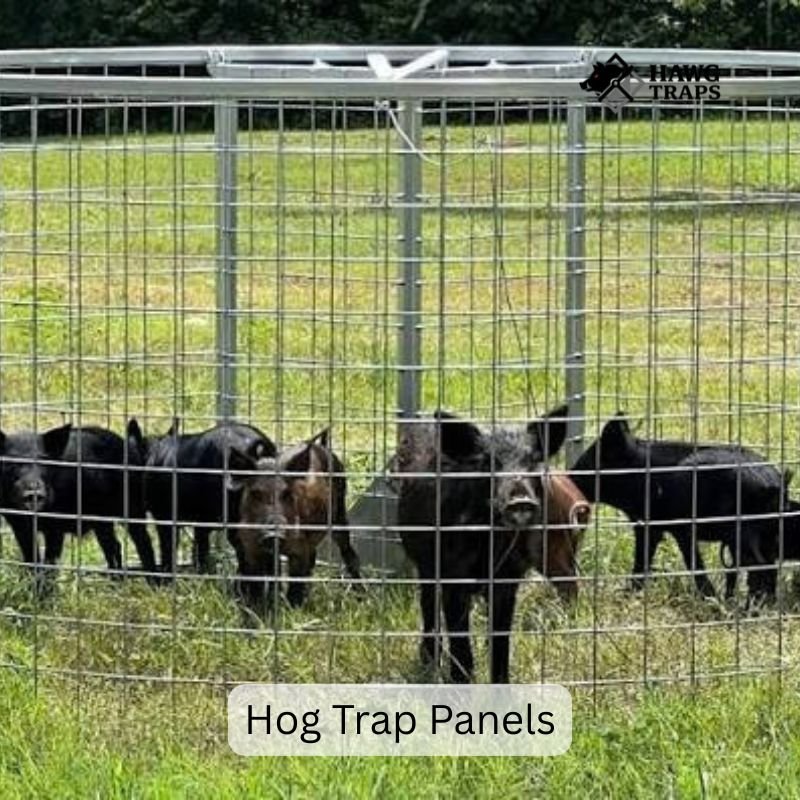
Hog trap panels should be 4-gauge or 6-gauge welded wire. The University of Arkansas prefers 4 gauge, which is about a quarter inch thick, but notes that 6 gauge is more common.
Gauge runs backward. A lower number means thicker wire. So 4 gauge is heavier than 6.
Look at the table again and you’ll spot the trade. The tall utility and horse panels at that store are 6 gauge. The shorter cattle and combo panels are 4 gauge. You can’t get everything in one panel off the rack.
For a trap, take height and tight mesh first. Then make up for thinner wire with more posts.
And be realistic about what bare wire can do. From the forum posts we read: “A large hog will bend a cattle/hog panel pretty good if they charge it at top speed.” Posts and ties are what keep a bent panel from becoming an open one.
For comparison, the wire on Boss Hawg traps is 6 gauge too. The difference is that ours is MIG welded to a frame of 1½-inch, 14-gauge square tubing. More on that below.
How many panels do you need for a hog trap?
You need at least four 20-foot panels or five 16-foot panels for a corral hog trap, according to University of Arkansas Extension. That makes a round trap about 25 feet across. Bigger sounders need more.
The sums are simple. Panels times length gives the distance around. Divide by 3.14 for the distance across. Divide the distance around by 4 for the number of T-posts.
| 16-foot panels | Distance around | Trap width, about | T-posts at 4 ft |
|---|---|---|---|
| 4 | 64 ft | 20 ft | 16 |
| 5 | 80 ft | 25 ft | 20 |
| 6 | 96 ft | 30 ft | 24 |
| 7 | 112 ft | 35 ft | 28 |
| 8 | 128 ft | 40 ft | 32 |
Our arithmetic. Overlaps at the joints make the real trap a little smaller, and the gate adds a little back.
Which row is yours?
- Four panels is the size of AgriLife’s example trap.
- Five panels meets the Arkansas minimum.
- Seven panels reaches the 35-foot width that JAGER PRO recommends as a minimum for whole-sounder trapping.
- Eight panels is what AgriLife’s Smith County office used at a peach farm in 2010. They caught 12 hogs in it.
AgriLife’s general rule: “Large sounders are seldom trapped using small traps.”
Count your hogs on camera first, then size the trap. A pen that’s too small can leave the wary ones standing outside.
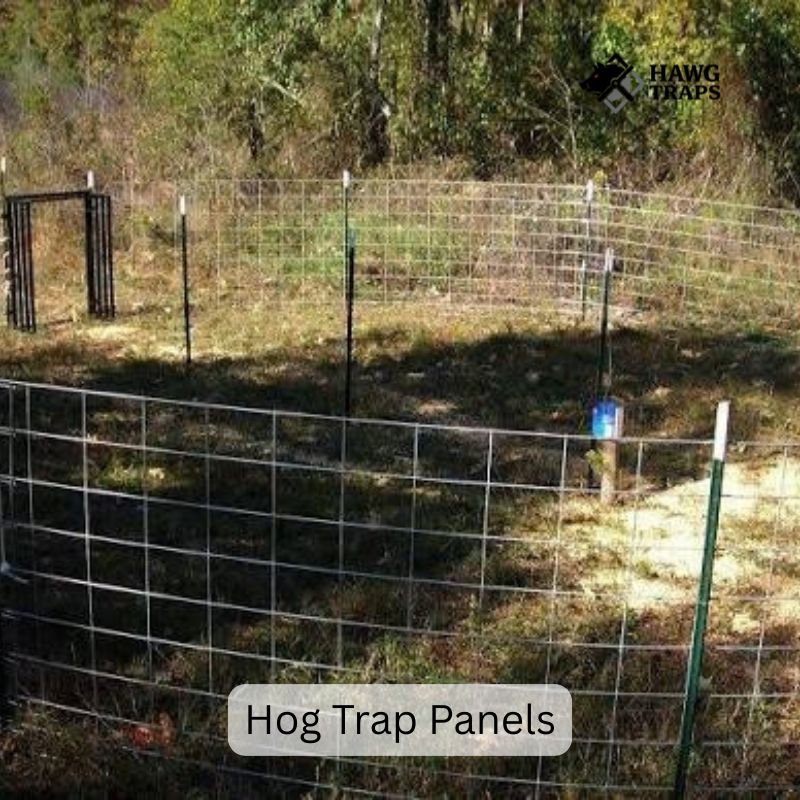
T-posts, spacing and tying the panels
Space T-posts about 4 feet apart and tie each panel to each post in four places with doubled wire. Use 6 or 6½-foot posts. Overlap the panel ends and tie the overlap.
The panel is only half of the wall. The posts are the other half.
The posts. Arkansas specifies a “6 foot or 6½ foot solid steel T-post, 1.25 pounds per foot.” That weight matters. Light-duty posts bend.
The spacing. AgriLife says to space T-posts “about 4 feet apart.” Arkansas says to use that spacing “if hogs are large in size or number.” Assume they are.
The ties. Arkansas ties the panel to the post “four times for each post,” using doubled baling wire of 14 gauge or heavier. A handy trick from that guide: hold everything in shape with plastic zip ties first, then go back and wire it.
The joints. AgriLife overlaps panel ends by 6 to 8 inches and ties them with doubled wire. Some trappers go a lot further. From the forum posts we read: “I overlap no less than 36″ and drive double posts at all overlaps.”
The bottom. AgriLife warns that a trap “should not have gaps along the bottom allowing hogs to escape.” Walk the whole circle. Fill any dip with dirt, or drop the panel into it.
The far end. One more from the forums, and it’s a good one: “Big hogs will attack the gate first. If the gate holds they will go after the opposite end.” Put an extra post or two there.
Trap shape: why corral traps have no corners
A corral hog trap should be round or teardrop-shaped, with no corners. AgriLife warns that hogs “congregate in corners and may escape over the top.”
Scared hogs bunch up. In a corner they pile, and the pile becomes a ramp. A curve gives them nowhere to stack.
This is one thing long wire panels do well. They bend into a smooth arc. AgriLife says a large teardrop shape works best for big sounders.
What do hog trap panels cost?
A 5 × 16-foot utility panel was listed at $99.99 on 4 October 2026, and a 6-foot T-post at $6.49. Panels and posts for a 25-foot trap come to about $630, before the gate.
| Trap width | Utility panels | T-posts | Panels and posts |
|---|---|---|---|
| About 20 ft | 4 × $99.99 = $399.96 | 16 × $6.49 = $103.84 | $503.80 |
| About 25 ft | 5 × $99.99 = $499.95 | 20 × $6.49 = $129.80 | $629.75 |
| About 30 ft | 6 × $99.99 = $599.94 | 24 × $6.49 = $155.76 | $755.70 |
| About 35 ft | 7 × $99.99 = $699.93 | 28 × $6.49 = $181.72 | $881.65 |
| About 40 ft | 8 × $99.99 = $799.92 | 32 × $6.49 = $207.68 | $1,007.60 |
Tractor Supply listed prices. Panel price checked 4 October 2026, T-post price 3 October 2026. Gate, wire, tools and bait are extra.
Want to spend less? The combo panel at $69.99 is the usual budget pick. Its bottom openings are shorter than a cattle panel’s, but they’re still bigger than 4 × 4. It’s also 52 inches tall, not 60. Our hog trap cost page prices a full corral built that way, gate included.
Want to spend more, for small pigs? Horse panel at $129.99 adds $30 a panel. It also weighs 74 pounds, against about 65 for the utility panel. You’ll feel that by panel six.
One practical note. A 16-foot panel doesn’t fit in a pickup bed lying flat. People bow them into an arch and strap them down, or bring a trailer.
Panels from our partners:
- 5 × 16 ft utility panel at Tractor Supply, 4 × 4 mesh, listed at $99.99 on 4 October 2026
- 5 × 16 ft horse panel at Tractor Supply, 2 × 4 mesh, listed at $129.99
- 16 ft × 52 in combo panel at Tractor Supply, listed at $69.99
- T-post drivers and rebar tie wire on Amazon
As an Amazon Associate we earn from qualifying purchases. Partner products are listed separately from our own and never replace them.
Rigid welded hog trap panels
Rigid hog trap panels are short, framed steel sections made for trapping. They stand without bending, connect to each other, and move from site to site. They cost more than farm-store wire panels.
This is the second family. Instead of one long floppy sheet, you get a stiff panel, often 8 feet long. Several connect into a ring.
What you gain.
- Speed. JAGER PRO says its rigid panels let “a single person” put up an enclosure “in 30 minutes or less.”
- Stiffness. A frame holds the wire flat. There’s less to bend.
- Reuse. They come apart and go to the next site.
What it costs. One example with a public price: J4 Welding lists a six-panel trap at $3,250. That buys six heavy 8 × 5-foot panels, a 6-foot drop gate, a cell trigger and a camera. It was the price on 4 October 2026.
The trade-offs. Money, first. Weight, second. And a ring of 8-foot panels has more joints than a ring of 16-foot ones. Every joint has to be made right.
If a trap will sit in one spot for years, wire panels on T-posts are hard to beat on price. Framed panels works best when it has to move every week.
Common hog trap panel mistakes
The most common panel mistakes are using panels that are too short, mesh that is too wide, and too few T-posts. Each one lets hogs out of a trap that looked finished.
- Buying the “hog panel.” It’s 34 inches tall. Leave it for the garden.
- Buying cattle panel to save $60 a panel. The savings walk out through the squares.
- Stretching the posts. Eight feet between posts looks fine until something heavy hits the middle.
- Leaving a corner. Usually where the panels meet the gate. Round it off.
- Gaps at the bottom. One low spot is all a pig needs.
- Skimpy ties. One wire per post isn’t four.
- A short gate with nothing above it. Covered on our hog trap door designs page.
- Building it too small. Then setting it anyway when half the sounder won’t come in.
One Georgia trapper summed up the whole list in eight words: “Don’t skimp on the panels, or t-posts.”
Boss Hawg panels: welded, framed and built to move
Boss Hawg builds hog trap panels as welded steel sections: 6-gauge wire MIG welded to a braced frame of 1½-inch, 14-gauge square tubing. They come as part of our pen traps, sized to your site.
Here’s where our panels show up.
- Big Pen hog trap A panel pen sized to your site and your sounder.
- Pro Pen hog trap A welded panel pen with panel gates, a trip wire and a loading ramp.
- Custom hog traps We’ve built small-wire panels for customers who needed to hold small pigs. Tell us what your camera shows.
Why we build them this way is on how Boss Hawg traps are built.
Now the bias, in plain sight. According to our field experience, a framed panel beats a wire sheet tied to posts. The wire is welded to a frame, not tied to a post, and the frame keeps it from bowing.
And the trade-offs, just as plain. Ours cost more than farm-store panels. They’re heavy. We don’t print prices or a size chart online, so it takes a call. If you’re fencing one pen that will never move, the utility panels above are a sound choice, and we’ve told you which ones to buy.
Have these ready when you call:
- Your hog count. The biggest group your camera has shown, and whether there are small pigs.
- Your ground. Open pasture, brush or creek bottom.
- Whether the trap will move. One site, or several.
- Your delivery ZIP code. We ship anywhere in the US. Freight is paid by the buyer and quoted before you order.
REQUEST A QUOTE: CALL (254) 725-4554
Tell us how many hogs and where. We’ll tell you what size pen fits, and what it costs delivered.
Also check our partner products for building a panel trap:
- T-post drivers and T-post pullers for setting and moving posts
- Fencing pliers and rebar tie wire for tying panels
- Hog ring pliers and rings for fastening panel overlaps
- Heavy-duty zip ties, 8-inch to hold the shape while you wire it
- Leather work gloves, because cut panel ends are sharp
As an Amazon Associate we earn from qualifying purchases. Partner products are listed separately from our own and never replace them.
Frequently asked questions
How tall does a hog trap need to be?
A hog trap needs walls at least 5 feet tall. That is the panel height in the Texas A&M AgriLife and University of Arkansas corral trap guides. Shorter panels let adult hogs climb or jump out.
Can you use cattle panels for a hog trap?
You can, but small pigs will escape. A cattle panel’s openings run up to 8 × 6 inches. Extension guides call for mesh no larger than 4 × 4 inches, especially along the bottom.
What is the difference between a hog panel and a cattle panel?
A hog panel is 34 inches tall with small openings at the bottom. A cattle panel is 50 inches tall with larger openings. Neither is the right panel for a wild hog trap. Use a 5-foot utility panel.
How many panels do I need for a corral hog trap?
At least four 20-foot panels or five 16-foot panels, according to University of Arkansas Extension. Five 16-foot panels make a trap about 25 feet across. Large sounders need six to eight feets.
How far apart should T-posts be on a hog trap?
About 4 feet apart. Use 6 or 6½-foot steel T-posts, and tie the panel to each post in four places with doubled wire.
Where can I buy hog trap panels?
Farm stores sell 16-foot utility and horse panels that extension guides use for corral traps. Framed steel trap panels come from trap makers. Boss Hawg builds welded panel pens to order at (254) 725-4554.