
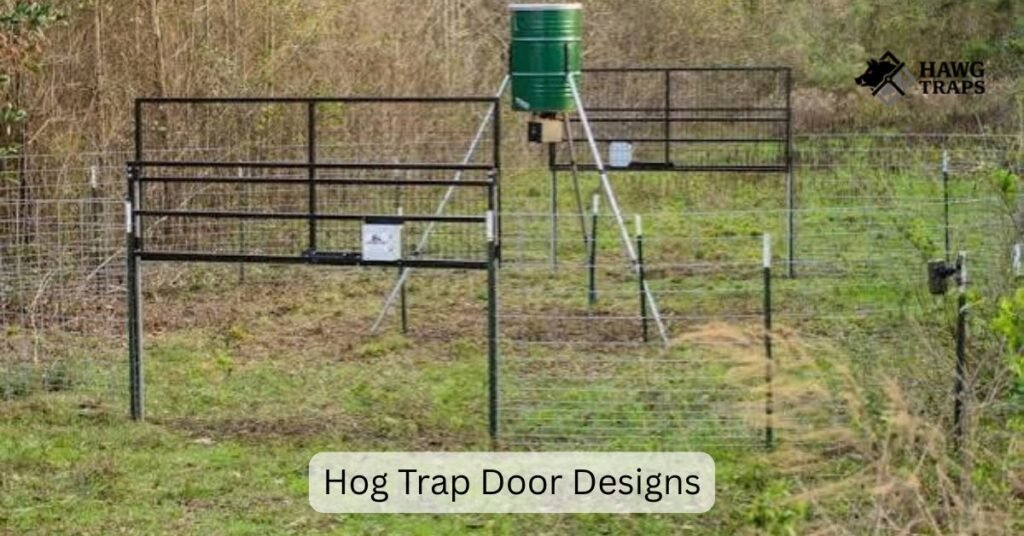
A hog trap door has one job and one chance to do it. Fall, swing or drop, then stay shut while angry hogs lean on it.
People have invented a lot of ways to get that done. Plywood that falls like a guillotine. Steel doors that swing like a saloon. Flaps a hog lifts with its nose. If you ask any hog trapper, they might have their favorite, they will suggest you confidently without telling you the backdraw. We want you to see the whole picture.
This page lays out five designs side by side. Then it walks through the guillotine door in full, because it’s the one most people build at home. Bring a tape measure.
We build hog traps with steel gates. Some links to other products are affiliate links, and we may earn from qualifying purchases.
Key Takeaways
- There are five hog trap door designs: guillotine, saloon, rooter, funnel and remote drop gate.
- The guillotine door is the cheapest to build. One Texas A&M AgriLife plan priced it at $113.99. Arkansas priced it at $131.25 in December 2016.
- The standard guillotine door is ¾-inch plywood, 4 feet wide and 6 feet tall, with an opening about 4 feet square.
- AgriLife says one person can build it in under three hours.
- Fancier doors rarely catch extra hogs. The specialist behind the plan wrote that you catch what you catch “on the first trip of the gate.”
- Close the gap above any door. Trap panels stand 5 feet tall, and most gates don’t.
Why Trust Us: How We Put This Together
Boss Hawg is a steel shop in Cross Plains, Texas. We weld gates. So a page that shows you how to build one from plywood may look like an odd thing for us to write.
Here’s our thinking. Some readers were always going to build their own. They deserve a straight answer. Others will read the cut list and decide they’d rather make one phone call.
- The build details come from two free extension plans. One is by Billy Higginbotham of Texas A&M AgriLife. The other is from the University of Arkansas. We’ve put them in our own words and linked both.
- We did not build this door ourselves for the page. Where we give a measurement, it’s from the plans.
- Every cost has its date. Lumber prices move a lot. Treat old totals as a floor.
- Every design gets its fault listed, including the steel swing gate we sell.
The shop started by trapping hogs off its own land, then removing hogs for local ranchers under contract.
What are the main hog trap door designs?
The five main hog trap door designs are the guillotine door, the saloon door, the rooter door, the funnel and the remote drop gate. AgriLife lists the first four as the usual headgates for a corral trap.
| Design | How it closes | Built from | Skill to build | After it closes |
|---|---|---|---|---|
| Guillotine | A panel slides straight down two channels | Plywood and lumber, or steel | Basic carpentry | No more hogs can enter |
| Saloon | Spring-loaded doors swing shut | Steel angle or tubing, springs | Welding | Hogs outside can still push in |
| Rooter | Top-hinged panels fall shut | Steel | Welding | Hogs outside can lift a panel and enter |
| Funnel | It doesn’t. Panels narrow to a throat hogs squeeze through | Extra trap panel | Very little | Stays open one way |
| Remote drop gate | A wide gate drops on a phone signal | Steel and a control box | Bought, not built | No more hogs can enter |
Two notes before we go deeper.
A box trap may also have a plain swing gate, which is what our own Standard trap uses.
And which design catches the most hogs is a shorter story than you’d think. We cover the research on our hog trap gates and doors page, and sum it up further down.
The guillotine hog trap door: how it works
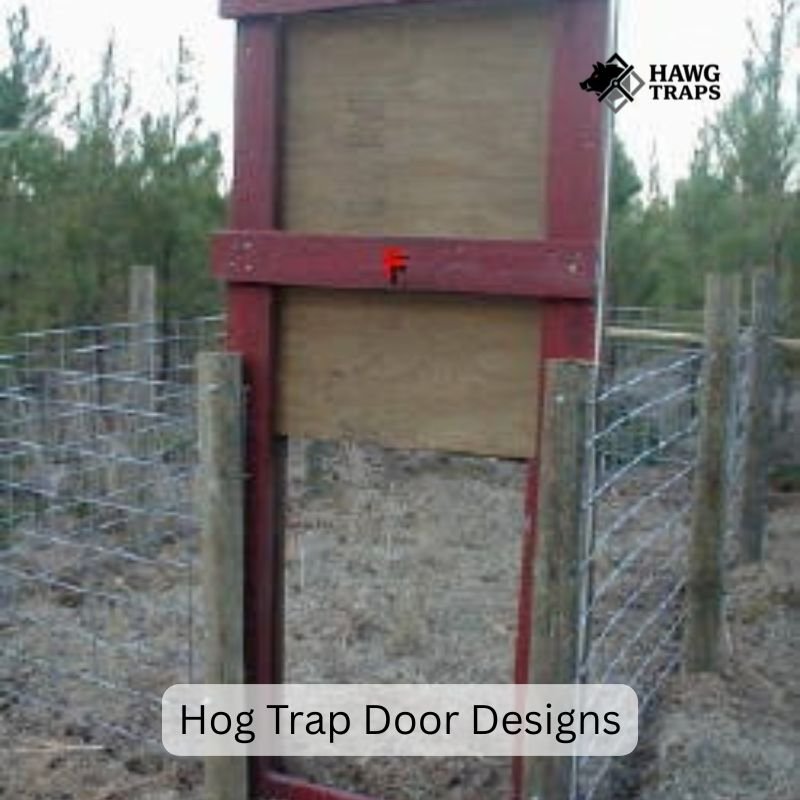
A guillotine hog trap door is a flat panel held up between two upright channels. When a trip wire pulls the trigger, the panel drops straight down by its own weight and closes the opening.
That’s the whole machine. There are no springs and no hinges on the door itself. In the AgriLife plan there aren’t even pulleys. Gravity does the work, and gravity has a good service record.
The design most people copy is called the Banta model. Higginbotham of AgriLife wrote it up, and Arkansas Extension later built its own guide on it.
Here’s the part worth knowing. Higginbotham didn’t start out a guillotine man. He writes that he first favored continuous-catch gates, the saloon and rooter kind. His worry was that with a guillotine, “more pigs could not push in” once it had closed.
Then the research came in, and he changed his mind in print:
“You are going to catch what you are going to catch on the first trip of the gate. Very rarely do additional pigs push open a continuous catch gate once it has been tripped and closes,” he wrote, “even though they can.”
So his case for the guillotine is simple. If the fancy door rarely traps extra hogs, the cheap door that closes just as well is the better buy.
What a guillotine door is good at:
- Cost. It’s the cheapest door to build, by a wide margin.
- Tools. A saw, a drill and a wrench. No welder.
- A solid close. A sheet of ¾-inch plywood comes down hard and lands in a buried bottom channel.
- Repairs. If a hog wrecks it, you’re out one sheet of plywood.
What it’s not good at gets its own section below.
How to build a guillotine hog trap door
To build a guillotine hog trap door, make two 6-foot channels from deck boards, slide a 4 × 6-foot sheet of ¾-inch plywood between them, tie them together with four cross braces, and add a folding wooden trigger.
Both plans below include drawings and photos. Print one before you start.
- Texas A&M AgriLife: Guillotine Style Wild Pig Trap Gate (Banta Model)
- University of Arkansas Extension: Do-It-Yourself Feral Hog Trapping Strategy, MP537
The cut list
| Part | Lumber | How many |
|---|---|---|
| Door | ¾-inch plywood, 4 feet wide by 6 feet tall | 1 |
| Channel sides | 1 × 6 deck boards, 6 feet long | 4 |
| Channel centers | 2 × 3, 6 feet long | 2 |
| Cross braces | 2 × 4, 5 feet long | 4 |
| Trigger | 2 × 3, 4 feet long, cut into two 2-foot pieces | 1 |
| Trigger block | 2 × 3, 12 inches long | 1 |
| Stop pieces | 2 × 2, 8 feet long, cut in half | 1 |
| Posts | 6½-foot steel T-posts | 2 |
Hardware is lag bolts, carriage bolts, deck screws, one strap hinge, one eye screw, a handle and about 4 feet of light chain. Arkansas uses treated lumber throughout, which makes sense for something that lives outdoors.
The steps, in plain words
- Build the two channels. Sandwich one 2 × 3 between two deck boards and screw it from both sides. The slot that’s left is the track the door rides in.
- Set the gap. Stand the door in the channels. Higginbotham spaces the channels 4 feet 1 inch to 4 feet 2 inches apart for a 4-foot door. That slack keeps the door from binding as it falls.
- Bolt on the cross braces. Two go at the bottom, one inside and one outside. One goes outside at the top, 6 feet up. One goes inside, about 4 feet up. Let each brace stick out 2 inches past the frame on both sides, to sit against the T-posts.
- Bury the bottom. Dig a shallow trench so the bottom braces sit flush with the ground. Hogs then walk in on dirt, with no board to step over.
- Fasten it to the T-posts. Short pieces of chain, lag-bolted to each channel about 2 and 4 feet up, wrap the posts and bolt tight.
- Make the trigger. Join the two 2-foot pieces end to end with the hinge. Put the eye screw near the middle, on the side opposite the hinge. The trip wire ties here.
- Add the trigger block. Bolt the 12-inch block across the inside face of the door, 52 to 54 inches up from the bottom.
- Set it. Raise the door about 4 feet. Prop the trigger between the block on the door and the inside brace. When the trip wire pulls, the trigger folds at the hinge and the door falls.
- Add a safety pin. Drill a hole through the plywood. A piece of rebar or a heavy bolt through that hole rests on the top brace and holds the door up.
With the door raised, the opening is about 4 feet wide and 4 feet tall. Roughly 2 feet of plywood stays in the channels, which keeps the door running true.
Higginbotham says the job takes “one person less than 3 hours.”
A safety word, and we mean it. This is a heavy sheet of plywood hanging over a doorway. The Arkansas guide warns that the door “could cause serious injury if precautions are not taken.” Keep the safety pin in whenever you’re baiting, working inside the trap, or training hogs to enter. Pull it only when you set the trap.
What it costs. Higginbotham’s sheet puts the gate at $113.99, of which the plywood was $35.97. That sheet carries no date. The Arkansas guide priced its list at $131.25 in December 2016. Lumber has climbed since, so take your cut list to the yard for today’s number.
The trigger and trip wire have a full page under hog trap triggers.
Hardware and tools for the build, from our partners:
- Exterior deck screws, 3-inch and 5/16-inch carriage bolt assortments
- Heavy strap hinges for the folding trigger
- Plastic-coated clothesline and braided fishing line, 65-pound for the trip wire
- T-post drivers for setting the posts
As an Amazon Associate we earn from qualifying purchases. Partner products are listed separately from our own and never replace them.
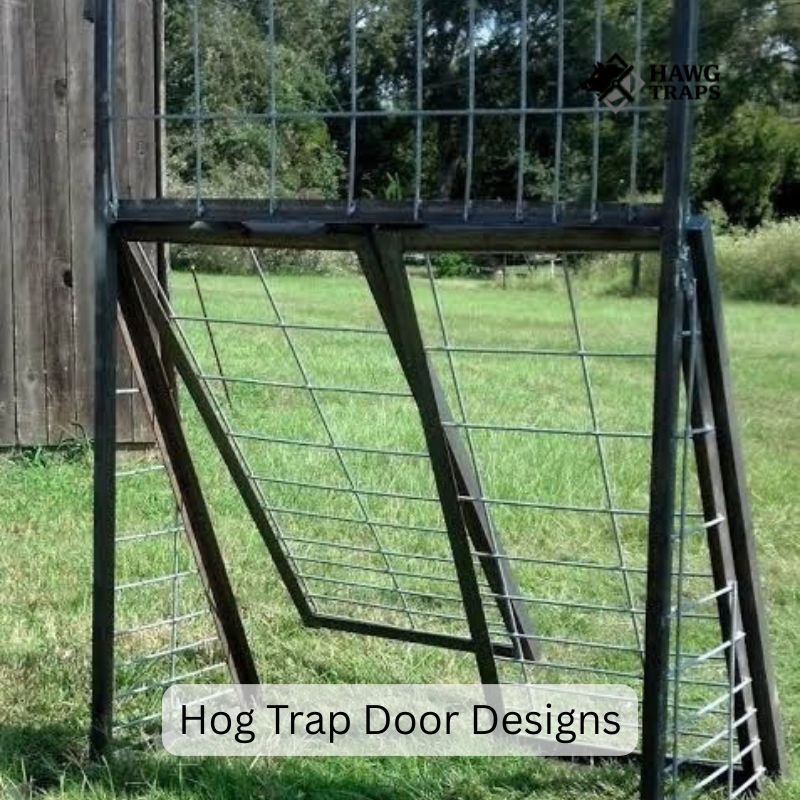
Guillotine door problems, and how to fix them
The guillotine door’s main faults are that it catches only once, it can bind in its channels, and its tall plywood can make hogs wary. Each has a known fix in the extension plans.
| Problem | Why it happens | The fix |
|---|---|---|
| It only catches once | Once the door is down, nothing else gets in | Set the trigger only when the whole sounder is feeding inside |
| The door binds or hangs up | Channels too tight, or out of square | Keep the 1 to 2 inches of slack the plan calls for. Check for square |
| Hogs balk at the doorway | Arkansas notes some hogs “may balk at the appearance of tall plywood above the gate opening” | Pre-bait longer with the door pinned open, or build the wide version |
| A board to step over | Bottom braces sitting on top of the ground | Bury them flush |
| The opening feels narrow | A 4-foot door is the size of one sheet turned upright | Higginbotham’s wide version turns the plywood sideways for an 8-foot doorway |
| Somebody gets hurt | A heavy door with no safety pin | Rebar through the door, every time |
On that wide version: it needs more frame lumber. It also needs a strip of panel above the door, 2 feet tall and 16 feet long, to prevent escape once the door trips.
Is wider worth it? Maybe. In an Alabama study, pigs entered a 2.6-foot door as quickly as a 3.9-foot door. We dont have any data that proves 8 foot door does it better.
Want a second gate on a big corral? Higginbotham notes that a second guillotine door can be rigged to trip along with the first.
The saloon door design
A saloon hog trap door is one or two side-hinged steel doors pulled shut by heavy springs. A trip wire releases them. Once shut, hogs outside can push in but hogs inside cannot push out.
Picture the doors on a western bar, with a much worse crowd.
How it’s built. Mississippi State describes these doors as usually made of steel, “either angle iron or steel tubing.” Heavy springs do the closing. AgriLife’s guidance is a total opening of 32 to 36 inches, with the frame braced at both the top and the bottom.
One ready-made example gives a feel for the size. The Hog Slammer saloon gate is 14-gauge steel with an opening 33⅜ inches wide and 42 inches tall. It was listed at $319.95 and $345 at two stores on 4 October 2026.
A real set-up. In 2010, AgriLife’s Smith County office trapped hogs at a peach farm. They used a saloon-style gate that cost $300 at the time, with eight 16-foot panels. The gate was shorter than the panels, so they placed a partial panel over it to bring the height to 5 feet. On 1 August they caught 12 hogs in one go.
What it’s good at. It closes fast and it’s steel. Ready made versions are easily available and you can get one set by tomorrow.
Its faults.
- It takes a welder to build. This isn’t a plywood job.
- Springs need care. Their tension has to be set, and they live outdoors.
- An unbraced frame racks. Then the doors stop meeting in the middle.
- The bonus rarely comes. In the Alabama door study, one pig in 115 chances pushed through a closed saloon door.
The rooter door design
A rooter hog trap door is a set of top-hinged steel panels that hang down across the opening. A hog lifts a panel with its snout to enter, and the panel falls shut behind it.
How it’s built. The door hangs from a hinge along the top of the gate frame. Many have two or three panels hinged side by side. The three-door gate at Tractor Supply is this type. It was listed at $349.99 on 4 October 2026.
The hold-open bracket. A rooter door has to be held up while hogs learn the trap. The national extension feral hog site shows a bracket for that, credited to Dan McMurtry of USDA. It’s cut from flat or angle iron and hinged to the gate, with a wire to the trigger.
No welder? The same guide gives a simpler way: a 4-inch hook and eye latch and a 4-foot 2 × 4 fixed to the gate’s top panel.
What it’s good at. No springs. And of the three continuous-catch doors in the Alabama study, the rooter did best. Nine pigs in 55 chances lifted their way in after it closed.
Its faults, in the extension guide’s own words:
- “Traps must be tied open and pre-baited for multiple days to train hogs to enter the trap.”
- “Some feral hogs may be too small to lift the gate.”
- “Older trap-shy hogs are often reluctant to enter through this type of gate.”
- If the panels hang too low, “a large hog entering the enclosure may trip the trap prematurely.”
Funnels and remote drop gates
A funnel is a trap entrance with no door at all, and a remote drop gate is a wide steel gate closed by phone. They sit at opposite ends of the price range.
The funnel. The end of a trap panel curls inward to a narrow throat. Hogs push through the gate, the panel springs back in its place, and they can’t find the gap from inside. It’s made from trap panel and has no trigger.
The catch is in the throat. Higginbotham puts it plainly: “big pigs just don’t like tight spots.” It also has to be wired open during pre-baiting.
The remote drop gate. This is a guillotine door grown up. It’s steel, it’s wide, and it has no hog-operated trigger. You watch a camera and close it yourself when the whole sounder is inside. One maker’s gate is 8 feet wide.
The design answers the guillotine’s main fault. It still catches only once, but you choose the moment. The price is the catch. Gate-and-trigger packages we found started at $1,350, plus a camera and service.
More on those under cellular and remote hog trap gates.
Which hog trap door design catches the most hogs?
No door design has been shown to catch clearly more hogs than another. In an Alabama study, only 11 pigs in 222 chances entered through continuous-catch doors after they closed. Timing matters more than the door.
That’s the short version. The numbers by door type:
- Rooter: 9 of 55 chances
- Trainer: 1 of 52
- Saloon: 1 of 115
AgriLife’s trapping page ends in about the same place: “Managers should select the headgate that works best in their specific situation.”
So choose by what you can build, buy and maintain. Then put your effort where it pays: bait first, count the hogs, and close on all of them. If you’d rather pick a whole trap than a door, see the best hog traps by situation.
How tall and how wide should a hog trap door be?
A hog trap door should be closed off to the full height of the panels, which is 5 feet in AgriLife’s corral design. For width, 3 to 4 feet is the common size and tested as well as wider.
Height. People ask how high a hog can jump. Higher than you’d like. Texas A&M’s Natural Resources Institute reports that fences of 28 to 34 inches kept feral pigs out of feeders. But it adds that adult pigs “have been recorded jumping much higher than this when motivated to escape from corral traps.”
A hog at a feeder is a shopper. A hog in a trap is a prisoner. Plan for the prisoner.
That’s why corral panels are 5 feet tall. It’s also why the Smith County trappers put a partial panel over their gate. A guillotine door’s 6-foot frame covers this by itself. Most steel saloon and rooter gates are shorter, so wire a section of panel above them.
Width. The common sizes run from about 32 inches for a saloon door to 4 feet for a guillotine. The one study on width found no real difference between 2.6 and 3.9 feet.
Shape of the pen. While you’re at it, round the trap. AgriLife says to “ensure that there are no corners anywhere in the trap,” because corners give pigs a place to pile up and work at getting out.
Common hog trap door mistakes
The most common hog trap door mistakes are setting the trigger too early, leaving a gap above the gate, and building a door that binds. Most cost nothing to fix.
- Closing on part of the sounder. The Arkansas guide is blunt: the key is “capturing every hog in a sounder,” to avoid “educating those left outside.”
- Skipping the pre-bait. Every design here needs days with the door fixed open.
- A gap over the gate. Covered above. One piece of panel fixes it.
- A tight track. A guillotine door needs slack in its channels.
- A step at the threshold. Bury the bottom brace.
- No bracing on a swing gate. Top and bottom, per AgriLife.
- Rooter panels hung too low. A big hog trips the trap on the way in.
- No safety pin. The door doesn’t know you’re not a hog.
One more thing, since people ask. Rules on trapping and moving feral hogs differ by state. Check with your state wildlife agency before you set a trap.
Build a door or buy one?
Build a guillotine door if you have basic tools, a free afternoon and a corral that stays put. Buy a steel gate if you want a door that moves with the trap, shrugs off weather and needs no carpentry.
| Build a plywood guillotine | Buy a steel gate | |
|---|---|---|
| Cost | Lowest. $113.99 to $131.25 on older extension price lists | $319.95 to $349.99 for the ready-made gates we found on 4 October 2026 |
| Time | Under 3 hours, per AgriLife | The drive to the store, or the wait for freight |
| Weather | Plywood and lumber wear outdoors | Steel lasts, if it’s coated |
| Moving it | A 6-foot frame, buried at the bottom | Stand it up, wire it in |
| Catch mode | Single catch | Usually continuous catch |
A whole home-built corral is priced out on our hog trap cost page.
Where Boss Hawg fits. We don’t build wooden doors. We build steel gates as part of our traps.
- Standard hog trap A 4 × 8 × 3-foot box trap with a swing gate and trip wire.
- Pro Pen hog trap A welded panel pen with panel gates, a trip wire and a loading ramp.
- Stand-alone gates. Dealers list a Boss Hawg Double Trap Door, a double gate for larger site-built panel traps. Call us for size and what’s available.
- Custom hog traps If you’ve sketched a door and can’t weld it, describe it to us.
Our gates share the trap’s steel: 1½-inch, 14-gauge square tubing, braced, with 6-gauge wire MIG welded on.
Now the faults, as promised. A steel swing gate costs more than a sheet of plywood. Ours come by phone quote, not a price tag. And if all you need is one door for a pen behind the barn, the plywood may be the right answer.
REQUEST A QUOTE: CALL (254) 725-4554
Tell us your hog count, your pen and your ZIP code. We’ll tell you which gate or trap fits, and what it costs delivered.
Also check our partner products if you’d rather buy a gate than build one:
- 3-door hog trapping gate at Tractor Supply, a rooter gate, listed at $349.99 on 4 October 2026
- Hog Slammer “V” Gate on Amazon. Check today’s price and reviews on the listing
- Heavy-duty gate springs for a saloon door
- Cellular trail cameras to count the sounder before you set any door
As an Amazon Associate we earn from qualifying purchases. Partner products are listed separately from our own and never replace them.
Frequently asked questions
What are the different types of hog trap doors?
There are five: the guillotine or drop door, the saloon door, the rooter door, the funnel and the remote drop gate. Guillotine and remote gates catch once. Saloon, rooter and funnel entrances let more hogs push in.
What can you make a hog trap door out of?
A guillotine door is made from ¾-inch plywood and lumber. Saloon and rooter doors are made from steel angle or tubing. A funnel entrance is made from the trap panel itself.
How much wood do I need for a guillotine hog trap door?
One sheet of ¾-inch plywood cut to 4 × 6 feet, four 6-foot deck boards, two 6-foot 2 × 3s, four 5-foot 2 × 4s, about 5 more feet of 2 × 3 for the trigger and block, and one 8-foot 2 × 2 for stops.
How high can feral hogs jump?
High enough to matter. Texas A&M reports that adult feral pigs have been recorded jumping well above 34 inches when trying to escape corral traps. Build to 5 feet, and cover the gap above the gate.
How much does it cost to build a hog trap door?
A plywood guillotine door was priced at $113.99 on an AgriLife plan and $131.25 by Arkansas Extension in December 2016. Lumber costs more today. A ready-made steel gate was about $320 to $350 in October 2026.
Is a guillotine door better than a saloon door?
Neither is proven better at catching hogs. The guillotine is cheaper and easier to build. The saloon door is steel and lets more hogs push in, though a study found that rarely happens.