
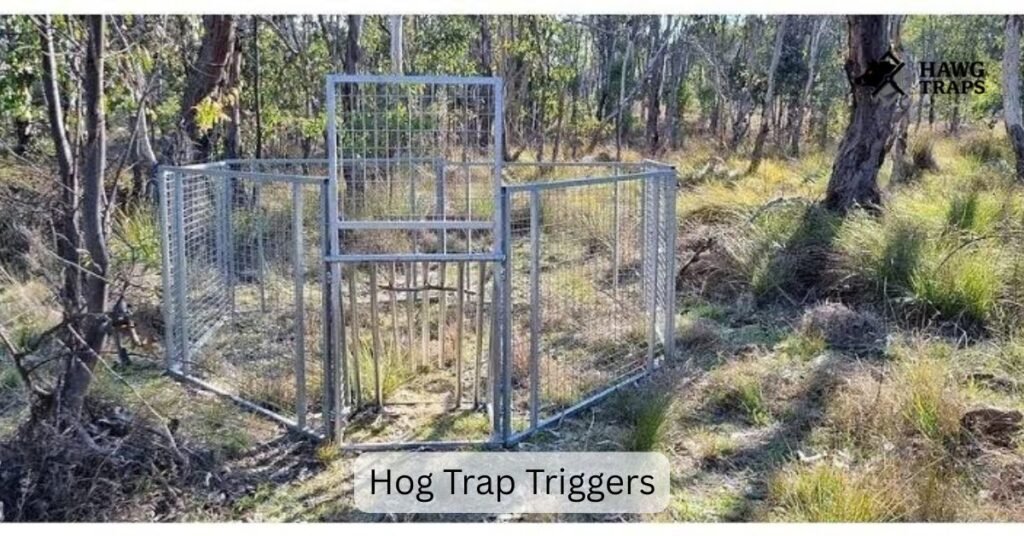
You can spend a weekend hauling panels, driving posts and hanging a gate. Then the whole trap gets decided by a piece of string.
That string is the trigger. Set it right, and the gate drops on a pen full of hogs. Set it wrong, and you catch one curious shoat while his mother watches from the brush and takes notes.
There are 7 ways to trap a hog manually. There are also remote ways to set up cameras and trap them with your phone. They are not equal. Some will close for a raccoon. Some will only close for a grown hog. This page sorts them out.
We build hog traps. Some links to other products are affiliate links, and we may earn from qualifying purchases.
Key Takeaways
- A trigger is the part that tells the gate to close. It matters as much as the gate itself.
- Texas A&M AgriLife sorts triggers into two groups: ones any animal can trip, and ones that take a pig to trip.
- The trip wire is the old standby. One AgriLife specialist says it has caught “thousands and thousands” of wild pigs.
- The tire trigger is the pickiest. That same specialist calls it the most specific toward adult pigs of all manual triggers.
- Put the trigger at the back of the trap, away from the door.
- A cellular trigger lets you count before you close. Kits we found were listed from $599.99 to $1,550 on 4 October 2026.
Why Trust Us: How We Put This Together
Boss Hawg is a steel shop in Cross Plains, Texas. Our traps ship with a trip wire, so we have a favorite. Read the page knowing that.
Here’s how we kept it fair.
- We leaned on the people who study this. Most of the trigger detail comes from Texas A&M AgriLife, Mississippi State and Clemson extension guides.
- We gave every trigger a weak point, including the trip wire we use.
- We read what trappers say. When we write “from the forum posts we read,” we mean a public hunting forum. We did not run our own trigger trials.
- Every price has a date. We checked seller pages on 4 October 2026.
The shop began by trapping hogs off its own land, then removing hogs for local ranchers under contract. Our traps and designs, and workflow comes from the field knowledge of that.
What is a hog trap trigger?
A hog trap trigger is the device that holds the gate open and releases it when hogs are inside. A line runs from the gate to something hogs move: a wire, a stick, a bucket or a tire.
Every manual trigger kind of follows the same idea. The gate wants to close. Something holds it back. A hog triggers something, and the get is closed.
AgriLife splits triggers into two families, and it’s the most useful way to think about them.
- Non-specific triggers. In AgriLife’s words, “any animal could potentially set them off.” These are pressure plates, trough triggers and trip wires.
- Pig-specific triggers. These “rely on behaviors commonly observed in pigs.” They are the rooter stick, the tire and the bucket.
Then there’s a third way: no hog touches anything. A person watching a camera closes the gate by phone.
A trigger is half of a pair. The gate it pulls is covered on our hog trap gates and doors page.
Seven hog trap trigger types at a glance
The seven manual hog trap triggers are the trip wire, root stick, bucket, tire, pressure plate, trough and the no-trigger funnel. Extension guides give the most detail on the first four.
| Trigger | What trips it | Who can trip it | Weak point |
|---|---|---|---|
| Trip wire | An animal bumps a low line | Any animal tall enough to reach it | Sensitive. Small pigs and other animals can set it off |
| Root stick | Rooting pushes a stick out from under two stakes | Mostly pigs, and it favors adults | Depends on soil. Works best with a drop door |
| Bucket | A weighted bait bucket gets knocked off a block | Larger pigs | Needs the right weight to be picky |
| Tire | A baited tire gets pushed or flipped | Adult pigs | Slow to trip. Hogs eat the easy bait first |
| Pressure plate | An animal steps on a pan | Any animal heavy enough | Pigs don’t like stepping on it |
| Trough | A bait trough gets pushed | Any pig, including small ones | Small pigs trip it first |
| No-trigger funnel | Nothing. Hogs push in through a narrowing panel | Any pig willing to squeeze | Big pigs avoid tight spots |
Source for the seven types: Billy Higginbotham, Texas A&M AgriLife Extension, “Selecting a Manual Pig Trap Trigger.”
Higginbotham doesn’t crown a winner. His advice is to “choose the one that works best for you based on the sizes and numbers of pigs encountered.” So let’s go through them.
The trip wire: the old standby
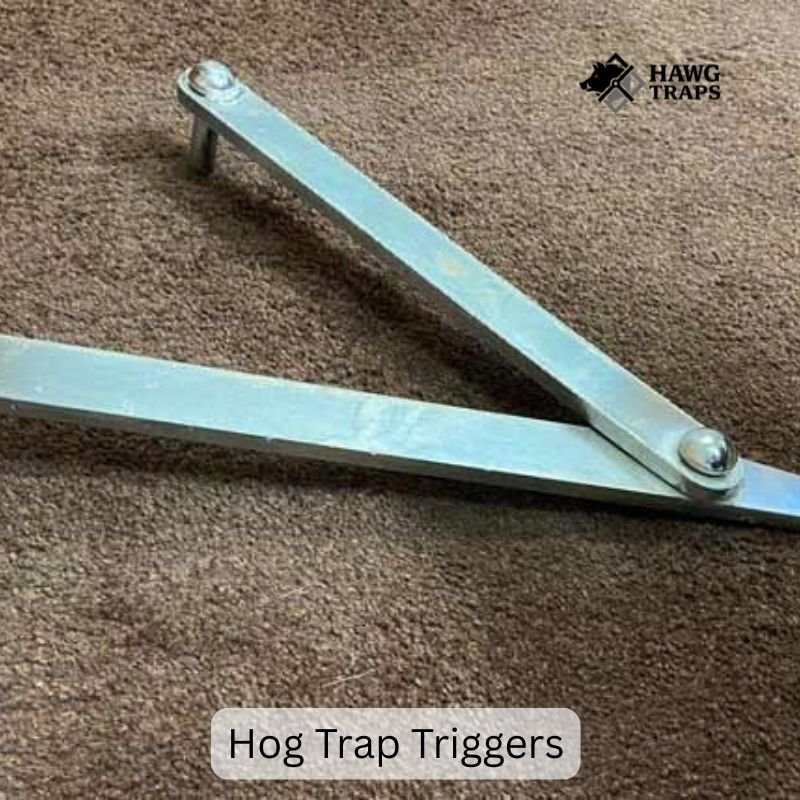
A trip wire is a line strung low across the back of the trap and tied to the gate release. Extension guides set it 12 to 20 inches off the ground. Hogs feeding there bump it and the gate closes.
It has earned its place. Higginbotham writes that the trip wire “has accounted for thousands and thousands of wild pigs trapped.” It’s cheap, simple and it works with nearly any gate.
How the line runs. From the gate, the line travels above hog height along the posts. Higginbotham takes it about three-quarters of the way to the back. There it drops down and crosses the bait area low.
How high to set the low part. The experts don’t quite agree, and that’s useful.
| Source | Trip wire height | Their reason |
|---|---|---|
| AgriLife (Higginbotham) | 12 inches, over a 5 to 10-foot run | Hogs meet the line while foraging for bait |
| Clemson Extension | 12 to 20 inches | A general range |
| Mississippi State Extension | 16 to 20 inches | Keeps younger, smaller pigs from springing it too soon |
Here’s our read. The height is a dial. Lower catches sooner, and catches smaller. Higher waits for bigger hogs. Look at your camera pictures and set the wire to the hogs you want inside first.
What to make it from. Higginbotham uses plastic-coated clothesline, with a leader of braided saltwater fishing line of 60-pound test or more. AgriLife’s corral trap guide mentions picture-framing wire, because it’s “durable enough to spring the trap but will break if a hog becomes entangled.”
The weak point. A trip wire can’t tell a boar from a raccoon. AgriLife classes it as non-specific. Mississippi State notes that “trip wires are more sensitive to disturbance” than root sticks. The fixes are height, placement at the back, and patience. More on all three below.
The root stick: a trigger hogs set off by rooting
A root stick is a stick or bar wedged under two angled stakes, with the gate line tied to it. Hogs rooting through bait push the stick free, and the gate drops.
Mississippi State gives the clearest recipe. Drive two set stakes, rebar or wood, into the ground at a 45 to 60 degree angle. Wedge the root stick behind them. The gate line pulls against it, and that holds the door open. Then pile bait “around and on top of the root stick.”
A hog doesn’t nibble around a stick. It plows. Sooner or later a snout shoves the stick out, and that’s the catch.
Why trappers like it. It takes real effort to move. Mississippi State says root sticks “require more effort on the part of pigs and nontarget species to spring the trap.” Higginbotham adds that a rooter stick “can serve to delay gate closure until adult pigs enter the trap.” That makes it harder for a raccoon picking at corn to shift it.
The weak points. Two of them.
- It wants a drop door. Mississippi State says the root stick “is dependent upon gravity and is best suited for use with a sliding drop door.”
- It depends on your dirt. If soil is “too loose or too compacted,” Mississippi State says a trip wire is the better option. The same goes if pigs seem to avoid the stick on purpose.
Bucket and tire triggers: built for bigger hogs
Bucket and tire triggers make a hog move something heavy before the gate closes. That sorts out small pigs, raccoons and deer. AgriLife calls the tire trigger the most specific toward adult wild pigs of all manual triggers.
These two are the picky eaters’ triggers. They cost almost nothing, and they do some of the sorting a trip wire can’t.
The bucket trigger. A bucket sits on a cinder block with the gate line tied to it. Inside goes what Higginbotham calls “bait and weight”: corn, plus a couple of bricks or some scrap iron. Holes near the bottom let bait dribble out. A big hog shoves the bucket off its perch, and the line pulls.
The weight is the trick. AgriLife’s guide on non-target animals says a heavier bucket is “harder to activate by juvenile pigs or non-target species.” It also notes that a deer or raccoon “may eat from the bucket, but generally will not knock it over.” Higginbotham agrees that smaller pigs typically can’t knock it down.
The tire trigger. An old car tire lies on the ground with the gate line tied to it. Bait goes under and inside it. Higginbotham suggests a compact car tire, about 13 inches. A later AgriLife guide gives 13 to 16 inches.
It takes an adult hog’s strength to push or flip a tire. And that usually happens late. Higginbotham writes that it “usually only occurs once all other bait has been consumed.” By then, more of the sounder has had time to wander in.
If the hogs fill up and leave before anyone flips the tire, the gate stays open.
Three triggers to be careful with
Pressure plates, trough triggers and no-trigger funnel traps all catch hogs, but each has a known flaw. Pigs dislike stepping on plates, small pigs trip troughs first, and big pigs avoid tight funnels.
These come straight from Higginbotham’s guide, and he doesn’t sugarcoat them.
- Pressure plate. The gate trips when an animal steps on a pan. His verdict: “pigs don’t really like stepping on these various shapes and sizes of pans.”
- Trough trigger. Hogs push a bait trough and the gate closes. The problem is who pushes first. It “can often be deployed by smaller pigs,” which he calls “the ones most likely to enter the trap first.”
- No-trigger funnel. The panel curls inward like a figure 6 or 9. Hogs push through the narrow throat and can’t find the way back. It needs pre-baiting with the throat wired open. And as he puts it, “big pigs just don’t like tight spots.”
From the forum posts we read, one Georgia trapper built a funnel like that from hog panel. He said it “worked great” until he caught a boar of about 300 pounds. “When he wanted to get out, he got out.”
Every one of them can be useful.
Cellular and remote hog trap triggers
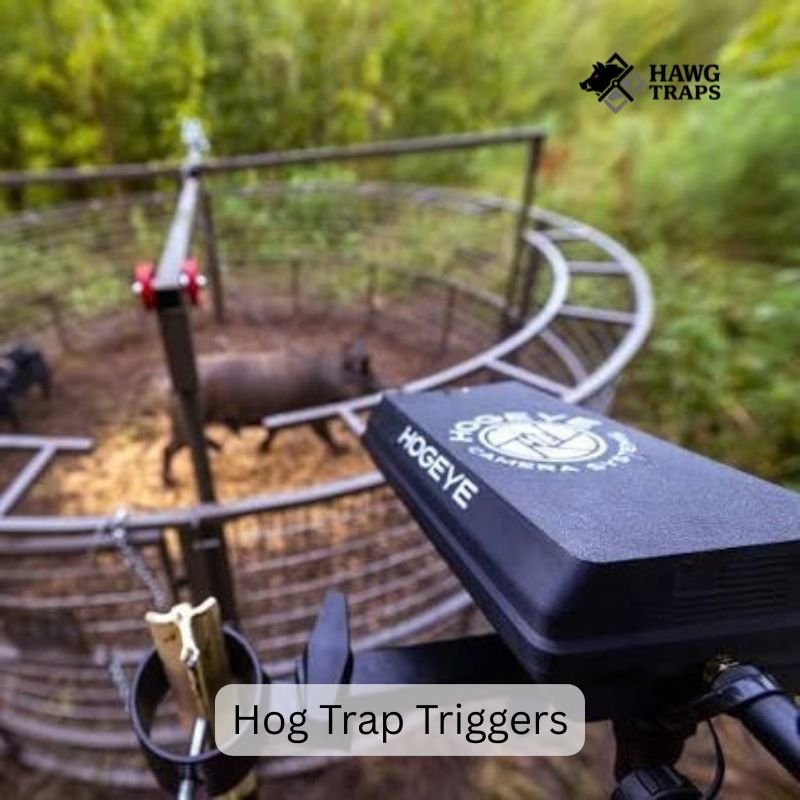
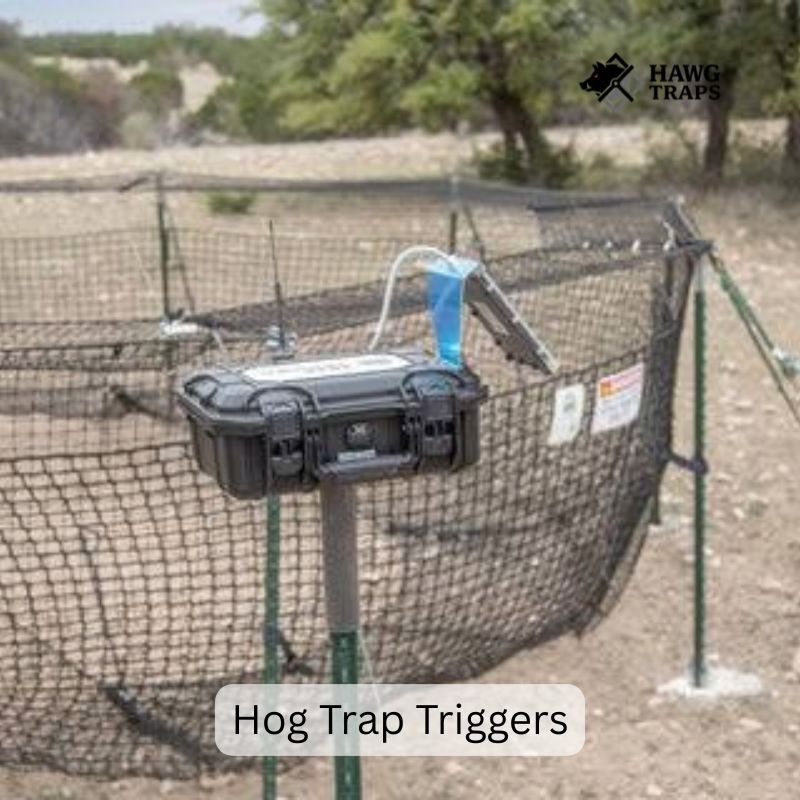
A cellular hog trap trigger closes the gate when you call or text it, while you watch the trap on a camera. AgriLife notes it costs more and needs cell service, but shows how many pigs are inside first.
Every manual trigger shares one flaw. It can’t count. It closes when one hog does one thing, whether the trap holds two pigs or twenty.
A remote trigger hands that decision to a person. AgriLife’s wording: it “can allow managers to see exactly how many pigs are present before closing the gate.”
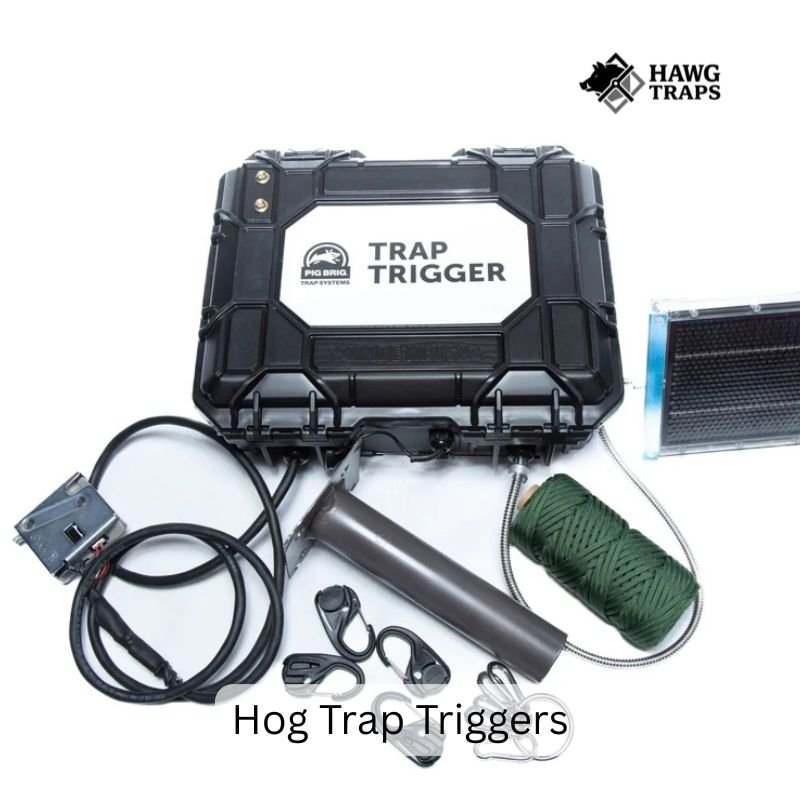
Most kits are the same handful of parts. One maker lists its own this way: a cellular controller with an antenna, a 12-volt battery, a small solar panel and a 12-volt latch. You add a cellular trail camera so you know when to send the text.
Here’s what we found listed on 4 October 2026.
| Product | Listed price | What’s included | What’s extra |
|---|---|---|---|
| Hogg Boss Conversion Unit | $599.99 | Control unit, SIM card, solar panel, antenna | Gate latch, battery, $5 a month service |
| Hogg Boss Conversion Pro | $799.99 | Control unit, electronic latch, solar panel, antenna, SIM card | Battery, $5 a month service |
| TrackSide Trapping Wireless Trigger | $975 | Trigger unit, battery, solar panel, 30 days of service | Service after 30 days, camera |
| J4 Welding 6-foot Boar Door gate and trigger package | $1,350 | Drop gate, cell trigger, battery, solar panel, one year of service | Panels, camera |
| Pig Brig Trap Trigger | $1,550 | Housing, solar panel, two batteries, latch release, one year of service | Made to drop the Pig Brig net trap. Shown as not available when we checked |
The first two say they convert any hog trap, so they can be fitted to a gate you already own. Ask the maker about your gate before you buy.
The trade-offs.
- Cost. Add a cellular camera and a data plan to every price above.
- Signal. No service at the trap means no trigger.
- Power. Batteries and solar panels need checking.
- Your sleep. Somebody has to be watching when the hogs show up.
Some people build their own from a GSM relay switch and a 12-volt latch. It can be done, and searches for it are common. We’ll cover that properly on our page about cellular and remote hog trap gates.
Remote trigger parts from our partners:
- 4G GSM relay switch on Amazon. Check today’s price and reviews on the listing
- Cellular trail cameras to see the trap before you close it
- 12-volt deep-cycle batteries and 12-volt solar panel chargers
As an Amazon Associate we earn from qualifying purchases. Partner products are listed separately from our own and never replace them.
What does a hog trap trigger cost?
A manual hog trap trigger costs little or nothing to make from wire, rebar, a bucket or an old tire. Ready-made cellular triggers were listed from $599.99 to $1,550 on 4 October 2026, before the camera and service.
| Trigger | Typical cost | Notes |
|---|---|---|
| Trip wire | Very little | Coated clothesline and fishing line, or picture wire |
| Root stick | Very little | Two pieces of rebar and a stick |
| Bucket | Very little | Bucket, cinder block, a couple of bricks |
| Tire | Free, usually | Any worn-out compact car tire |
| Ready-made manual trigger | $75 | One seller’s replacement part for its own saloon trap, shipped free in the lower 48 |
| Cellular trigger kit | $599.99 to $1,550 | Plus camera, battery on some, and monthly service |
Notice the gap. Manual triggers are mostly home-made, which is why few stores sell them. The money jump comes when a phone gets involved.
The trigger is a small slice of the whole trap. Our hog trap cost page adds up the rest.
Where to put the trigger and when to set it
Put the trigger at the back of the trap, away from the door, and set it only after hogs have fed inside freely for days. A trigger near the door catches the first pig and loses the rest.
This section matters more than which trigger you picked.
Back of the trap. AgriLife’s corral guide says to “place the trigger at the back of the trap, away from the door.” Its trapping page says non-specific triggers should sit “near the back of the trap” and be adjusted so only large animals can trip them. Hogs at the back mean hogs well clear of the gate.
Not yet. Higginbotham is firm on this: “You must pre-bait pigs and then allow them to gain confidence in entering a trap long before you are ready to set the trap gate.” Tie the gate open. Leave the trigger off. Feed them.
Count first. Put a camera on the trap. Learn how many hogs are in the group. Set the trigger when every one of them is walking in.
In an Alabama study, researchers closed traps on part of a sounder on purpose. The pigs left outside had 222 chances to push in through doors made for that. Only 11 did.
Trappers say the same. From the forum posts we read, one put it this way: a manual trip string “can be triggered by the first hog that goes inside.” Another ran his trigger at the rear of the pen and still warned that hogs outside when it trips “become trap shy.”
Always remember to set the trigger at the back, this is what makes a trap as effective as cell phone trapping.
Keeping raccoons and deer from tripping the trap
To keep other animals from tripping a hog trap, raise the trip wire, switch to a pig-specific trigger, or sour the corn. Raccoons and deer eat hog bait too, and a closed empty trap catches nothing all night.
A sprung trap with a raccoon in it is worse than no trap. It’s closed for the night, and the hogs can’t reach the bait.
Three fixes, all from extension guides:
- Raise the wire. Mississippi State’s 16 to 20-inch height is meant to cut down on trips by raccoons, opossums and small pigs.
- Change the trigger. A weighted bucket, a tire or a root stick asks for strength a raccoon doesn’t have.
- Change the bait. AgriLife says fermenting or “souring” the corn “is an easy first step to reduce non-target interference.” The idea is to make the bait less tasty to everything except hogs.
Bait gets a page of its own under hog bait.
Which hog trap trigger should you use?
Use a trip wire on a box trap or a first corral trap. Use a root stick, bucket or tire when small pigs or other animals keep springing it. Use a cellular trigger for big or trap-shy sounders.
By situation:
- A box trap and one or two hogs. Trip wire at the back. Simple, and it suits the swing or drop gate you already have.
- A corral with a drop door, and decent soil. Root stick.
- Raccoons or shoats keep closing the gate. Weighted bucket or tire.
- A big sounder and good cell signal. Cellular trigger with a camera.
- Hogs that have been trapped at before. Cellular trigger, or a different trap. Our drop hog trap page covers that case.
And if you can’t decide, start with the trip wire. It’s the one with thousands of hogs behind it.
Boss Hawg traps and triggers
Boss Hawg traps come with a trip wire. The Standard trap pairs it with a swing gate. The Pro Pen pairs it with panel gates and a loading ramp.
- Standard hog trap A 4 × 8 × 3-foot box trap with a trip wire and swing gate. It fits a full-size pickup bed.
- Pro Pen hog trap A welded panel pen with panel gates, a trip wire and a loading ramp.
Now the honest part. AgriLife classes the trip wire as non-specific, and we’ve said so above. We still ship it, because it’s simple, proven and easy to set up. If you’d rather run a bucket, a tire or a phone, tell us when you call. We’ll tell you straight whether our gate suits it.
Two more trade-offs. We don’t list a cellular trigger of our own. And we don’t post prices, so it takes a phone call.
Have these ready when you call:
- Your hog count. The biggest group your camera has shown.
- Your trap. A box trap, or a corral you’re building.
- Your trigger plan. Trip wire, or something else.
- Your delivery ZIP code. We ship anywhere in the US. Freight is paid by the buyer and quoted before you order.
REQUEST A QUOTE: CALL (254) 725-4554
Tell us what you’re trapping and where. We’ll tell you which trap fits, and what it costs delivered.
Also check our partner products for building and setting a trigger:
- Hog trap trigger on Amazon. Check today’s price and reviews on the listing
- Plastic-coated clothesline and braided fishing line, 65-pound for a trip line
- Picture hanging wire for a line that breaks if a hog tangles in it
- Rebar stakes for root stick set stakes
- Cellular trail cameras to count the sounder before you set anything
As an Amazon Associate we earn from qualifying purchases. Partner products are listed separately from our own and never replace them.
Frequently asked questions
What is the best trigger for a hog trap?
There is no single best trigger. AgriLife’s advice is to choose by the sizes and numbers of pigs you have. A trip wire suits most traps. A tire or bucket trigger is better when small pigs spring the trap early.
How high should a hog trap trip wire be?
Extension guides give 12 to 20 inches. AgriLife’s specialist uses 12 inches. Mississippi State recommends 16 to 20 inches, so younger and smaller pigs are less likely to spring the trap too soon.
How does a root stick trigger work?
Two stakes are driven into the ground at a 45 to 60 degree angle. A stick tied to the gate line is wedged behind them and covered with bait. Rooting hogs push the stick out and the gate drops.
Can a raccoon set off a hog trap?
Yes, with a trip wire, pressure plate or trough. AgriLife calls those non-specific triggers because any animal could set them off. A weighted bucket, tire or root stick is much harder for a raccoon to move.
How much does a cellular hog trap trigger cost?
Cellular trigger kits were listed from $599.99 to $1,550 on 4 October 2026. A cellular trail camera and monthly service cost extra. Some kits also need a battery or a latch bought separately.
Can I make my own hog trap trigger?
Yes. Trip wires, root sticks, bucket triggers and tire triggers are all home-made from common materials. AgriLife and Mississippi State both publish free instructions.