
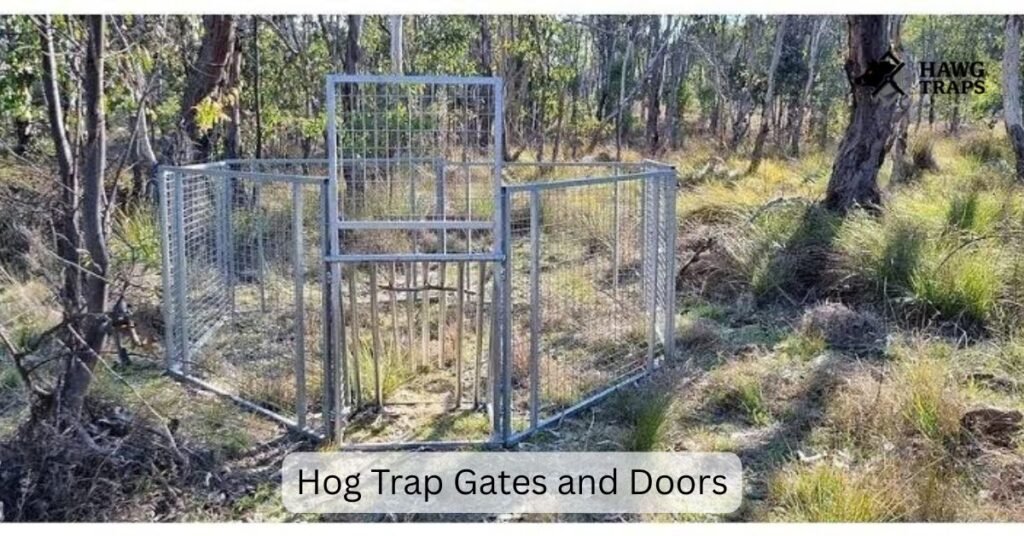
After you set the hog trap, you can go home and sleep thinking about what you might see tomorrow. But, the gate is the one part that has to do its work, and it has to do it at two in the morning with nobody watching.
That’s why trappers argue about gates more than anything else. Saloon or guillotine. Three feet wide or eight. Trip wire or cell phone. Every one of those arguments has a fellow on a forum who is completely sure.
We build hog traps for a living, so we went and read the research instead. Some of it surprised us. Some of it won’t please people who sell gates, and that includes us.
We build hog traps and gates. Some links to other products are affiliate links, and we may earn from qualifying purchases.
Key Takeaways
- A hog trap gate and a hog trap door are the same thing. Extension writers also call it a head gate.
- There are four main types: guillotine (drop), saloon, rooter and remote-controlled drop gates.
- “Continuous catch” rarely catches any extra hogs. In an Alabama study, only 11 pigs entered a closed trap in 222 chances.
- Wider doesn’t work faster according to different studies. Pigs entered a 2.6-foot door as readily as a 3.9-foot door.
- Listed prices on 4 October 2026 ran from $319.95 to $1,599.99 for a ready-made gate, depending on type.
- The trigger belongs at the back of the trap, away from the door, so the last hog is inside before it trips.
Why Trust Us: How We Put This Together
Boss Hawg is a steel shop in Cross Plains, Texas. We build hog traps with gates on them, so we have a horse in this race. Read the page knowing that.
Here’s what we did to keep it straight.
- We started with the research. Two Alabama studies tested gate types and gate widths with cameras on real traps. We report what they found, even where it cuts against a sales pitch.
- We used extension guides from Texas A&M AgriLife, Mississippi State and Clemson for how each door works and how to set it.
- We read owner reviews of ready-made gates on store pages. When we say “from the owner reviews we read,” that’s what we mean. We did not run our own side-by-side gate test.
- Every price comes with a date. We checked store listings on 4 October 2026. Prices move, so check before you buy.
- We don’t print our own prices. We build to order, so ours come by phone.
What is a hog trap gate?
A hog trap gate is the door that lets hogs into a trap and then shuts behind them. Gate, door and head gate all mean the same part. It comes built into a box trap or stands alone in a corral.
On a box trap, the gate comes with the trap. On a corral trap, the gate is its own piece. You stand it between two posts, tie the panels to it, and the pen is closed.
That’s why so many people shop for a gate alone. Panels and T-posts are easy to buy at any farm store. The gate is one of the vital parts of the hog trap. The whole thing can sit still but the gate needs to do its job.
A gate has four things worth comparing:
- How it closes. By falling, by spring, or by the hog letting go of it.
- How wide it opens. From under 3 feet to 8 feet.
- What trips it. A wire, a stick, a bucket or a phone signal.
- What it’s made of. Plywood, steel angle or steel tubing.
The rest of this page takes those one at a time.
The four types of hog trap doors
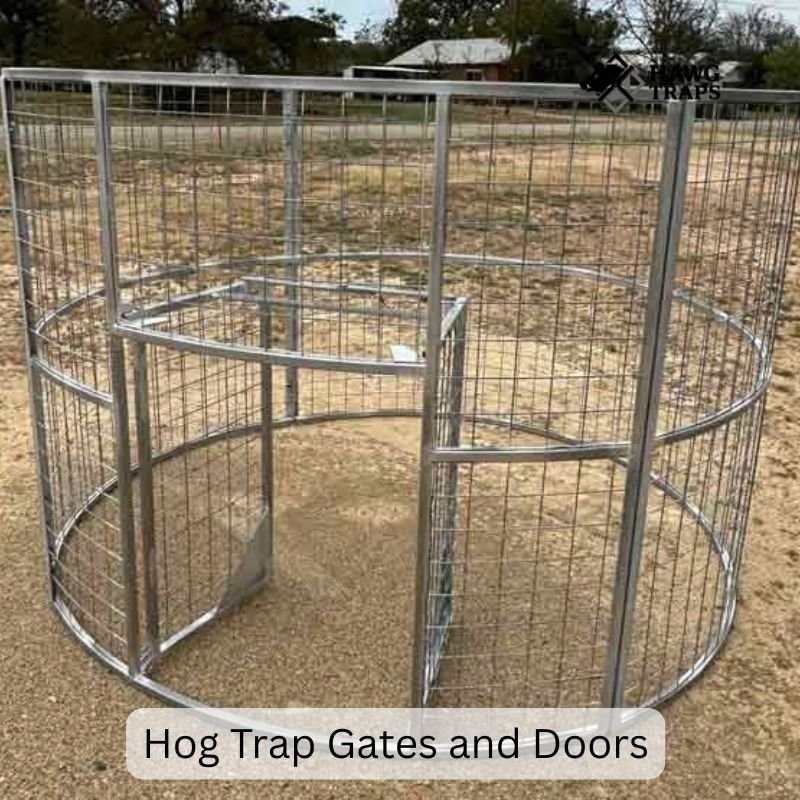
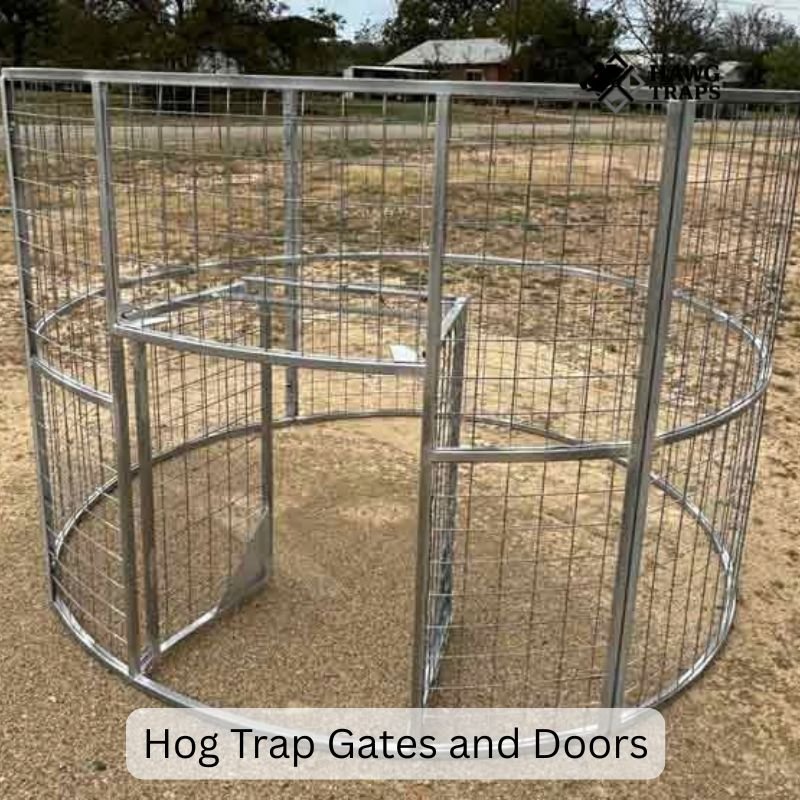
The four main hog trap doors are the guillotine or drop door, the saloon door, the rooter door and the remote-controlled drop gate. The first falls shut once. The middle two let more hogs push in after closing.
| Door type | How it closes | Catch mode | Usually made of | Weak point |
|---|---|---|---|---|
| Guillotine (drop) | Slides straight down when the trigger is pulled | Single catch | Lumber and ¾-inch plywood, or steel | Once it drops, the catching is over until you reset it |
| Saloon | One or two side-hinged doors pulled shut by springs | Continuous catch | Steel angle or tubing | Springs and hinges need tension and upkeep |
| Rooter | Top-hinged panels drop shut; a hog lifts them with its nose to enter | Continuous catch | Steel | Small pigs can’t lift it, and wary hogs often won’t try |
| Remote drop gate | A wide gate dropped by a signal from your phone | Single catch, on your command | Steel, plus a control box | Price, a battery, and cell signal at the trap |
Guillotine doors are the simple ones. Clemson Extension calls them “the most budget-friendly doors.” A sheet of plywood rides in a wooden frame. A wire holds it up. The wire lets go and gravity does the rest. Gravity has never once needed a new spring.
Saloon doors swing like the ones in a western. According to Clemson, they “rely on springs and are activated using a tripwire.” Once shut, a hog outside can still push in. A hog inside can’t push out.
Rooter doors hang from a top hinge. As the national extension feral hog site describes it, a hog must “use its nose to root or lift open the door.” The door then falls shut behind it.
Remote drop gates are the newest type. You watch the trap on a camera and drop the gate when the whole sounder is inside. We cover those further down.
You’ll also see a “trainer door” mentioned, which is another continuous-catch design. And some box traps use a plain swing gate, including our own Standard trap.
Build plans and the finer points of each design belong on our page about hog trap door designs. Here we’ll stick to the question that matters for buying one: does the type change how many hogs you catch?
Single-catch or continuous-catch: which door catches more hogs?
Neither type clearly catches more. In an Alabama study, continuous-catch doors let in only 11 extra pigs out of 222 chances. A single catch door comes with almost similar effectiveness with less money.
This is the biggest selling point in the gate business, so it’s worth a slow look.
The pitch goes like this. A guillotine door falls once. A saloon or rooter door keeps working. More hogs show up at midnight, push in, and you wake up to a bonus. It sounds right.
Researchers in Alabama checked. In the summer of 2011 they built 26 corral traps. They fitted rooter, saloon and trainer doors. Then they set each trap to catch only part of a sounder on purpose, and filmed what the rest did.
The pigs left outside did come back. They visited the closed traps almost three times a night. They hung around for close to an hour each visit. Their family was inside, and the gate would have let them join.
And they almost never went in.
| Door type | Chances to enter | Pigs that entered | Entry rate |
|---|---|---|---|
| Rooter | 55 | 9 | 16.4% |
| Saloon | 115 | 1 | 0.9% |
| Trainer | 52 | 1 | 1.9% |
| All three | 222 | 11 | about 5% |
Source: Smith, Smith and Johnson, 2012, Journal of the Southeastern Association of Fish and Wildlife Agencies. Corral traps in east-central and southwest Alabama.
The authors’ conclusion was blunt. Continuous-catch doors “were ineffective in capturing substantial numbers of additional pigs after the door closes.” Mississippi State’s extension site agrees, and calls those extra captures a rare event.
So should you skip saloon and rooter gates? No. Here’s the fair reading.
- Rooter doors were the most effective. About one pig in six went in. That’s a few extra hogs over a season.
- Steel multi-catch gates still do a pretty decent job. They’re strong, they close fast, and they hold. Mississippi State notes that with either style, “rarely will a pig be able to run out of the trap before the door closes.”
- Buy one for the build, not the bonus. Don’t pay extra for hogs that mostly won’t walk in.
The real lesson sits one step back. The hogs outside a closed gate are now educated hogs. The fix isn’t a cleverer door. It’s waiting until the whole sounder is inside before anything closes.
How wide should a hog trap gate be?
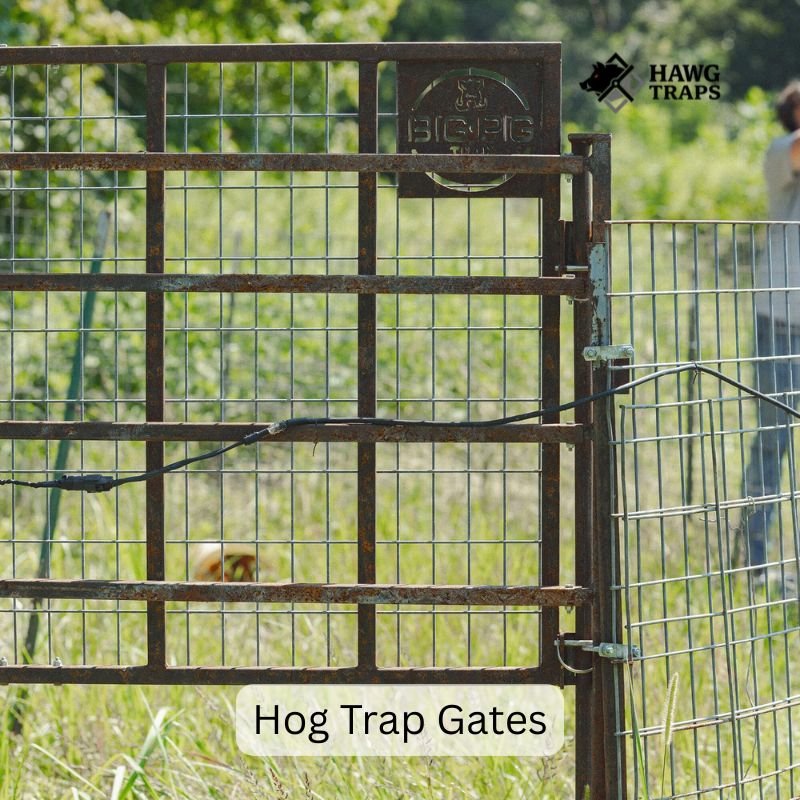
Most ready-made hog trap gates open about 3 to 4 feet wide, and that is wide enough. In the one study that tested width, pigs entered a 2.6-foot door as quickly as a 3.9-foot door.
Width is the second big argument. Here’s what’s on the market, measured by the opening a hog walks through.
| Gate | Opening width |
|---|---|
| AgriLife guidance for saloon doors | 32 to 36 inches in total |
| Hog Slammer saloon gate | 33⅜ inches |
| AgriLife plywood guillotine plan | Almost 4 feet |
| Tractor Supply 3-door gate | 4-foot-wide frame |
| JAGER PRO remote gate | 8 feet |
The maker of the 8-foot gate argues that narrow gates need “excessive conditioning times.” In plain words, hogs take longer to trust a small doorway. Lots of trappers believe the same.
Alabama researchers tested that idea too. Over the summers of 2014 and 2015 they ran 12 corral traps in Macon County, Alabama. Some had guillotine doors 0.8 meters wide, about 2.6 feet. The others had doors 1.2 meters wide, about 3.9 feet. Cameras timed 47 sounders and 27 lone pigs.
The result: no meaningful difference in how long pigs took to enter. Not for the first pig, not for half the sounder, not for all of it.
The authors wrote that door width “may not have as large of an impact on entrance rates into traps as previously thought.” Their advice was to put your effort into “trap placement, baiting, monitoring” instead.
Two honest limits on that. The study compared 2.6 feet with 3.9 feet. It did not test an 8-foot gate, and we found no published study that has. And a wide gate helps in another way: a big sounder walks in together instead of single file.
So here’s our read. For a box trap or a small corral, a 3 to 4-foot gate is plenty. An 8-foot gate works just fine on big sounders with a camera and a remote trigger. You should lose sleep over six inches.
How hog trap gates are triggered
A hog trap gate is triggered by a trip wire, a root stick, a bait bucket or a remote signal. Set it at the back of the trap, away from the door, so hogs are well inside first.
That last part matters more than the trigger type. Dot put the trigger near the door, it will capture the first greedy pig and the rest of the pigs will stand outside of the trap. Texas A&M AgriLife puts the trigger “at the back of the trap, away from the door” for that reason.
The four common triggers:
- Trip wire. Clemson describes “a length of wire that runs across the back of a trap,” set 12 to 20 inches above the ground. Hogs feeding at the back bump it.
- Root stick. A line runs from the gate to a stick held under two stakes. Clemson has those stakes driven at a 45 to 60 degree angle. Hogs rooting through the bait knock the stick loose.
- Bait bucket or trigger rod. Some ready-made gates release when a hog tips a bait bucket tied to a rod.
- Remote. A person watching a camera sends the signal. More on that below.
One good tip from AgriLife: use picture-framing wire for the trip line. It’s strong enough to pull the pin and it “will break if a hog becomes entangled.” A hog wrapped in unbreakable cable wrecks a trap in a hurry.
Height matters too. Set a trip wire too low and the first small pig through the door can spring it. Raccoons are happy to help with that as well.
Trigger builds, parts and settings get a full page of their own under hog trap triggers.
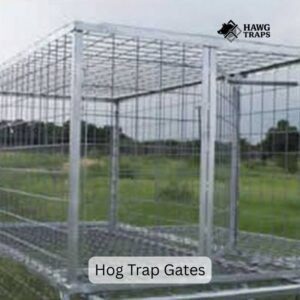
What does a hog trap gate cost?
A ready-made steel hog trap gate was listed between $319.95 and $349.99 on 4 October 2026. A cellular gate was $1,599.99 plus a yearly plan. A home-built plywood guillotine door costs the least.
| Gate | Type | Listed price, 4 Oct 2026 | What you should know |
|---|---|---|---|
| Home-built plywood door | Guillotine | Materials only | An older AgriLife plan sheet put gate materials near $115. Lumber costs more now |
| Hog Slammer saloon gate | Saloon | $319.95 at one store, $345 at another | 14-gauge steel, powder coated. Opening 33⅜ by 42 inches |
| Tractor Supply 3-door hog trapping gate | Rooter | $349.99 | 80 pounds. Steel angle frame with 6-gauge, 4 × 4-inch mesh |
| Hogg Boss single gate | Remote drop | $1,599.99, plus $100 a year | 12-volt battery and cellular camera sold separately |
| Boss Hawg gates | Swing and panel gates | By phone | Built to order. Call (254) 725-4554 |
A few notes on that table.
The remote gate price is only the start. You add a battery, a cellular camera and a data plan. JAGER PRO’s remote-controlled trap package was listed from $4,800 when we checked.
The gate is also only part of a trap. Panels, posts and wire come on top. Our hog trap cost page adds up a full home-built corral, line by line.
And one money-saving idea comes straight from AgriLife. A corral trap doesn’t need its gate until the day you set it. So AgriLife suggests you “consider sharing gates with your neighbor.” Two pens, one gate, and a reason to stay on speaking terms.
Ready-made gates from our partners:
- 3-door hog trapping gate at Tractor Supply, listed at $349.99 on 4 October 2026
- Hog Slammer “V” Gate on Amazon. Check today’s price and reviews on the listing
As an Amazon Associate we earn from qualifying purchases. Partner products are listed separately from our own and never replace them.
What makes a hog trap gate hold
A hog trap gate holds when its frame is braced, its welds are sound, and there is no gap above or beside it. The gate is the only moving part, so it is the first place a trap gives.
A panel is one welded piece. A gate has hinges, a latch and a seam where the doors meet. Every one of those is a place for a 200-pound hog to find a weakness.
Here’s what to look at before you buy or build.
The frame. AgriLife’s trap design guidance says to brace saloon doors at the top and the bottom. An unbraced frame racks out of square. Then the doors stop meeting, and a gap is an invitation.
The steel. Mississippi State notes that multi-catch doors are usually built from angle iron, steel tubing or both. Ask for the gauge. On our own traps the frame is 1½-inch, 14-gauge square tubing with bracing. The wire is 6-gauge, MIG welded to the frame. The reasons are on how Boss Hawg traps are built.
The gap above. A gate is often shorter than the panels beside it. AgriLife’s corral design uses panels 5 feet tall. From the owner reviews we read, one Tractor Supply buyer liked his gate and still wrote, “I added a panel above the gate to prevent escape.” That’s a cheap fix. Do it on day one.
The trip from the store. Another reviewer’s gate arrived bent. He straightened the frame, reset the doors, and reported that it worked. Check any shipped gate for square before you set it. Another owner of that same gate reported 13 hogs in one night, so a straight one clearly works.
The welds. A Hog Slammer owner called his gate “very well built with solid welds and finish.” A second said it was his second one. Repeat buyers are the best review a gate can get.
How low the doors hang. This one is for rooter gates. The national extension feral hog site warns that if the panels hang too low, “a large hog entering the enclosure may trip the trap prematurely.”
A plywood guillotine door can hold hogs too. But wood can swell in its track, and a door that sticks halfway is just a window.
Hog trap panels: what the gate bolts to
Hog trap panels are the welded wire sections that form the pen around the gate. AgriLife says most corral traps use 20-by-5-foot panels with 4-inch square mesh and steel T-posts.
A gate is only as good as what’s beside it. Two things decide whether panels hold.
- Mesh size. AgriLife’s rule is to “use small enough mesh to catch all hogs, even juveniles.” A plain cattle panel has openings a small pig can walk through.
- Height. AgriLife’s panels stand 5 feet tall. Don’t go shorter to save a few dollars.
Tie the gate to the panels and posts tight, top to bottom, with no slack. Panel types, layouts and how many you need are covered on our page about hog trap panels.
Cellular and remote hog trap gates
A cellular hog trap gate is a drop gate you close from your phone while watching a live camera. It lets you wait until the whole sounder is inside, no door design can fix this problem. You can bypass some of the luck factors.
Think back to the Alabama study. The hogs left outside almost never walked in later. A remote gate goes at that problem from the other end. You don’t close until nobody is left outside.
That’s why costly systems exist. In a three-year Oklahoma study, suspended drop traps had a removal rate of 88.1%, against 48.5% for corral traps. Our drop hog trap page has the full numbers.
The trade-offs are real:
- Price. The Hogg Boss gate above was $1,599.99, then $100 a year, then a battery and a camera.
- Signal. No bars at the trap, no trigger.
- Power. A dead battery makes a very expensive open gate.
- You. Somebody has to watch the phone. Hogs keep bad hours.
A good middle road costs far less. Put a cellular trail camera on an ordinary trap. Watch for a week. Set the trip wire only when the camera shows the whole group feeding inside every night.
We’ll go deeper on cellular and remote hog trap gates on their own page.
Setting a hog trap gate: five habits that catch more hogs
To set a hog trap gate well, prop it open and bait for days first, put the trigger at the back, and close it only when the whole sounder feeds inside. Patience beats hardware here.
- Leave it open first. AgriLife says saloon and rooter doors “can be set in an open position using a prop such as a two-by-four or a stick.” Let hogs come and go freely for several days.
- Don’t rush rooter gates. The same extension site notes these traps “must be tied open and pre-baited for multiple days.” It also notes that some hogs are too small to lift the door.
- Count before you set. Use a camera. Set the trigger when every hog you’ve counted is walking in.
- Hold it open the simple way. AgriLife notes a hook and eye latch “can also be used to hold the trap door open until it is triggered.”
- Check it every morning. Know your state’s rules on trap checks and on handling live feral hogs before you set anything.
The Alabama width study landed on this same point. Placement, bait and watching all are vital for success, not just the door.
Boss Hawg gates: what we build
Boss Hawg builds hog trap gates as part of our traps and to order. The Standard trap has a swing gate and trip wire. The Pro Pen has panel gates. Custom gates are built to your pen.
Here’s what leaves our shop with a gate on it.
- Standard hog trap A 4 × 8 × 3-foot box trap with a swing gate and trip wire. It fits a full-size pickup bed.
- Pro Pen hog trap A welded panel pen with panel gates, a trip wire and a loading ramp.
- Big Pen hog trap A pen sized to your site, for whole sounders.
- Stand-alone gates. Dealers list a Boss Hawg Double Trap Door, a double gate made for larger site-built panel traps. Call us for size and what’s available now.
- Custom hog traps We’ve built continual-load chutes and small-wire panels for customers. If your pen needs an odd gate, describe it.
Now the bias, out in the open. Among all the gates in this page, we think we have the best one. They share one published steel spec with the rest of the trap: 1½-inch, 14-gauge square tubing, braced, with 6-gauge wire MIG welded on. And they were designed by people who had to get the hogs out the next morning.
Three honest trade-offs. We don’t list a cellular gate, so if you want phone control, ask us or look at a partner product. We don’t post prices, so it takes a call. And heavy steel is heavy.
Have these ready when you call:
- Your hog count. The biggest group your camera has shown.
- Your pen. A box trap, or a corral you’re building, and how wide the gap for the gate is.
- Your trigger. Trip wire, or something else you plan to use.
- Your delivery ZIP code. We ship anywhere in the US. Freight is paid by the buyer and quoted before you order.
REQUEST A QUOTE: CALL (254) 725-4554
Tell us what you’re penning and how many. We’ll tell you which gate fits, and what it costs delivered.
Also check our partner products for building and setting a gate:
- Hog trap trigger on Amazon. Check today’s price and reviews on the listing
- Picture hanging wire for a trip line that breaks if a hog tangles in it
- Gate springs and hook and eye latches for saloon doors and for holding a door open
- Cellular trail cameras to count the sounder before you set the trigger
- T-post drivers and rebar tie wire for tying the gate into the panels
As an Amazon Associate we earn from qualifying purchases. Partner products are listed separately from our own and never replace them.
Frequently asked questions
What is the best door for a hog trap?
The best hog trap door is the one that closes after the whole sounder is inside. There are no clear winner when it comes to hog trap doors. A braced steel gate with the trigger at the back is a sound choice for most traps.
What is the difference between a hog trap gate and a hog trap door?
There is no difference. Gate, door and head gate all name the part that closes behind the hogs. Many people say “gate” for a corral trap and “door” for a box trap.
Do continuous-catch hog trap doors work?
They close and hold well, but they rarely catch extra hogs. In an Alabama study, only 11 pigs entered a closed trap out of 222 chances. Rooter doors did best, at about one pig in six.
Can I build my own hog trap door?
Yes. A guillotine door is the easiest to build. Mississippi State says it can be made from 2 × 4 and 2 × 2 lumber and ¾-inch plywood. Saloon and rooter doors need steel and welding.
How tall should a hog trap gate be?
A hog trap gate should leave no gap up to the top of the panels. AgriLife’s corral design uses 5-foot panels. If your gate is shorter than that, wire a section of panel above it.
Do I need a gate while I’m pre-baiting a corral trap?
No. AgriLife points out that the gate doesn’t need to be in place until the trap is set. Leave the gap open while hogs get used to the pen, then stand the gate in.