
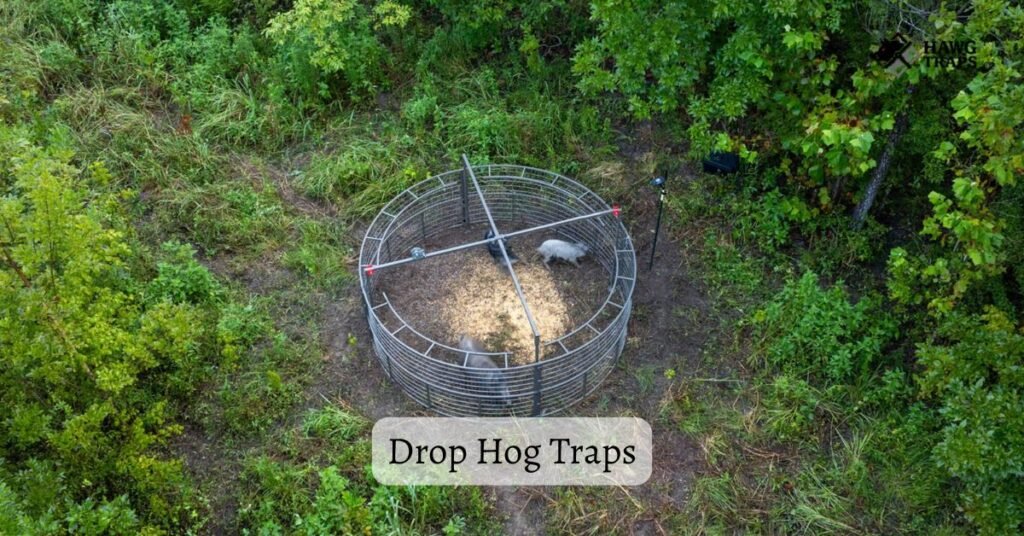
Drop Hog Traps: How They Work, What They Cost and When One Is Worth It
It’s 2 a.m. on the trail camera. Twelve hogs are standing in a neat half-circle outside your corral gate. They’re eating every kernel of corn on the ground, right up to the threshold. Not one of them steps inside.
Somewhere in that sounder is an old sow who has seen a gate close before. She remembers. And by the look of it, she’s told the family.
That’s the night people start searching for a drop hog trap. It has no gate to walk through and no walls to walk past. The whole pen hangs in the air and comes down around them. And they are caught with whole family. This page covers how a drop trap works, what the research really says, what one costs, and when a cheaper trap will do the job just as well.
Key Takeaways
- A drop trap is a rigid pen hung in the air that falls around the hogs. A drop net and a drop gate are different tools.
- In a three-year Oklahoma study, suspended traps removed 88.1% of the pigs and corral traps removed 48.5%.
- A 2025 study of 31 professional trappers found drop, corral and net traps all effective, with drop traps best in acorn season.
- Bait goes in the center, never at the edge. According to Texas A&M AgriLife.
- Listed prices start at $2,295. A camera for dropping it from your phone adds cost and needs cell service.
- Boss Hawg builds drop traps to order from the same steel as the rest of our traps.
Why Trust Us: How We Put This Together
Boss Hawg didn’t start out selling traps. The shop started out trapping hogs that were destroying its own property. Then local ranchers began contracting with the shop to remove hogs from their land. Our traps came out of those years of hands-on work.
Our team in the US works with hog traps on real ranch ground. We talk with the landowners and trappers who use them, and we read what owners say about traps from different brands. For this page we studied two published studies on drop traps, plus what Texas A&M AgriLife, Mississippi State and Clemson publish. We also checked today’s listed prices on the sellers’ own pages. Every outside fact is named with its source. Where the research disagrees with the sales pitch, we show you both.
What a drop hog trap is, and how it differs from a drop net and a drop gate
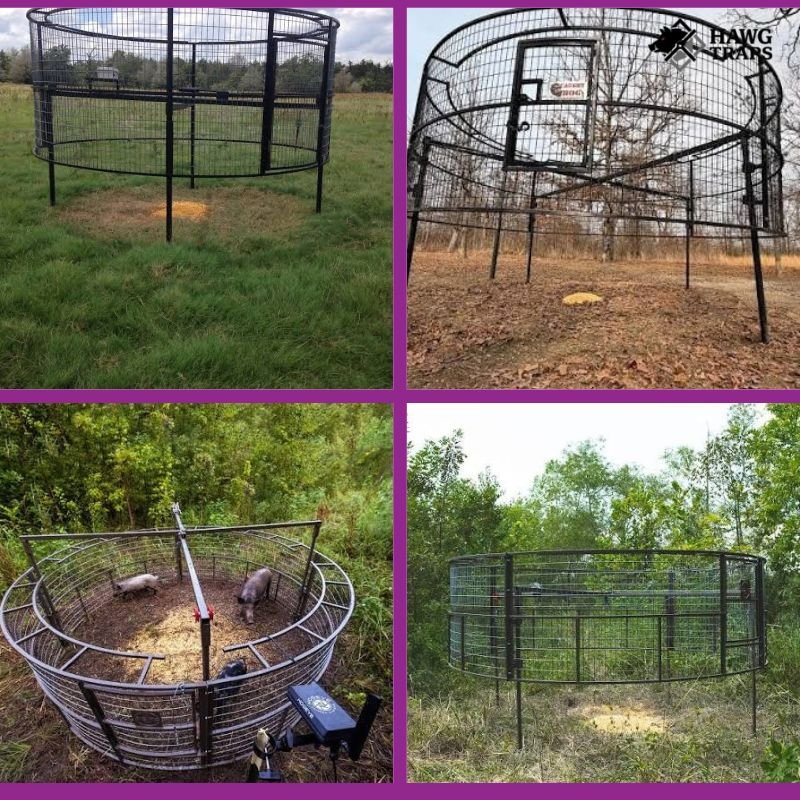
A drop hog trap is a rigid pen hung a few feet above the ground that falls around a group of feral hogs when triggered. Texas A&M AgriLife describes it as a large circular fence suspended in the air.
The word “drop” causes a lot of confusion, because three different tools share it. So let’s clear that up first. A drop hog trap is a rigid pen hung above the ground that falls around the hogs; a drop net is a net, and a drop gate is only a door.
| Name | What falls | What it is | What it catches |
|---|---|---|---|
| Drop trap | A rigid pen | A fence ring hung 3 to 4 feet up that falls around the hogs | A whole group at once |
| Drop net | A net | A large net hung on poles above the bait | A whole group at once |
| Drop gate | A door | A guillotine-style door on a normal corral or box trap | Whatever is inside when the door falls |
Only the first one is a drop trap; the other two share the word and nothing else.
A drop gate is worth one more line, because it’s the cheapest of the three. Clemson Extension calls drop-style doors “the most budget-friendly doors.” The catch is in the next sentence: after the door falls, “no other animals will be caught.” And the hogs still have to walk through a gate to get in, which is the very thing a trap-shy sounder won’t do.
You’ll also hear researchers call a drop trap a “suspended trap.” Same thing. If you’re still comparing every type of trap, start with our hog traps for sale page. If the hogs at your place have stopped walking through gates, keep reading.
How a drop hog trap works
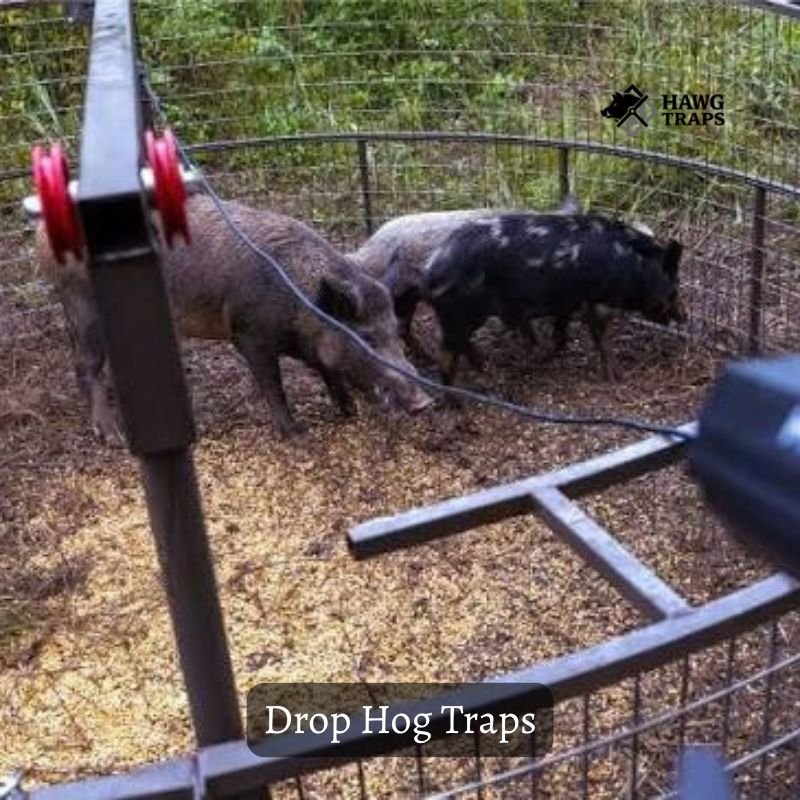
A drop hog trap works in four steps: hang the pen about 3 to 4 feet up, bait the center, wait until the whole sounder feeds underneath, then drop it by trip stick or by phone.
A sounder is a family group of feral hogs, usually sows and their young. The whole idea of a drop trap is to let that family eat dinner without ever noticing the dining room has walls.
- Hang the pen. A winch raises it. Benjamin Buckley, a USDA APHIS district supervisor, told Great Days Outdoors the trap typically hangs 36 to 48 inches off the ground. In his words, that leaves “very little visual barrier.”
- Bait the center. Texas A&M AgriLife is firm on this: bait goes “in the center of the trap NOT the perimeter.” The pen comes down fast, and you want every hog well inside the ring when it lands. Putting baits in the center ensures it.
- Wait for the whole sounder. Keep feeding with the pen raised until the entire group is eating underneath it, night after night. A trail camera does the counting for you.
- Drop it. Some traps use trip sticks that the hogs knock while rooting. Others use a cellular camera, so you watch the live picture and drop the pen from your device.
The phone option is the one that gets people excited, and for a fair reason. AgriLife says a camera-based trigger lets you “see exactly how many pigs are present” before you close the trap. You stop guessing. You count twelve, you see twelve, you drop.
Did you know? Two easy mistakes with a drop trap are both about patience. One is baiting near the edge, so hogs feed half in and half out. The other is dropping the pen on six hogs when the camera has been showing you twelve all week.
What the research says about drop traps
In a three-year Oklahoma study, suspended drop traps had a removal rate of 88.1%, drop nets 85.7% and corral traps 48.5%. A 2025 study of professional trappers found drop, corral and net traps all effective.
Those are two different studies, and most sellers only tell you about the first one. Here are both.
The Oklahoma study. Researchers trapped wild pigs in Love County, Oklahoma, from 2010 to 2012 and removed 601 of them. They compared three methods. Removal rate means the share of the known pigs that each method took out.
| Trap type | Removal rate | Person-hours per pig |
|---|---|---|
| Suspended (drop) trap | 88.1% | 0.64 |
| Drop net | 85.7% | 1.9 |
| Corral trap | 48.5% | 2.3 |
In this one Oklahoma study, traps that fell from above removed far more pigs for far less labor. Source: Gaskamp, Gee, Campbell, Silvy and Webb, 2021, in the journal Animals.
The authors gave three reasons. Whole sounders could be caught under one trap. There were no “trap thresholds to cross, or paneling or fencing at ground level.” And the trapper chose the moment to drop it. The trap they used was about 16 feet square and hoisted roughly 3 feet off the ground. You can read the full study free online.
The Noble Foundation, the Oklahoma research group behind this work, went on to develop a commercial drop trap called the BoarBuster. It went on sale in 2015. So when a seller quotes “88 percent,” this is where the number comes from.
The 2025 study. Three researchers at the University of Georgia looked at more than 850 captures by 31 professional trappers across the Southeast. They compared drop traps, corral traps and net traps. Their finding, published in the Wildlife Society Bulletin: all three “were effective at capturing entire social groups of wild pigs.” The university’s summary called the differences between trap types “insignificant.”
Drop traps did win one round. They performed best in mast season. That’s the time of year when acorns and other tree nuts cover the ground and hogs lose interest in your corn. Trap-shy hogs are hard. Trap-shy hogs with a free acorn buffet are harder.
So which study is right? Both. One was a single county in Oklahoma. The other measured professionals who trap for a living. Our reading is simple. In skilled, patient hands, every one of these traps works. A drop trap earns its price when the hogs have already learned to avoid the others.
The trade-offs of a drop hog trap
A drop hog trap’s limits are weight, transport, installation time and the ground it suits, according to a USDA APHIS district supervisor. A remote trigger also needs cell service, and each set makes one drop.
No seller will lead you with the list, but we will help you to understand it.
- Weight and transport. A rigid steel pen, a frame to hang it from and a winch add up. Buckley names “weight, transport, installation time, and habitats that limit use” as the limits of drop traps.
- Set-up time. AgriLife says a box trap can be set quickly. A drop trap has to be assembled and raised first.
- Cell service. AgriLife notes that a remote camera trigger “is typically more costly and does require cell service.” No signal in the creek bottom means no phone drop. Trip sticks still work there.
- One drop per set. When the pen comes down, that catch is finished. A hog that was standing outside the ring just watched the whole show, and you’ll need to raise the trap and start again.
- Size. One seller’s drop trap is 12 feet across, which is about 113 square feet. AgriLife’s minimum for a corral is about 20 by 30 feet. Another seller describes its drop trap as suited “for smaller sounders or trap shy hogs.”
- Cost. The Oklahoma researchers said it plainly: “Financial costs will be a major factor.”
Two rules apply to a drop trap exactly as they do to any other trap. First, check it every day. AgriLife says traps need checking “within 24 hours and before the day heats up.” A camera can do some of that for you, but someone still has to deal with the hogs.
Also make sure to keep children, pets and live stock to reach in the traps area.
What a drop hog trap costs
Listed US prices for drop hog traps run from $2,295 for a 12-foot round trap with manual trip sticks to $4,499 and up with a cellular camera (checked 3 October 2026). Boss Hawg quotes custom drop traps per build.
Here’s what sellers were listing when we checked.
| What you buy | Listed price | What’s included | Seller |
|---|---|---|---|
| 12-foot round drop trap | $2,295 | One piece, manual winch, trip sticks | That’s A Hog Trap |
| 12-foot round drop trap | $3,245 | Four piece, electric winch, trip sticks | That’s A Hog Trap |
| Camera system for remote drop | $750 extra | Lets you drop the trap by cell phone | That’s A Hog Trap |
| Drop trap with camera app | From $4,499 | Trap with a HogEye camera, dropped from the app | Big Pig Trap |
A drop trap you trigger by hand starts near $2,300; phone-triggered setups run from about $3,000 to $4,500 and up. Prices checked 3 October 2026. Ask each seller about delivery.
Three things move the price. The first is how the trap comes apart: a one-piece ring costs less than one that breaks down into four pieces for hauling. The second is the winch, manual or electric. The third, and the biggest, is the camera.
For comparison, a net trap from Pig Brig is listed “starting at $2,500.” A cellular drop gate for a corral is listed at $1,599.99 plus $100 a year, with the corral sold separately. Welded corral systems run about $3,500 to $8,000.
Drop trap, corral trap or net trap: which one fits your hogs
Choose a drop trap for trap-shy hogs and heavy acorn years, a corral pen for a sounder that keeps returning to one spot, and a net trap when one person must carry everything in.
| Drop trap | Corral pen | Net trap | |
|---|---|---|---|
| Catches | A whole group, one drop | A whole sounder | A whole group, hogs keep entering |
| Best when | Hogs are trap-shy, or acorns are down | A sounder keeps coming back to one place | One person, remote ground |
| Needs cell service | Only for a phone drop | Only with a cellular gate | No, the maker says |
| Moves by | Heavy: pen, frame and winch | Panels on a flatbed | “Fits in a tote,” the maker says |
| Listed price | From about $2,300 | About $3,500 to $8,000 welded; less if you build it | From $2,500 |
| Who builds it here | Boss Hawg, to order | Boss Hawg Big Pen and Pro Pen | Not us |
The drop trap wins with educated hogs, the corral wins on staying power, and the net trap wins on portability.
Here’s the honest version, and it may save you money. If your hogs have never seen a trap, you probably don’t need a drop trap. Texas A&M AgriLife says a large corral trap can capture an entire sounder. Our Big Pen corral hog trap does that job, and the Pro Pen hog trap adds a loading ramp for getting them out.
If you trap alone on ground you can’t drive to, a net trap is the lightest thing to carry in. We don’t build one. Pig Brig does.
A drop trap is the right buy when the cameras show hogs that walk up to a gate and stop. Buckley says drop traps are “often utilized when feral swine have been educated from previous trapping activities.” That’s the customer a drop trap was made for. If other farmers commonly use other types of traps and they are having lower success rate, drop trap can be a good option.
AgriLife sums up the whole question in one line: “The best trap for each operation will vary based on resources, goals, and quantity of pigs to be removed.”
Custom drop hog traps from Boss Hawg
Boss Hawg builds drop hog traps to order in Cross Plains, Texas, from 1½-inch 14-gauge tubing and 6-gauge welded wire. Call (254) 725-4554 with your sounder size and site for a design, a quote and freight.
We don’t keep a drop trap on the shelf, and we don’t sell one size. Each one is sized to your sounder and your site. The lift and the trigger are agreed when we design it, so the trap suits the ground, the signal and the number of hands you have.
What stays the same is the steel. Every Boss Hawg trap frame is 1½-inch, 14-gauge square tubing with bracing. The wire is 6-gauge, MIG welded to the frame, not clipped on. All the tubing is prime coated. The reasons behind each choice are on how Boss Hawg traps are built, and the full custom process is on our custom hog traps page.
Have these ready when you call:
- Your hog count. The biggest group your trail camera has shown.
- Your site. Open pasture, brush, creek bottom or woods.
- Your cell coverage. Bars at the trap site decide whether a phone trigger is even an option.
- How you’ll move it. Trailer, tractor, or how many people.
- Your delivery ZIP code. We ship anywhere in the US. Freight is paid by the buyer and quoted before you order.
Three honest trade-offs. We build to order, so ask about the current build time. Heavy steel is heavy, and a drop trap has to be lifted, so we’ll talk through how yours gets raised. And we won’t quote a price on this page, because the price depends on the build. Nothing gets cut until you’ve seen the plan and the number.
REQUEST A QUOTE: CALL (254) 725-4554
Tell us how many hogs you’re seeing and where. If a corral will do the job for less, we’ll say so.
Also check our partner products that finish a drop trap setup:
- Cellular trail cameras to count the sounder and watch the trap from your phone
- 12-volt electric winches for raising the pen
- Hand winches for a simple manual lift
- Deep-cycle 12-volt batteries to power a winch or trigger in the field
- Solar panels for trail cameras to keep the camera running
- Game feeders for pre-baiting the center of the hog trap
As an Amazon Associate we earn from qualifying purchases. Partner products are listed separately from our own and never replace them.
Frequently asked questions
Is a drop net the same as a drop trap?
No they are not. Both fall on the hogs from above, but a drop net is a net hung on poles, and a drop trap is a rigid pen. In the Oklahoma study they scored close: 85.7% for drop nets and 88.1% for suspended traps.
What is a drop gate on a hog trap?
A drop gate is a guillotine-style door on a corral or box trap. A trigger makes the door fall suddenly. Mississippi State notes that once it has closed, no more animals can enter until it is reset by hand.
Do drop hog traps need cell service?
Only if you want to drop the trap from your phone. Texas A&M AgriLife says a remote camera trigger needs cell service. A trap with manual trip sticks does not.
How high should a drop hog trap hang?
Typically 36 to 48 inches off the ground, according to USDA APHIS district supervisor Benjamin Buckley. One seller’s 12-foot trap hangs at 36 inches.
Where do you put the bait in a drop trap?
In the center. Texas A&M AgriLife says bait should be placed “in the center of the trap NOT the perimeter.”
What happens to the hogs after the trap drops?
Check the trap within 24 hours and before the day heats up, as AgriLife advises. Loading them out and the Texas rules for hauling live hogs are covered in our guide to hog trap trailers and loading ramps.