
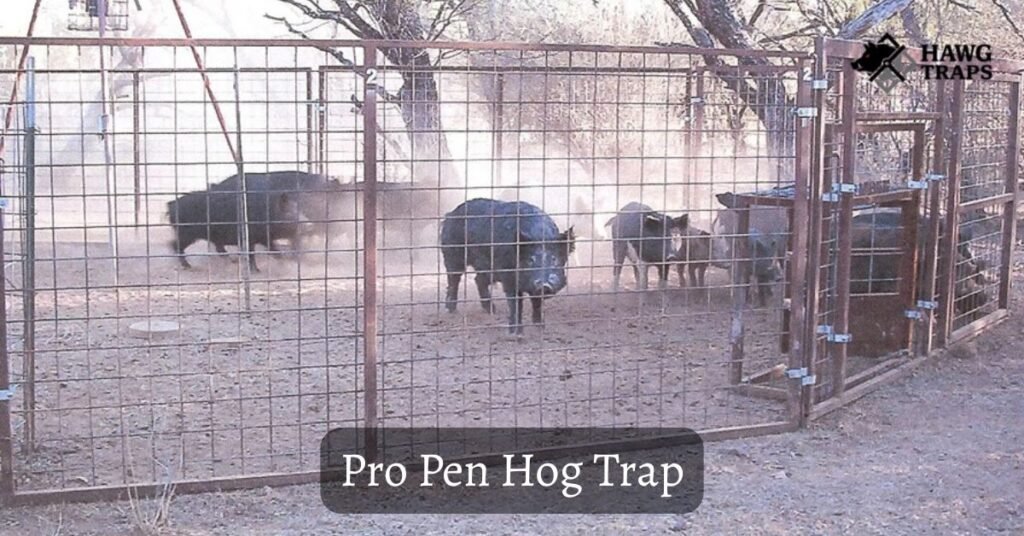
Every trapper remembers their first full pen. You pull up at dawn, and there they are: a whole sounder, caught. You feel like a genius for a moment. Then a very practical question lands. Now what?
A pen full of angry feral hogs doesn’t empty itself. They have to get from the pen to a trailer, and that’s the part nobody puts in the YouTube videos. Most hog trap pens are built to catch. The Boss Hawg Pro Pen is built to catch and to load out safely. This page covers what comes in the package, why the loading ramp matters more than people think, how it compares with the Big Pen and a homemade pen, and how to order one from us.
Key Takeaways
- The Pro Pen is a complete package: the pen, a loading ramp and panel gates, with the trip wire set for the gates.
- Same steel as every Boss Hawg trap: 1½-inch, 14-gauge square tubing with 6-gauge wire, MIG welded and prime coated.
- Catching is half the job. Getting a pen of hogs onto a trailer is the other half, and that’s what the ramp is for.
- Texas A&M AgriLife places a corral’s gate where it leads hogs toward a loading trailer. The Pro Pen is built around the same idea.
- Already have your own loading setup? The Big Pen is the pen alone.
- We ship anywhere in the US. Freight is paid by the buyer and quoted to your ZIP code.
Why Trust Us: How We Put This Together
Boss Hawg didn’t start out selling traps. The shop started out trapping hogs that were tearing up its own property, then removing hogs for local ranchers under contract. The traps we sell today came out of those years of hands-on work. Our team in the US still works with these pens on real ranch ground. We talk with the landowners and trappers who run them, listen what owners say about pens from different brands, and study what Texas A&M AgriLife and Mississippi State University publish on corral trapping. Outside facts on this page are named with their source.
What the Pro Pen hog trap is
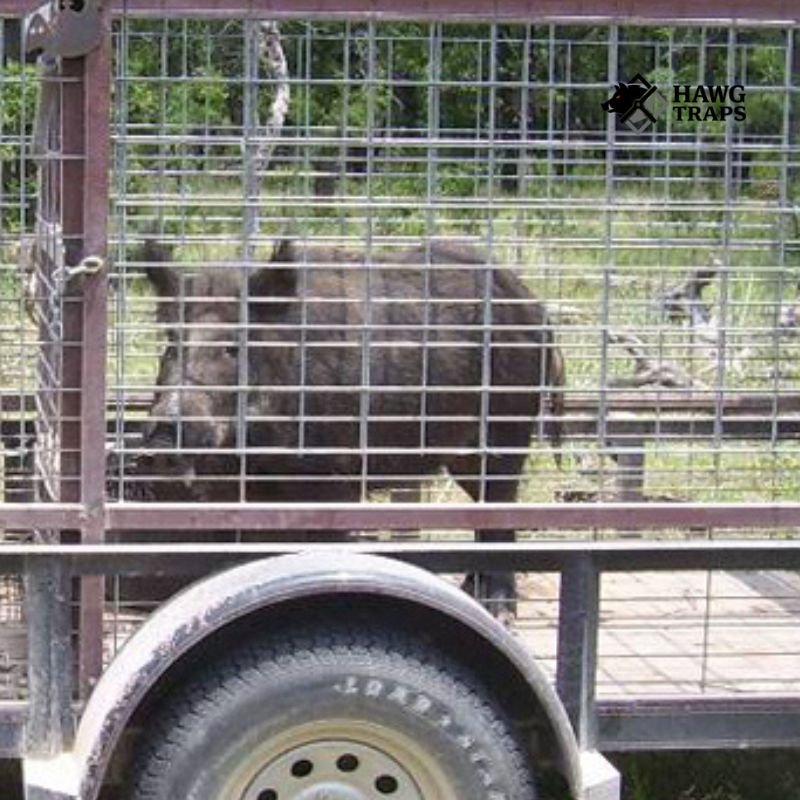
The Boss Hawg Pro Pen is a complete hog trap pen of welded steel panels, panel gates with the trip wire set, and a loading ramp, built in Cross Plains, Texas.
A sounder is a family group of feral hogs, usually sows and their young. A pen trap is a large enclosure of panels with a one-way gate, big enough for the whole family to walk in and feed together. When the gate closes, it closes on all of them.
The Pro Pen is the top of our line of hog traps for sale. Think of it as the Big Pen with everything you need after the catch already bolted on, so to speak. There’s nothing left to track down before you start trapping, and nothing left to worry when the pen is full.
What comes in the Pro Pen package
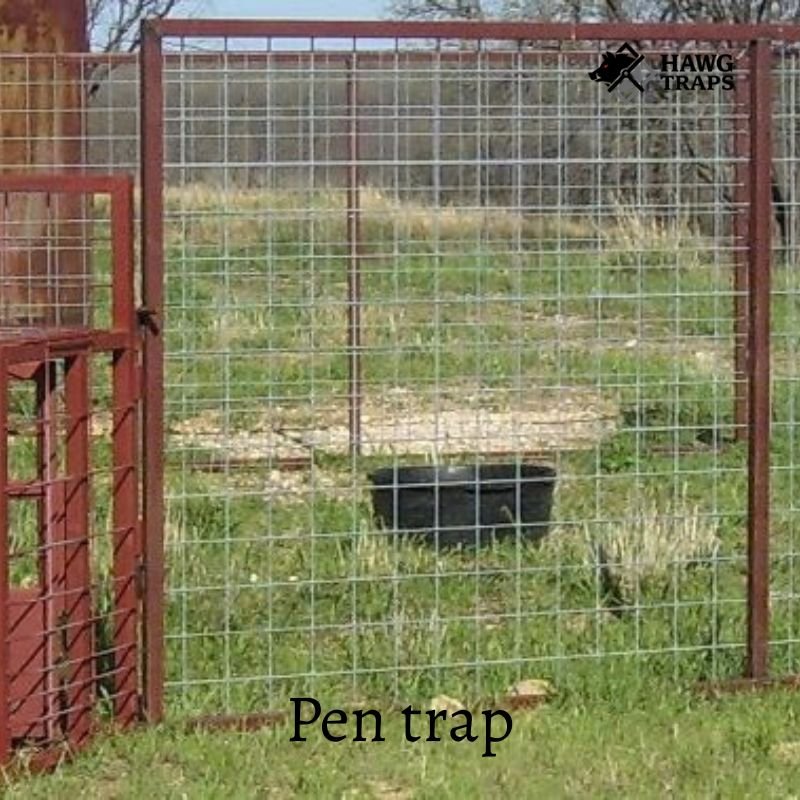
The Pro Pen package includes the pen, a loading ramp and panel gates, with the trip wire set for the gates. Every panel uses 1½-inch 14-gauge square tubing and 6-gauge wire, MIG welded and prime coated.
| Item | What it does | Spec |
|---|---|---|
| The pen | Holds the whole sounder | Panels of 1½-inch, 14-gauge square tubing with 6-gauge wire, sized to your site |
| Panel gates | Let hogs in, then close on the group | Same steel as the pen |
| Trip wire, set for the gates | Closes the gates when a hog pushes it | Set up for the Pro Pen’s gates |
| Loading ramp | Moves caught hogs from the pen onto a trailer | Built to work with the pen |
Everything you need to catch a sounder and load it out comes in one order.
Here’s why the steel matters. In a pen, the frame takes the load when a dozen excited hogs start working the corners. That’s why every Boss Hawg frame is 1½-inch, 14-gauge square tubing with bracing throughout. The wire is 6-gauge and MIG welded to the frame. Not clipped. Not tied on with tie wire. A panel that’s only fastened is the first thing to give under steady pressure, and hogs are nothing if not steady.
All the tubing is prime coated, which keeps the joints from rusting after a few seasons sitting out in Texas weather. The full reasoning behind each part is on how Boss Hawg traps are built.
Why the loading ramp matters: the second half of the job
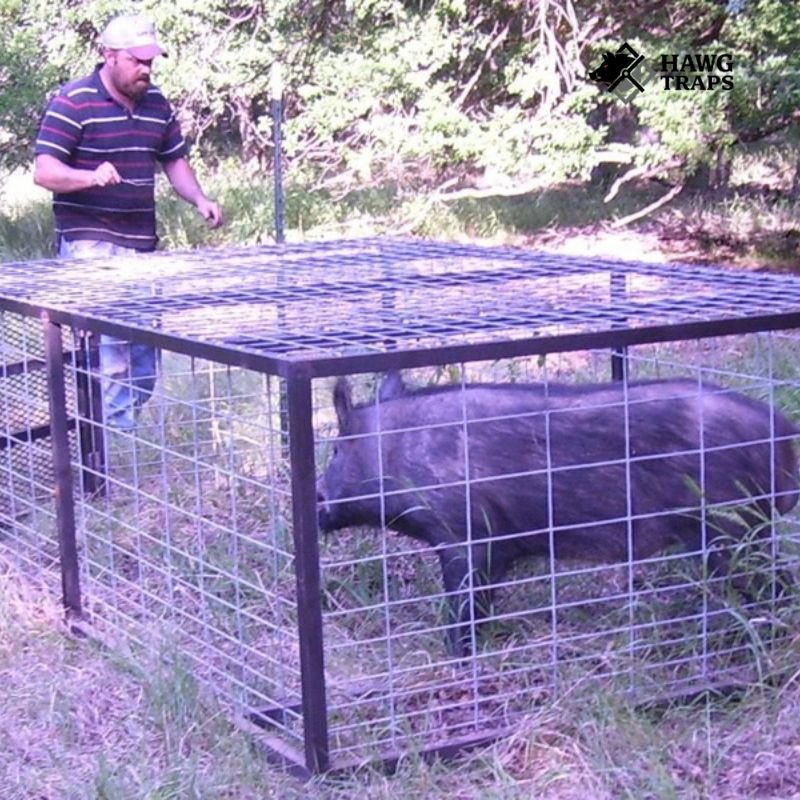
The loading ramp matters because catching hogs is only half the job; the other half is moving a pen full of hogs onto a trailer. Texas A&M AgriLife places a corral’s gate where it leads hogs toward a loading trailer.
Picture it without a ramp. You’ve got fifteen hogs in a pen, a trailer backed up to the gate, and a gap between them that no hog wants to cross. Hogs don’t climb into trailers out of politeness. You end up with a shovel, a sheet of plywood, a lot of shouting and possibly a new appreciation for the phrase “pig-headed.”
Texas A&M AgriLife’s corral trap design puts the gate at the narrow end of a teardrop-shaped pen, and the reason is right there in its guidance: to direct hogs toward a loading trailer. The design thinks about loading out from day one. So does the Pro Pen. The ramp gives the hogs a path from the pen up to the trailer, so loading becomes a job and not a rodeo.
This is the gap in most “hog trap pen” plans you’ll find online. They’re good at catching. They stop the moment the gate closes. The Pro Pen was put together by a shop that spent years removing hogs for ranchers, and anyone who’s done that knows the catch is where the work starts.
How the panel gates and trip wire work
The Pro Pen’s panel gates stay open while the sounder feeds; when a hog pushes the trip wire, the gates close and the pen holds the group.
Here’s the sequence:
- Gates open. The panel gates are set open, and the hogs come and go while you pre-bait.
- The sounder settles in. Over several nights, the whole group gets comfortable feeding inside.
- The trip wire is set. When you’re ready, you set the trip wire for the gates.
- A hog pushes the wire. Nose down in the bait, a hog pushes the trip wire and the gates close.
No batteries, no app, no cell signal needed. The trip wire works the same in a creek bottom with no coverage as it does next to the barn.
Our shop field tested its traps for continuous loading, retention and durability. In plain words: they catch, they hold what they catch, and they hold up. Gate and trigger designs vary from trap to trap, and the details for other designs will be on our hog trap gates and doors page.
Pro Pen vs Big Pen vs a DIY hog pen
The Pro Pen adds the loading ramp and gates to a welded panel pen; the Big Pen is the pen alone; a DIY pen of livestock panels costs least but leaves loading out to you.
| Pro Pen | Big Pen | DIY livestock-panel pen | |
|---|---|---|---|
| Catches | Whole sounders | Whole sounders | Whole sounders |
| Gates | Panel gates, trip wire set | Gate for the pen | Whatever you build |
| Loading ramp | Included | Not included | Not included |
| Steel | 1½-in 14-ga tube, 6-ga wire, welded | Same | Livestock panels on T-posts |
| Relative cost | Highest of the three | Lower | Lowest; materials plus your time |
The Pro Pen is the only one of the three that comes ready for loading out.
For context, corral and panel trap systems from US sellers list at about $3,500 to $8,000 (checked 1 October 2026).
Let’s be fair to the homemade pen. Texas A&M AgriLife’s corral design uses sheep and goat panels with 4 × 4-inch mesh on T-posts every 4 feet, and it works fine. If you’ve got the time and a strong back, it’s the cheapest way to catch a sounder. The trade-off is that you still have to work out the loading yourself.
Shape matters too, whichever pen you choose. One Mississippi trapper, Jimmy Gouras, told Mississippi Sportsman that round pens work best for his crew “because the pigs figure out how to bust the corners loose on the square ones.” They have equal intiligance level as dogs. That’s one trapper’s experience, not a study, but it matches why we brace our frames.
If you already own a loading setup, the Big Pen corral hog trap does the catching for less. If you’re seeing one or two hogs instead of a sounder, skip the pens and look at the Standard hog trap.
Setting up the Pro Pen and loading out
Setting up the Pro Pen means placing the pen on fresh sign, setting the gates open, pre-baiting until the whole sounder feeds inside, then using the ramp to load out after the catch.
- Pick the spot where the rooting and tracks are fresh, with room to back a trailer up to the ramp later.
- Stand the pen and check the bottom edge all the way around. Piglets find gaps you miss.
- Pre-bait with the gates open until the whole sounder is coming in. Texas A&M AgriLife’s advice is to wait until hogs are feeding inside consistently and the whole sounder appears to be visiting.
- Set the trip wire.
- Load out over the ramp. Back the trailer to the ramp and move the hogs up.
Patience at step three is what turns a three-hog morning into a whole sounder.
Order the Pro Pen
To order the Pro Pen, call the shop at (254) 725-4554 with your ground, the number of hogs you see and your trailer setup; you get a quote with build time and freight.
Have these ready:
- Your ground: pasture, brush, creek bottom or woods.
- Your hog count: your best number from the trail camera.
- Your trailer setup: what you’ll back up to the ramp.
- Your delivery ZIP code, or whether you’ll pick up in Cross Plains.
What happens next: we size the pen to your site, then quote the package, the build time and the freight. We ship anywhere in the US; freight is paid by the buyer and quoted before you order.
Two honest trade-offs. The Pro Pen costs more than a pen alone, because you’re buying the gates and ramp too. And we build to order, so we will let you know the current build time. What you get for it is one system that catches the sounder and gets it on the trailer.
REQUEST A QUOTE: CALL (254) 725-4554
Tell us your ground, your hog count and your trailer setup. We’ll size the Pro Pen and quote it with freight.
Also check our partner products that go with a pen trap: – Cellular trail cameras to see when the whole sounder is coming in – Hog sorting boards for moving hogs up the ramp – Heavy-duty ratchet straps for securing the load
As an Amazon Associate we earn from qualifying purchases. Partner products are listed separately from our own and never replace them.
Frequently asked questions
Is the Pro Pen the same as the Big Pen?
No. The Big Pen is the pen alone. The Pro Pen adds a loading ramp and panel gates with the trip wire set.
Can I move the Pro Pen?
Yes. It’s panel built, so it can be taken down and set up again where the hogs move.
What steel is the Pro Pen made of?
1½-inch, 14-gauge square steel tubing with bracing, and 6-gauge wire MIG welded to the frame. All tubing is prime coated.
Can I haul live hogs from the pen?
Texas restricts moving live feral hogs. Check the current rules before you load and haul.