
H-15. H-20. HS-20. U-80. You’ll see these labels next to cattle guard prices everywhere, and almost nobody explains what they mean. Search for a standard cattle guard size and you’ll find a different answer on every page. If you’re the one signing off on a guard for a county road, a lease road or your own ranch entrance, that’s a real problem. The size and rating are the whole decision.
So let’s make it simple. This page explains each load rating in plain pounds per axle, shows the range of guard sizes found on real ranch roads, and walks you through sizing a guard to your own opening.
Key Takeaways
- HS-20 is the highway truck standard: 32,000 pounds per axle and 16,000 pounds per wheel, set by AASHTO in 1944.
- H-20 and H-15 as sold: one retailer lists H-20 guards at 16 tons per axle and H-15 at 12 tons.
- Size the rating to your heaviest axle, not your average vehicle.
- Real guards vary a lot: surveyed guards in Kansas ran 7.75 to 30 feet long and 40 to 120 inches wide.
- Boss Hawg guards: 2 7/8” steel pipe rails on an 8” channel iron frame, 7’5” wide, any length. They carry no third-party load rating.
- Three facts size any guard: road width, heaviest axle, and whether the site allows a pit.
Why Trust Us: How We Put This Together
We work with cattle guards every day, from choosing the right size and load capacity to building them for ranch and oilfield roads. Our US team also talks with the ranchers and road crews who install and use them, giving us a practical view of what works in the field, not just what manufacturers claim.
For technical details, we cross-check manufacturer specifications, real-world owner feedback, and published engineering sources. When we explain a load rating or technical term, we identify the source so you can see where the information comes from.
Standard cattle guard sizes
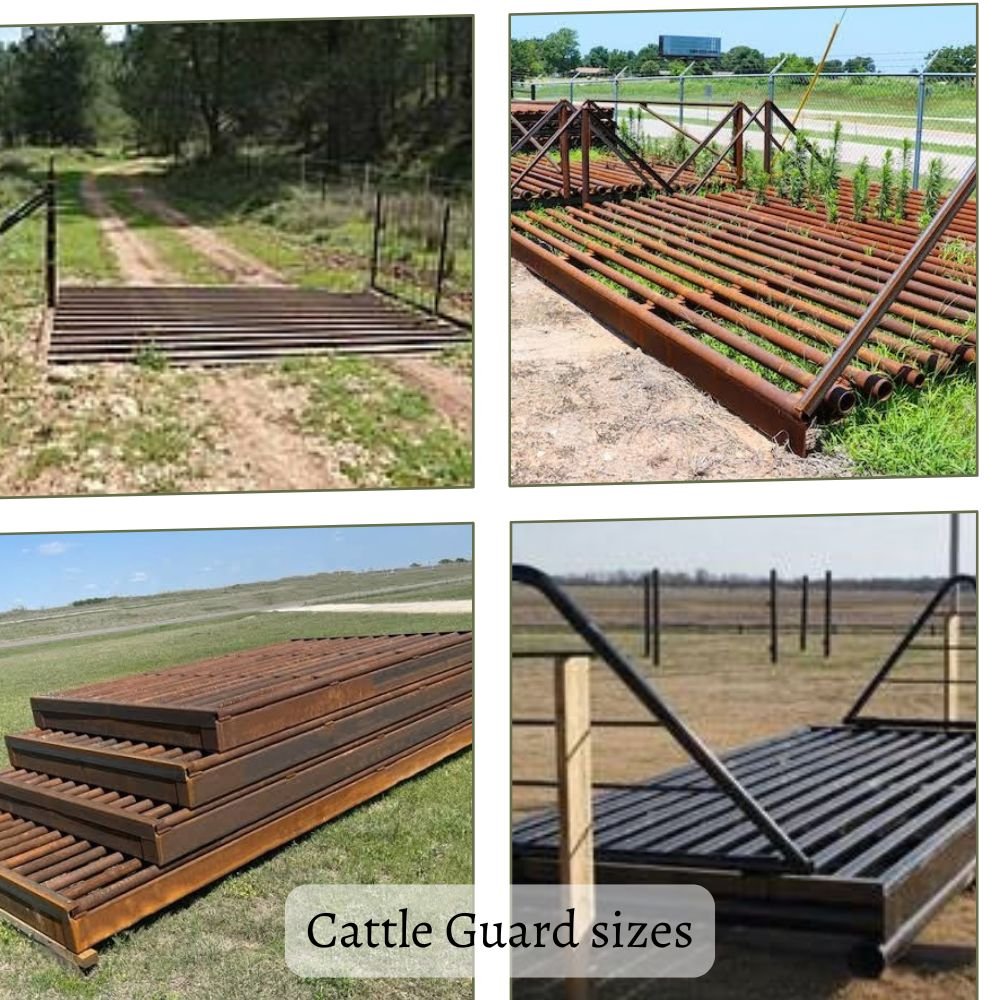
Boss Hawg builds cattle guards 7’5” wide and to custom lengths. Field surveys show a wide spread: guards in Kansas’s Flint Hills ranged from 7.75 to 30 feet long and 40 to 120 inches wide.
Two measurements define every guard, and people mix them up all the time:
- Length runs across the road, fence post to fence post. It should cover the full width of the roadway.
- Width runs in the direction of travel. It’s the distance an animal would have to cross, and the distance your tires roll over.
There’s no single standard size, and that’s the honest answer. Guards are built to the opening. For a reference point on heavy traffic, University Lands, which manages oil and gas leases on Texas university land, publishes detail drawings for 8 × 16 ft, 16 × 16 ft, 8 × 30 ft and 16 × 30 ft guards on its lease roads.
How Boss Hawg sizes a guard: every guard is 7’5” wide in the direction of travel, and we build the length to your opening. You measure, we build to it. There’s no stock size to fit around.
Photo suggestion: guard on the shop floor with a tape measure across the width.
Cattle guard load ratings: H-15, H-20 and HS-20
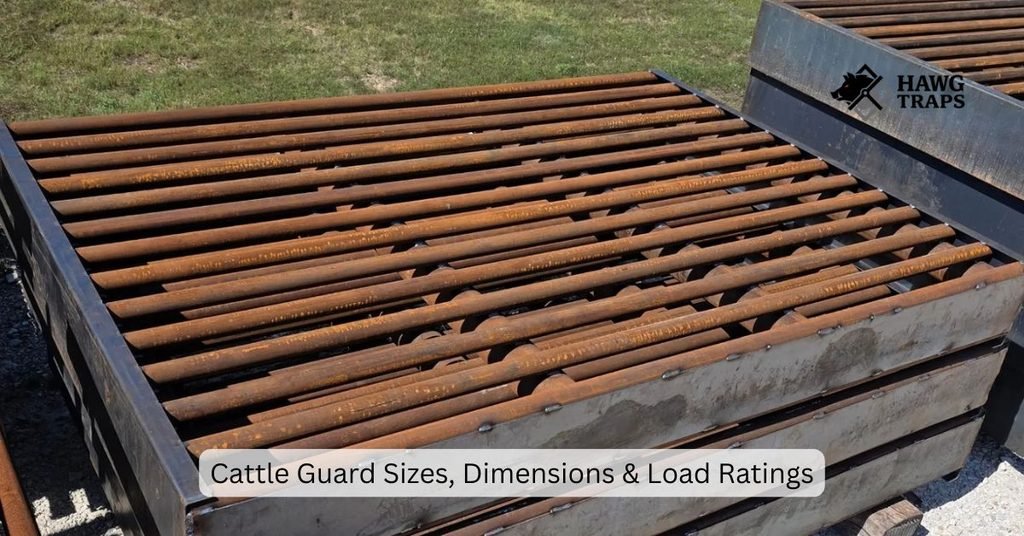
HS-20 is the AASHTO truck loading from 1944: a 32,000-pound axle and 16,000-pound wheel load. Retail H-20 guards are listed at 16 tons per axle, H-15 guards at 12 tons.
AASHTO is the American Association of State Highway and Transportation Officials. Its HS-20 design truck, often written HS-20-44 for the 1944 year, has three axles: 8,000 pounds on the front and 32,000 pounds on each of the next two. In everyday terms, that’s the loading for a fully loaded 18-wheeler.
| Class | Axle load | What it’s built for | Source |
|---|---|---|---|
| HS-20 | 32,000 lb (16,000 lb per wheel) | Moving highway truck traffic up to an 18-wheeler | AASHTO, via Locke Solutions |
| H-20 (as listed) | 16 tons | Retail listing class | Retailer listing, 27 Sep 2026 |
| H-15 (as listed) | 12 tons | Lighter retail class | Retailer listing, 27 Sep 2026 |
| U-54 / U-80 (as listed) | 25 / 30 tons | Heavier retail classes | Retailer listing, 27 Sep 2026 |
HS-20 is the highway truck standard: a 32,000-pound axle.
Where Boss Hawg guards stand: our guards don’t carry a third-party load rating, and we won’t put a label on a guard without one. What we can tell you is exactly how they’re built: 2 7/8” steel pipe rails on an 8” channel iron frame, MIG welded. Tell us the heaviest axle that will cross, and we’ll talk through the build for your road.
Rail pipe size and spacing
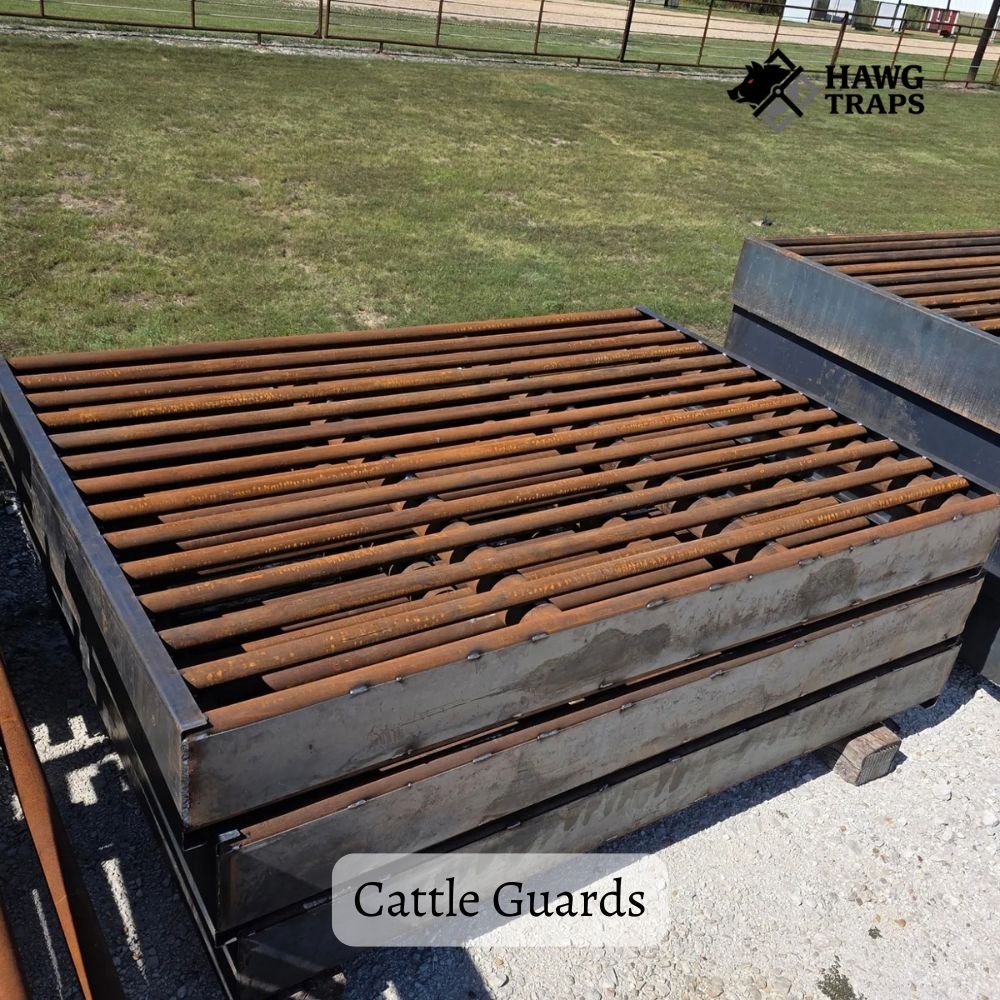
Boss Hawg rails are 2 7/8” steel pipe, with spacing set for each guard design. For truck and rig traffic, University Lands in Texas specifies 4-inch XX heavy wall pipe.
Two numbers matter on a rail: – Outside diameter. It sets how wide a surface each tire rolls across. – Wall thickness. It sets how much load the pipe carries before it dents. “XX” means double extra strong, a heavy-wall pipe grade.
Spacing is the gap between rails. On surveyed Flint Hills guards it ran from 1.75 to 8 inches. It has to be wide enough that cattle won’t step onto the rails. Spacing also affects how easily a horse’s hoof can slip between them. That’s covered on cattle guards and horses.
Pit depth and base dimensions
A Boss Hawg guard sits over a pit designed for the guard size and the installation. Guards surveyed in Kansas’s Flint Hills ranged from no pit at all to 98 inches deep.
- Pit depth: set by the installation design and your site.
- Base under each side: set by the guard design and the load it carries.
- Approaches: on its rig roads, University Lands specifies a caliche approach rising 2 feet from ordinary grade.
Base types are covered on cattle guard wings and bases. Guards that sit on the surface with no pit are covered on no-pit cattle guards.
How to choose the right size and rating
Three facts choose a cattle guard: the road’s usable width, the heaviest axle that will cross, and whether the site allows a pit. Match the rating to the heaviest axle, not the average vehicle.
- Measure the opening fence post to fence post. The guard’s length should cover the full roadway.
- Name the heaviest vehicle. A pickup and stock trailer is one thing. A cattle pot, a feed truck or a drilling rig is another. Plan for the heaviest one that will ever cross, even if it only comes twice a year.
- Check the ground. Rock or a high water table may call for a shallower pit or a no-pit guard.
- Check who owns the road. A county road guard has to match the county’s own plans. See cattle guard installation.
Building heavier than you need costs money you didn’t have to spend. Building lighter than you need is the expensive mistake. Prices by class are on cattle guard cost.
Send us your three facts and we’ll size the guard with you: request a quote or call (254) 725-4554.
Frequently asked questions
Is H-20 the same as HS-20? The terms are often used interchangeably, but there’s a slight difference in how the wheel loads are placed. One precast engineering supplier notes there is minimal, if any, cost saving from designing to H-20 instead of HS-20.
What is a standard cattle guard size? There isn’t one universal size. Guards are built to the opening. Surveyed guards ran 7.75 to 30 feet long and 40 to 120 inches wide. Boss Hawg builds 7’5” wide, to any length.
Can a cattle guard be longer than the road is wide? Yes. Boss Hawg builds custom lengths to fit your full opening.
How much does a 16-foot cattle guard weigh? It depends on the build. Call Boss Hawg at (254) 725-4554 for the weight of a specific size before you plan unloading.