
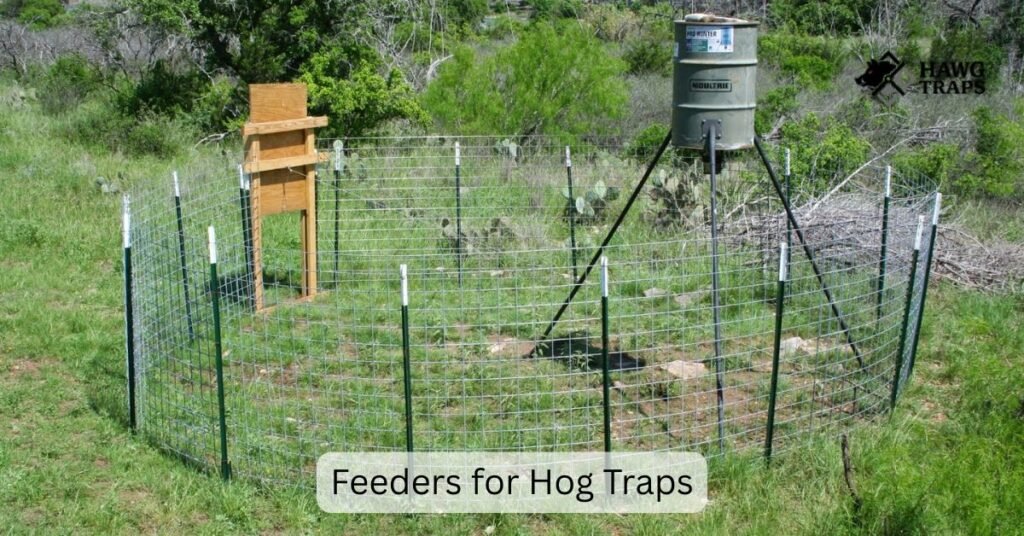
Pre-baiting a hog trap is a lot like feeding a teenager. They show up every night, they eat everything, and they never say thank you.
The difference is that the teenager comes to you. With hogs, you drive to the trap with a bucket of corn every evening for two weeks, and skip one night, and the sounder may go somewhere else.
Timer feeders for hog traps takes care of that for you. This page covers where to hang a feeder, when to set the timer, how much corn to throw, and five feeders and kits suited to hog traps.
We’re a steel shop. We build hog traps, cattle guards and H-posts, and we don’t make or sell feeders. Some links are affiliate links, and as an Amazon Associate we earn from qualifying purchases.
Key Takeaways
- Hang the feeder over the trap. Mississippi State Extension describes a spin-cast feeder “suspended over the trap during the prebaiting period.”
- Bait inside, not outside. Texas A&M AgriLife: “make the hogs enter the trap in order to get the bait.”
- Set the timer for evening. Feral hogs are “generally nocturnal.” Your trail camera will tell you their hour.
- Mississippi State’s pre-bait pile is about 1 to 2 gallons of shelled corn, with “a constant supply” after that. On one kit’s figure, a gallon is roughly 30 seconds of throw.
- Expect 1 to 2 weeks of pre-baiting before the whole sounder goes in.
- A feeder brings deer and raccoons too. Soured corn, hand-placed, helps keep deer off.
- Bait laws vary by state. Check yours first.
Why Trust Us: How We Picked These Feeders
Boss Hawg is a steel shop in Cross Plains, Texas. We build the corral and pen traps these feeders hang over. The shop started by trapping hogs off its own land, and our team talks with the ranchers who trap on theirs.
We have not tested these feeders. The settings on this page come from Mississippi State and Texas A&M extension guides, and the feeders from listings and public reviews we read on 12 and 13 October 2026.
How a feeder made this page: it dispenses feed on a timer, can be hung over a trap or placed beside one, and is available from a farm or sporting goods store. None of them is sold for hogs. They’re deer feeders put to better use.
We don’t score these feeders, because two have no readable reviews. Each pick shows its pros, cons, worst review and the trap it suits. We sell no feeder, and our editorial policy and affiliate disclosure explains how we handle those links.
Why use a feeder at a hog trap?
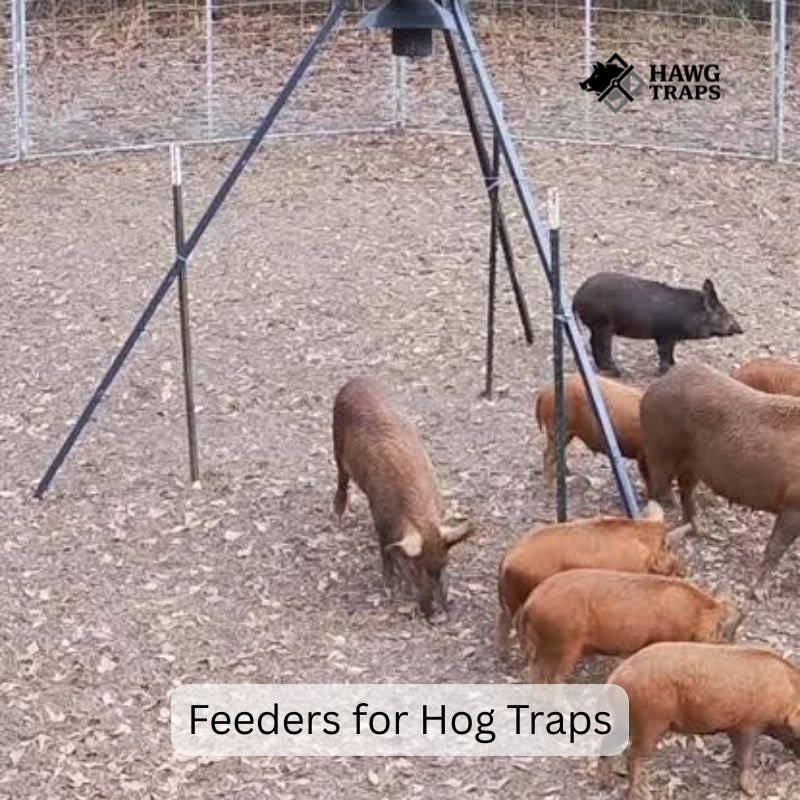
A timer feeder keeps bait at the trap every day without a trip. Mississippi State Extension says a spin-cast feeder “suspended over the trap during the prebaiting period will reduce the amount of time and effort needed.”
Pre-baiting is the slow part of trapping. Mississippi State says “Usually, 1 to 2 weeks of prebaiting is necessary before the entire sounder will enter the trap.” Texas A&M AgriLife calls pre-baiting “critical” for every kind of trap.
Mississippi State also says to keep “a constant supply of bait in and around the trap.” That means keeping corn available every day for up to two weeks. A feeder spreads it on schedule, at the same time every evening. Mississippi State adds that it cuts human disturbance at the trap site.
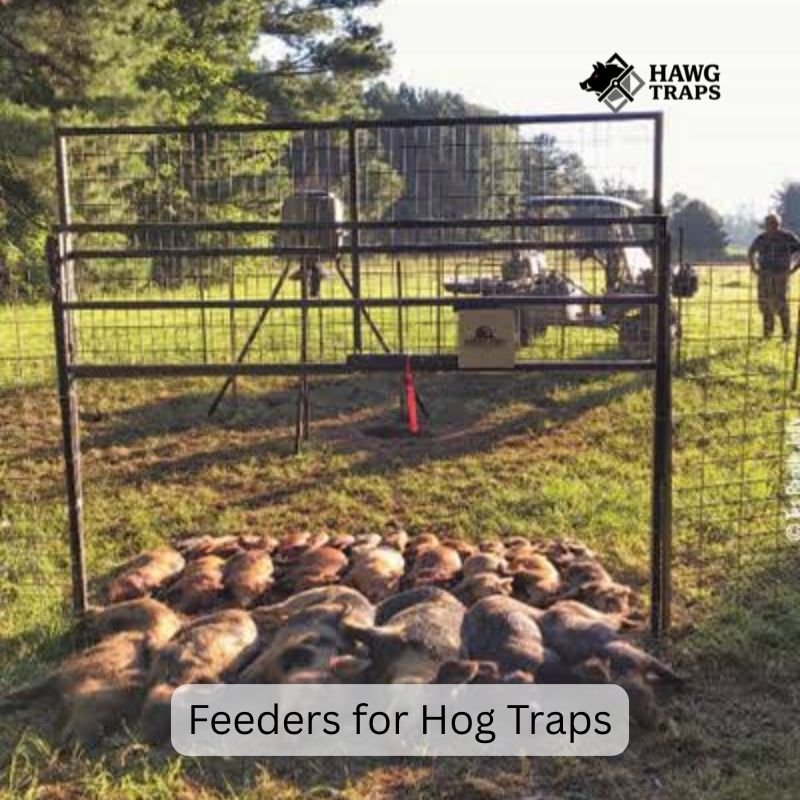
A feeder doesn’t replace the rest of the job: the gate, the trigger and the timing. Our guide on how to trap hogs is coming; the feeder is one tool inside it.
Where to put the feeder: over the trap, not beside it
Hang the feeder over the trap, so the corn lands inside. Texas A&M AgriLife says to “make the hogs enter the trap in order to get the bait.” Once the trap is set, keep bait off the trip wire.
AgriLife’s corral trap guide is blunt: “Minimize baiting outside the trap.” Corn scattered outside teaches hogs to eat without going in. So:
- Hanging feeder or bucket: from a frame, a limb or a pole over the middle of the pen. This is the setup Mississippi State describes.
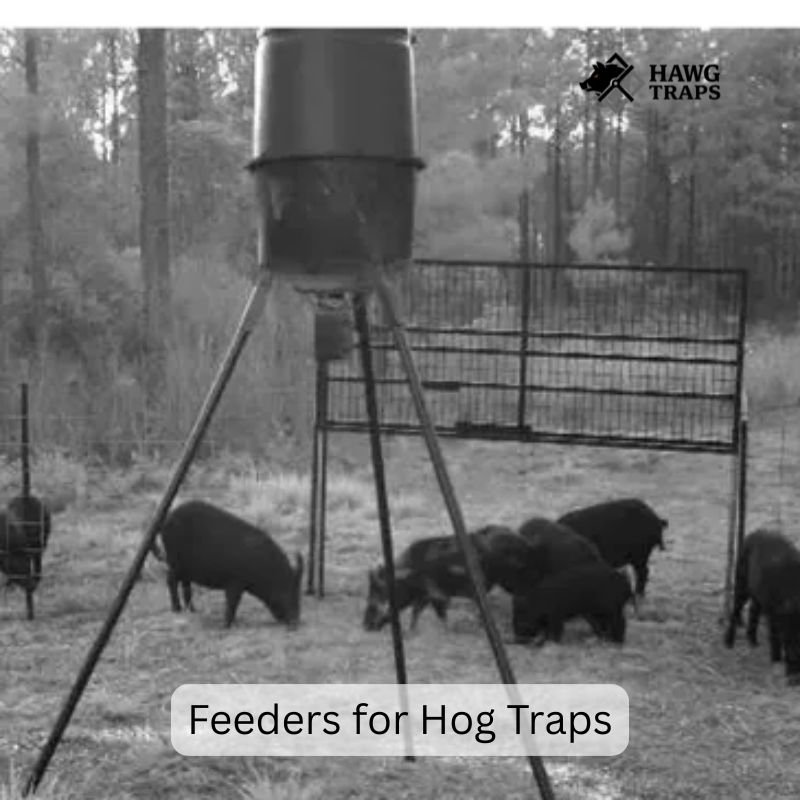
- Tripod feeder: If you can’t hang one, place it beside the trap with the spinner aimed inward, so most of the feed lands inside the panels. Some will land outside. Keep that to a little.
- At first: AgriLife’s guidance is bait near the gate and inside the trap while hogs get used to it.
- When you set the trap: AgriLife says to “place bait all the way back to the trigger,” and “Do not scatter bait directly along the trip wire.” A hog eating at the wire springs the gate before the sounder is in.
Two safety notes. Fill the feeder before you set the gate, never under a raised gate. And hang it where a falling gate or a climbing hog can’t hit it.
When to set the timer?
Set the feeder to throw late in the day. Feral hogs are “generally nocturnal,” a Texas A&M review says, and can shift to dawn and dusk where they aren’t pressured. Your trail camera will show your hogs’ hours.
The same review notes that “Cold snaps and intense heat caused a sudden reduction in overall wild pig activity.” So the hour your hogs come in shifts with the season.
Here’s the schedule we recommend. It’s our judgment, not a rule:
- Start with one throw at dusk. Fresh corn, right before they move.
- Watch the camera for a week. Note when they actually arrive.
- Move the throw to just before that. Corn sitting all day feeds deer, birds and raccoons.
- Add a second throw only if the first is gone before the hogs come.
The timers here allow 4 to 24 feed times a day. At a trap you’ll use one or two.
A camera that sends pictures to your phone makes this easy. Our page on cellular trail cameras for hog traps covers which ones suit a pen.
How much corn to throw, and how long a hopper lasts?
Throw what the sounder eats in a night, and no more. Mississippi State’s starting pile is about 1 to 2 gallons of shelled corn. According to one kit’s published figures, a 4-second throw dispenses about 0.8 pound. By our arithmetic, throwing 1 to 2 gallons would take roughly 30 to 60 seconds.
Shelled corn weighs about 6 pounds a gallon, by our arithmetic (a 56-pound bushel fills about 9.3 gallons). Here’s what that means at the feeder:
| If you throw a day | Weight | Throw time at 0.8 lb per 4 s | Days in a 30-gal hopper (about 180 lb) |
|---|---|---|---|
| 1 gallon | about 6 lb | about 30 seconds | about 30 days |
| 2 gallons | about 12 lb | about 60 seconds | about 15 days |
| Trap set: ½ to 1 gallon at the trigger | 3 to 6 lb | 15 to 30 seconds | — |
Our arithmetic. Throw rates vary by feeder and spinner speed: run yours into a bucket for 10 seconds and weigh it.
Keep two things in mind when using these estimates. The throw rate comes from one kit; a faster spinner or larger feed opening may dispense more corn. And Mississippi State’s 1 to 2 gallons is a starting pile placed by hand, not a daily ration. Watch the camera: if the corn is gone every morning and the sounder is growing, throw more; if corn is left over, throw less.
When the trap is set, Mississippi State changes the amount: “Place only a small amount (1/2 to 1 gallon) of bait around the trigger mechanism.” Turn the feeder down or off then, and bait the trigger by hand.
Feeders for hog traps, compared
Five feeders and timer kits that suit a hog trap were listed from $49.99 to $199.99 in October 2026. A timer kit on a bucket you hang over the trap is the cheapest way in; a tripod stands beside it.
| Feeder | How it mounts | Feeds a day | Power | Price, Oct 2026 | Public rating |
|---|---|---|---|---|---|
| Moultrie All-in-One Timer Kit | Bolts under a bucket or drum | Up to 4 | 4 AA, solar port | $49.99 | 4.4 of 5 (219) |
| American Hunter Heavy-Duty Spin Kit | Under most feed containers | Up to 8 | 6 V or 12 V, extra | $129.99 | 4.7 of 5 (286) |
| American Hunter 50 lb Hanging Feeder | Hangs | Up to 24 | 6 V, extra | Not shown | None shown |
| Moultrie 30 gal Standard Feeder | Tripod, 5.5 ft | Up to 4 | Solar port | $119.99 | 4.3 of 5 (560) |
| Moultrie 250 lb Feeder Pro III | Tripod, 6 ft | Up to 10 | 6 V, extra; solar | $199.99 | 3.7 of 5 (27) |
The two timer kits are the trap-friendly buys: they turn a bucket into a feeder that hangs over the pen.
Feeder reviews: pros, cons and the trap each suits
Moultrie All-in-One Timer Kit: best budget build
A roughly $50 timer kit that converts a bucket into a feeder you can hang over a hog trap.
- Pros: fits “any homemade or existing feeder set-up with a flat mounting surface.” 4.4 stars from 219 reviews, 97% recommend. Solar port. One owner: “Very easy to set up and use with just about any drum or bucket.” $49.99 at Tractor Supply.
- Cons: plastic housing. Four feeds a day at most. The listing contradicts itself on whether batteries are included.
- Worst review we found: “I’ve had 2 of these both water logged after 4 months.”
- Best for: a bucket hung over a corral trap setup.
American Hunter Heavy-Duty Spin Kit: best tough kit
A timer kit with a metal housing and industrial motor, designed for a feeder that stays outdoors year-round.
- Pros: heavy-duty metal housing. 1 to 8 feeds a day and day-of-week settings. Three spinner speeds. 4.7 stars from 286 reviews, 95% recommend. $129.99 at Tractor Supply.
- Cons: battery sold separately. Two and a half times the Moultrie kit’s price.
- Worst review we found: none we could read; the reviews shown on the page were for other products.
- Best for: a drum or barrel feeder you’ll run on traps for years.
American Hunter 50 lb Hanging Feeder: best ready-made hanger
A metal hopper and timer in one, built to hang.
- Pros: metal hopper. Built-in varmint guard. 1 to 24 feeds a day, 1 to 30 seconds each. One-year warranty. Sold at Academy.
- Cons: no price or reviews on the page we read. A 6-volt battery is not included. Fifty pounds is about a week at 1 gallon a day, by our arithmetic.
- Worst review we found: we found none.
- Best for: hanging over a pen when you don’t want to build one.
Moultrie 30 gal Standard Feeder: best tripod
The biggest review record here, on legs, for a trap you can’t hang over.
- Pros: 4.3 stars from 560 reviews, 88% recommend. A 30-gallon hopper lasts weeks at trap rates. Metal spin plate. Solar port. $119.99 at Tractor Supply.
- Cons: it stands beside the trap, so some corn lands outside. One buyer: “Worked great with small pellet feed for about 4 months. Then the motor died.”
- Worst review we found: “Don’t let the pictures lie to you.” The buyer said the feet and batteries in the photos weren’t included.
- Best for: a box trap or small pen with nothing to hang a feeder from.
Moultrie 250 lb Feeder Pro III: best for control from your phone
A big tripod feeder you can set by Bluetooth, and by phone when paired with a Moultrie cellular camera.
- Pros: up to 10 feeds a day, 1 to 60 seconds. The Moultrie app sets it by Bluetooth with no subscription, and remotely when paired with an EDGE 3 camera. 250 pounds is three to six weeks at trap rates, by our arithmetic. $199.99 at Tractor Supply.
- Cons: 3.7 stars from 27 reviews. Plastic hopper. Battery sold separately.
- Worst review we found: “the squirrels and coons destroyed both my feeders.”
- Best for: a cellular trap you watch from home. Our page on cellular hog traps covers the gate side.
How to make a hog trap feeder from a bucket?
A trap feeder can be a 5-gallon bucket with a timer kit bolted to the bottom, hung from a frame or limb over the trap. The kit throws the corn; the bucket holds about 30 pounds, by our arithmetic.
This is the cheapest feeder you can hang over a pen. A timer kit’s listing says it fits any setup “with a flat mounting surface,” and owners mount them on buckets and drums. Follow the kit’s instructions. The order goes like this:
- Pick a bucket with a lid. A lid keeps rain out of the corn and the kit.
- Cut the feed hole in the bottom to match the kit’s funnel.
- Bolt the kit on underneath.
- Hang it from a frame, pole or strong limb over the middle of the pen, high enough that hogs can’t reach it standing up.
- Set the timer for a short throw at dusk, then calibrate: run it into a bucket and weigh what comes out.
- Load dry, shelled corn. A spinner throws dry feed. Soured corn goes in by hand.
A bucket holds about 30 pounds of corn, so at 1 gallon a day you refill it about every five days. For longer runs, use a drum or barrel and the heavier kit.
Which feeder for your trap?
For a corral trap you can hang over, a timer kit on a bucket or a metal hanging feeder. For a trap you can’t hang over, a tripod beside it, aimed in. For remote control, choose a feeder that pairs with a compatible cellular camera.
Quick picks:
- Cheapest that works: Moultrie All-in-One Timer Kit on a 5-gallon bucket.
- Built to last outdoors: American Hunter Heavy-Duty Spin Kit on a drum.
- Ready to hang: American Hunter 50 lb Hanging Feeder.
- Nothing to hang from: Moultrie 30 gal tripod, aimed into the trap.
- Run it from home: Moultrie 250 lb Pro III with a Moultrie EDGE 3 camera.
A feeder fills the pen. The pen has to hold what comes in. We build corral traps in heavy steel: the Big Pen hog trap, sized to your sounder, and the Pro Pen hog trap, welded panels with panel gates. Our steel is 1½-inch, 14-gauge square tubing with 6-gauge wire. For the full range, see our best hog traps page.
REQUEST A QUOTE: CALL (254) 725-4554
Tell us how many hogs your camera shows under the feeder. We’ll tell you what pen holds them, and what it costs delivered.
Also check our partner products for pre-baiting a hog trap: – Feeder timer kits and heavy-duty spin feeder kits – Hanging game feeders and tripod game feeders – 6-volt feeder batteries and feeder solar chargers – Feeder varmint guards and 5-gallon buckets with lids
As an Amazon Associate we earn from qualifying purchases. Partner products are listed separately from our own and never replace them.
For the rest of your kit, see our page of ranch tools and trapping gear.
Bait, deer and the rules
Corn brings deer as well as hogs. AgriLife says souring corn in water “will help avoid attracting nontarget animals, such as deer.” Mississippi State says bait laws vary by state: check yours before you pre-bait.
Bait. Shelled corn is the standard in both extension guides. AgriLife describes souring it: “Soaking the corn in water for 1 week will cause it to sour.” Soured corn is wet, so it goes in by hand, not through a spinner. Recipes and mixes belong in our hog bait guide, which is coming.
Deer and other visitors. AgriLife warns that with corn, “nontarget animals such as deer may be captured.” Raccoons and squirrels go for the feeder itself; one owner’s plastic feeders were destroyed by them. A metal hopper or a varmint guard helps. A short evening throw leaves less corn lying around for daytime visitors.
The rules. Mississippi State: “Game laws regarding the use of bait vary between states.” In Texas, Texas A&M’s Natural Resources Institute says “Feral pigs are considered exotic livestock.” Rules elsewhere differ, and baiting may be restricted where you are, so check with your state wildlife agency before you hang a feeder. This is not legal advice.
Frequently asked questions
What is the best feeder for a hog trap?
A spin feeder you can hang over the trap. A timer kit on a bucket is the cheapest; the Moultrie All-in-One kit holds 4.4 stars from 219 reviews at $49.99. Where you can’t hang one, use a tripod aimed into the trap.
How do you make a hog feeder?
Bolt a feeder timer kit under a 5-gallon bucket with a lid, hang it over the trap from a frame or limb, and set a short throw at dusk. Calibrate by weighing what one throw puts out.
What is the best bait for a hog trap?
Shelled corn, in both extension guides we read. AgriLife says soured corn helps keep deer away. Mississippi State starts with a pile of about 1 to 2 gallons inside the entrance, then ½ to 1 gallon at the trigger when you set the trap.
What time of day do wild hogs come out?
Mostly at night. A Texas A&M review calls feral swine “generally nocturnal,” with dawn and dusk activity where they aren’t pressured. Extreme heat and cold may cut their activity.
How long should I pre-bait before setting a hog trap?
Usually 1 to 2 weeks, Mississippi State says, and until the whole sounder is going in. Some hogs take longer.
Will a feeder at a hog trap attract deer?
Yes, corn attracts deer. AgriLife says souring corn helps avoid them. Throw feed late in the day, just before the hogs come. Deers usually come in the daytime.
What deer feed will hogs not eat?
We found no source naming a feed hogs reliably refuse. Deer hunters who want hogs off a feeder fence or use a feeder hog can’t reach, which is the opposite of what a trapper wants.
Can I control a trap feeder from my phone?
Some feeders, yes you can. Moultrie’s Pro III sets by Bluetooth through the Moultrie app, and by cellular when paired with a Moultrie EDGE 3 camera.
Before you fill it
Think back to that teenager. Feed them on time, every time, and they’ll show up.
Hogs are the same. Hang the feeder over the pen, throw a little corn at dusk, watch the camera, and wait for the whole sounder.
When your trail-camera photos show more hogs than your trap can hold, give us a call about a larger pen.