
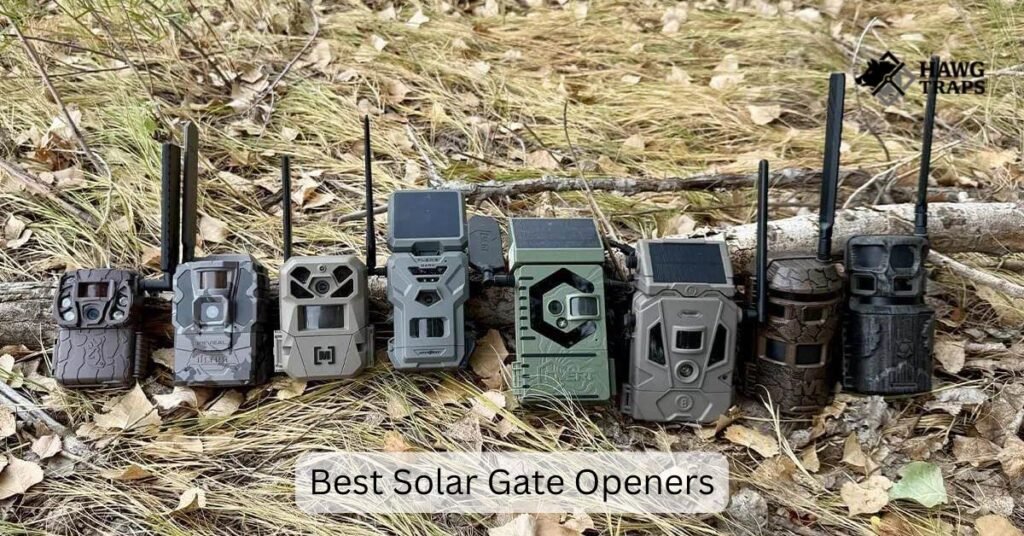
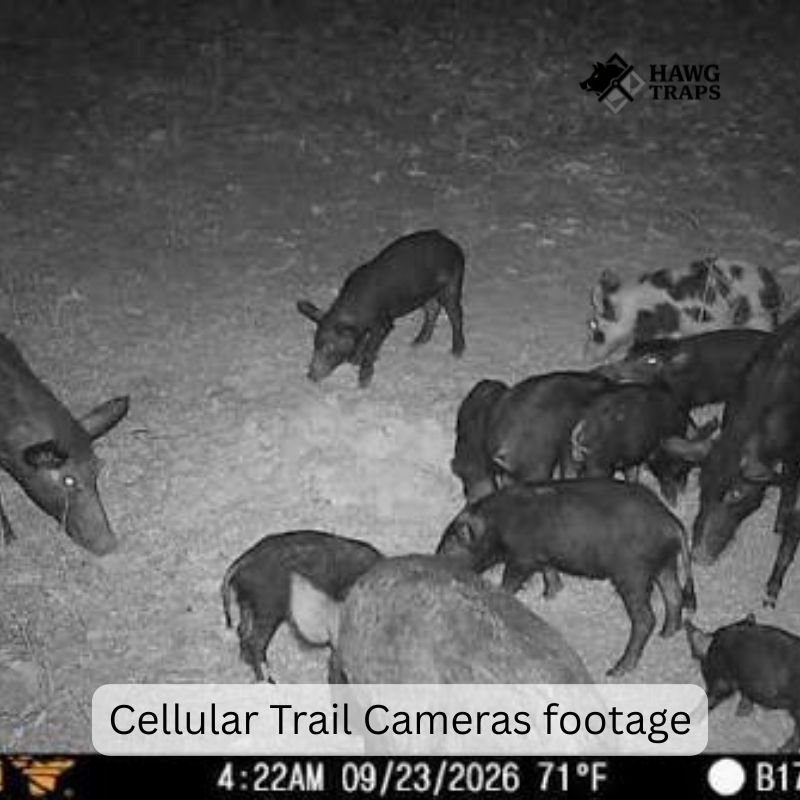
Nine hogs came to the pen last night. You know because the camera told you, at 2:14 a.m., with a grainy picture of nine black backs and one big sow standing just outside the gate.
That sow is why you need a camera. Close the gate on nine, and she’ll learn to avoid the trap. Wait until the entire group is inside, and you can catch them together. This is particularly important because a hog that escaped, may be very hard to catch afterwards.
A cellular trail camera for hog traps lets you count hogs from the kitchen table instead of estimating their numbers from tracks. This page shows what a camera has to do at a trap, where to put it, what the data plan really costs, and how six cameras score for the job.
We’re a steel shop. We build hog traps, cattle guards and H-posts, and we don’t make or sell cameras. Some links are affiliate links, and as an Amazon Associate we earn from qualifying purchases.
Key Takeaways
- At a hog trap, the camera’s main job is to count the hogs and show when they enter. Texas A&M AgriLife says a game camera shows “the number of hogs entering the trap” and “the best time to set the trap.”
- Live view matters most when you need to decide when to close the gate remotely. For a trip-wire trap, photos or on-demand shots do the job.
- Mount it far enough back to see the whole pen. By our arithmetic, a 50-degree camera has to sit about 26 feet back to see across a 24-foot corral.
- Plans run from free to about $20 a month. On Bushnell’s own figures, 250 MB holds about 2,500 standard photos or 112 minutes of live video.
- Our top score: Bushnell CelluCORE Live, 7.8 out of 10, for live view, dual SIM and a 100-foot no-glow night range.
- The rules being written are about hunting game. Texas treats feral pigs as exotic livestock. Check your own state.
Why Trust Us: How We Rate These Cameras
Boss Hawg is a steel shop in Cross Plains, Texas. We build the pens and corral traps these cameras watch. The shop started by trapping hogs off its own land, and our team talks with the people who trap on theirs.
We have not field-tested these cameras, and we won’t pretend we did. Every camera gets Our Rating, a score out of 10 from one method, applied the same way to all six. We read each listing, features and the public reviews on 12 and 13 October 2026.
| What we score | Weight | What earns points |
|---|---|---|
| Live look | 30% | Live video any time scores 10. Short live sessions score 9. On-demand photos and video score 7. Photos only when motion triggers score 4 |
| Night view | 20% | No-glow with a listed 100-foot night range scores highest. A night range under 40 feet scores lowest |
| Running cost | 20% | A free plan scores highest. No published plan price scores lowest |
| Signal and power | 15% | Dual SIM or multi-carrier scores highest. A muddled carrier list scores lowest |
| Public reviews | 15% | 4.4 stars or more from 300 or more reviews scores highest. No reviews scores lowest |
Price isn’t in the score. We print it beside the score so you can weigh it. We sell no camera, and our editorial policy and affiliate disclosure explains how we handle links.
What a cellular trail camera does at a hog trap?
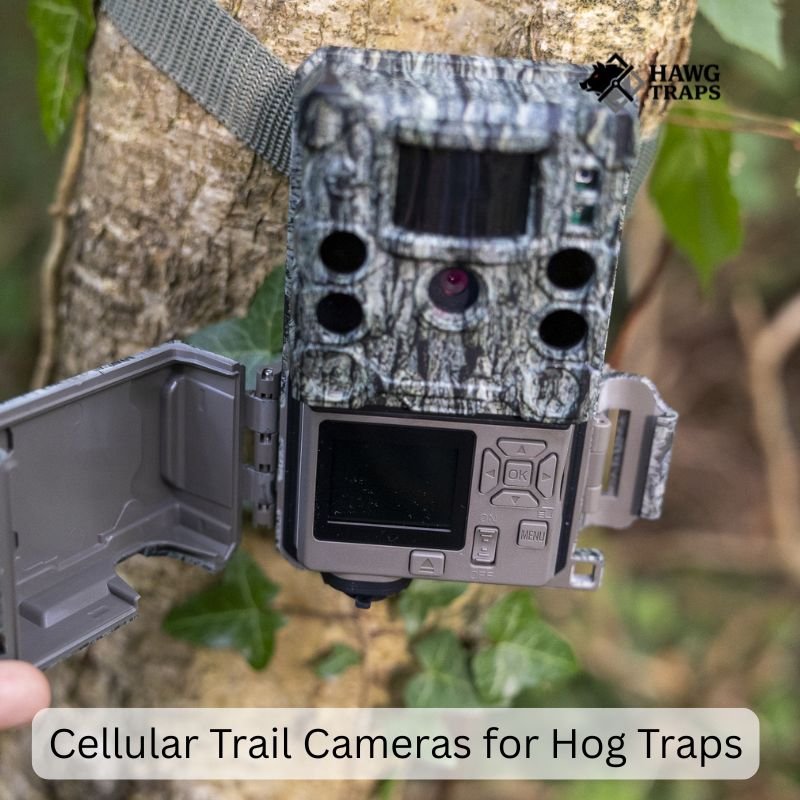
At a hog trap, a cellular trail camera tells you how many hogs are coming and when they’re all inside. Texas A&M AgriLife says a game camera shows “the number of hogs entering the trap” and “the best time to set the trap.”
It’s a motion-triggered camera with a SIM card. Something walks past, it takes a photo or video, and it sends that to your phone over the cell network. Biologists call the same device a camera trap. You might have seen it in the animal documentaries.
At a trap, that does three jobs:
- Tells you hogs found the bait. AgriLife’s guide says to put the gate on “only after the hogs respond to pre-baiting.”
- Counts the sounder. Night after night, you learn whether it’s six hogs or sixteen. The same guide says to keep pre-baiting until “the entire sounder (group) is comfortable entering the trap.”
- Saves you the drive. You stop checking an empty pen every morning.
How to set and bait the trap itself is its own subject; our guide on how to trap hogs is coming.
Photos, on-demand or live view: what a trap needs
If you close the gate yourself by phone, buy live view. If a trip wire closes it, photos or on-demand shots are enough: you need the count over several nights, not the second the last hog walks in.
| Mode | What you get | Data use | Best for |
|---|---|---|---|
| Photos on trigger | A photo each time motion sets it off | Lowest | Counting hogs before a trip-wire set |
| On-demand | Photos as above, plus a fresh photo or clip when you ask | Low to medium | Checking the pen when an alert looks promising |
| Live view | Video from the trap as it happens | Highest | Closing a gate by phone |
Live view is for closing a gate by phone; photos are for counting.
A cellular gate trigger changes everything. Once you can drop the gate from your phone, a photo that arrives late is a photo of an empty pen. Our page on cellular hog traps covers the triggers, the gates and the kits.
How late is late? On one hunting forum, a trapper using a live-stream trail camera reported a “3-5 second delay.” One Bushnell buyer wrote, “Great notification time! Less than 30 seconds in deep woods valley.” For counting, seconds don’t matter. For dropping a gate, they usually do.
One trap maker, Pig Brig, said as much in its 2022 camera round-up: “For cellular-based cameras, we’d recommend the Tactacam Reveal X — but only if you don’t need live video.”
Where to put the camera: distance, angle and night range?
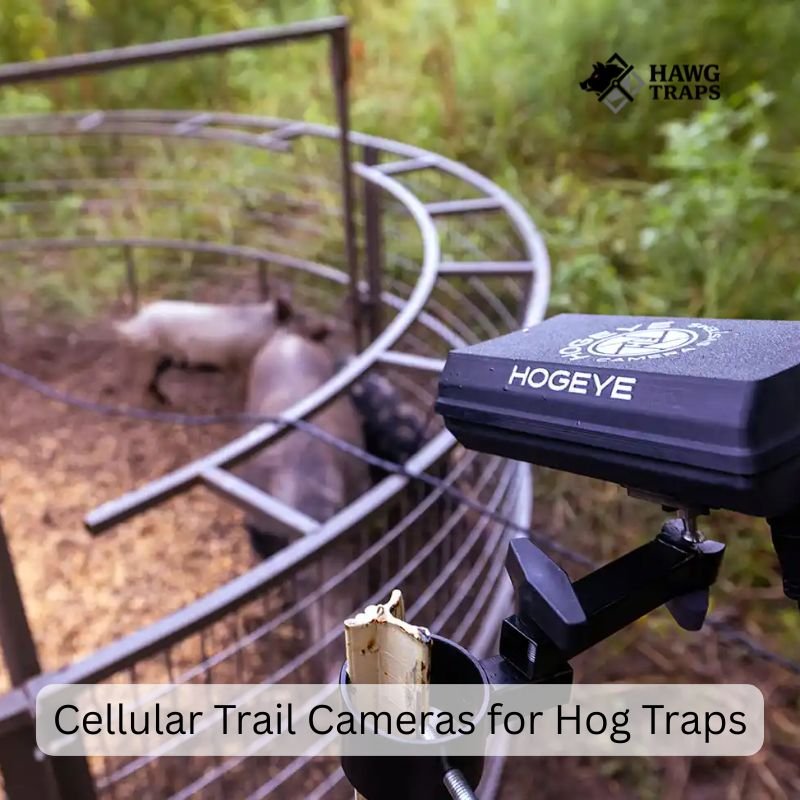
Mount the camera far enough back that its field of view spans the whole pen, but inside its night range. By our arithmetic, a 50-degree camera must sit about 26 feet back to see across a 24-foot corral.
Field of view is how wide the camera sees. It is measured in degrees. A camera with a narrower field of view must be mounted farther back to capture the whole pen. Here’s the arithmetic for two lenses we found published:
| Pen width | 50° camera (Spypoint Flex Dark) | 90° camera (Reolink Go PT Ultra) |
|---|---|---|
| 16 ft | about 17 ft back | about 8 ft back |
| 24 ft | about 26 ft back | about 12 ft back |
| 32 ft | about 34 ft back | about 16 ft back |
Narrow cameras sit far back; check the night range. Our arithmetic: width seen = 2 × distance × tan(half the angle).
Now check the night range. Bushnell and Moultrie list 100 feet at night, so a 34-foot setback is easy. Reolink lists infrared to 33 feet, so its wide lens has to do the work by sitting close. A pan-and-tilt camera can also be turned remotely to look at the gate.
Corral traps can span several dozen feet, so camera placement matters even more on larger pens. JAGER PRO’s system runs 20 to 32 feet across. Measure yours, then work back from the table.
A few more placement points, all from common sense rather than rules:
- Aim at the gate as well as the bait. The gate is where you count the last hog in.
- Keep the sun behind the camera if you can, so morning and evening shots aren’t washed out due to direct light exposure.
- Clear the grass and branches in front of it. One Spypoint buyer complained of “far too many false triggers from heat, sunlight, or vegetation.”
- Check the bars where the camera will sit, not at the truck.
What it costs to run: plans, data and power?
Monthly cellular camera plans range from free for limited photo uploads to about $20 for larger data allowances. By Bushnell’s own data figures, a 250 MB plan covers about 2,500 standard photos or about 112 minutes of live video.
Here’s what the plans we read looked like in October 2026:
- Spypoint: 100 free photos a month per camera, with paid upgrades.
- Tactacam: $5 a month for 250 photos up to $13 for unlimited, by a dealer’s list from March 2025.
- Moultrie: plans from $9.99 a month per camera.
- Bushnell CelluCORE Live: $9.99 for 250 MB, $14.99 for 500 MB, $19.99 for 1 GB, first 30 days free.
Bushnell’s listing at Scheels is the only one we read that gives data sizes. That lets us do the sums:
| What you send | Size (Bushnell’s figures) | How many fit in 250 MB |
|---|---|---|
| Standard photo | 0.1 MB | about 2,500 |
| HD photo | 1.69 MB | about 147 |
| 20-second video | 11.9 MB | about 21 |
| One minute of live view | 2.23 MB | about 112 minutes |
Photos are cheap; HD and live minutes are not. Our arithmetic from Bushnell’s listed sizes.
A busy trap can stay on a low-cost plan if photo uploads provide enough information to monitor the hogs. Live view is another matter. By our arithmetic, two minutes of live view a night for a month is about 134 MB, inside 250 MB. Ten minutes a night is about 669 MB, which needs the 1 GB plan.
Power is the other running cost. Bushnell’s camera takes 12 AA batteries, not included, and one owner said battery life ran out “after 200 pictures.” One Tractor Supply answer says Moultrie’s Edge 2 Pro drains batteries faster than the original Edge. Reolink’s camera has a rechargeable battery and an optional 6-watt solar panel. An optional solar panel can reduce battery changes and the trips required to maintain a busy trap camera.
The best cellular trail cameras for hog traps, compared
Six cellular cameras suited to watching a hog trap ran from $59.99 on sale to $1,299 in October 2026. On our scoring, Bushnell’s CelluCORE Live scored highest, 7.8 out of 10, for its live view, dual SIM and no-glow night range.
| Camera | Live look | Night | Plan from | Price, Oct 2026 | Public rating | Our Rating |
|---|---|---|---|---|---|---|
| Bushnell CelluCORE Live | Live, up to 2 min | No-glow, 100 ft | $9.99/mo | $169.95 to $299.99 | 4.6 of 5 (27) | 7.8 |
| Moultrie Edge 2 Pro | On-demand | 100 ft | $9.99/mo | $59.99 sale ($119.99) | 4.4 of 5 (597) | 7.4 |
| Tactacam Reveal X 3.0 | On-demand | Low-glow | $5/mo (Mar 2025) | $99.99 | 4.5 of 5 (67) | 6.9 |
| HogEye Mini | Live, plus gate trigger | Night vision | Not listed | $1,299 | None read | 6.9 |
| Spypoint Flex Dark | Photos | No-glow | Free, 100 photos | $119.99 | 4.6 of 5 (54) | 6.8 |
| Reolink Go PT Ultra | Live, any time | IR 33 ft | Prepaid SIM | Not listed | None read | 6.0 |
The top two are 0.4 apart; live view costs more in data, not always in dollars.
Why does HogEye, designed specifically for traps, rank in the middle? Because our scoring method rates the camera’s features rather than the value of the complete trapping system. HogEye’s gate trigger and hog-counting filter are real advantages. Its unpublished plan price and lack of public reviews pull it down, and the camera price isn’t scored at all. If you want one box that watches and closes the trap, read its card first.
Camera reviews: pros, cons and our rating
Bushnell CelluCORE Live: best for closing a gate by phone
Our Rating: 7.8 / 10 (live 9 · night 9 · cost 6 · signal 9 · reviews 5)
A trail camera with live view, two SIMs and a 100-foot no-glow night range.
- Pros: one-button live video “up to 2 minutes.” Dual SIM picks the stronger of AT&T or Verizon. No-glow IR to 100 feet. Its Scheels listing gives the data each photo and live minute uses. $169.95 at Bushnell; $299.99 at Scheels.
- Cons: 12 AA batteries, not included, and one owner said they ran down “after 200 pictures.” Live view is in two-minute bites. Only 27 reviews at Scheels.
- Worst review we found: “first one I got didn’t work … now the new one is not working properly.”
Moultrie Edge 2 Pro: best for counting the sounder
Our Rating: 7.4 / 10 (live 7 · night 7 · cost 6 · signal 9 · reviews 9)
The biggest review record here, on-demand photos and video, and the lowest price, while the sale lasts.
- Pros: 597 reviews at 4.4. A 0.3-second trigger. 100-foot detection and flash range. Multi-carrier, and no SD card needed. On Demand photo or video from the app. $59.99 on sale (regular $119.99) at Tractor Supply.
- Cons: no true live view. Plans from $9.99 a month. Flash type isn’t listed, and a buyer says it glows.
- Worst review we found: “Moultrie advertises these as”No Glow” but they do in fact light up red in the dark when they take a photo.”
Tactacam Reveal X 3.0: best on a cheap plan
Our Rating: 6.9 / 10 (live 7 · night 6 · cost 8 · signal 6 · reviews 7)
The camera a trap maker picked for monitoring “only if you don’t need live video,” with the cheapest paid plan we found.
- Pros: on-demand HD photos and video. 8 GB built in, so no SD card needed. Plans from $5 a month, by a March 2025 dealer list. $99.99 at Tractor Supply.
- Cons: low-glow flash, not no-glow. Verizon and AT&T only. One owner: “The motion sensor has a delay which I cannot get out.”
- The worst review we found: “The battery compartment was full of water, the terminals rusted.”
HogEye Mini: best complete trap camera system
Our Rating: 6.9 / 10 (live 10 · night 7 · cost 4 · signal 8 · reviews 3)
Built for hog traps: live video, a gate trigger and a filter that only alerts you for hogs.
- Pros: live video, and HogEye says “Trigger your trap from anywhere.” Its AI filter can wait for 1, 3 or 5 or more hogs; HogEye says “In field testing, 50 notifications dropped to 3.” Solar. A 3-year replacement warranty. A Starlink version for places with no cell signal. From HogEye.
- Cons: $1,299, or $2,999 for Starlink, when we checked in early October. No plan price on the site, though it says “no contracts, no fees.” No public reviews we could read.
- Worst review we found: none on the maker’s page.
Spypoint Flex Dark: best with no monthly bill
Our Rating: 6.8 / 10 (live 4 · night 7 · cost 9 · signal 9 · reviews 7)
A no-glow dual-SIM camera that sends 100 photos a month for free.
- Pros: 100 free photos a month per camera. Dual SIM, “all major carriers.” No-glow and low-glow LEDs. 94% of 49 reviewers recommend it. $119.99 at Tractor Supply.
- Cons: a narrow 50-degree view, so it sits far back. One reviewer titled his review “No on demand photos.” 100 photos go fast at a busy trap.
- Worst review we found: “The FLEX-DARK takes average photos at best and produces far too many false triggers from heat, sunlight, or vegetation.”
Reolink Go PT Ultra: best for watching live from far away
Our Rating: 6.0 / 10 (live 10 · night 5 · cost 4 · signal 5 · reviews 3)
A 4G security camera that pans and tilts. A cellular trap maker sells the earlier model for traps.
- Pros: live view any time. Pans 355 degrees and tilts 140. A 90-degree lens. Rechargeable battery with an optional 6-watt solar panel. Hogg Boss sells the earlier Go PT for $289.99 and says you can “log into live video feed any time.”
- Cons: infrared reaches only 33 feet. You buy a SIM and data yourself; Reolink lists prepaid AT&T and T-Mobile, then names Verizon elsewhere, so check your carrier. Price not shown on Reolink’s page.
- Worst review we found: none read.
Which camera to buy for your trap?
For a trap you close remotely, start with the Bushnell CelluCORE Live. For counting hogs before setting a trip-wire trap, consider the Moultrie Edge 2 Pro. No plan at all, Spypoint’s free plan. For a full trap system, HogEye.
Quick picks:
- You close the gate by phone: Bushnell CelluCORE Live, or HogEye if you want the camera and trigger as one system.
- You run a trip wire and want the count: Moultrie Edge 2 Pro or Tactacam Reveal X 3.0.
- You won’t pay a monthly bill: Spypoint Flex Dark, and keep the pictures under 100 a month.
- Weak signal: a dual-SIM camera (Bushnell or Spypoint) or Moultrie’s multi-carrier, and HogEye’s Starlink model where there’s no signal at all.
- A wide pen, close mount: a 90-degree lens like Reolink’s.
A camera only counts hogs. The pen still has to hold them. We build corral traps in heavy steel: the Big Pen hog trap, sized to your sounder, and the Pro Pen hog trap, welded panels with panel gates. Our steel is 1½-inch, 14-gauge square tubing with 6-gauge wire. If you plan to add a cellular trigger, say so when you call. For the full range, see our best hog traps page.
REQUEST A QUOTE: CALL (254) 725-4554
Tell us the biggest group your camera has shown you. We’ll tell you what pen holds it, and what it costs delivered.
Also check our partner products for watching a hog trap: – Bushnell CelluCORE Live and Moultrie Edge 2 Pro – Tactacam Reveal X 3.0 and Spypoint Flex cellular cameras – Reolink Go PT 4G cameras – Solar panels for trail cameras and lithium AA batteries – Trail camera security boxes and tree and post mounts
As an Amazon Associate we earn from qualifying purchases. Partner products are listed separately from our own and never replace them.
For bait on a timer, our page on feeders for hog traps is coming. For the rest of the kit, see our page of ranch tools and trapping gear.
Are trail cameras legal for hog trapping?
The bans we read are about hunting wildlife or state game areas. Arizona bars trail cameras used to take or locate wildlife. Iowa bans them on game management areas from 1 February 2027. Texas classes feral pigs as exotic livestock. Check your state.
Here’s what each source says:
- Arizona: its rule says a person “shall not place, maintain, or use a trail camera” to take wildlife, aid in taking it, or locate it to take it.
- Iowa: “Trail cameras are prohibited on game management areas,” from 1 February 2027, unless permitted.
- Texas: Texas A&M’s Natural Resources Institute wrote in April 2026 that “Feral pigs are considered exotic livestock,” with no bag limits or closed season.
Other states have rules of their own, and some may change over time. Make sure to check your local rules.
This is a summary, not legal advice. Check your state wildlife agency before you set a camera on public land or use one to hunt.
Frequently asked questions
What’s the difference between a Wi-Fi and a cellular trail camera?
A Wi-Fi camera needs a router nearby. Moultrie says they “need to be close to a Wi-Fi router to connect.” A cellular camera sends over the cell network and needs a data plan. At a trap in a pasture, that means cellular.
How much is the monthly fee for a cellular trail camera?
From free to about $20 a month. Spypoint gives 100 free photos a month. Paid plans we read ran from $5 a month (Tactacam, March 2025) to $19.99 (Bushnell’s 1 GB plan).
Can I use a cellular trail camera without a subscription?
Some, with limits. Spypoint’s free plan sends 100 photos a month per camera. Moultrie says its cellular cameras “require cellular data plans to operate.”
Can you watch a trail camera live on your phone?
Yes, on some. Bushnell’s CelluCORE Live streams for up to 2 minutes at a time. HogEye and Reolink’s 4G camera offer live video. Most others send photos, plus photos or clips on request.
Does a cellular trail cam need an SD card?
Not always. Moultrie’s Edge 2 Pro uses built-in memory, and Tactacam’s Reveal X 3.0 has 8 GB built in. Spypoint takes a microSD card, and Bushnell’s takes SD cards up to 256 GB.
How far will a trail camera pick up?
The cameras here list up to 100 feet at night (Bushnell and Moultrie). Reolink’s infrared reaches 33 feet. At a trap, the pen width matters more than the range.
What is the difference between a trail camera and a camera trap?
None, in practice. “Camera trap” is the term researchers use for “a camera that is automatically triggered by motion in its vicinity.” Hunters and trappers say trail camera or game camera.
Who has the best cellular trail camera for a hog trap?
On our scoring, Bushnell’s CelluCORE Live, at 7.8 out of 10, for closing a gate by phone. For counting hogs on a trip-wire trap, Moultrie’s Edge 2 Pro scored 7.4.
Before you buy
Remember that sow by the gate. The camera’s whole job is letting you know whether she’s in.
So decide first how the gate closes: trip wire or phone. Measure the pen and work out where the camera goes. Check the bars at that spot. Then choose a data plan that covers your expected photo uploads or live-view time each month.
And if the pictures keep showing more hogs than your trap can hold, that’s a call we’d like to take.