
The short answer is that a cattle guard is built for one animal. For the rest, the evidence ranges from “walks right over” to “can be badly hurt” to “no one has studied it.” This page goes animal by animal, with the studies and the numbers, and ends with what to build if you have a horse.
What the evidence says
- The US Forest Service calls cattle guards “dangerous for horses and mules — whether they are loose or under saddle.”
- A board-certified equine vet reports that most horses trapped in a guard suffer severe blunt trauma to the lower leg; some suffer fractures.
- In Colorado, 16 of 18 mule deer crossed steel-rail deer guards (Reed et al., 1974).
- In Florida, a deer grate with a diagonal cross member stopped Key deer 99.5% of the time (Peterson et al., 2003).
- No published study was found on whether cattle guards stop feral hogs.
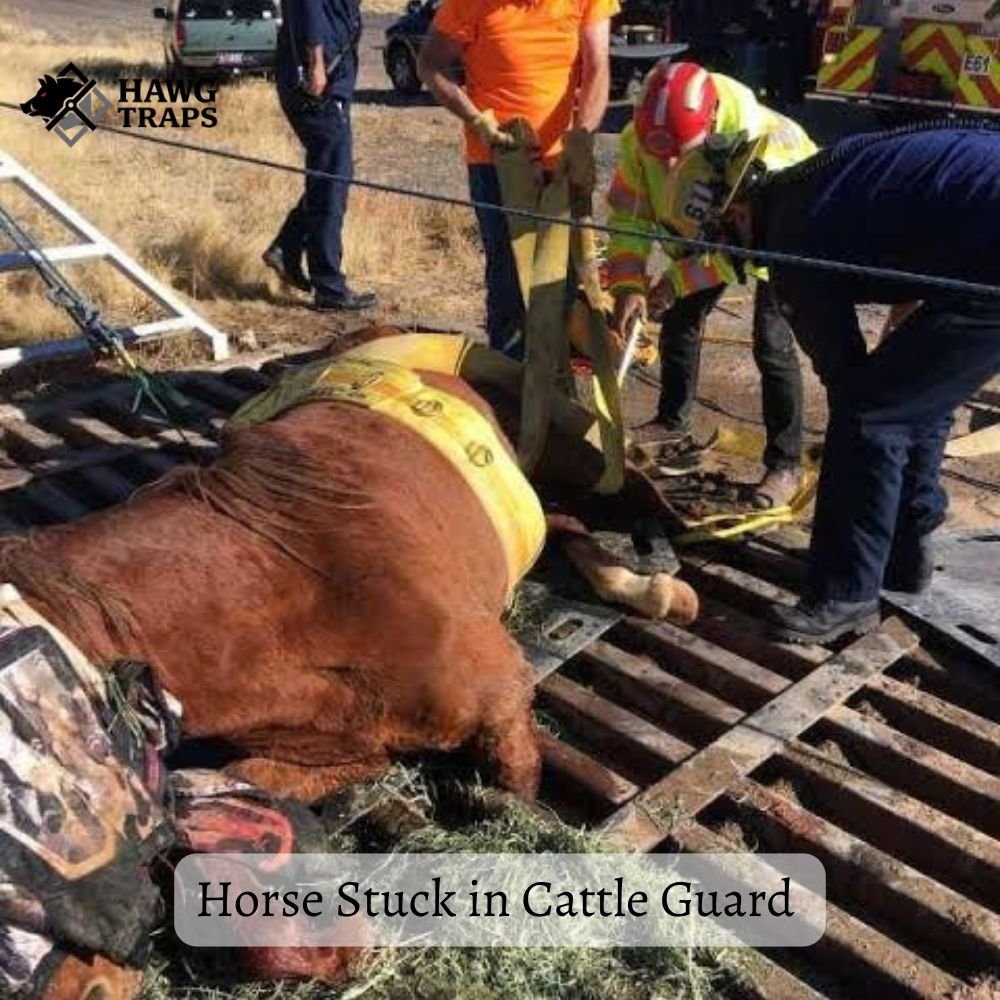
Do cattle guards work on horses?
No. Cattle guards do not reliably stop horses, and they pose a high risk of injuring them. The US Forest Service calls cattle guards dangerous for horses and mules, which may try to cross and trap a hoof or leg.
The warning comes from the Forest Service’s Equestrian Design Guidebook for Trails, Trailheads, and Campgrounds. It’s written for engineers who build trailheads where horses and traffic meet. Its wording is blunt. Horses and mules may try to walk or jump over the cattle guard or walk around its ends. They can trap a hoof or leg in the cattle guard. The trapping itself can be dangerous, but they can start panicking and might hurt themself even badly.
That covers all three ways a guard fails a horse owner. The horse walks across, jumps it, or goes around. Horse forums are full of owners trying to train horses to respect a guard. The guidebook recommends not to rely on training.
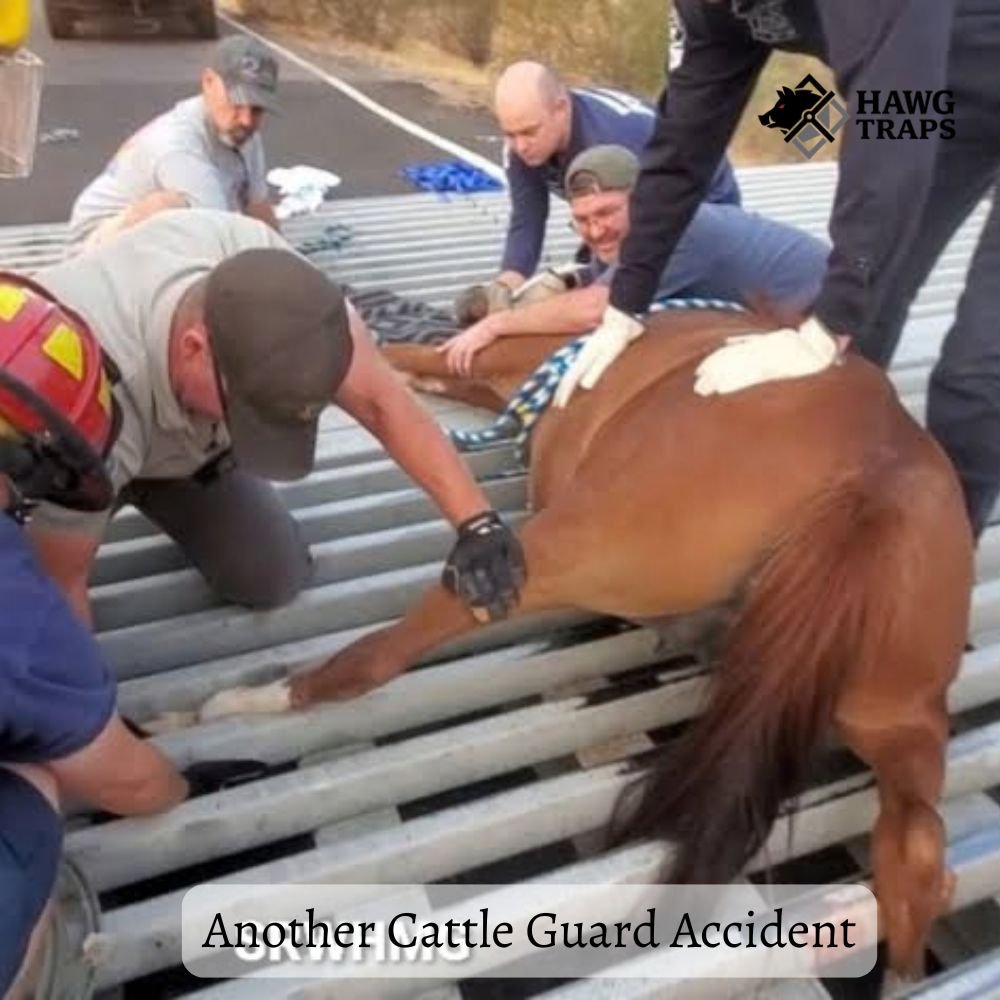
Why horses are at risk on a cattle guard
Horses are at risk because a hoof can slip between the rails and trap the leg, causing severe injury. Loose horses and horses under saddle face the same risk, according to the US Forest Service.
The difference is in the foot. Cattle walk on a split hoof. A horse stands on one solid hoof, and a single hoof can easily drop between two rails. Single-toed hooves can slip between the bars and trap their legs in an easily broken position.
What happens next is described by Dr. Doug Thal, DVM, a diplomate of the American Board of Veterinary Practitioners, in the Horse Side Vet Guide. Of horses trapped in steel cattle guards, “some escaped with only minor injuries. Some even sustained lower limb fractures. Most had severe blunt trauma to the lower limb without fracture. He also lists large wounds and severe damage to the hoof.
Rail spacing sets how wide the gap is. The spacing on each guard we build is listed on cattle guard sizes and load ratings. We don’t know of any spacing that makes a cattle guard safe for horses, and we don’t sell one as horse-safe. There is no cattle guard safe for horses.
Do cattle guards stop deer? What studies found
No, cattle guards can not stop deers reliably. In a Colorado study, 16 of 18 mule deer crossed steel-rail guards. A Florida grate with diagonal cross members allowed one crossing, against 305 when the grate was covered.
Three field studies tested guards and grates against deer.
| Study | Where and what | Result |
|---|---|---|
| Reed et al. (1974) | Colorado. Mule deer released next to steel-rail deer guards | 16 of 18 crossed |
| Peterson et al. (2003), Wildlife Society Bulletin 31(4) | Florida Keys. Three 6.1 m × 6.1 m grates tested on endangered Key deer | The grate with a diagonal cross member was 99.5% effective; the two without were 75% effective |
| Allen, Huijser and Willey (2013), Wildlife Society Bulletin 37(2) | Montana, US Highway 93. Wildlife guards at access roads, July 2008 to July 2010 | At least 85% effective at keeping deer off the road; 33–55% for black bears and coyotes |
The practical reading is simple. A cattle guard is not a deer fence. If deer are the problem, the answer is a wildlife grate built for deer.
Sheep, goats, bison and feral hogs
Sheep can jump grids or run alongside them, goats are generally not contained. Bisons also can clear eight feet. No published source was found on whether cattle guards stop feral hogs.
- Sheep can jump across a grid, step carefully between the bars.
- Goats are generally not contained by a cattle guard. Painted yellow and white stripes have been used to discourage them from approaching.
- Bison and bulls can jump an 8-foot guard. Jumps of up to 14 feet have been documented.
- Feral hogs. We build hog traps as well as cattle guards, so we looked. We found no study on whether a cattle guard keeps feral hogs in or out. If the hogs are the problem, a guard is not the tool.
How to make a cattle guard crossing safer for horses
The safest fix is a gate: the US Forest Service advises a vehicle gate to contain loose stock. Where a gate is not possible, bold white stripes make some horses reluctant to cross.
In order of reliability:
- Hang a bypass gate beside the guard, and use it every time a horse crosses. Trucks use the guard; horses use the gate. See cattle guard gates.
- Keep horses out of the pasture the guard serves. Then the guard only has to hold cattle.
- Put a vehicle gate between the horses and the guard. This is the Forest Service’s recommendation for sites where horses could get loose near a guard.
- If none of that is possible, paint bold white parallel stripes on the road before the guard. The Forest Service says “some horses and mules are reluctant to cross these highly visible markings.” Some, not all. Stripes are the last resort, not a solution.
Choosing a crossing for a mixed-stock property
A mixed-stock property needs a cattle guard with a bypass gate, so vehicles use the guard and horses use the gate. A guard alone suits cattle-only pastures.
Match the crossing to the animals, not the traffic:
| What grazes the pasture | What to build |
|---|---|
| Cattle only | A cattle guard |
| Cattle and horses | A cattle guard with a bypass gate |
| Goats or sheep | A gate. A guard will not reliably hold them. |
| Deer to keep out | A purpose-built wildlife grate, not a cattle guard |
Plan the gate at the same time as the guard, so the fence corner, wings and gate post are set together. Boss Hawg builds steel cattle guards to order in Cross Plains, Texas: see cattle guards for sale. How a guard works in the first place is covered on what a cattle guard is.
Frequently asked questions
What should I do if my horse is trapped in a cattle guard? Call your veterinarian immediately, even after hours, and keep the horse as calm as you can until the vet arrives. Do not force the leg free, and do not pull on the horse to free it. That’s the guidance from Dr. Doug Thal, DVM, in the Horse Side Vet Guide.
Do painted stripes stop horses? Some horses and mules are reluctant to cross bold white stripes, according to the US Forest Service. It doesn’t reliably stop them. A gate is a safer option for them.
Can a horse learn to avoid a cattle guard? Some owners try. The Forest Service guidance doesn’t rely on it; it recommends a gate.