
You’ve driven over one. The tires drum across a row of steel bars at a ranch gate, and there’s no gate to open in the farm. On the far side, a pasture full of cattle that could walk out through that same gap, and don’t. Impressive, isn’t it? Most explanations online stop at “cows are afraid of it.” The real answer may be more interesting, and less certain than people like to claim. Here is what a cattle guard is, what’s under it, why it works, where it started, and which animals it will not stop.
The short version
- A cattle guard is a grid of rails set across a road where it passes through a fence. Vehicles cross it; cattle won’t. This allows the cows to be locked in place without opening the gate.
- Nobody has proven exactly why cattle avoid it. Depth perception is the leading explanation.
- The first recorded road cattle guard was in Archer County, Texas, in 1881.
- It stops cattle. It does not reliably stop horses, deer, sheep or goats, and it can badly injure a horse.
- Where horses or goats graze, pair the guard with a gate.
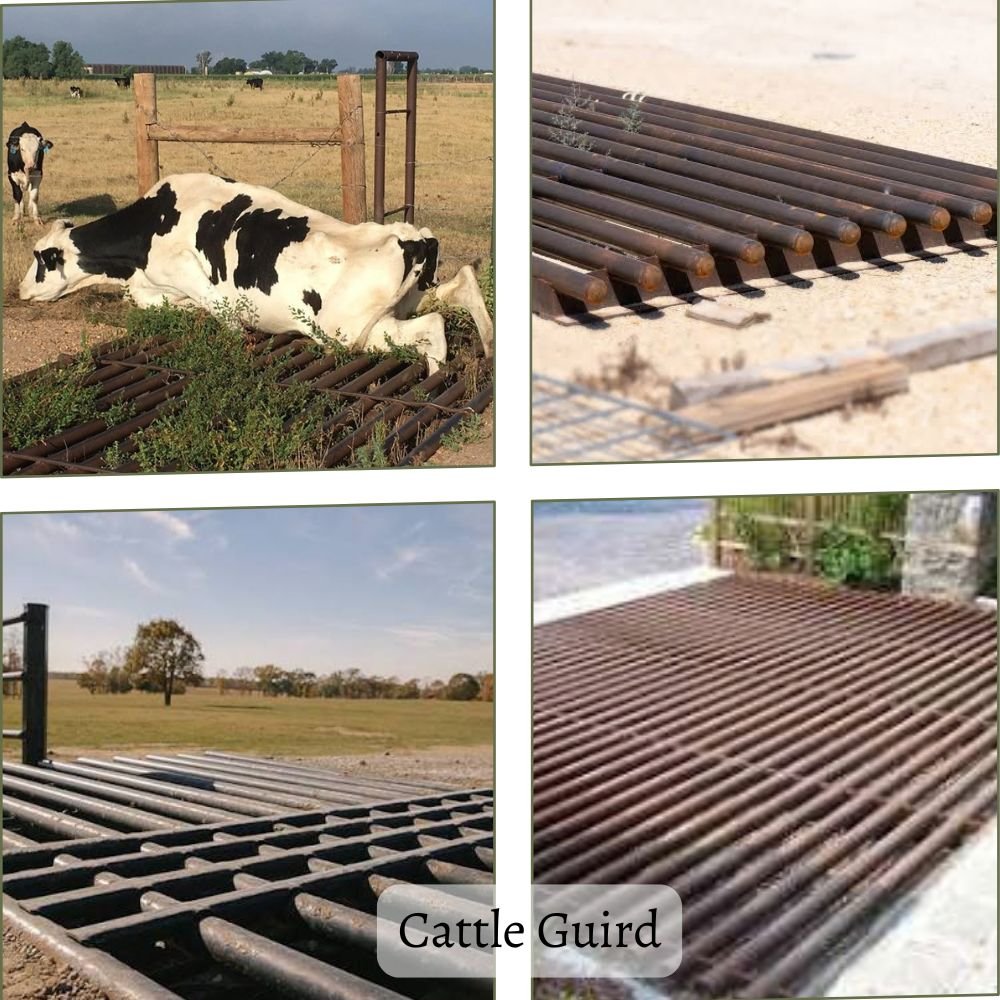
What is a cattle guard?
A cattle guard is a grid of steel rails set across a road opening in a fence, so vehicles can drive through while cattle will not walk across it. It replaces a gate that someone must open.
The Texas Department of Transportation defines it the same way in its right-of-way manual: “a structure placed across a highway which allows vehicles to pass but prevents livestock from crossing.”
Oftentimes farmers do not have an extra person in their farm, and even if they have, a cattle guard makes their life a lot more convenient.
Three things are not cattle guards, though they share the name in searches:
- A truck “cattle guard” is a grille guard bolted to the front of a pickup.
- A “cattle guard dog” is a livestock guardian dog.
- A painted cattle guard is a set of stripes on the road. It’s related, and covered at the end of this page.
Cattle guards are built from steel pipe, railroad rail, beams or precast concrete. The job never changes. Keep livestock on one side of a fence line, and let traffic through without anyone stopping.
How does a cattle guard work?
A cattle guard works because cattle avoid stepping onto widely spaced rails over a gap. The usual explanation, cattle depth perception, is suggested rather than proven; learned avoidance also plays a part.
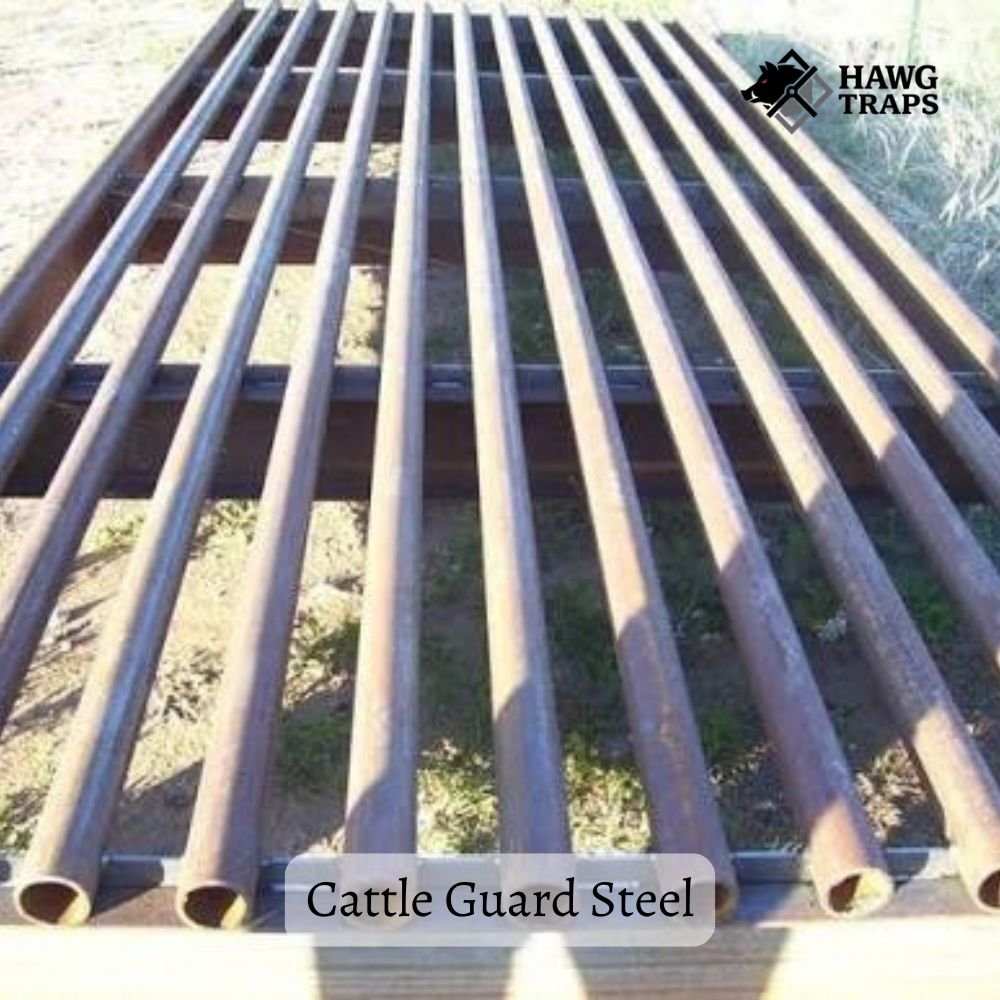
Look at a guard from a cow’s height. There’s a row of round or narrow rails with open space between them and a pit or gap below. No where to put the hoof.
Two explanations are offered, and they aren’t exclusive.
Depth perception. The Wikipedia article on cattle grids states that a cow “makes little or no distinction between painted stripes on a dark background and bars over a pit.” If that’s right, cattle read a guard as a drop they can’t judge, and they have to stop there.
Learned avoidance. The same article notes that cattle may learn to avoid guards from experience, or by copying other cattle in the herd.
One piece of evidence points toward sight rather than learning. Ted Friend, an animal scientist at Texas A&M, reportedly tested several hundred cattle on painted grids. He found that cattle that had never met a real guard avoided the stripes as much as cattle that had. Both explanations describe the same thing at the gate: cattle stop at the edge of the rails.
Parts of a cattle guard
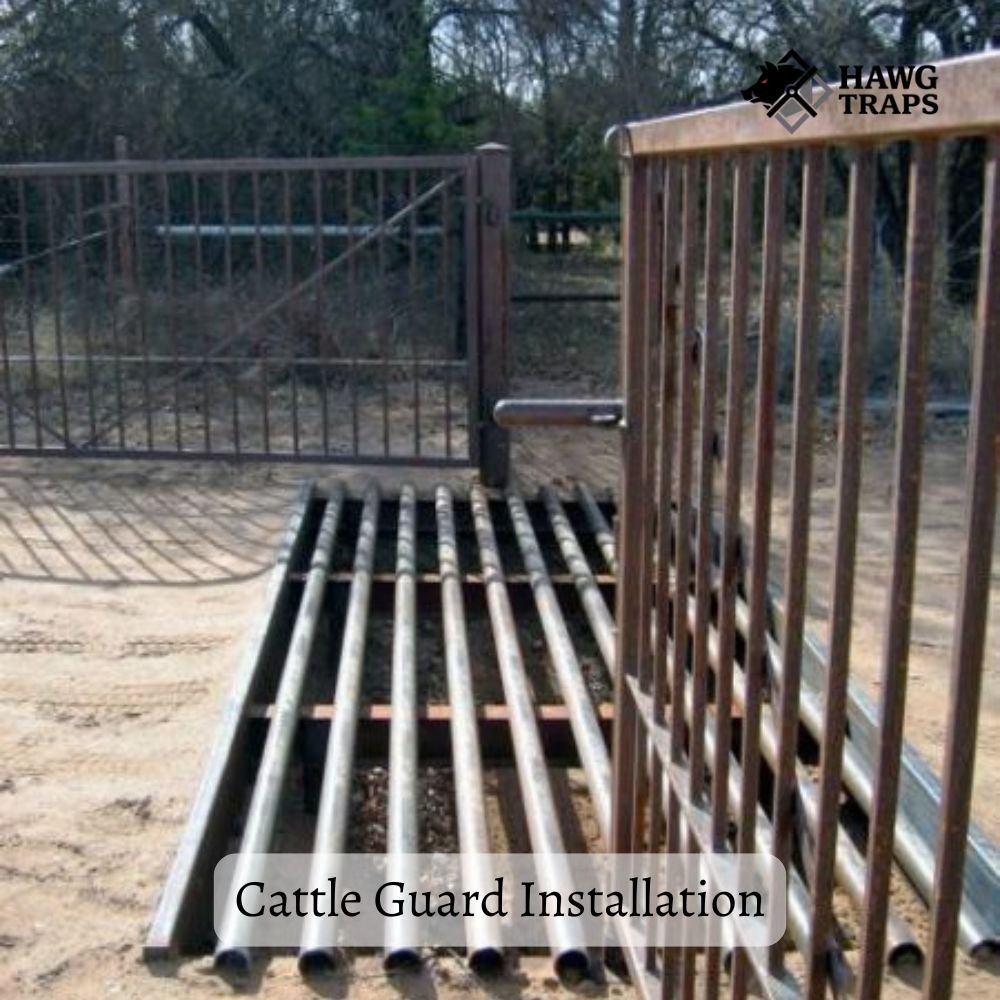
A cattle guard has four parts: the rails vehicles drive over, the frame holding them, the base or pit underneath, and wings at each end that close the gap to the fence.
| Part | What it does | Why it matters |
|---|---|---|
| Rails | Carry the tires and form the gap cattle avoid | Their size and spacing set the gap |
| Frame | Holds the rails and carries the load to the base | Every heavy axle bears on it |
| Base or pit | Supports the frame and leaves open space under the rails | A weak base lets the guard settle or rock |
| Wings | Close the space between the guard’s ends and the fence | Without them, animals can walk around the ends |
Caption: A guard only works as a system. The rails stop animals crossing; the wings stop them going around. Everything plays their role.
Real guards vary widely. A survey of guards in Kansas’s Flint Hills, summarised on Wikipedia, found pipe on about 80% of them. Bars ran from 1.5 to 6.5 inches across and 1.75 to 8 inches apart. Guards were 7.75 to 30 feet long, and pits ran from none to 98 inches deep.
Rail size, spacing and pit depth for each guard we build are on cattle guard sizes and load ratings. Wing and base types are on cattle guard wings and bases.
Other names and a Texas origin
Cattle guards are also called cattle grids, cattle grates and Texas gates. The first recorded non-railroad cattle guard was used in 1881 in Archer County, Texas.
The idea started on the railroads. Versions were in use along track by 1836. On roads, the cattle guard was invented more than once on the Great Plains, around 1905 to 1915. A US patent for one was issued to William J. Hickey of Nevada on 15 January 1915.
The Texas link runs further than Archer County. The Encyclopedia of Saskatchewan traces the Canadian name “Texas gate” to the great cattle drives north from Texas in the late 1870s. In Texas, it’s simply a cattle guard. Every regional name is mapped on cattle grid.
Which animals does a cattle guard stop?
Cattle guards are built to stop cattle, not every animal. Horses risk trapping a hoof, goats are generally not contained, and 16 of 18 mule deer crossed rail guards in a Colorado study.
| Animal | Stopped by a cattle guard? | The evidence |
|---|---|---|
| Cattle | Yes | It is what guards are built for |
| Horses and mules | Strictly No, and at risk of injury | US Forest Service: guards are “dangerous for horses and mules” |
| Mule deer | Not reliably Stops them | 16 of 18 crossed steel-rail deer guards |
| Key deer | Only with a purpose-built deer grate | A grate with a diagonal cross member was 99.5% effective |
| Sheep | Not reliably | Can jump grids or run alongside them |
| Goats | Generally not | Generally not contained |
| Bison and bulls | Not reliably | Can jump an 8-foot guard; 14-foot jumps documented |
| Feral hogs | Unknown | No published study found |
Horses are the one that matters most on a working ranch. A horse stands on a single hoof, not a split one, and that hoof can slip between the rails. The injuries, the studies and the fixes are on cattle guards and horses.
When a cattle guard makes sense instead of a gate
A cattle guard makes sense where vehicles pass often and the pasture holds cattle only. Where horses or goats graze, a gate or a guard with a bypass gate is safer.
A guard earns its place at openings you drive through every day. Think of the main ranch road, the feed route, or a lease road with trucks in and out. Nobody stops, climbs out, drags a gate and chains it.
A guard is the wrong choice on its own in three cases:
- If horses share the pasture. Hang a bypass gate for them.
- You drive cattle through the opening. The guard is built to stop them, so you need a gate to move them often it may not be a good choice.
Boss Hawg builds steel cattle guards to order in Cross Plains, Texas, and ships them nationwide. See sizes and specifications on cattle guards for sale.
Do painted cattle guards work?
Sometimes, for a while. Light and dark stripes painted to mimic a real guard can turn cattle back, and they cost way less than steel. They fail when animals learn the stripes are safe, or when there’s a strong reason to cross the guard: feed on the other side, or cattle being pushed hard. Treat a painted guard as a trial, not a permanent fence.